AI Infrastructure Management Software Market Size, Share, Forecast Report 2026 to 2035
What is AI Infrastructure Management Software Market Size?
Global AI Infrastructure Management Software Market Size is valued at USD 7.88 Bn in 2025 and is predicted to reach USD 39.85 Bn by the year 2035 at a 17.7% CAGR during the forecast period for 2026 to 2035.
AI Infrastructure Management Software Market Size, Share & Trends Analysis By Component (Infrastructure Management Platforms, AI Resource Orchestration Solutions, Monitoring & Performance Analytics Software and AI Infrastructure Security & Optimization Solutions), By Deployment Mode (Cloud-Based, On-Premise and Hybrid), By Enterprise Size (Large Enterprises and Small & Medium Enterprises), By End User (IT & Telecom, BFSI, Healthcare, Manufacturing, Government & Defense, Retail & E-Commerce, Media & Entertainment and Others), and Segment Forecasts, 2026 to 2035.
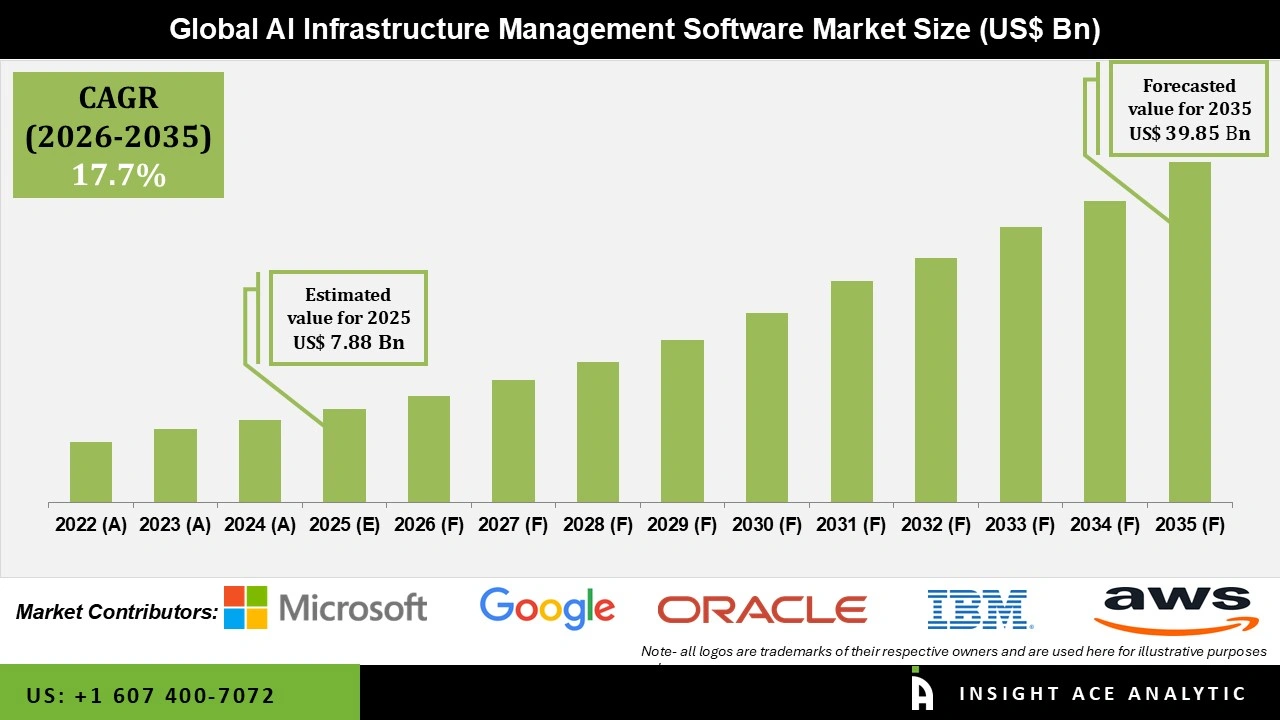
AI infrastructure management software is a kind of smart software which is able to automate, monitor, optimize, and manage the IT infrastructure by means of artificial intelligence, machine learning, predictive analytics, and automation. This type of solution is designed for helping companies to control servers, cloud infrastructure, storage, networking equipment, virtual machines, databases, and applications via a unified platform while making the operations simple.
The growing use of hybrid cloud infrastructure, fast-paced digital transformation, and rising complexity of the company's IT infrastructure are the key drivers behind the global AI infrastructure management software market growth. Enterprises are becoming more interested in using AI-powered infrastructure management software for making the process of infrastructure management less time-consuming, less expensive, and more effective. Enterprises are also implementing AIOps platforms where artificial intelligence is combined with IT operations for processing enormous amounts of operational data, detecting any anomalies, and solving incidents.
With the increasing use of cloud-native apps, edge computing, IoT, and high performance computing, infrastructure complexities have become much greater. There is a need to have some new kind of infrastructure management software that uses AI to ensure real-time visibility within these kinds of infrastructures. In addition to this, organizations are also implementing intelligent automation solutions to better utilize the resources, increase cybersecurity capabilities, and enable business continuity.
Government as well as private sector companies' rising investments in artificial intelligence will be helping the industry grow further. Organizations belonging to industries such as banking, healthcare, telecommunication, retail, manufacturing, and government are utilizing AI infrastructure management platforms to keep the services running in order to support business critical applications. With organizations migrating more workloads to public and hybrid cloud platforms, the demand for automated infrastructure management software will increase gradually.
Competitive Landscape
Which are the Leading Players in AI Infrastructure Management Software Market?
- Microsoft Corporation
- IBM Corporation
- Cisco Systems Inc.
- Broadcom Inc. (VMware)
- ServiceNow Inc.
- Dynatrace Inc.
- BMC Software Inc.
- Hewlett Packard Enterprise (HPE)
- Dell Technologies Inc.
- Amazon Web Services (AWS)
- Google Cloud
- Oracle Corporation
- Red Hat Inc.
- Splunk Inc.
- SolarWinds Corporation
- ManageEngine (Zoho Corporation)
- Nutanix Inc.
- Datadog Inc.
- ScienceLogic Inc.
- LogicMonitor Inc.
- New Relic Inc.
- VMware Tanzu
- Lenovo Group
- Fujitsu Ltd.
- NEC Corporation
Market Dynamics
Driver
Rising Adoption of Hybrid Cloud and AIOps Platforms
The fast adoption of hybrid cloud infrastructure is one of the leading factors driving the AI infrastructure management software market. Firms are operating their workloads through public cloud, private cloud, on-premise data centers, and edge computing. It is challenging to manage such infrastructures manually, making it necessary for businesses to opt for AI-based infrastructure management software. The use of AI platforms helps in continuous monitoring of infrastructure performance, detecting any anomaly in the system, performing troubleshooting tasks, and workload optimization. This helps in reducing downtime, improving application availability, and decreasing the operational cost of IT. In addition, AI-based predictive analytics helps in detecting any failure of the infrastructure before it happens. Growing adoption of AIOps software solutions is boosting the market growth. AIOps software solutions integrate machine learning capabilities with infrastructure monitoring tools that automate mundane operational tasks and minimize alert fatigue among IT professionals. There is an increasing investment by businesses in monitoring tools that can intelligently perform operations.
Restrain/Challenge
Data Security Concerns and Complex Integration Across Legacy Infrastructure
However, despite the immense opportunities for development, incorporating AI infrastructure management software into the existing organization environment is quite challenging. Some companies still work on legacy IT systems, which cannot be compatible with AI-driven automation platforms. The integration of AI into various infrastructure may also entail considerable expenses, tailor-made approaches, and special technical competencies. The issues related to data privacy and cyber security are an obstacle for using AI infrastructure management platforms in highly regulated industries such as health care, finance, and government agencies. The AI infrastructure management platforms constantly gather the information about the operation of the enterprise from various sources, thus raising the question about the possible breaches of data protection rules and risks of leakage of sensitive business information. In addition, good quality of operational data is needed for accurate AI model predictions. Insufficient quality of operational data, inconsistent configurations of the infrastructure, and inadequate monitoring systems negatively affect the accuracy of AI models. Also, there is a lack of specialists in AI and cloud infrastructure.
Large Enterprises Segment is Expected to Drive the AI Infrastructure Management Software Market
Big corporations formed the highest proportion of the AI infrastructure management software market in 2025. Such entities have to deal with very Complicated IT infrastructures that consist of hundreds or even thousands of servers, cloud-based workloads, enterprise applications, storage systems, and network devices. The AI-driven infrastructure management tools allow companies to automate maintenance, enhance infrastructure visibility, decrease downtime, and optimize resource usage. Furthermore, large corporations have quickly adopted hybrid clouds, AIOps, and intelligent automation solutions, thus ensuring the segment's dominance during the forecast period.
Cloud-based Deployment Segment is Growing at the Highest Rate in the AI Infrastructure Management Software Market
The cloud deployment segment is anticipated to be the fastest growing during the forecast period. Organizations have developed a preference for cloud-based infrastructure management solutions because such solutions allow scalability, remote management, reduced cost of deployment, and easier software updates. In addition, cloud deployment helps manage geographically scattered infrastructure using dashboards and provides AI-powered analytics and automation. With companies shifting more workloads to cloud platforms, cloud-native infrastructure management software is anticipated to see high adoption rates.
Why North America Led the AI Infrastructure Management Software Market?
The region of North America held the largest share of the global AI Infrastructure Management Software Market in 2025 because of the presence of top cloud service providers, AI software providers, and the availability of sophisticated IT infrastructures. The US is one of the leaders in innovation with regard to artificial intelligence, cloud computing, cyber security, and enterprise software solutions.
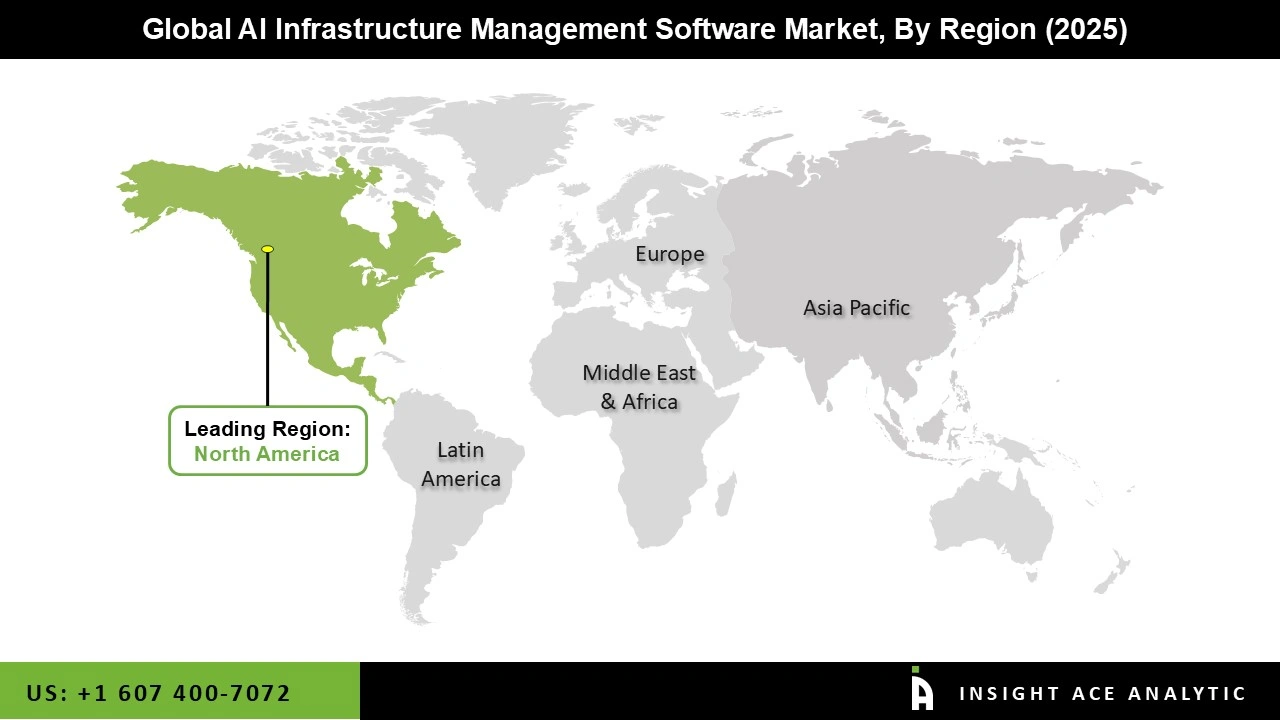
There have been heavy investments made by organizations operating in various sectors, including banking, healthcare, manufacturing, telecom, and government in infrastructure automation using AI technology to help boost operational efficiency and cut down on IT management costs. Increasing number of hyperscale data centers and growing usage of enterprise clouds in the region is likely to drive the regional market growth. Increasing investments in digital transformation, adoption of hybrid clouds, and AI-based IT operations platforms have contributed to the dominance of the region. Asia-Pacific region is expected to exhibit the fastest growth rate in the forecast period.
Key Development
• In January 2025, ServiceNow announced agentic AI innovations, including AI Agent Orchestrator and AI Agent Studio, to help enterprises automate complex workflows across IT, customer service, HR, and other business functions.
AI Infrastructure Management Software Market Report Scope :
| Report Attribute | Specifications |
| Market size value in 2025 | USD 7.88 Bn |
| Revenue forecast in 2035 | USD 39.85 Bn |
| Growth Rate CAGR | CAGR of 17.7% from 2026 to 2035 |
| Quantitative Units | Representation of revenue in US$ Bn and CAGR from 2026 to 2035 |
| Historic Year | 2022 to 2025 |
| Forecast Year | 2026-2035 |
| Report Coverage | The forecast of revenue, the position of the company, the competitive market structure, growth prospects, and trends |
| Segments Covered | Component, Deployment Mode, Enterprise Size, End User and By Region |
| Regional Scope | North America; Europe; Asia Pacific; Latin America; Middle East & Africa |
| Country Scope | U.S.; Canada; U.K.; Germany; China; India; Japan; Brazil; Mexico; The UK; France; Italy; Spain; China; Japan; India; South Korea; Southeast Asia; South Korea; Southeast Asia |
| Competitive Landscape | Microsoft Corporation, IBM Corporation, Cisco Systems Inc., Broadcom (VMware), ServiceNow Inc., Dynatrace Inc., BMC Software Inc., Dell Technologies Inc., Hewlett Packard Enterprise, Amazon Web Services, Google Cloud, Oracle Corporation, Red Hat Inc., Splunk Inc., SolarWinds Corporation, ManageEngine (Zoho), Nutanix Inc., Datadog Inc., ScienceLogic Inc., LogicMonitor Inc., New Relic Inc., Lenovo Group, Fujitsu Ltd., NEC Corporation, and others. |
| Customization Scope | Free customization report with the procurement of the report, Modifications to the regional and segment scope. Geographic competitive landscape. |
| Pricing and Available Payment Methods | Explore pricing alternatives that are customized to your particular study requirements. |
Segmentation of AI Infrastructure Management Software Market:
AI Infrastructure Management Software Market by Component -
- Infrastructure Management Platforms
- AI Resource Orchestration Solutions
- Monitoring & Performance Analytics Software
- AI Infrastructure Security & Optimization Solutions
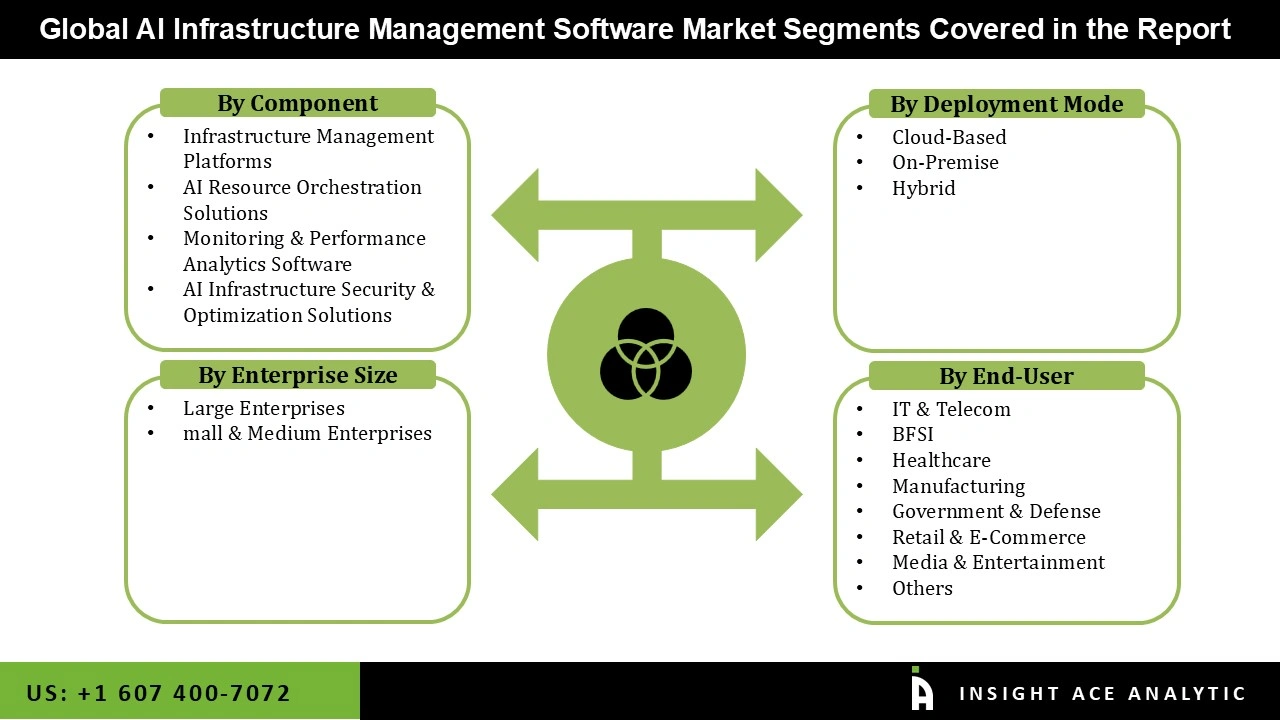
AI Infrastructure Management Software Market by Deployment Mode-
- Cloud
- On-premises
- Hybrid
AI Infrastructure Management Software Market by Enterprise Size -
- Large Enterprises
- Small & Medium Enterprises
AI Infrastructure Management Software Market by End-user-
- IT & Telecom
- BFSI
- Healthcare
- Manufacturing
- Government & Defense
- Retail & E-Commerce
- Media & Entertainment
- Others
AI Infrastructure Management Software Market By Region-
- North America-
- The US
- Canada
- Europe-
- Germany
- The UK
- France
- Italy
- Spain
- Rest of Europe
- Asia-Pacific-
- China
- Japan
- India
- South Korea
- South East Asia
- Rest of Asia Pacific
- Latin America-
- Brazil
- Argentina
- Mexico
- Rest of Latin America
- Middle East and Africa-
- GCC Countries
- South Africa
- Rest of Middle East and Africa
Research Design and Approach
This study employed a multi-step, mixed-method research approach that integrates:
- Secondary research
- Primary research
- Data triangulation
- Hybrid top-down and bottom-up modelling
- Forecasting and scenario analysis
This approach ensures a balanced and validated understanding of both macro- and micro-level market factors influencing the market.
Secondary Research
Secondary research for this study involved the collection, review, and analysis of publicly available and paid data sources to build the initial fact base, understand historical market behaviour, identify data gaps, and refine the hypotheses for primary research.
Sources Consulted
Secondary data for the market study was gathered from multiple credible sources, including:
- Government databases, regulatory bodies, and public institutions
- International organizations (WHO, OECD, IMF, World Bank, etc.)
- Commercial and paid databases
- Industry associations, trade publications, and technical journals
- Company annual reports, investor presentations, press releases, and SEC filings
- Academic research papers, patents, and scientific literature
- Previous market research publications and syndicated reports
These sources were used to compile historical data, market volumes/prices, industry trends, technological developments, and competitive insights.

Primary Research
Primary research was conducted to validate secondary data, understand real-time market dynamics, capture price points and adoption trends, and verify the assumptions used in the market modelling.
Stakeholders Interviewed
Primary interviews for this study involved:
- Manufacturers and suppliers in the market value chain
- Distributors, channel partners, and integrators
- End-users / customers (e.g., hospitals, labs, enterprises, consumers, etc., depending on the market)
- Industry experts, technology specialists, consultants, and regulatory professionals
- Senior executives (CEOs, CTOs, VPs, Directors) and product managers
Interview Process
Interviews were conducted via:
- Structured and semi-structured questionnaires
- Telephonic and video interactions
- Email correspondences
- Expert consultation sessions
Primary insights were incorporated into demand modelling, pricing analysis, technology evaluation, and market share estimation.
Data Processing, Normalization, and Validation
All collected data were processed and normalized to ensure consistency and comparability across regions and time frames.
The data validation process included:
- Standardization of units (currency conversions, volume units, inflation adjustments)
- Cross-verification of data points across multiple secondary sources
- Normalization of inconsistent datasets
- Identification and resolution of data gaps
- Outlier detection and removal through algorithmic and manual checks
- Plausibility and coherence checks across segments and geographies
This ensured that the dataset used for modelling was clean, robust, and reliable.
Market Size Estimation and Data Triangulation
Bottom-Up Approach
The bottom-up approach involved aggregating segment-level data, such as:
- Company revenues
- Product-level sales
- Installed base/usage volumes
- Adoption and penetration rates
- Pricing analysis
This method was primarily used when detailed micro-level market data were available.

Top-Down Approach
The top-down approach used macro-level indicators:
- Parent market benchmarks
- Global/regional industry trends
- Economic indicators (GDP, demographics, spending patterns)
- Penetration and usage ratios
This approach was used for segments where granular data were limited or inconsistent.
Hybrid Triangulation Approach
To ensure accuracy, a triangulated hybrid model was used. This included:
- Reconciling top-down and bottom-up estimates
- Cross-checking revenues, volumes, and pricing assumptions
- Incorporating expert insights to validate segment splits and adoption rates
This multi-angle validation yielded the final market size.
Forecasting Framework and Scenario Modelling
Market forecasts were developed using a combination of time-series modelling, adoption curve analysis, and driver-based forecasting tools.
Forecasting Methods
- Time-series modelling
- S-curve and diffusion models (for emerging technologies)
- Driver-based forecasting (GDP, disposable income, adoption rates, regulatory changes)
- Price elasticity models
- Market maturity and lifecycle-based projections
Scenario Analysis
Given inherent uncertainties, three scenarios were constructed:
- Base-Case Scenario: Expected trajectory under current conditions
- Optimistic Scenario: High adoption, favourable regulation, strong economic tailwinds
- Conservative Scenario: Slow adoption, regulatory delays, economic constraints
Sensitivity testing was conducted on key variables, including pricing, demand elasticity, and regional adoption.
Request Customization
Add countries, segments, company profiles, or extend forecast — free 10% customization with purchase.
Customize This Report →Enquire Before Buying
Speak with our analyst team about scope, methodology, pricing, or deliverable formats.
Enquire Now →Frequently Asked Questions
AI Infrastructure Management Software Market Size is valued at USD 7.88 Bn in 2025 and is predicted to reach USD 39.85 Bn by the year 2035
The AI Infrastructure Management Software Market is expected to grow at a 17.7% CAGR during the forecast period for 2026 to 2035
Microsoft Corporation, IBM Corporation, Cisco Systems Inc., Broadcom (VMware), ServiceNow Inc., Dynatrace Inc., BMC Software Inc., Dell Technologies Inc., Hewlett Packard Enterprise, Amazon Web Services, Google Cloud, Oracle Corporation, Red Hat Inc., Splunk Inc., SolarWinds Corporation, ManageEngine (Zoho), Nutanix Inc., Datadog Inc., ScienceLogic Inc., LogicMonitor Inc., New Relic Inc., Lenovo Group, Fujitsu Ltd., NEC Corporation, and others.
AI Infrastructure Management Software Market is segmented into Component, Deployment Mode, Enterprise Size, End User and Other.
North America region is leading the AI Infrastructure Management Software Market.