



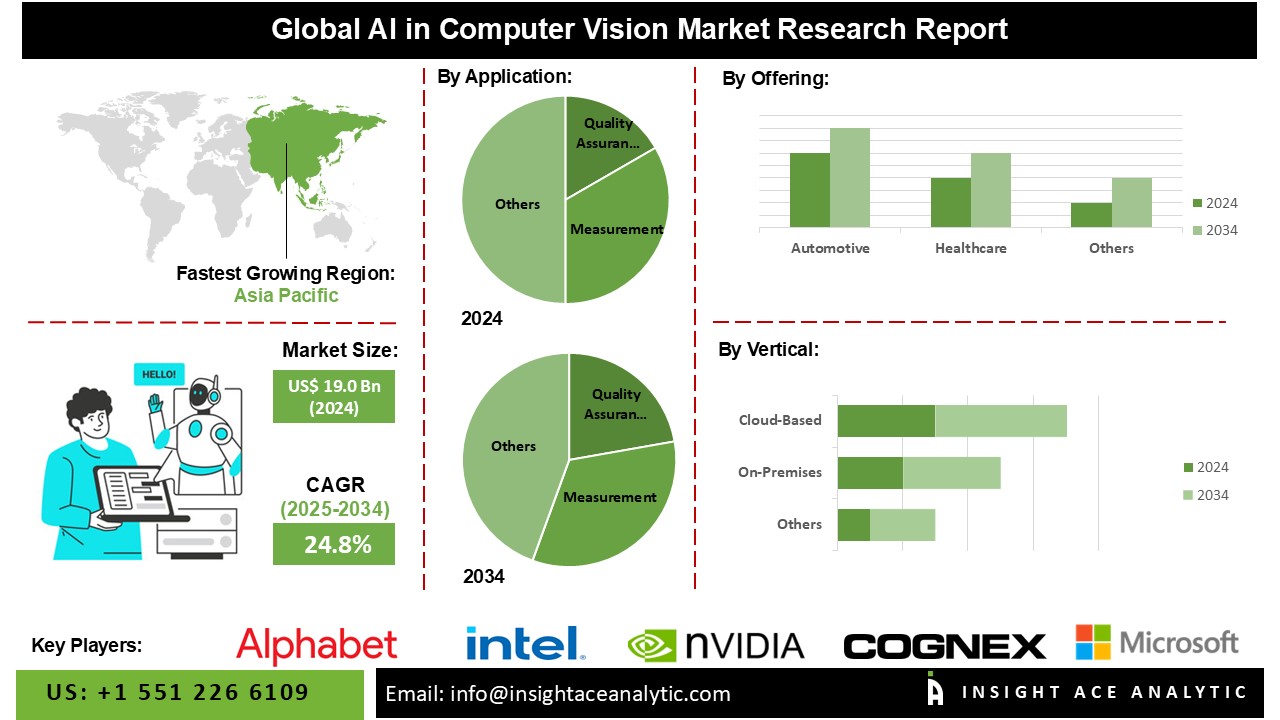
Global AI in Computer Vision Market Size is valued at USD 19.0 Bn in 2024 and is predicted to reach USD 172.6 Bn by the year 2034 at a 24.8% CAGR during the forecast period for 2025-2034.
Computer Vision (CV) empowers machines to interpret and analyze digital images and videos using computational techniques. By mimicking human vision, CV enables automated detection, recognition, and understanding of visual inputs from cameras or sensors. Unlike human vision, computer vision systems operate with exceptional accuracy and consistency, reducing errors and proving invaluable in critical applications—such as early cancer detection through medical image analysis.
Businesses across industries leverage CV and machine learning to derive actionable insights from vast visual datasets, automating repetitive tasks, boosting operational efficiency, detecting fraud, enhancing customer experiences, & accelerating the development of innovative products and services.
In autonomous vehicles, computer vision processes data from cameras, LiDAR, and radar to perceive and navigate the environment. It enables real-time decision-making through traffic sign recognition, object detection, and lane tracking. AI-powered vision also drives Advanced Driver Assistance Systems (ADAS), supporting features like adaptive cruise control, lane-keeping, parking assistance, and collision avoidance. These systems enhance driver safety by instantly identifying obstacles, vehicles, and pedestrians.
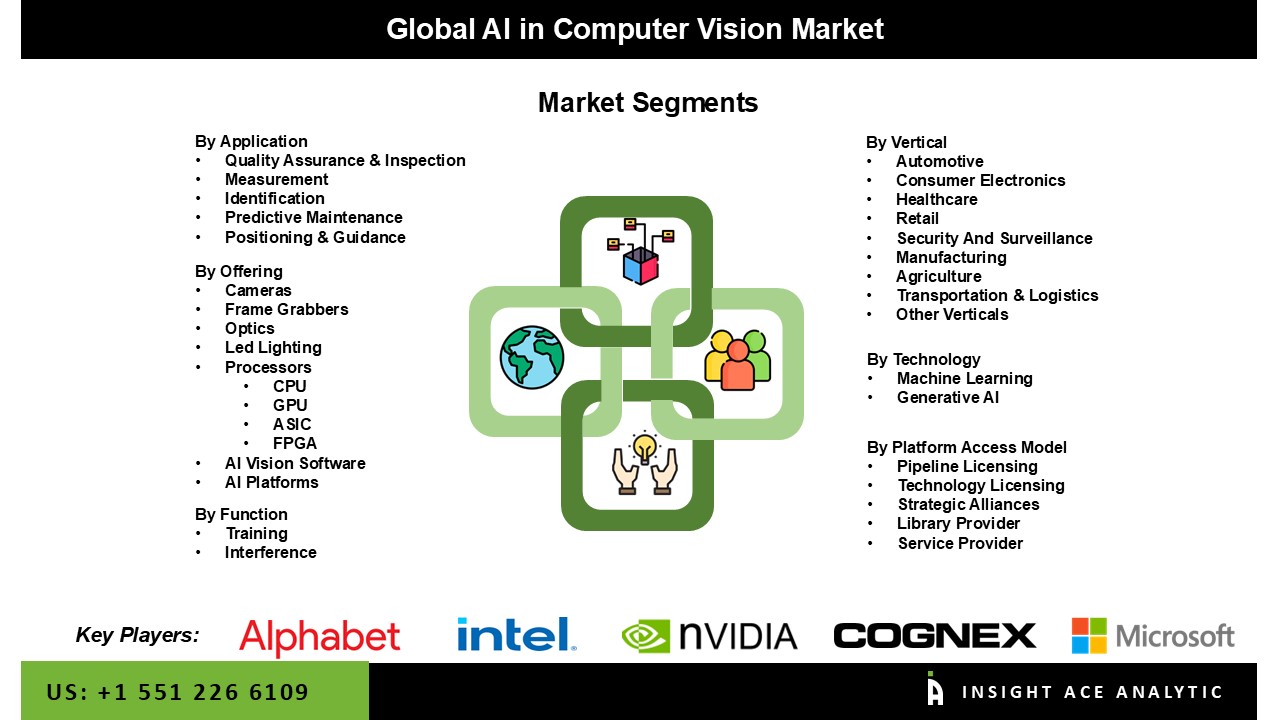
The AI in the computer vision market is segmented into application, function, technology, vertical, and offering. The application segmentation includes quality assurance & inspection, measurement, identification, predictive maintenance, positioning & guidance. As per the function, the market is divided into training and inference. Whareas the technology segment divided into machine learning and generative AI. Based on the Vertical, the market is divided into automotive, consumer electronics, healthcare, retail, security and surveillance, manufacturing, agriculture, transportation & logistics, and other verticals. According to the offering, the market is divided into cameras, frame grabbers, optics, LED lighting, processors, AI vision software, and AI platforms.
Computer vision technologies in the automotive industry offer unmatched accuracy when checking cars for flaws like scratches or misassembled parts. Businesses like Audi have reduced the number of defective parts produced by using AI vision to find tiny flaws in sheet metal components. By streamlining production procedures and enhancing quality assurance, this lowers expenses and boosts productivity. To improve vehicle functionality, the automobile industry uses computer vision in conjunction with machine learning, sensor fusion, and the Internet of Things. For instance, in complex driving situations, vision-based systems use data from vehicle-to-everything (V2X) communication to make decisions in real time. High-performance computing for autonomous features is further supported by the integration of LiDAR, GPUs, and AI chips. Intel published OpenVINO 2024.5 in November 2024, which optimized AI vision applications for use in automobiles. It facilitates effective deployment in local, cloud, and edge contexts, improving autonomous driving systems' problem detection and safety compliance.
AI vision software is essential to computer vision since it makes it possible for fundamental features, including segmentation, classification, object identification, facial recognition, and image recognition. It is a crucial part of contemporary AI ecosystems because of its scalability and adaptability, which enable smooth implementation across a variety of devices and sectors. Furthermore, real-time processing is supported, and its application area is expanded by the integration of AI software platforms with cloud and edge computing environments. As technology businesses concentrate on integrating cutting-edge deep learning models like Convolutional Neural Networks & Transformers to improve performance and capabilities, the segment continues to benefit from high levels of R&D expenditure. For instance, Amazon Web Services launched AWS Panorama, a software development kit enhancing computer vision capabilities in the Asia-Pacific region. It supports edge devices for tasks like quality control and real-time analytics, driving adoption in automotive and manufacturing.
The market for AI in computer vision is dominated by the Asia Pacific region. The rapid advancement of technology, the increasing adoption of AI solutions, and robust governmental support in key economies. Major industries such as retail, manufacturing, healthcare, and automotive are propelling the necessity for AI to augment operational efficiency via automation and boost consumer experience. Also the collaborations enhance AI vision software for autonomous vehicles, improving object detection and safety features in Japan and China.
| Report Attribute | Specifications |
| Market Size Value In 2024 | USD 19.0 Bn |
| Revenue Forecast In 2034 | USD 172.6 Bn |
| Growth Rate CAGR | CAGR of 24.8% from 2025 to 2034 |
| Quantitative Units | Representation of revenue in US$ Mn and CAGR from 2025 to 2034 |
| Historic Year | 2021 to 2024 |
| Forecast Year | 2025-2034 |
| Report Coverage | The forecast of revenue, the position of the company, the competitive market structure, growth prospects, and trends |
| Segments Covered | By Application, Function, Technology, Vertical, Offering |
| Regional Scope | North America; Europe; Asia Pacific; Latin America; Middle East & Africa |
| Country Scope | U.S.; Canada; U.K.; Germany; China; India; Japan; Brazil; Mexico; France; Italy; Spain; South Korea; Southeast Asia; |
| Competitive Landscape | NVIDIA Corporation, Microsoft Corporation, Intel Corporation, Alphabet Inc., Amazon.com, Inc., Cognex Corporation, Qualcomm Technologies, Inc., Sony Group Corporation, OMRON Corporation, KEYENCE CORPORATION, SICK AG, Teledyne Technologies, Texas Instruments Incorporated, Basler AG, Hailo Technologies Ltd. |
| Customization Scope | Free customization report with the procurement of the report and modifications to the regional and segment scope. Particular Geographic competitive landscape. |
| Pricing and Available Payment Methods | Explore pricing alternatives that are customized to your particular study requirements. |
Global AI in Computer Vision Market - By Application
Global AI in Computer Vision Market – By Function
Global AI in Computer Vision Market – By Technology
Global AI in Computer Vision Market- By Vertical
Global AI in Computer Vision Market – By Platform Access Model
Global AI in Computer Vision Market – By Offering
Global AI in Computer Vision Market – By Region
North America-
Europe-
Asia-Pacific-
Latin America-
Middle East & Africa-
Rest of the Middle East and Africa
This study employed a multi-step, mixed-method research approach that integrates:
This approach ensures a balanced and validated understanding of both macro- and micro-level market factors influencing the market.
Secondary research for this study involved the collection, review, and analysis of publicly available and paid data sources to build the initial fact base, understand historical market behaviour, identify data gaps, and refine the hypotheses for primary research.
Secondary data for the market study was gathered from multiple credible sources, including:
These sources were used to compile historical data, market volumes/prices, industry trends, technological developments, and competitive insights.

Primary research was conducted to validate secondary data, understand real-time market dynamics, capture price points and adoption trends, and verify the assumptions used in the market modelling.
Primary interviews for this study involved:
Interviews were conducted via:
Primary insights were incorporated into demand modelling, pricing analysis, technology evaluation, and market share estimation.
All collected data were processed and normalized to ensure consistency and comparability across regions and time frames.
The data validation process included:
This ensured that the dataset used for modelling was clean, robust, and reliable.
The bottom-up approach involved aggregating segment-level data, such as:
This method was primarily used when detailed micro-level market data were available.

The top-down approach used macro-level indicators:
This approach was used for segments where granular data were limited or inconsistent.
To ensure accuracy, a triangulated hybrid model was used. This included:
This multi-angle validation yielded the final market size.
Market forecasts were developed using a combination of time-series modelling, adoption curve analysis, and driver-based forecasting tools.
Given inherent uncertainties, three scenarios were constructed:
Sensitivity testing was conducted on key variables, including pricing, demand elasticity, and regional adoption.