Access Doors and Panels Market Size, Trend, Forecast Report 2026 to 2035
What is Access Doors and Panels Market Size?
Global Access Doors and Panels Market Size is valued at USD 5.24 Bn in 2025 and is predicted to reach USD 7.67 Bn by the year 2035 at a 4.00% CAGR during the forecast period for 2026 to 2035.
Access Doors and Panels Market Size, Share & Trends Analysis Report By Type (General-Purpose, Fire-Rated, Drywall, Security), By Installation (Exterior, Interior, By Material (Steel, Plastic), By End-user (Residential, Commercial & Industrial), By Distribution Channel (Offline, Online), By Region, And By Segment Forecasts, 2026 to 2035.
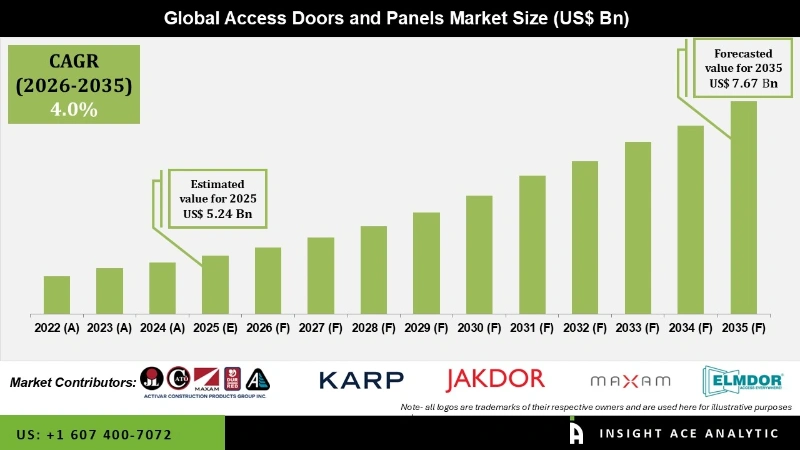
Access Doors and Panels Market Key Takeaways:
|
Access doors and panels are components in buildings that allow easy access to hidden areas, such as behind walls, ceilings, or floors, for maintenance, inspection, or repairs. They are used to access mechanical, electrical, and plumbing systems, and come in various types, including flush, recessed, fire-rated, and security doors.
Furthermore, there is a notable uptick in residential construction projects, particularly in the U.S., India, and China, where homeowners prioritize access doors and panels that blend seamlessly with architectural designs while maintaining aesthetic appeal. This emphasis on innovation aligns with the broader trend towards greater reliance on Internet of Things (IoT) technologies, facilitating the connectivity of smart doors. This advancement enables users to remotely monitor and manage access from diverse devices, thereby enhancing security infrastructure responsiveness and intelligence.
Additionally, economic conditions, such as fluctuations in inflation rates, currency values, and geopolitical developments, can profoundly influence the prices of essential raw materials used in manufacturing access doors and panels. The interconnected nature of global markets means that changes originating in one region can propagate, impacting material costs sourced from various parts of the world.
Competitive Landscape
Some Major Key Players In The Access Doors and Panels Market:
- Activar Construction Products Group
- Acudor Products
- Elmdor
- Karp Associates
- Williams Brothers Corporation of America
- Various other companies
- Elmdor
- WB Doors
- Milcor
- Nystrom
- Access Panel Company
- Karp Associates
- Cendrex
- Babcock-Davis
- Karpinc
- Larsen
- MAXAM
- Jakdor
- EZ Concept
- JUGE Electromechanical Equipment
- Activar Construction Products Group
- Proaks Metal Construction
- Allmar
- Envisivent
- Manthorpe
- AirTech-UK
- FlipFix
- Steinberg14
- Timloc
- EUROPLAST
- Other Market Players
Market Segmentation:
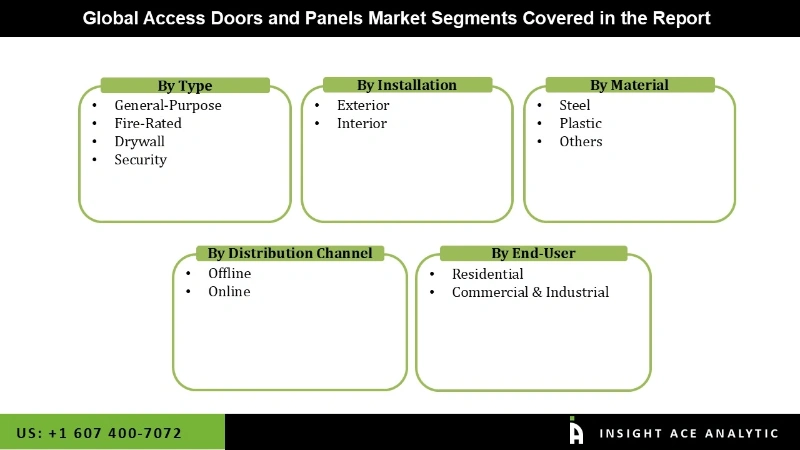
The market for access doors and panels is categorized into several key segments based on type, installation requirements, materials used, end-user applications, and distribution channels. In terms of type, the segments include General-Purpose doors, Fire-Rated doors, Drywall access panels, and Security doors. Based on Installation methods are divided into Exterior and Interior. Based on end users categorized into Residential and Commercial & Industrial sectors, Based on distribution channels encompass Offline and Online channels.
Based On Type, The General Purpose Segment Accounts For A Major Contributor In The Access Doors And Panels Market.
In 2023, the general-purpose segment held the largest market share. These access doors are designed to be versatile, serving a wide range of applications rather than being tailored to specific industries or functions. They are crafted to offer flexible solutions suitable for various use cases across commercial, industrial, institutional, and residential buildings. These general-purpose door panels are known for their ease of installation and compatibility with diverse construction environments. The renovation and retrofit market provides opportunities for access door and panel manufacturers as existing buildings undergo upgrades and enhancements.
The Steel Segment Witnessed Growth At A Rapid Rate.
During the forecast period, the steel segment emerged as the dominant force in the market. The demand for steel access doors is driven significantly by security considerations. Steel's inherent strength creates a sturdy barrier that enhances security in various environments, such as commercial, industrial, and institutional settings. As the market addresses the necessity for secure access solutions, steel doors are positioned as crucial elements in projects where safeguarding assets and restricted areas is paramount. Concurrently, the global demand for aluminium access doors and panels is fueled by a variety of market factors that highlight their distinctive properties and advantages. These lightweight and corrosion-resistant access solutions cater to diverse needs and contribute to their popularity in the market.
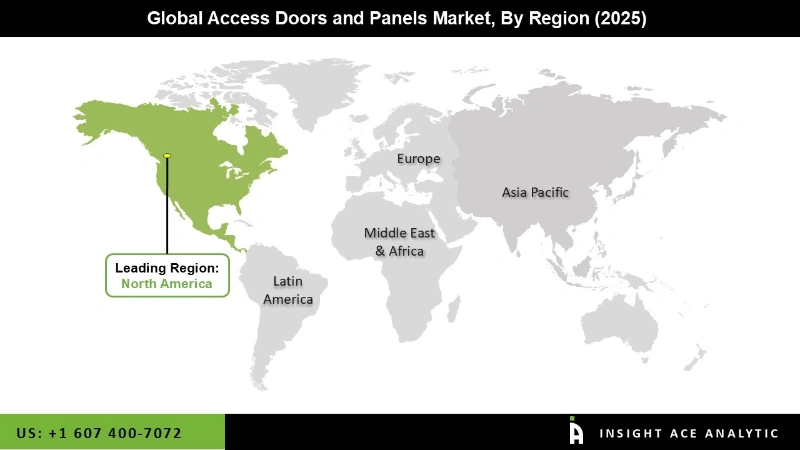
In The Region, The North American Access Doors And Panels Market Holds A Significant Revenue Share.
The North American access doors and the market is expected to register the highest market share in terms of revenue in the near future. The market is propelled by increasing installations in new buildings and heightened demand from door renovations and retrofit projects. Growth in the American construction sector is anticipated to be widespread, encompassing residential, non-residential, and civil engineering segments, spanning both new construction and renovation initiatives. This trend drives the expansion of the access doors and panels market in the region. Furthermore, the growth in the APAC region of the construction industry is bolstered by rising urban populations and ongoing renovation activities. Significant investments in infrastructure, particularly in Australia, China, Hong Kong, Japan, the Philippines, Singapore, Taiwan, Thailand, Myanmar, and Vietnam, highlight these countries as key potential markets for access doors and panels in the region.
Recent developments
- In Aug 2022, Maxam Metal Products Limited has formed a partnership with Activar Construction Products Group, Inc. (ACPG), a reputable maker of commercial construction products. ACPG has been distributing Maxam access panels and floor doors for the past eight years under their JL Industries brand. They are eager to expand their offerings to include more of the Maxam product lines.
Access Doors and Panels Market Report Scope
| Report Attribute | Specifications |
| Market Size Value In 2025 | USD 5.24 Bn |
| Revenue Forecast In 2035 | USD 7.67 Bn |
| Growth Rate CAGR | CAGR of 4.00% from 2026 to 2035 |
| Quantitative Units | Representation of revenue in US$ Bn and CAGR from 2026 to 2035 |
| Historic Year | 2022 to 2025 |
| Forecast Year | 2026-2035 |
| Report Coverage | The forecast of revenue, the position of the company, the competitive market structure, growth prospects, and trends |
| Segments Covered | By Type, Installation Requirements, Materials Used, End-User Applications, And Distribution Channels. |
| Regional Scope | North America; Europe; Asia Pacific; Latin America; Middle East & Africa |
| Country Scope | U.S.; Canada; U.K.; Germany; China; India; Japan; Brazil; Mexico; France; Italy; Spain; South East Asia; South Korea |
| Competitive Landscape | Activar Construction Products Group, Acudor Products, Elmdor, Karp Associates, Williams Brothers Corporation of America, Envisivent, Manthorpe, AirTech-UK, FlipFix, Steinberg14, Timloc, EUROPLAST and others. |
| Customization Scope | Free customization report with the procurement of the report and modifications to the regional and segment scope. Particular Geographic competitive landscape. |
| Pricing And Available Payment Methods | Explore pricing alternatives that are customized to your particular study requirements. |
Segmentation of Access Doors and Panels Market-
Access Doors and Panels Market By Type
- General-Purpose
- Fire-Rated
- Drywall
- Security
Access Doors and Panels Market By Installation
- Exterior
- Interior
Access Doors and Panels Market By Material:
- Steel
- Plastic
- Others
Access Doors and Panels Market By End-user
- Residential
- Commercial & Industrial
Access Doors and Panels Market By Distribution Channel
- Offline
- Online
Access Doors and Panels Market By Region-
North America-
- The US
- Canada
Europe-
- Germany
- The UK
- France
- Italy
- Spain
- Rest of Europe
Asia-Pacific-
- China
- Japan
- India
- South Korea
- South East Asia
- Rest of Asia Pacific
Latin America-
- Brazil
- Mexico
- Argentina
- Rest of Latin America
Middle East & Africa-
- GCC Countries
- South Africa
- Rest of Middle East and Africa
Research Design and Approach
This study employed a multi-step, mixed-method research approach that integrates:
- Secondary research
- Primary research
- Data triangulation
- Hybrid top-down and bottom-up modelling
- Forecasting and scenario analysis
This approach ensures a balanced and validated understanding of both macro- and micro-level market factors influencing the market.
Secondary Research
Secondary research for this study involved the collection, review, and analysis of publicly available and paid data sources to build the initial fact base, understand historical market behaviour, identify data gaps, and refine the hypotheses for primary research.
Sources Consulted
Secondary data for the market study was gathered from multiple credible sources, including:
- Government databases, regulatory bodies, and public institutions
- International organizations (WHO, OECD, IMF, World Bank, etc.)
- Commercial and paid databases
- Industry associations, trade publications, and technical journals
- Company annual reports, investor presentations, press releases, and SEC filings
- Academic research papers, patents, and scientific literature
- Previous market research publications and syndicated reports
These sources were used to compile historical data, market volumes/prices, industry trends, technological developments, and competitive insights.

Primary Research
Primary research was conducted to validate secondary data, understand real-time market dynamics, capture price points and adoption trends, and verify the assumptions used in the market modelling.
Stakeholders Interviewed
Primary interviews for this study involved:
- Manufacturers and suppliers in the market value chain
- Distributors, channel partners, and integrators
- End-users / customers (e.g., hospitals, labs, enterprises, consumers, etc., depending on the market)
- Industry experts, technology specialists, consultants, and regulatory professionals
- Senior executives (CEOs, CTOs, VPs, Directors) and product managers
Interview Process
Interviews were conducted via:
- Structured and semi-structured questionnaires
- Telephonic and video interactions
- Email correspondences
- Expert consultation sessions
Primary insights were incorporated into demand modelling, pricing analysis, technology evaluation, and market share estimation.
Data Processing, Normalization, and Validation
All collected data were processed and normalized to ensure consistency and comparability across regions and time frames.
The data validation process included:
- Standardization of units (currency conversions, volume units, inflation adjustments)
- Cross-verification of data points across multiple secondary sources
- Normalization of inconsistent datasets
- Identification and resolution of data gaps
- Outlier detection and removal through algorithmic and manual checks
- Plausibility and coherence checks across segments and geographies
This ensured that the dataset used for modelling was clean, robust, and reliable.
Market Size Estimation and Data Triangulation
Bottom-Up Approach
The bottom-up approach involved aggregating segment-level data, such as:
- Company revenues
- Product-level sales
- Installed base/usage volumes
- Adoption and penetration rates
- Pricing analysis
This method was primarily used when detailed micro-level market data were available.

Top-Down Approach
The top-down approach used macro-level indicators:
- Parent market benchmarks
- Global/regional industry trends
- Economic indicators (GDP, demographics, spending patterns)
- Penetration and usage ratios
This approach was used for segments where granular data were limited or inconsistent.
Hybrid Triangulation Approach
To ensure accuracy, a triangulated hybrid model was used. This included:
- Reconciling top-down and bottom-up estimates
- Cross-checking revenues, volumes, and pricing assumptions
- Incorporating expert insights to validate segment splits and adoption rates
This multi-angle validation yielded the final market size.
Forecasting Framework and Scenario Modelling
Market forecasts were developed using a combination of time-series modelling, adoption curve analysis, and driver-based forecasting tools.
Forecasting Methods
- Time-series modelling
- S-curve and diffusion models (for emerging technologies)
- Driver-based forecasting (GDP, disposable income, adoption rates, regulatory changes)
- Price elasticity models
- Market maturity and lifecycle-based projections
Scenario Analysis
Given inherent uncertainties, three scenarios were constructed:
- Base-Case Scenario: Expected trajectory under current conditions
- Optimistic Scenario: High adoption, favourable regulation, strong economic tailwinds
- Conservative Scenario: Slow adoption, regulatory delays, economic constraints
Sensitivity testing was conducted on key variables, including pricing, demand elasticity, and regional adoption.
Request Customization
Add countries, segments, company profiles, or extend forecast — free 10% customization with purchase.
Customize This Report →Enquire Before Buying
Speak with our analyst team about scope, methodology, pricing, or deliverable formats.
Enquire Now →Frequently Asked Questions
Access Doors and Panels Market Size is valued at USD 5.24 Bn in 2025 and is predicted to reach USD 7.67 Bn by the year 2035.
Access Doors and Panels Market is expected to grow at a 4.00% CAGR during the forecast period for 2026-2035
Activar Construction Products Group, Acudor Products, Elmdor, Karp Associates, Williams Brothers Corporation of America, Envisivent, Manthorpe, AirTec
market for access doors and panels is categorized into several key segments based on type, installation requirements, materials used, end-user applications, and distribution channels.
North America region is leading the Access Doors and Panels Market.