3D Protein Structure Analysis Market Size, Share & Trends Analysis Report By Product (Consumables, Equipment, Computational Software), By End-User (Biopharmaceutical Company, Academic and Research Institute, Other), End User, By Region, And By Segment Forecasts, 2024-2031

Report Id: 1373 Pages: 180 Last Updated: 12 August 2024 Format: PDF / PPT / Excel / Power BI
Share With : linkedin twitter facebook

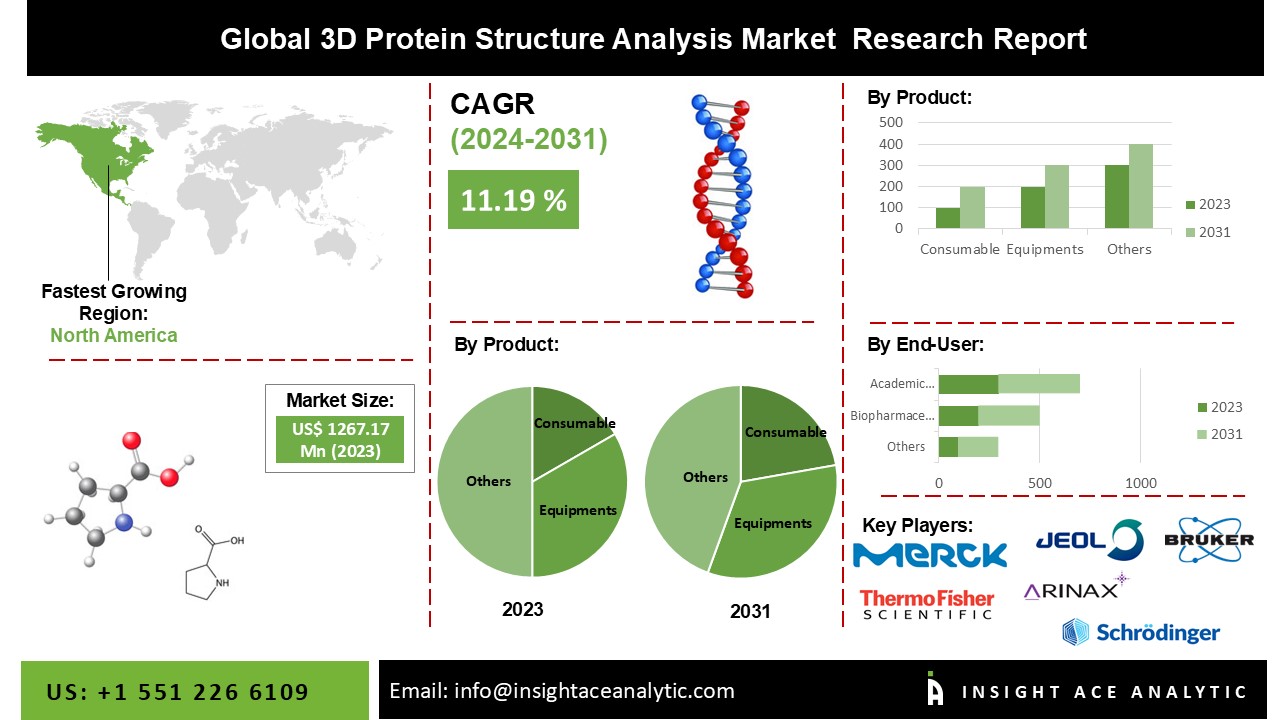
The 3D Protein Structure Analysis Market Size is valued at 1267.17 Million in 2023 and is predicted to reach 2,945.23 Million by the year 2031 at a 11.19% CAGR during the forecast period for 2024-2031

Key Industry Insights & Findings from the Report:

  • The increasing need for personalized medicine, which relies heavily on understanding individual protein structures to tailor treatments, is propelling the market.
  • The growth is due to the increasing need to understand protein structures for drug discovery and to develop treatments for chronic and infectious diseases.
  • North America dominated the market and accounted for a global revenue share in 2023.
  • The technical complexity can limit the adoption of technologies to institutions with specialized personnel, further restricting market growth. 

 3d protein

The three-dimensional arrangement of atoms determines a protein's biological function. This could be catalytic residues in an active site or how a protein interacts with others for structural or regulatory purposes. Protein structures help us understand how a protein operates, allowing us to form theories about how to alter, control, or modify it. Knowing a protein's structure could allow site-directed alterations to change function. Predict protein-binding compounds.

The amino acid sequence of a protein decides the stable three-dimensional forms, or conformations, into which it folds. It is becoming increasingly apparent that the number of unique folds in proteins is significantly smaller than the total number of protein structures because X-ray crystallography and nuclear magnetic resonance (NMR) are rapidly being used to determine a multitude of different protein structures. Understanding a protein's structure and function in the cell depends on knowing its amino acid sequence. For example, following the instructions recorded in the genetic code, the collection of nucleotides that makes up a gene is first translated into a collection of amino acids. Only after taking on a three-dimensional shape, the so-called tertiary, or native structure of the protein, does the matching linear chain of amino acids become functional.

Rising emphasis on automation and miniaturisation in X-ray crystallography workflow influence the 3D protein structure analysis market growth. Also, increase in Drug Discovery and Development R&D Expenditures and Technological Advances in Protein Structure Analysis Equipment. Drug discovery makes extensive use of artificial intelligence by researchers and pharmaceutical businesses. Recently, DeepMind, the artificial intelligence unit of Google's parent firm Alphabet, has stated that it has successfully foreseen the structure of nearly every protein in the human body. In addition, they can anticipate the structure of thousands of additional proteins found in species such as mice, fruit flies, and yeast that are essential to scientific research.

The major limitations are expenditure, time, and knowledge. In order to solve structures using crystallography and nuclear magnetic resonance (NMR), one has to have received very specific training and a high level of experience. Additionally, the expense of resolving a unique structure is quite significant.

Competitive Landscape:

Some major key players in the 3D Protein Structure Analysis Market:

  • Merck KGaA,
  • Bruker Corporation,
  • JEOL Ltd.,
  • Spectris plc,
  • Schrodinger, Inc.,
  • Thermo Fisher Scientific Inc.,
  • Molecular Dimensions,
  • DNASTAR,
  • Arinax Scientific Instrumentation.,
  • org,
  • Cambridge Isotope Laboratories, Inc.,
  • HAMPTON RESEARCH CORP.,
  • Dassault Systemes,
  • Rigaku Corporation,
  • Jena Bioscience GmbH
  • other market players.

The 3D protein structure analysis market is segmented by product and end-user. The product segment comprises Consumable (X-Ray Crystallography, Nuclear Magnetic Resonance (NMR) Spectroscopy, Cryo-Electron Microscopy (Cryo-EM), Small Angle X-Ray Scattering (SAXS) ), Equipment (X-Ray Crystallography, Nuclear Magnetic Resonance (NMR) Spectroscopy, Cryo-Electron Microscopy (Cryo-EM), Small Angle X-Ray Scattering (SAXS)), and Computational Software. The second major segment is the end-user segment which includes Biopharmaceutical companies, Academic and Research institutes, and Other End-User. In which the segment of biopharmaceutical companies is the dominant market end user.

The North American market is anticipated to grow due to significant funding, collaborations, investments, and innovations for economic development and public health, as well as the region's prioritisation of using 3D protein structures for molecular research and the development of novel drugs.

Recent Developments:

  • In April 2024, Bruker Corporation, the dominant supplier of nuclear magnetic resonance (NMR) spectroscopy solutions, has declared the launch of innovative high-resolution solid-state NMR scientific capabilities. These skills have the potential to facilitate groundbreaking structural biology findings in complex proteins, membrane proteins, and protein aggregates.

3D Protein Structure Analysis Market Report Scope:

Report Attribute Specifications
Market size value in 2023 USD 1267.17 Million
Revenue forecast in 2031 USD 2,945.23 Million
Growth rate CAGR CAGR of 11.19% from 2024 to 2031
Quantitative units Representation of revenue in US$ Million and CAGR from 2024 to 2031
Historic Year 2019 to 2023
Forecast Year 2024-2031
Report coverage The forecast of revenue, the position of the company, the competitive market structure, growth prospects, and trends
Segments covered Product, End-User
Regional scope North America; Europe; Asia Pacific; Latin America; Middle East & Africa
Country scope U.S.; Canada; U.K.; Germany; China; India; Japan; Brazil; Mexico ;The UK; France; Italy; Spain; China; Japan; India; South Korea; South East Asia; South Korea; South East Asia
Competitive Landscape Merck KGaA, Bruker Corporation, JEOL Ltd., Spectris plc, Schrodinger, Inc., Thermo Fisher Scientific Inc., Molecular Dimensions, DNASTAR, Arinax Scientific Instrumentation., RosettaCommons.org, Cambridge Isotope Laboratories, Inc., HAMPTON RESEARCH CORP., Dassault Systemes, Rigaku Corporation, Jena Bioscience GmbH and other market players.
Customization scope Free customization report with the procurement of the report, Modifications to the regional and segment scope. Particular Geographic competitive landscape.
Pricing and available payment methods Explore pricing alternatives that are customized to your particular study requirements.

Global 3D Protein Structure Analysis Market Segmentation

Global 3D protein structure analysis  Market, by Product

  • Consumable
    • X-Ray Crystallography
    • Nuclear Magnetic Resonance (NMR) Spectroscopy
    • Cryo-Electron Microscopy (Cryo-EM)
    • Small Angle X-Ray Scattering (SAXS) 

 3d protein

  • Equipment
    • X-Ray Crystallography
    • Nuclear Magnetic Resonance (NMR) Spectroscopy
    • Cryo-Electron Microscopy (Cryo-EM)
    • Small Angle X-Ray Scattering (SAXS)
  • Computational Software           

Global 3D protein structure analysis  Market, by End-User

  • Biopharmaceutical Company
  • Academic and Research Institute
  • Other End User

Global 3D protein structure analysis  Market, by Region

  • North America
  • Europe
  • Asia Pacific
  • Latin America
  • Middle East & Africa

North America 3D protein structure analysis  Market, by Country

  • U.S.
  • Canada

Europe 3D protein structure analysis  Market, by Country

  • Germany
  • France
  • Italy
  • Spain
  • Russia
  • Rest of Europe

Asia Pacific 3D protein structure analysis  Market, by Country

  • India
  • China
  • Japan
  • South Korea
  • Australia & New Zealand

Latin America 3D protein structure analysis  Market, by Country

  • Brazil
  • Mexico
  • Rest of Latin America

Middle East & Africa 3D protein structure analysis  Market, by Country

  • GCC Countries
  • South Africa
  • Rest of Middle East & Africa

Need specific information/chapter from the report of the custom data table, graph or complete report? Tell us more.

Research Design and Approach

This study employed a multi-step, mixed-method research approach that integrates:

  • Secondary research
  • Primary research
  • Data triangulation
  • Hybrid top-down and bottom-up modelling
  • Forecasting and scenario analysis

This approach ensures a balanced and validated understanding of both macro- and micro-level market factors influencing the market.

Secondary Research

Secondary research for this study involved the collection, review, and analysis of publicly available and paid data sources to build the initial fact base, understand historical market behaviour, identify data gaps, and refine the hypotheses for primary research.

Sources Consulted

Secondary data for the market study was gathered from multiple credible sources, including:

  • Government databases, regulatory bodies, and public institutions
  • International organizations (WHO, OECD, IMF, World Bank, etc.)
  • Commercial and paid databases
  • Industry associations, trade publications, and technical journals
  • Company annual reports, investor presentations, press releases, and SEC filings
  • Academic research papers, patents, and scientific literature
  • Previous market research publications and syndicated reports

These sources were used to compile historical data, market volumes/prices, industry trends, technological developments, and competitive insights.

Secondary Research

Primary Research

Primary research was conducted to validate secondary data, understand real-time market dynamics, capture price points and adoption trends, and verify the assumptions used in the market modelling.

Stakeholders Interviewed

Primary interviews for this study involved:

  • Manufacturers and suppliers in the market value chain
  • Distributors, channel partners, and integrators
  • End-users / customers (e.g., hospitals, labs, enterprises, consumers, etc., depending on the market)
  • Industry experts, technology specialists, consultants, and regulatory professionals
  • Senior executives (CEOs, CTOs, VPs, Directors) and product managers

Interview Process

Interviews were conducted via:

  • Structured and semi-structured questionnaires
  • Telephonic and video interactions
  • Email correspondences
  • Expert consultation sessions

Primary insights were incorporated into demand modelling, pricing analysis, technology evaluation, and market share estimation.

Data Processing, Normalization, and Validation

All collected data were processed and normalized to ensure consistency and comparability across regions and time frames.

The data validation process included:

  • Standardization of units (currency conversions, volume units, inflation adjustments)
  • Cross-verification of data points across multiple secondary sources
  • Normalization of inconsistent datasets
  • Identification and resolution of data gaps
  • Outlier detection and removal through algorithmic and manual checks
  • Plausibility and coherence checks across segments and geographies

This ensured that the dataset used for modelling was clean, robust, and reliable.

Market Size Estimation and Data Triangulation

Bottom-Up Approach

The bottom-up approach involved aggregating segment-level data, such as:

  • Company revenues
  • Product-level sales
  • Installed base/usage volumes
  • Adoption and penetration rates
  • Pricing analysis

This method was primarily used when detailed micro-level market data were available.

Bottom Up Approach

Top-Down Approach

The top-down approach used macro-level indicators:

  • Parent market benchmarks
  • Global/regional industry trends
  • Economic indicators (GDP, demographics, spending patterns)
  • Penetration and usage ratios

This approach was used for segments where granular data were limited or inconsistent.

Hybrid Triangulation Approach

To ensure accuracy, a triangulated hybrid model was used. This included:

  • Reconciling top-down and bottom-up estimates
  • Cross-checking revenues, volumes, and pricing assumptions
  • Incorporating expert insights to validate segment splits and adoption rates

This multi-angle validation yielded the final market size.

Forecasting Framework and Scenario Modelling

Market forecasts were developed using a combination of time-series modelling, adoption curve analysis, and driver-based forecasting tools.

Forecasting Methods

  • Time-series modelling
  • S-curve and diffusion models (for emerging technologies)
  • Driver-based forecasting (GDP, disposable income, adoption rates, regulatory changes)
  • Price elasticity models
  • Market maturity and lifecycle-based projections

Scenario Analysis

Given inherent uncertainties, three scenarios were constructed:

  • Base-Case Scenario: Expected trajectory under current conditions
  • Optimistic Scenario: High adoption, favourable regulation, strong economic tailwinds
  • Conservative Scenario: Slow adoption, regulatory delays, economic constraints

Sensitivity testing was conducted on key variables, including pricing, demand elasticity, and regional adoption.


Enter Details and Get your PDF Brochure

Name field cannot be blank!
Email field cannot be blank!(Use email format)
Designation field cannot be blank!
Company field cannot be blank!
Contact No field cannot be blank!
Message field cannot be blank!
8032
Security Code field cannot be blank!

Frequently Asked Questions

The 3D Protein Structure Analysis Market Size is valued at 1267.17 Million in 2023 and is predicted to reach 2,945.23 Million by the year 2031

3D Protein Structure Analysis Market expected to grow at 11.19% CAGR during the forecast period for 2024-2031

Merck KGaA, Bruker Corporation, JEOL Ltd., Spectris plc, Schrodinger, Inc., Thermo Fisher Scientific Inc., Molecular Dimensions, DNASTAR, Arinax Scien
Send Me the Sample Report Enquiry Before Buying