High-Performance Textile Market Size, Share & Trends Analysis Report By Application (Aerospace And Defense And Automotive And Transportation And Sports And Energy And Chemical And Others), By Fiber Type , By Technology, By Region, And Segment Forecasts, 2025-2034
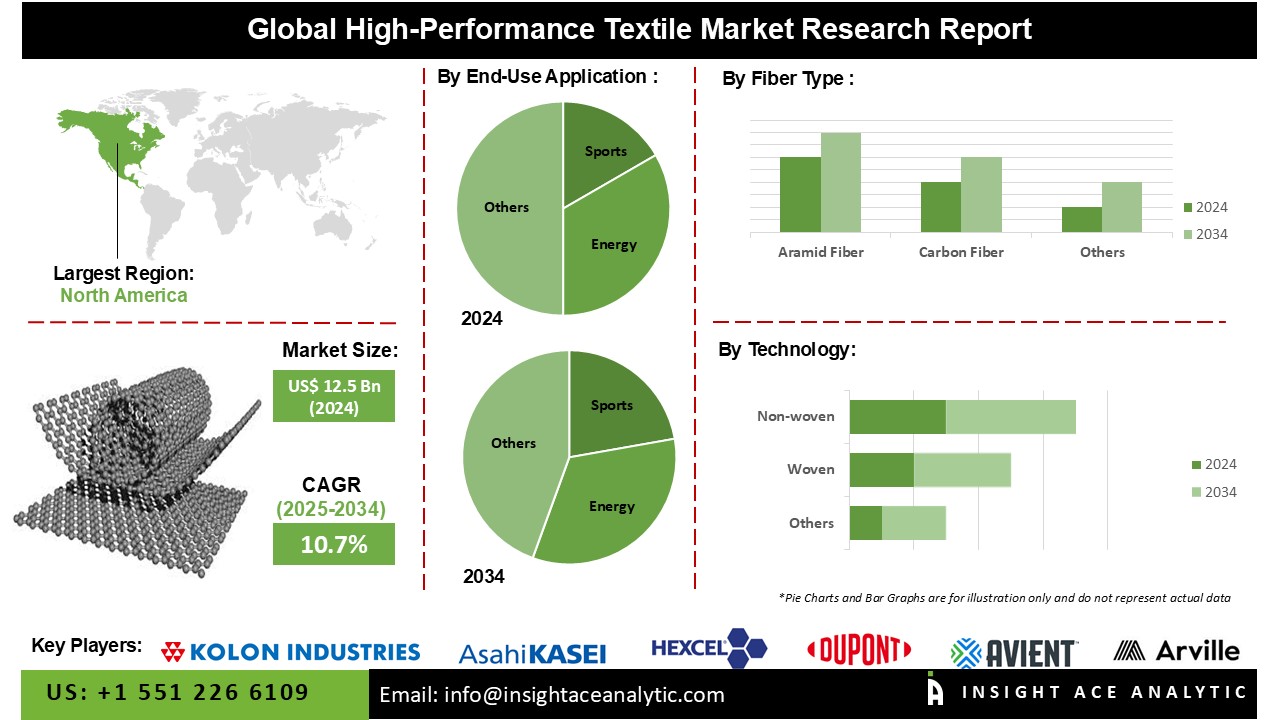
High-Performance Textile Market Size is valued at USD 12.5 Billion in 2024 and is predicted to reach USD 34.2 Billion by the year 2034 at an 10.7% CAGR during the forecast period for 2025-2034.
Key Industry Insights & Findings from the Report:
- Technical textiles are defined as textile materials manufactured to meet technical and performance requirements rather than decorative or aesthetic requirements.
- The increase in demand for formal and casual wear and other fashionable clothing among all age groups in the global population is a major driver of the textiles market's growth.
- North America dominated the market and accounted for a revenue share of global revenue in 2024.
- Technical textiles are used mainly in agriculture and horticulture, construction and civil engineering, footwear and clothing, household furniture and coverings, and cleaning and conveying industrial equipment.
High-performance textiles have been designed to provide high strength, high modulus, thermal stability at high temperatures, chemical and solvent resistance, and various other characteristics for their specific end-use application. The market is projected to grow in the coming years due to the expanding manufacturing sectors worldwide. Technological developments in manufacturing technologies will drive the market in the coming years.
However, a significant element favorably influencing market growth is the high cost of completed products together with challenging manufacturing processes. The demand for durable textiles is growing due to the trend toward more materials in end-use industries. The increased emphasis on sturdy construction, quality, sturdiness, and specialized specialty materials across the globe is to blame for this. The transition is especially apparent in the aerospace and defense sectors.
Moreover, New trends, such as digital techniques in increased textiles, rising major automobile demand and the implementation of safety features in the automotive industry, new product innovations in safety gear, and rising sustainability awareness, are expected to present opportunities for the market to grow in the years to come.
Recent Developments:
- In Dec 2021, Huvis and Korea Textile Smart Processing Institute ad entered into an MOU for developing and commercialising cool-to-touch composite functional materials. According to the MOU, the two organizations are expected to create high-added value in the domestic cool-to-touch material industry by researching and developing products using cool-to-touch composite functional materials, developing production technologies, such as design, weaving, and dyeing and finishing technology, and cooperating in evaluating the performance of cool-to-touch materials.
- In Aug 2019, Arville now provided specialist textiles for an increasingly broad range of applications. The company, which initially weaved fabric for public transport uniforms, has a customer base in more than 50 countries supplying to varied sectors such as defence, aerospace, pharmaceutical, food, medical, automotive and filtration.
Competitive Landscape:
Some of the major key players in the High-Performance Textile market are:
- Arville
- Asahi Kasei Corporation
- Avient Corporation
- Baltex
- DuPont
- Freudenberg Performance Materials
- Hexcel Corporation
- High Performance Textiles Pvt. Ltd.
- Huvis Corp.
- Kermel
- Kolon Industries, Inc.
- Mitsui Chemicals, Inc.
- Performance Textiles
- Porcher Industries
- Toray Industries, Inc.
- Cass Materials
- Crosslink Composites, Inc.
- Fabiosys Innovations
- High Performance Textiles GmbH
- Spintex Engineering Ltd.
Market Segmentation:
The high-performance textile market is segmented based on end-users applications, field type and technology. Based on end-user application, the market is segmented as aerospace and defense and automotive and transportation and sports and energy and chemical and other. The market is segmented by fiber type: aramid, carbon, glass, high-strength polyethylene, aromatic polyester, and others. Based on technology, the high-performance textile market is divided into woven, non-woven, knitting and 3D.
Based on fiber type, the carbon fiber segment is a major contributor to the high-performance textile market.
The carbon fiber category is expected to hold a major share of the global high-performance textile market in 2021 due to various aerospace sector applications, including airplanes, rockets, telescopes, and weapons. As a result of their lightweight and stiffness qualities, CFRCs are becoming increasingly prevalent in aviation components, which is another factor that is anticipated to fuel demand. Carbon fiber structures weigh about one-third and a half as much compared to aluminum and steel. CFRC consumption, however, is far more expensive than using metals. The high expense of carbon fiber has limited its use to high-performance vehicles, including aircraft like Boeing and Airbus, jet fighters, rockets, racing automobiles, sports cars, and racing yachts.
The aerospace & defense segment has witnessed growth at a rapid rate.
The aerospace & defense segment is projected to increase in the global high-performance textile market. The industry is shifting toward lightweight materials to increase the aircraft's budgetary performance and ecological sustainability. Therefore, aircraft production depends on high-strength, lighter, and jute structural components. In aircraft applications, aluminum alloys and structures are advantageous because they give great strength and stiffness at a decreased weight, significantly lowering fuel consumption. These materials make it possible for airplanes, particularly military aircraft, to carry greater payload and fuel, extending missions and reducing downtime.
The North America high-performance textile market holds a significant regional revenue share.
The North America high-performance textile market is expected to register the highest market share in revenue soon on account of well-developed markets for the aerospace and defense industries. The market in this region is expanding due to factors such as increased defense spending in the United States, the use of excellent-performance fibers in the architecture, electronics, and automotive industries, and the use of high-performing fibers as an alternative to mesothelioma and steel. In addition, the Asia Pacific region is projected to grow rapidly in the global high-performance textile market. The rising demand for textile materials with high performance is driving the market in the Asia Pacific. The increased use of technical textiles in Asia is fueled by industrialization, the availability of low-cost raw materials, and growing consumer awareness of their improved functioning. There are an increasing number of manufacturers in the Asia Pacific technical textiles market.
Global High-Performance Textile Market Report Scope:
| Report Attribute | Specifications |
| Market size value in 2024 | USD 12.5 Billion |
| Revenue forecast in 2034 | USD 34.2 Billion |
| Growth rate CAGR | CAGR of 10.7% from 2025 to 2034 |
| Quantitative units | Representation of revenue in US$ Bn,Volume (KT) and CAGR from 2025 to 2034 |
| Historic Year | 2021 to 2024 |
| Forecast Year | 2025-2034 |
| Report coverage | The forecast of revenue, the position of the company, the competitive market structure, growth prospects, and trends |
| Segments covered | Application, Fiber Type, Technology |
| Regional scope | North America; Europe; Asia Pacific; Latin America; Middle East & Africa |
| Country scope | U.S.; Canada; U.K.; Germany; China; India; Japan; Brazil; Mexico ;The UK; France; Italy; Spain; China; Japan; India; South Korea; South East Asia; South Korea; South East Asia |
| Competitive Landscape | Arvill, Asahi Kasei Corporation, Avient Corporation, Balte, DuPont, Freudenberg Performance Materials, Hexcel Corporatio, High Performance Textiles Pvt. Ltd., Huvis Corp, Kermel, Kolon Industries, Inc., Mitsui Chemicals, Inc, Performance Textiles, Porcher Industrie, Toray Industries, Inc, Cass Materials, Crosslink Composites, Inc., Fabiosys Innovation, High Performance Textiles GmbH, Spintex Engineering Ltd. |
| Customization scope | Free customization report with the procurement of the report, Modifications to the regional and segment scope. Particular Geographic competitive landscape. |
| Pricing and available payment methods | Explore pricing alternatives that are customized to your particular study requirements. |
Segmentation of High-Performance Textile Market-
High-Performance Textile Market By End-Use Application
- Aerospace and Defense
- Automotive and Transportation
- Sports
- Energy
- Chemical
- Other
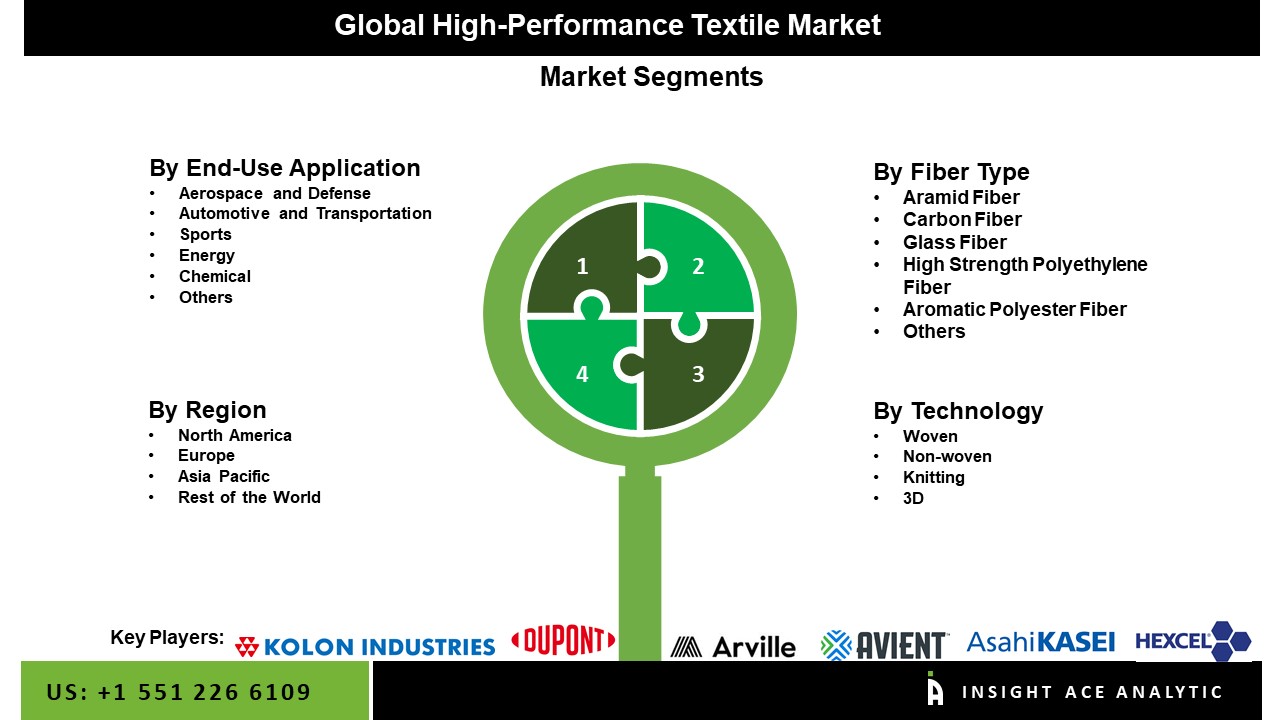
High-Performance Textile Market By Fiber Type
- Aramid Fiber
- Carbon Fiber
- Glass Fiber
- High Strength Polyethylene Fiber
- Aromatic Polyester Fiber
- Others
High-Performance Textile Market By Technology
- Woven
- Non-woven
- Knitting
- 3D
High-Performance Textile Market By Region-
North America-
- The US
- Canada
- Mexico
Europe-
- Germany
- The UK
- France
- Italy
- Spain
- Rest of Europe
Asia-Pacific-
- China
- Japan
- India
- South Korea
- South East Asia
- Rest of Asia Pacific
Latin America-
- Brazil
- Argentina
- Rest of Latin America
Middle East & Africa-
- GCC Countries
- South Africa
- Rest of Middle East and Africa
Research Design and Approach
This study employed a multi-step, mixed-method research approach that integrates:
- Secondary research
- Primary research
- Data triangulation
- Hybrid top-down and bottom-up modelling
- Forecasting and scenario analysis
This approach ensures a balanced and validated understanding of both macro- and micro-level market factors influencing the market.
Secondary Research
Secondary research for this study involved the collection, review, and analysis of publicly available and paid data sources to build the initial fact base, understand historical market behaviour, identify data gaps, and refine the hypotheses for primary research.
Sources Consulted
Secondary data for the market study was gathered from multiple credible sources, including:
- Government databases, regulatory bodies, and public institutions
- International organizations (WHO, OECD, IMF, World Bank, etc.)
- Commercial and paid databases
- Industry associations, trade publications, and technical journals
- Company annual reports, investor presentations, press releases, and SEC filings
- Academic research papers, patents, and scientific literature
- Previous market research publications and syndicated reports
These sources were used to compile historical data, market volumes/prices, industry trends, technological developments, and competitive insights.

Primary Research
Primary research was conducted to validate secondary data, understand real-time market dynamics, capture price points and adoption trends, and verify the assumptions used in the market modelling.
Stakeholders Interviewed
Primary interviews for this study involved:
- Manufacturers and suppliers in the market value chain
- Distributors, channel partners, and integrators
- End-users / customers (e.g., hospitals, labs, enterprises, consumers, etc., depending on the market)
- Industry experts, technology specialists, consultants, and regulatory professionals
- Senior executives (CEOs, CTOs, VPs, Directors) and product managers
Interview Process
Interviews were conducted via:
- Structured and semi-structured questionnaires
- Telephonic and video interactions
- Email correspondences
- Expert consultation sessions
Primary insights were incorporated into demand modelling, pricing analysis, technology evaluation, and market share estimation.
Data Processing, Normalization, and Validation
All collected data were processed and normalized to ensure consistency and comparability across regions and time frames.
The data validation process included:
- Standardization of units (currency conversions, volume units, inflation adjustments)
- Cross-verification of data points across multiple secondary sources
- Normalization of inconsistent datasets
- Identification and resolution of data gaps
- Outlier detection and removal through algorithmic and manual checks
- Plausibility and coherence checks across segments and geographies
This ensured that the dataset used for modelling was clean, robust, and reliable.
Market Size Estimation and Data Triangulation
Bottom-Up Approach
The bottom-up approach involved aggregating segment-level data, such as:
- Company revenues
- Product-level sales
- Installed base/usage volumes
- Adoption and penetration rates
- Pricing analysis
This method was primarily used when detailed micro-level market data were available.

Top-Down Approach
The top-down approach used macro-level indicators:
- Parent market benchmarks
- Global/regional industry trends
- Economic indicators (GDP, demographics, spending patterns)
- Penetration and usage ratios
This approach was used for segments where granular data were limited or inconsistent.
Hybrid Triangulation Approach
To ensure accuracy, a triangulated hybrid model was used. This included:
- Reconciling top-down and bottom-up estimates
- Cross-checking revenues, volumes, and pricing assumptions
- Incorporating expert insights to validate segment splits and adoption rates
This multi-angle validation yielded the final market size.
Forecasting Framework and Scenario Modelling
Market forecasts were developed using a combination of time-series modelling, adoption curve analysis, and driver-based forecasting tools.
Forecasting Methods
- Time-series modelling
- S-curve and diffusion models (for emerging technologies)
- Driver-based forecasting (GDP, disposable income, adoption rates, regulatory changes)
- Price elasticity models
- Market maturity and lifecycle-based projections
Scenario Analysis
Given inherent uncertainties, three scenarios were constructed:
- Base-Case Scenario: Expected trajectory under current conditions
- Optimistic Scenario: High adoption, favourable regulation, strong economic tailwinds
- Conservative Scenario: Slow adoption, regulatory delays, economic constraints
Sensitivity testing was conducted on key variables, including pricing, demand elasticity, and regional adoption.
Request Customization
Add countries, segments, company profiles, or extend forecast — free 10% customization with purchase.
Customize This Report →Enquire Before Buying
Speak with our analyst team about scope, methodology, pricing, or deliverable formats.
Enquire Now →Frequently Asked Questions
High-Performance Textile Market Size is valued at USD 12.5 Billion in 2024 and is predicted to reach USD 34.2 Billion by the year 2034
High-Performance Textile Market expected to grow at a 10.7% CAGR during the forecast period for 2025-2034
Arvill, Asahi Kasei Corporation, Avient Corporation, Balte, DuPont, Freudenberg Performance Materials, Hexcel Corporatio, High Performance Textile
Application, Fiber Type and Technology are the key segments of the High-Performance Textile Market.
North American region is leading the High-Performance Textile Market.