Tooth Sensor Market Size, Share & Trends Analysis Report By Application (Monitoring Dietary Intake, Diagnostics, and Imaging), By End-Users, Region And Segment Forecasts, 2023-2031.
Share With :



A tooth sensor is an innovative technology to monitor and detect a person’s diet or smoking habits. It helps dentists to know whether a person is deviating from diet or has any smoking habits, etc. It is basically a chip less than half an inch in size and can be embedded in an artificial tooth or fitted into dentures or braces. The sensor has three different layers. It has layers of gold, and a sandwiched biosensor shows like an antenna that is utilized to detain information in real-time and transmit physiological data. The middle layer detects nutrients and chemicals reacting to various inputs with a shift in its electrical properties, i.e., change in color of central layer and outer layer absorbs chemicals in the diet. This shift causes the sensor to transmit an intensity of radiofrequency waves back to the app. This impressive tiny chip is helpful to measure just 2 mm square and can detect alcohol, sugar, salt, and even bio-chemicals. This is useful to improvise diet and overall health of a person. The sensor uses a small accelerometer to monitor the movements of the mouth. Every time a person performs oral activities such as coughing, chewing, drinking, and speaking, create a different teeth motion. The sensor recognizes and records motion profiles for every activity, building classifiers to distinguish between them.
A tooth sensor has been developed by Tufts University, MA, USA. Danish researchers at Aarhus University have developed a sensor capable of detecting specific bacteria in drinking water, such as E. coli. The sensor uses DNA-magnetic particle technology to seek out and isolate the bacteria using nano-sized magnets.
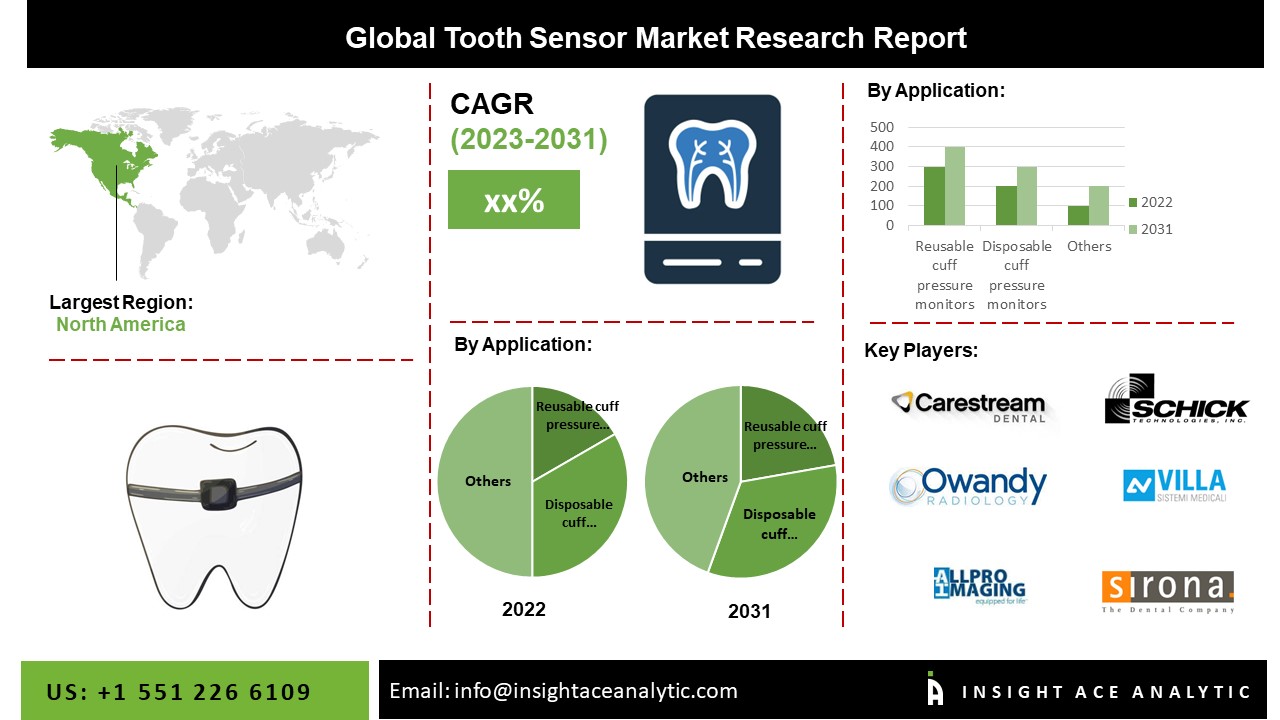
The Tooth Sensor Market is segmented on the basis of the Application, End-user, and geography. The primary application of the tooth sensors is monitoring dietary intake. As food passes the sensor, a signal is sent to a mobile device that interprets information on glucose, salt, and alcohol intake. Other significant application of tooth sensors is imaging. A suitable quality sensor produces crystal-clear images of the intraoral environment. Tooth sensors for monitoring diet are newer and will hold a significant share in the market, owing to the fact that health is directly related to diet, and these types of tooth sensors will find applications in the treatment of many diet-related ailments. On the basis of end-user users, the market is sub-segmented into the middle-aged population and special age groups. Middle-aged population contains person ages 19-60. Special age groups are pediatric and geriatric populations. According to a paper from Dental Economics, 17.5% of children aged 5–19 have problems with dental caries, and approximately 28% of all preschoolers have untreated cavities. Also, the rising geriatric population and their demand for preventive services for dental care are likely to boost the market growth in the coming years. This subsegment is expected to grow significantly in the future.
Geographically, the market is segmented into North America, Europe, Asia Pacific, Latin America, and Middle East & Africa. The USA holds the largest share of the market owing to the increasing geriatric population prone to tooth problems and the presence of sophisticated infrastructure. By revenue, North America and Europe hold the highest share, due to high dentist consultation charges and high other test charges.
The market is driven by increasing health consciousness, the need for prevention and treatment of oral diseases, increasing demand for flexible and compact wearable sensors, advancement in technology, and others. The rising geriatric population led to the high prevalence of age-related dental disorders, which is expected to support the industry growth. WHO has undertaken initiatives pertaining to the promotion of oral disease prevention and hygiene across the globe. These initiatives are responsible for future growth in this area.
| Report Attribute | Specifications |
| Market Size Value In 2022 | USD XX Million |
| Revenue Forecast In 2031 | USD XX Million |
| Growth Rate CAGR | CAGR of XX % from 2023 to 2031 |
| Quantitative Units | Representation of revenue in US$ Million, Volume (Unit), and CAGR from 2023 to 2031 |
| Historic Year | 2019 to 2022 |
| Forecast Year | 2023-2031 |
| Report Coverage | The forecast of revenue, the position of the company, the competitive market structure, growth prospects, and trends |
| Segments Covered | By Application, By End-Users |
| Regional Scope | North America; Europe; Asia Pacific; Latin America; Middle East & Africa |
| Country Scope | U.S.; Canada; U.K.; Germany; China; India; Japan; Brazil; Mexico; The UK; France; Italy; Spain; China; Japan; India; South Korea; South East Asia; South Korea; South East Asia |
| Competitive Landscape | Schick Technologies, Carestream Dental, Sistemi Medicali, Owandy, Corix Medical Systems, Allpro Imaging, Villa Sirona Dental Systems, Gendex Dental Systems, Fona Dental, and Others |
| Customization Scope | Free customization report with the procurement of the report, Modifications to the regional and segment scope. Particular Geographic competitive landscape. |
| Pricing and Available Payment Methods | Explore pricing alternatives that are customized to your particular study requirements. |
Global Tooth Sensor Market Outlook (Revenue, US$ Mn, 2019 - 2030) By Application
Global Tooth Sensor Market Outlook (Value & Volume, US$ Mn, 2019 – 2030) By Region
This study employed a multi-step, mixed-method research approach that integrates:
This approach ensures a balanced and validated understanding of both macro- and micro-level market factors influencing the market.
Secondary research for this study involved the collection, review, and analysis of publicly available and paid data sources to build the initial fact base, understand historical market behaviour, identify data gaps, and refine the hypotheses for primary research.
Secondary data for the market study was gathered from multiple credible sources, including:
These sources were used to compile historical data, market volumes/prices, industry trends, technological developments, and competitive insights.

Primary research was conducted to validate secondary data, understand real-time market dynamics, capture price points and adoption trends, and verify the assumptions used in the market modelling.
Primary interviews for this study involved:
Interviews were conducted via:
Primary insights were incorporated into demand modelling, pricing analysis, technology evaluation, and market share estimation.
All collected data were processed and normalized to ensure consistency and comparability across regions and time frames.
The data validation process included:
This ensured that the dataset used for modelling was clean, robust, and reliable.
The bottom-up approach involved aggregating segment-level data, such as:
This method was primarily used when detailed micro-level market data were available.

The top-down approach used macro-level indicators:
This approach was used for segments where granular data were limited or inconsistent.
To ensure accuracy, a triangulated hybrid model was used. This included:
This multi-angle validation yielded the final market size.
Market forecasts were developed using a combination of time-series modelling, adoption curve analysis, and driver-based forecasting tools.
Given inherent uncertainties, three scenarios were constructed:
Sensitivity testing was conducted on key variables, including pricing, demand elasticity, and regional adoption.