Tattoo Needle Market Size, Share & Trends Analysis Report, By Type (Temporary, Permanent), By Location (Upper Arm, Chest, Abdomen), By End-user (Men, Women), By Product Type (Magnum, Round Liners, Round Shaders, Cartridge), By Application (Lining, Shading or Colouring), By Needle Size, By Region, Forecasts, 2024-2031
The Tattoo Needle Market Size was valued at USD 289.8 Mn in 2023 and is predicted to reach USD 403.8 Mn by 2031 at a 4.4% CAGR during the forecast period for 2024-2031.

A tattoo needle is a specialist instrument used for ink injection into the skin to produce varied effects and details in a tattoo; these needles are arranged in a variety, including liners. The tattoo needle industry is booming for several reasons. Demand has skyrocketed due to the increasing number of people getting tattoos and the widespread acceptance of tattoo culture. To get widespread acceptance, tattoos rely heavily on social media and famous people's support. Furthermore, tattoo artists and enthusiasts alike have been drawn to safer, more precise, and long-lasting goods made possible by technological breakthroughs in needle design and materials. Tattooing has become increasingly popular and safe as professional tattoo studios worldwide have increased. This has increased the demand for tattoos. Furthermore, fresh opportunities for market expansion are presented by the rising popularity of cosmetic tattooing and the trend for personalized, high-quality tattoo work. In addition, tattoo needle market development and potential are boosted by expanding markets in emerging economies, where disposable incomes are on the rise, which will propel the industry's growth during the forecast period.
However, stringent regulatory requirements and the general public's lack of familiarity can hinder their market expansion. Furthermore, due to temporary tattoo studio closures, disruptions in the supply chain, and lower consumer spending, the COVID-19 pandemic had a negative effect on the tattoo needle business. However, the market started to turn around when limitations were relaxed, and demand came back. Furthermore, the cosmetic tattoo industry is booming, as is the need for high-quality, personalized tattoos; markets in developing nations are opening up due to rising disposable incomes and cultural acceptance, and innovations in needle technology are potential opportunities in the tattoo needle market.
Competitive Landscape
Some of the Major Key Players in the Tattoo Needle Market are
- Cheyenne Professional Tattoo Equipment
- Bishop Rotary
- Eikon Device Inc.
- Dragonhawk Tattoo Supply
- Kwadron
- Tatsoul
- EZ Tattoo Supply
- FK Irons
- Eternal Tattoo Supply
- Workhorse Irons
- Stigma Rotary
- Axys Rotary
- Peak Needle Co.
- Mithra Tattoo Supplies
- Precision Needles
- Kingpin Tattoo Supply
- Tattoo Everything Supplies
- Monster Point
- Protat
- Sunskin
- Others
Market Segmentation:
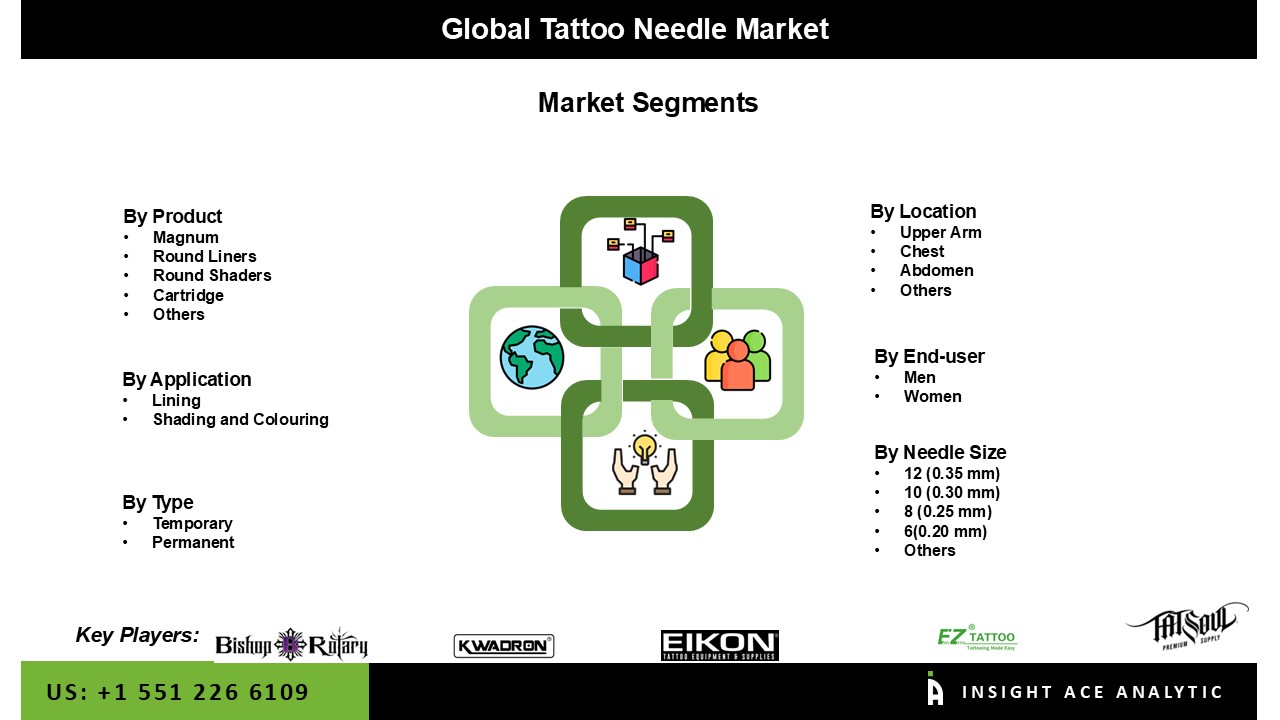
The tattoo needle market is segmented based on type, location, end-user, product type, and application. Based on the type, the market is segmented into temporary and permanent. The market is segmented by location into the upper arm, chest, abdomen, and others. By end-user, the market is segmented into men and women. The market is segmented by product type into magnum, round liners, round shaders, cartridges, and others. By application, the market is segmented into lining and shading or coloring.
Based on the Type, the Permanent Segment is Accounted as a Major Contributor to the Tattoo Needle Market
The permanent tattoo segment holds a major share of the global tattoo needle market in 2023 because permanent tattoos are becoming more commonplace and well-liked in society. Influencers on social media, celebrity sponsorships, and the proliferation of tattoo parlors are driving this trend. Additionally, tattoo needle technology has also advanced, making permanent tattoos safer and better and increasing their popularity. Permanent tattoos are in high demand due to their durability and permanence.
The Upper Arm Segment Witnessed Growth at a Rapid Rate
The upper arm segment is projected to grow rapidly in the global tattoo needle market because of its prominence as a tattoo location. Many people find the upper arm appealing because it offers a bigger canvas for intricate designs and is readily hideable if necessary. Furthermore, this area has quite a low pain level and plenty of muscle mass appeal, driving demand for tattoo needles fit for upper arm tattoos and expanding this market’s segment in the future.
In the Region, the North American Tattoo Needle Market Holds a Significant Revenue Share
The North American tattoo needle market is expected to register the highest market share in revenue in the near future. This is because of the region's great concentration of professional tattoo studios, high disposable incomes, and general acceptance of tattoos across society. In addition, the Asia Pacific region's market is anticipated to experience expansion in the global market for tattoo needles because tattoos are becoming increasingly fashionable among younger generations and because more people can acquire body art due to rising disposable earnings. As a result of the proliferation of professional tattoo studios and artists in the area, the quality and safety of tattoos have improved, which has further contributed to an increase in demand for the tattoo needle market in this area.
Recent Developments:
- In March 2024, Kwadron showed off the power of the Critical x Prime Pen portable tattoo machine, which has a Japanese Bishop motor. Due to its 4.2 mm stroke, it works great for every method, from lining to shading.
- In June 2024, Stigma Rotary introduced a new line of cartridges called Stigma EN05-FG. These cartridges are lighter and more streamlined than previous models, allowing users unprecedented comfort and control when using needles. Crafted with the same unmatched quality that EN05 is known for, satisfying the needs of artists everywhere. You’re familiar with and adore the characteristic Stigma Needle pins and configurations, and EN05-FG Cartridges feature them.
Tattoo Needle Market Report Scope
| Report Attribute | Specifications |
| Market Size Value In 2023 | USD 289.8 Mn |
| Revenue Forecast In 2031 | USD 403.8 Mn |
| Growth Rate CAGR | CAGR of 4.4% from 2024 to 2031 |
| Quantitative Units | Representation of revenue in US$ Mn and CAGR from 2024 to 2031 |
| Historic Year | 2019 to 2023 |
| Forecast Year | 2024-2031 |
| Report Coverage | The forecast of revenue, the position of the company, the competitive market structure, growth prospects, and trends |
| Segments Covered | By Type, By Application, By Location, By End-user, By Product Type and By Region |
| Regional Scope | North America; Europe; Asia Pacific; Latin America; Middle East & Africa |
| Country Scope | U.S.; Canada; U.K.; Germany; China; India; Japan; Brazil; Mexico; France; Italy; Spain; South East Asia; South Korea |
| Competitive Landscape | Cheyenne Professional Tattoo Equipment, Bishop Rotary, Eikon Device Inc., Dragonhawk Tattoo Supply, Kwadron, Tatsoul, EZ Tattoo Supply, FK Irons, Eternal Tattoo Supply, Workhorse Irons, Stigma Rotary, Axys Rotary, Peak Needle Co., Mithra Tattoo Supplies, Precision Needles, Kingpin Tattoo Supply, Tattoo Everything Supplies, Monster Point, Protat, Sunskin, and Others. |
| Customization Scope | Free customization report with the procurement of the report and modifications to the regional and segment scope. Particular Geographic competitive landscape. |
| Pricing And Available Payment Methods | Explore pricing alternatives that are customized to your particular study requirements. |
Segmentation of Tattoo Needle Market
Tattoo Needle Market By Type
- Temporary
- Permanent
Tattoo Needle Market By Location
- Upper Arm
- Chest
- Abdomen
- Others
Tattoo Needle Market By End-User
- Men
- Women
Tattoo Needle Market By Product Type
- Magnum
- Round Liners
- Round Shaders
- Cartridge
- Others
Tattoo Needle Market By Application
- Lining
- Shading or Colouring
Tattoo Needle Market By Needle Size
- 12 (0.35 mm)
- 10 (0.30 mm)
- 8 (0.25 mm)
- 6(0.20 mm)
- Others
Tattoo Needle Market - By Region
North America-
- The US
- Canada
- Mexico
Europe-
- Germany
- The UK
- France
- Italy
- Spain
- Rest of Europe
Asia-Pacific-
- China
- Japan
- India
- South Korea
- South East Asia
- Rest of Asia Pacific
Latin America-
- Brazil
- Argentina
- Rest of Latin America
Middle East & Africa-
- GCC Countries
- South Africa
- Rest of Middle East and Africa
Research Design and Approach
This study employed a multi-step, mixed-method research approach that integrates:
- Secondary research
- Primary research
- Data triangulation
- Hybrid top-down and bottom-up modelling
- Forecasting and scenario analysis
This approach ensures a balanced and validated understanding of both macro- and micro-level market factors influencing the market.
Secondary Research
Secondary research for this study involved the collection, review, and analysis of publicly available and paid data sources to build the initial fact base, understand historical market behaviour, identify data gaps, and refine the hypotheses for primary research.
Sources Consulted
Secondary data for the market study was gathered from multiple credible sources, including:
- Government databases, regulatory bodies, and public institutions
- International organizations (WHO, OECD, IMF, World Bank, etc.)
- Commercial and paid databases
- Industry associations, trade publications, and technical journals
- Company annual reports, investor presentations, press releases, and SEC filings
- Academic research papers, patents, and scientific literature
- Previous market research publications and syndicated reports
These sources were used to compile historical data, market volumes/prices, industry trends, technological developments, and competitive insights.
Primary Research
Primary research was conducted to validate secondary data, understand real-time market dynamics, capture price points and adoption trends, and verify the assumptions used in the market modelling.
Stakeholders Interviewed
Primary interviews for this study involved:
- Manufacturers and suppliers in the market value chain
- Distributors, channel partners, and integrators
- End-users / customers (e.g., hospitals, labs, enterprises, consumers, etc., depending on the market)
- Industry experts, technology specialists, consultants, and regulatory professionals
- Senior executives (CEOs, CTOs, VPs, Directors) and product managers
Interview Process
Interviews were conducted via:
- Structured and semi-structured questionnaires
- Telephonic and video interactions
- Email correspondences
- Expert consultation sessions
Primary insights were incorporated into demand modelling, pricing analysis, technology evaluation, and market share estimation.
Data Processing, Normalization, and Validation
All collected data were processed and normalized to ensure consistency and comparability across regions and time frames.
The data validation process included:
- Standardization of units (currency conversions, volume units, inflation adjustments)
- Cross-verification of data points across multiple secondary sources
- Normalization of inconsistent datasets
- Identification and resolution of data gaps
- Outlier detection and removal through algorithmic and manual checks
- Plausibility and coherence checks across segments and geographies
This ensured that the dataset used for modelling was clean, robust, and reliable.
Market Size Estimation and Data Triangulation
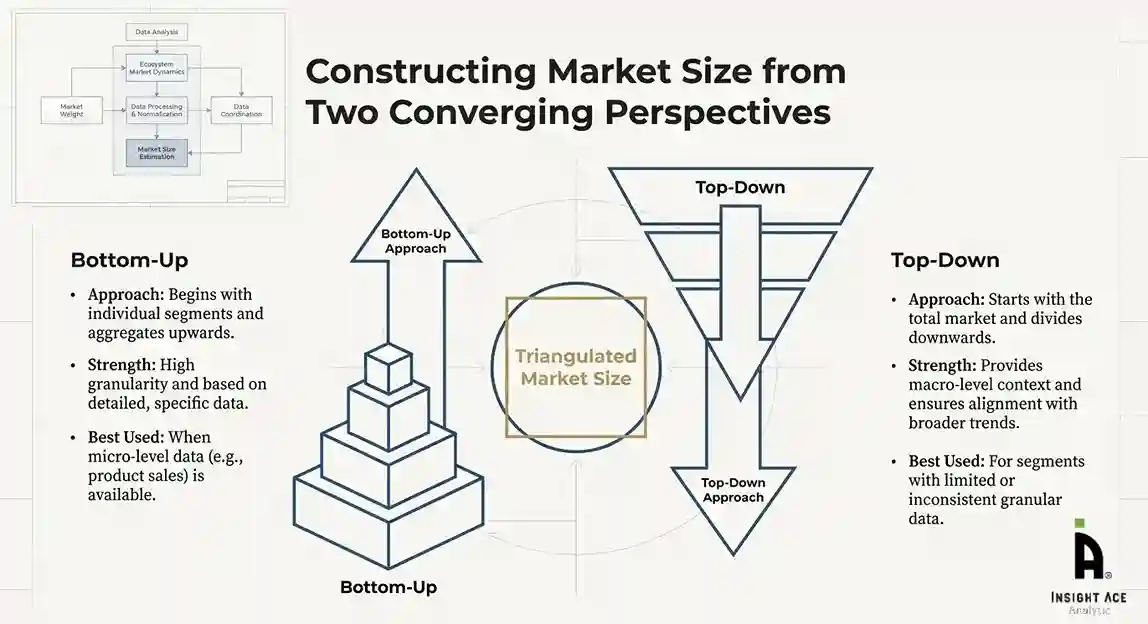
Bottom-Up Approach
The bottom-up approach involved aggregating segment-level data, such as:
- Company revenues
- Product-level sales
- Installed base/usage volumes
- Adoption and penetration rates
- Pricing analysis
This method was primarily used when detailed micro-level market data were available.
Top-Down Approach
The top-down approach used macro-level indicators:
- Parent market benchmarks
- Global/regional industry trends
- Economic indicators (GDP, demographics, spending patterns)
- Penetration and usage ratios
This approach was used for segments where granular data were limited or inconsistent.
Hybrid Triangulation Approach
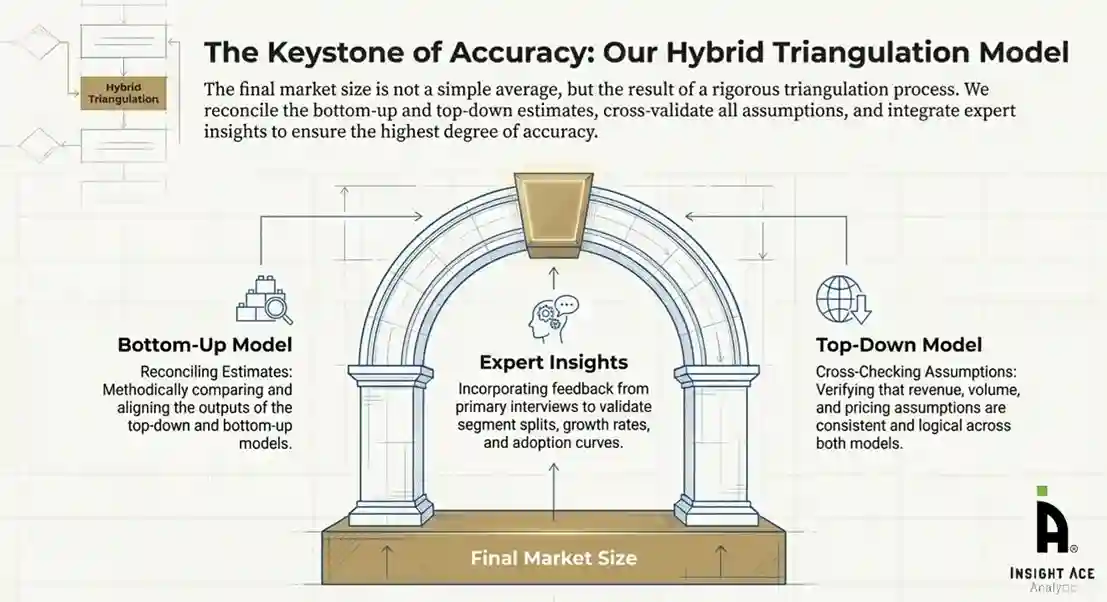
To ensure accuracy, a triangulated hybrid model was used. This included:
- Reconciling top-down and bottom-up estimates
- Cross-checking revenues, volumes, and pricing assumptions
- Incorporating expert insights to validate segment splits and adoption rates
This multi-angle validation yielded the final market size.
Forecasting Framework and Scenario Modelling
Market forecasts were developed using a combination of time-series modelling, adoption curve analysis, and driver-based forecasting tools.
Forecasting Methods
- Time-series modelling
- S-curve and diffusion models (for emerging technologies)
- Driver-based forecasting (GDP, disposable income, adoption rates, regulatory changes)
- Price elasticity models
- Market maturity and lifecycle-based projections
Scenario Analysis
Given inherent uncertainties, three scenarios were constructed:
- Base-Case Scenario: Expected trajectory under current conditions
- Optimistic Scenario: High adoption, favourable regulation, strong economic tailwinds
- Conservative Scenario: Slow adoption, regulatory delays, economic constraints
Sensitivity testing was conducted on key variables, including pricing, demand elasticity, and regional adoption.
Request Customization
Add countries, segments, company profiles, or extend forecast — free 10% customization with purchase.
Customize This Report →Enquire Before Buying
Speak with our analyst team about scope, methodology, pricing, or deliverable formats.
Enquire Now →Frequently Asked Questions
The Tattoo Needle Market Size was valued at USD 289.8 Mn in 2023 and is predicted to reach USD 403.8 Mn by 2031
The Tattoo Needle Market is estimated to grow at a 4.4% CAGR during the forecast period for 2024-2031.
Cheyenne Professional Tattoo Equipment, Bishop Rotary, Eikon Device Inc., Dragonhawk Tattoo Supply, Kwadron, Tatsoul, EZ Tattoo Supply, FK Irons, Eter