



Sustainability Certification Market is valued at USD 3.0 Bn in 2024 and is predicted to reach USD 5.9 Bn by the year 2034 at a 7.5% CAGR during the forecast period for 2025-2034.

Sustainability certification is the process by which products, services, or organizations are assessed and confirmed to meet specific environmental, social, and economic standards set by unbiased certifying bodies. Encouraging ethical conduct in areas such as resource consumption, energy efficiency, waste management, labor conditions, and community effect is the aim of these certificates. By obtaining a sustainability certification, businesses demonstrate their commitment to reducing negative environmental impacts and encouraging ethical behavior across their supply chains or operations.
The demand for sustainable and socially responsible business practices around the world is the main driver of this market's growth. Additionally, customers' growing desire for products made ethically and sustainably has raised the demand for sustainability certificates.
In addition, companies are being forced to pursue sustainability certifications due to regulatory compliance and environmental, social, and governance (ESG) considerations. The market is expanding due to rising investor demand for ESG performance. Additionally, opportunities are provided by certifications for the industry sector and the circular economy, which are enhanced by technologies like blockchain, IoT, and AI for improved traceability.
The Sustainability Certification market is segmented based on sustainability focus, application, and vertical. Based on Sustainability Focus, the market is segmented into climate impact, energy efficiency, material sustainability, and supply chain sustainability. By application, the market is divided into Energy & emissions management [renewable energy (solar, wind, hydrogen, biomass), carbon & greenhouse gas management], mobility & transportation [electric vehicle (EV) batteries, vehicle emission standards], infrastructure [green buildings, sustainable construction materials], circular economy [sustainable packaging & materials, waste management & recycling, responsible sourcing]. By Vertical, the market is divided into industrial [discrete, process], commercial, and residential.
The supply chain sustainability category is expected to hold a major global market share in 2021 because of growing consumer demand for responsible production, carbon footprint reduction, and ethical sourcing. Companies use sustainability certifications to monitor environmental performance, assess supplier practices, and ensure that standards are being followed across the supply chain, from the sourcing of raw materials to distribution. Self-reporting and manual verification were common in the past, but they fell short of real-time sustainability norms. By reducing compliance risk and enabling the automatic collection of data, online certification platforms have greatly improved tracking accuracy.
In the market for sustainability certification, the industrial category is anticipated to have the largest market share. The need for certification solutions in the manufacturing, energy, and construction sectors is being driven by the increased need to reduce carbon footprints and uphold environmental standards. In sectors such as energy, manufacturing, and construction, these certificates guarantee adherence to environmental standards. Certification procedures are becoming more efficient because of digital platforms and AI-powered solutions that automate audits, track emissions, and validate sustainability claims.
The North American Sustainability Certification market is expected to register the highest market share in revenue in the near future because its infrastructure, energy, and mobility sectors are progressively implementing certifications to adhere to strict environmental standards. Sustainability certifications are used by big businesses like Tesla and General Motors to boost their reputation and meet carbon reduction goals. Growing emphasis on renewable resources and green building operations fuels the demand for sustainability certifications to achieve resource efficiency and environmental sustainability. Rapid growth in the electric car market also fuels the need for sustainability standards to ensure ethical sourcing and lower emissions.
In addition, Asia Pacific is projected to grow rapidly in the global Sustainability Certification market due to economic expansion, industrialization, and stricter environmental laws in major nations, including Australia, South Korea, Japan, India, and China. Sustainability certifications are becoming more common as governments and businesses place more emphasis on reducing carbon emissions, improving energy efficiency, and sourcing sustainably across all industries. The region's leadership is driven by strict regulatory frameworks, growing consumer awareness, and sustainable business initiatives.
| Report Attribute | Specifications |
| Market Size Value In 2024 | USD 3.0 Bn |
| Revenue Forecast In 2034 | USD 5.9 Bn |
| Growth Rate CAGR | CAGR of 7.5% from 2025 to 2034 |
| Quantitative Units | Representation of revenue in US$ Million and CAGR from 2025 to 2034 |
| Historic Year | 2021 to 2024 |
| Forecast Year | 2025-2034 |
| Report Coverage | The forecast of revenue, the position of the company, the competitive market structure, growth prospects, and trends |
| Segments Covered | By Climate Impact, Material Sustainability, Energy & Emissions Management |
| Regional Scope | North America; Europe; Asia Pacific; Latin America; Middle East & Africa |
| Country Scope | U.S.; Canada; U.K.; Germany; China; India; Japan; Brazil; Mexico; France; Italy; Spain; South East Asia; South Korea |
| Competitive Landscape | Société Générale de Surveillance SA (SGS SA), UL LLC, Bureau Veritas, TUV NORD Group, TUV SUD, TUV Rheinland, SCS Global Services, Intertek Group plc, Element Materials Technology, DEKRA, DNV GL, LRQA Group Limited, and Control Union. |
| Customization Scope | Free customization report with the procurement of the report and modifications to the regional and segment scope. Particular Geographic competitive landscape. |
| Pricing And Available Payment Methods | Explore pricing alternatives that are customized to your particular study requirements. |
Sustainability Certification Market By Sustainability Focus-

Sustainability Certification Market By Application-
Sustainability Certification Market By Vertical-
Sustainability Certification Market By Region-
North America-
Europe-
Asia-Pacific-
Latin America-
Middle East & Africa-
This study employed a multi-step, mixed-method research approach that integrates:
This approach ensures a balanced and validated understanding of both macro- and micro-level market factors influencing the market.
Secondary research for this study involved the collection, review, and analysis of publicly available and paid data sources to build the initial fact base, understand historical market behaviour, identify data gaps, and refine the hypotheses for primary research.
Secondary data for the market study was gathered from multiple credible sources, including:
These sources were used to compile historical data, market volumes/prices, industry trends, technological developments, and competitive insights.
Primary research was conducted to validate secondary data, understand real-time market dynamics, capture price points and adoption trends, and verify the assumptions used in the market modelling.
Primary interviews for this study involved:
Interviews were conducted via:
Primary insights were incorporated into demand modelling, pricing analysis, technology evaluation, and market share estimation.
All collected data were processed and normalized to ensure consistency and comparability across regions and time frames.
The data validation process included:
This ensured that the dataset used for modelling was clean, robust, and reliable.
The bottom-up approach involved aggregating segment-level data, such as:
This method was primarily used when detailed micro-level market data were available.
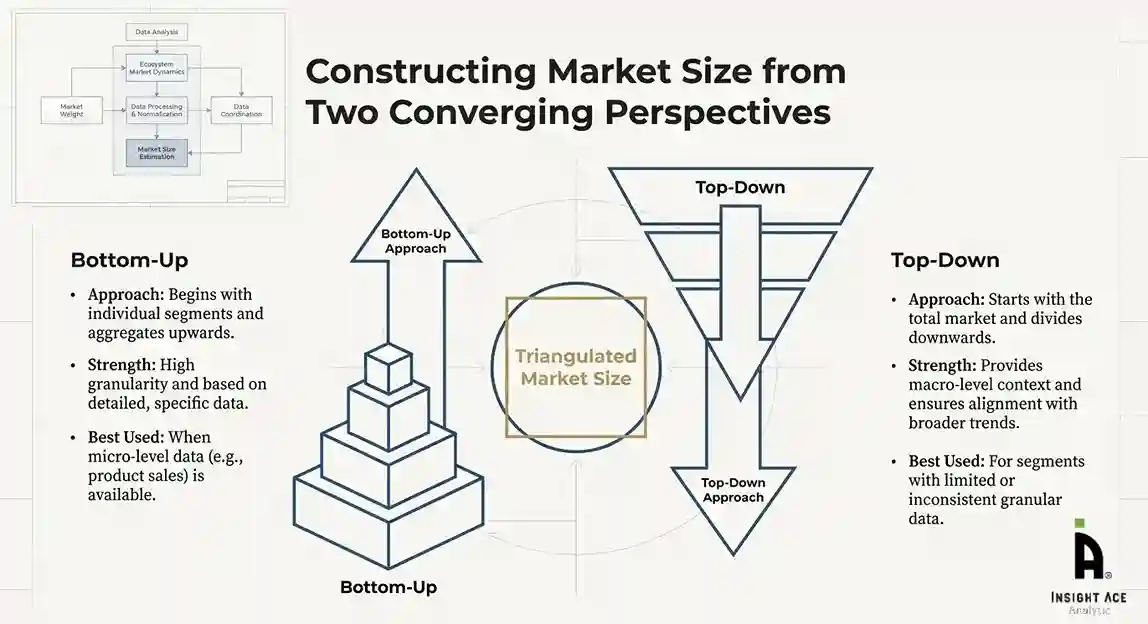
The top-down approach used macro-level indicators:
This approach was used for segments where granular data were limited or inconsistent.
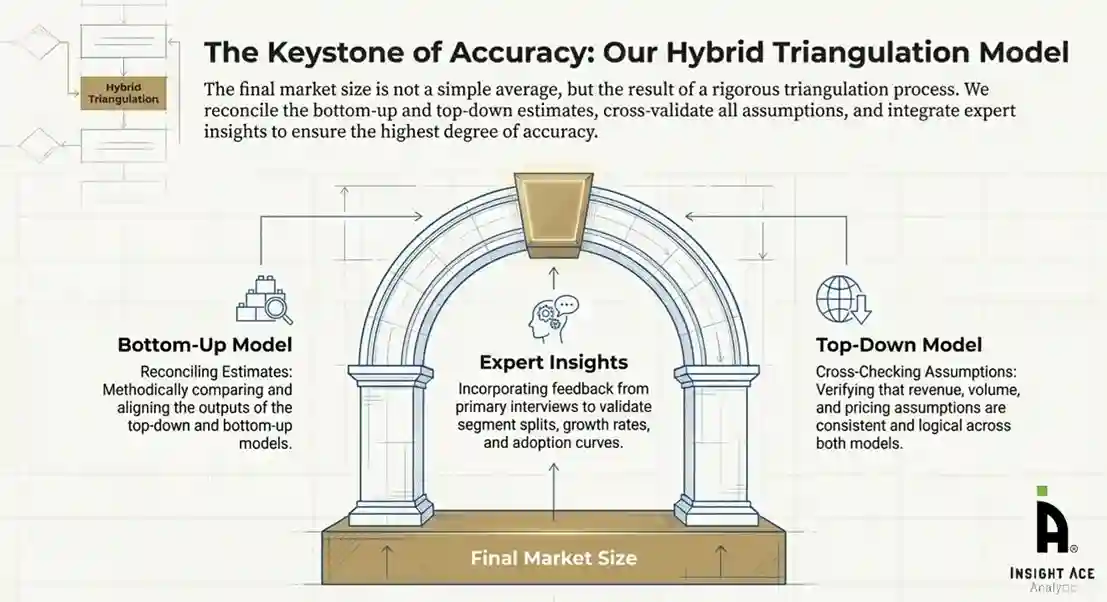
To ensure accuracy, a triangulated hybrid model was used. This included:
This multi-angle validation yielded the final market size.
Market forecasts were developed using a combination of time-series modelling, adoption curve analysis, and driver-based forecasting tools.
Given inherent uncertainties, three scenarios were constructed:
Sensitivity testing was conducted on key variables, including pricing, demand elasticity, and regional adoption.