SD-WAN and SASE Market Size, Share & Trends Analysis Distribution By Application (IT & Telecommunication, Retail, Financial Services, and Insurance (BFSI), Manufacturing, and Others), By Type (Solutions, and Services), By Deployment Mode (On-Premises, and Cloud), By Enterprise Size (Small & Medium Enterprises, and Large Enterprises) and Segment Forecasts, 2025-2034
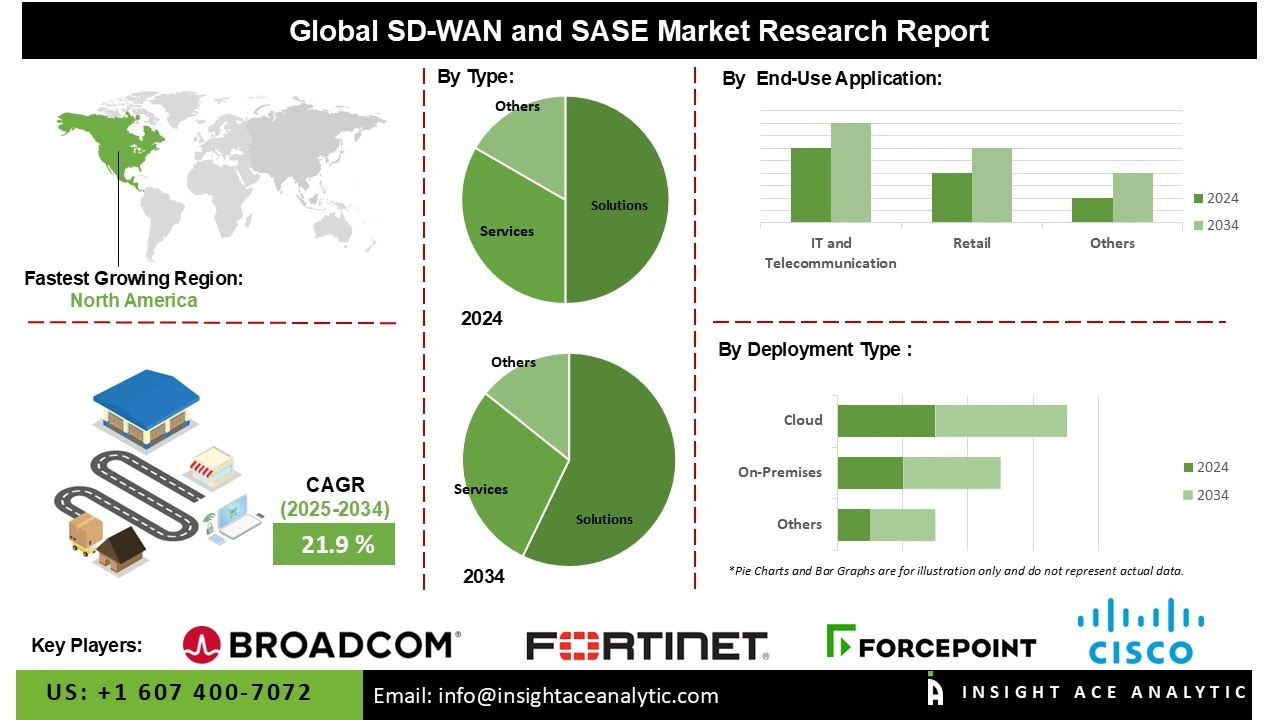
Global SD-WAN and SASE Market Size is predicted to grow at an 21.9% CAGR during the forecast period for 2025-2034.
SD-WAN optimizes connectivity across distributed networks, while SASE integrates networking and security into a unified cloud-based framework, allowing secure, scalable, and efficient access for modern enterprises. The SD-WAN and Secure Access Service Edge (SASE) market is experiencing significant growth, fueled by the rising adoption among small and medium-sized enterprises (SMEs).
SMEs are increasingly turning to cost-efficient, scalable, and secure network solutions to facilitate cloud migration, remote work, and digital transformation efforts. SD-WAN provides streamlined management and optimized bandwidth usage, while SASE combines the enhanced security capabilities of zero-trust and secure web gateways. This merging of technologies diminishes complexity and operational expense, making them extremely appealing to SMEs. The need for flexibility, improved performance, and strong cybersecurity is a major force driving SD-WAN and SASE adoption globally.
The SD-WAN and secure access service edge (SASE) market is expanding rapidly as enterprises modernize their IT infrastructures to support hybrid work models and digital transformation. A key driver is the rising adoption of cloud applications, which demand seamless, secure, and high-performance connectivity across distributed networks. Traditional WAN architectures struggle to provide efficient access to cloud-hosted services, creating demand for SD-WAN’s dynamic path selection and SASE’s integrated security framework. By delivering scalability, reduced latency, and cost efficiency, SD-WAN and SASE enable organizations to ensure secure, optimized access to business-critical cloud applications, fueling strong market growth globally.
Competitive Landscape
Some of the Key Players in the SD-WAN and SASE Market:
· Cisco Systems, Inc.
· Tata Communications
· Hewlett Packard Enterprise Development LP
· Nokia
· Broadcom Inc.
· Fortinet, Inc.
· Oracle
· Huawei Technologies Co., Ltd.
· Juniper Networks, Inc.
· Ciena Corporation
· Citrix Systems, Inc.
· Hillstone Networks
· Telefonaktiebolaget LM Ericsson
· ARYAKA NETWORKS, INC.
· Forcepoint
Market Segmentation:
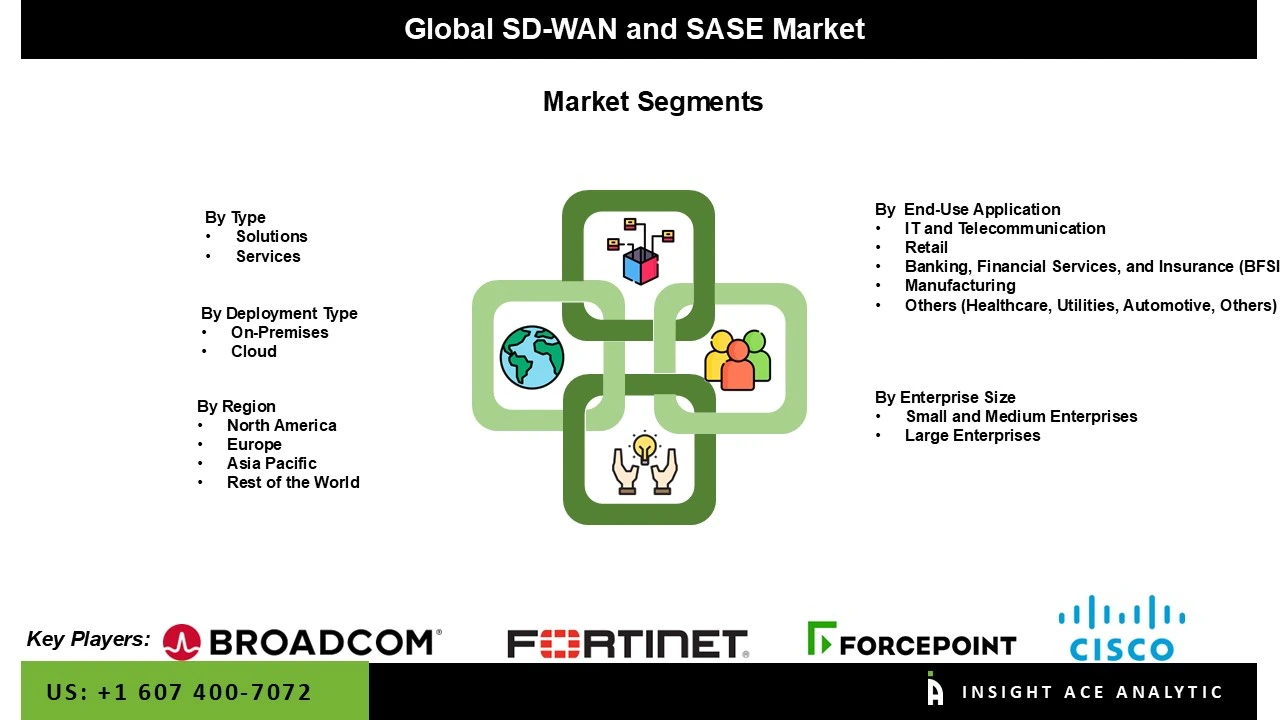
The SD-WAN and SASE market is segmented by application, type, deployment mode, and enterprise size. By application, the market is segmented into IT & telecommunication, retail, financial services, & insurance (BFSI), manufacturing, and (healthcare, utilities, automotive, others). By type, the market is segmented into solutions, and services. By deployment mode, the market is segmented into on-premises, and cloud. By enterprise size, the market is segmented into small & medium enterprises, and large enterprises.
By Type, the Solutions Segment is Expected to Drive the SD-WAN and SASE Market
In 2024, the solutions held the major market share due to the rising demand for integrated security and networking frameworks that reduce complexity while ensuring seamless connectivity across multiple locations. Organizations are adopting solutions such as Cisco SD-WAN, VMware SASE, Fortinet Secure SD-WAN, and Palo Alto Prisma Access to improve performance, optimize bandwidth, and enhance zero-trust security capabilities.
Banking, Financial Services, and Insurance (BFSI) Segment is Growing at the Highest Rate in the SD-WAN and SASE Market
The SD-WAN and SASE market is dominated by banking, financial services, & insurance (BFSI) due to the increasing need for secure, reliable, and scalable network connectivity. Financial institutions and insurance providers are embracing cloud-based software, digital banking, and remote working solutions, triggering demand for sophisticated network security and traffic optimization. Compliance with regulations, cyber threat protection, and low-latency, high-performance connectivity needs also fuel adoption, allowing BFSI companies to improve operational efficiency, customer satisfaction, and secure data transfer.
Regionally, North America Led the SD-WAN and SASE Market
North America dominates the market for SD-WAN and SASE due to region’s surge in cloud adoption, remote work, and demand for secure, flexible network solutions. Enterprises are shifting from traditional WAN to cloud-native architectures for advance scalability, performance, and cost efficiency. Rising cyber threats and regulatory compliance requirements are driving the adoption of SASE, which integrates networking and security. Additionally, the presence of leading technology vendors and advanced IT infrastructure in the region accelerates market growth.
Moreover, Europe's SD-WAN and SASE market is also fueled due to increasing need for secure, reliable, and flexible networking solutions. The expansion of remote work, cloud adoption, and digital transformation initiatives across enterprises drives need for scalable connectivity and enhanced cybersecurity. Regulatory compliance requirements, along with the requirement to reduce operational costs and optimize network performance, further accelerate adoption. Investments in cutting-edge network infrastructure and European organizations’ focus on secure cloud access are key growth drivers.
SD-WAN and SASE Market Report Scope :
Segmentation of SD-WAN and SASE Market :
SD-WAN and SASE Market by Application
· IT & Telecommunication
· Retail
· Banking, Financial Services, and Insurance (BFSI)
· Manufacturing
· Others (Healthcare, Utilities, Automotive, Others)
SD-WAN and SASE Market by Type
· Solutions
· Services
SD-WAN and SASE Market by Deployment Type
· On-Premises
· Cloud
SD-WAN and SASE Market by Enterprise Size
· Small and Medium Enterprises
· Large Enterprises
SD-WAN and SASE Market by Region
North America-
· The US
· Canada
Europe-
· Germany
· The UK
· France
· Italy
· Spain
· Rest of Europe
Asia-Pacific-
· China
· Japan
· India
· South Korea
· Southeast Asia
· Rest of Asia Pacific
Latin America-
· Brazil
· Argentina
· Mexico
· Rest of Latin America
Middle East & Africa-
· GCC Countries
· South Africa
· Rest of the Middle East and Africa
Research Design and Approach
This study employed a multi-step, mixed-method research approach that integrates:
- Secondary research
- Primary research
- Data triangulation
- Hybrid top-down and bottom-up modelling
- Forecasting and scenario analysis
This approach ensures a balanced and validated understanding of both macro- and micro-level market factors influencing the market.
Secondary Research
Secondary research for this study involved the collection, review, and analysis of publicly available and paid data sources to build the initial fact base, understand historical market behaviour, identify data gaps, and refine the hypotheses for primary research.
Sources Consulted
Secondary data for the market study was gathered from multiple credible sources, including:
- Government databases, regulatory bodies, and public institutions
- International organizations (WHO, OECD, IMF, World Bank, etc.)
- Commercial and paid databases
- Industry associations, trade publications, and technical journals
- Company annual reports, investor presentations, press releases, and SEC filings
- Academic research papers, patents, and scientific literature
- Previous market research publications and syndicated reports
These sources were used to compile historical data, market volumes/prices, industry trends, technological developments, and competitive insights.

Primary Research
Primary research was conducted to validate secondary data, understand real-time market dynamics, capture price points and adoption trends, and verify the assumptions used in the market modelling.
Stakeholders Interviewed
Primary interviews for this study involved:
- Manufacturers and suppliers in the market value chain
- Distributors, channel partners, and integrators
- End-users / customers (e.g., hospitals, labs, enterprises, consumers, etc., depending on the market)
- Industry experts, technology specialists, consultants, and regulatory professionals
- Senior executives (CEOs, CTOs, VPs, Directors) and product managers
Interview Process
Interviews were conducted via:
- Structured and semi-structured questionnaires
- Telephonic and video interactions
- Email correspondences
- Expert consultation sessions
Primary insights were incorporated into demand modelling, pricing analysis, technology evaluation, and market share estimation.
Data Processing, Normalization, and Validation
All collected data were processed and normalized to ensure consistency and comparability across regions and time frames.
The data validation process included:
- Standardization of units (currency conversions, volume units, inflation adjustments)
- Cross-verification of data points across multiple secondary sources
- Normalization of inconsistent datasets
- Identification and resolution of data gaps
- Outlier detection and removal through algorithmic and manual checks
- Plausibility and coherence checks across segments and geographies
This ensured that the dataset used for modelling was clean, robust, and reliable.
Market Size Estimation and Data Triangulation
Bottom-Up Approach
The bottom-up approach involved aggregating segment-level data, such as:
- Company revenues
- Product-level sales
- Installed base/usage volumes
- Adoption and penetration rates
- Pricing analysis
This method was primarily used when detailed micro-level market data were available.

Top-Down Approach
The top-down approach used macro-level indicators:
- Parent market benchmarks
- Global/regional industry trends
- Economic indicators (GDP, demographics, spending patterns)
- Penetration and usage ratios
This approach was used for segments where granular data were limited or inconsistent.
Hybrid Triangulation Approach
To ensure accuracy, a triangulated hybrid model was used. This included:
- Reconciling top-down and bottom-up estimates
- Cross-checking revenues, volumes, and pricing assumptions
- Incorporating expert insights to validate segment splits and adoption rates
This multi-angle validation yielded the final market size.
Forecasting Framework and Scenario Modelling
Market forecasts were developed using a combination of time-series modelling, adoption curve analysis, and driver-based forecasting tools.
Forecasting Methods
- Time-series modelling
- S-curve and diffusion models (for emerging technologies)
- Driver-based forecasting (GDP, disposable income, adoption rates, regulatory changes)
- Price elasticity models
- Market maturity and lifecycle-based projections
Scenario Analysis
Given inherent uncertainties, three scenarios were constructed:
- Base-Case Scenario: Expected trajectory under current conditions
- Optimistic Scenario: High adoption, favourable regulation, strong economic tailwinds
- Conservative Scenario: Slow adoption, regulatory delays, economic constraints
Sensitivity testing was conducted on key variables, including pricing, demand elasticity, and regional adoption.
Request Customization
Add countries, segments, company profiles, or extend forecast — free 10% customization with purchase.
Customize This Report →Enquire Before Buying
Speak with our analyst team about scope, methodology, pricing, or deliverable formats.
Enquire Now →Frequently Asked Questions
The SD-WAN and SASE market Size is predicted to expand at an 21.9% CAGR over the forecast period.
The major players in the SD-WAN and SASE market are Cisco Systems, Inc., Tata Communications, Hewlett Packard Enterprise Development LP, Nokia, Broadcom Inc., Fortinet, Inc., Oracle, Huawei Technologies Co., Ltd., Juniper Networks, Inc., Ciena Corporation, Citrix Systems, Inc., Hillstone Networks, Telefonaktiebolaget LM Ericsson, ARYAKA NETWORKS, INC., and Forcepoint.
The primary SD-WAN and SASE market segments are type, application, deployment type, enterprise size and region.
North America leads the market for SD-WAN and SASE due to growing demand for ultra-secure communication and next-generation computing solutions.