Explosion Proof Valve Market Size, Share & Trends Analysis Distribution by Type (Directional Control Valves, Pressure Control Valves and Flow Control Valves), by Operating Pressure (Low Pressure (Up to 2500 PSI), Medium Pressure (2500-4000 PSI), and High Pressure (Above 4000 PSI)), by End-use Industry (Oil & Gas, Metals & Mining, Energy & Power, Chemicals & Petrochemicals, Aerospace, Marine and Other End-use Industries), and Segment Forecasts, 2025-2034
Global Explosion Proof Valve Market is valued at US$ 1.23 Bn in 2025 and it is expected to reach US$ 1.70 Bn by 2034, with a CAGR of 3.7% during the forecast period of 2025-2034.
Explosion-proof valves are specialised safety components designed for hazardous industrial environments containing flammable gases, vapours, or combustible dust. They play a vital role in oil & gas refineries, chemical processing plants, mining operations, and petrochemical facilities by preventing sparks, excessive heat, or electrical faults that could trigger catastrophic explosions.
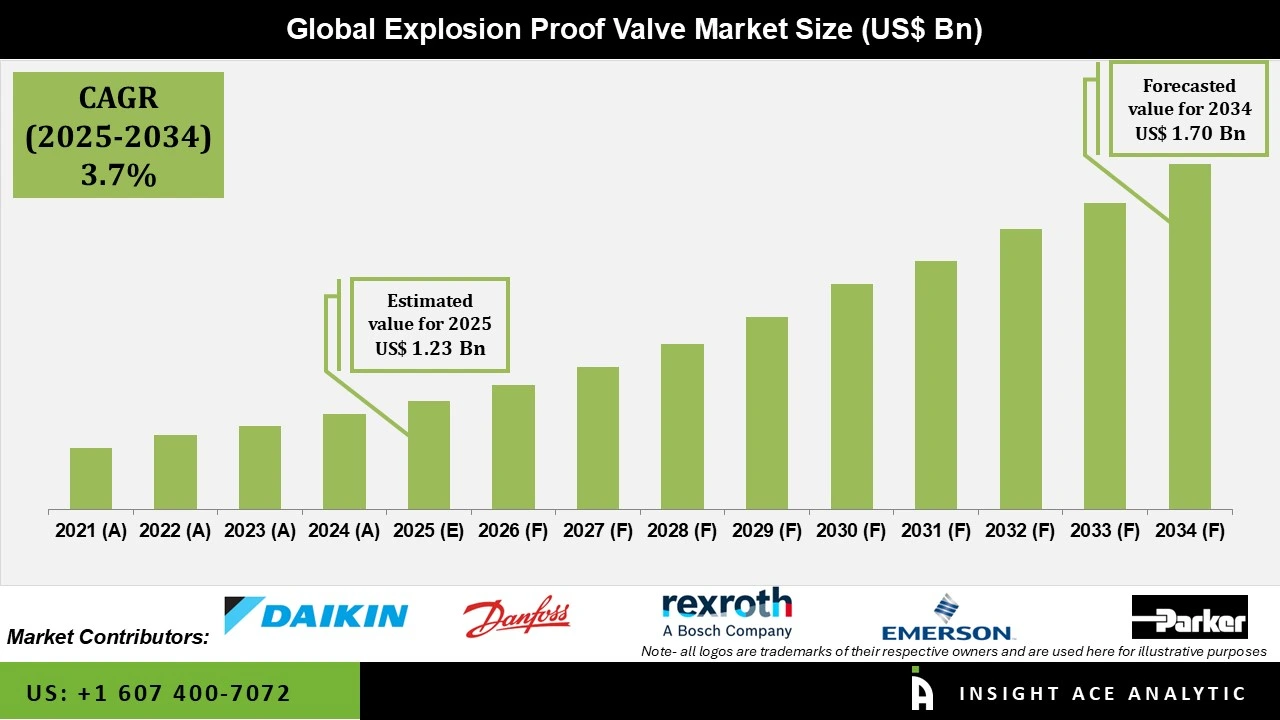
These robust valves provide secure flow control for liquids and gases in high-pressure systems, ensuring operational continuity without compromising safety. Certified to global standards like ATEX and IECEx, their durable construction makes them essential for modern industrial hazard management. The explosion-proof valve market is expanding rapidly, driven by automation advancements and escalating safety requirements across high-risk sectors.
The rising need for safe fluid control in dangerous industries drives market growth. Over 350 million tons of hazardous waste were generated worldwide in 2023, highlighting the scale of risk management required. New innovations like digital monitoring, smart pressure controls, and IoT integration expand valve capabilities. Stricter safety regulations and growing industrial automation push companies to upgrade to explosion-proof systems. These factors create strong, steady demand across high-risk sectors.
High costs remain the biggest barrier. Specialised materials, rigorous certification (ATEX, IECEx), and precision engineering make explosion-proof valves expensive and challenging for smaller plants. However, opportunities are growing in extreme applications like high-temperature processing and underwater mining. Demand for custom valves in hydrogen plants, LNG facilities, and deep-sea operations is surging. As safety standards tighten globally and manufacturing costs decline, the market will expand into new high-value segments.
Competitive Landscape
Some of the Key Players in the Explosion-Proof Valve Market:
- Parker Hannifin Corp
- Bosch Rexroth AG
- Danfoss
- Daikin Industries, Ltd.
- Emerson Electric Co.
- Dana Limited
- Kawasaki Heavy Industries, Ltd.
- Moog Inc.
- Rotork PLC
- Bucher Industries AG
- Yuken Kogyo Co., Ltd.
- Hawe Hydraulik SE
- Hydac International GmBH.
- Argo-Hytos Group AG
- Atos SPA
Market Segmentation:
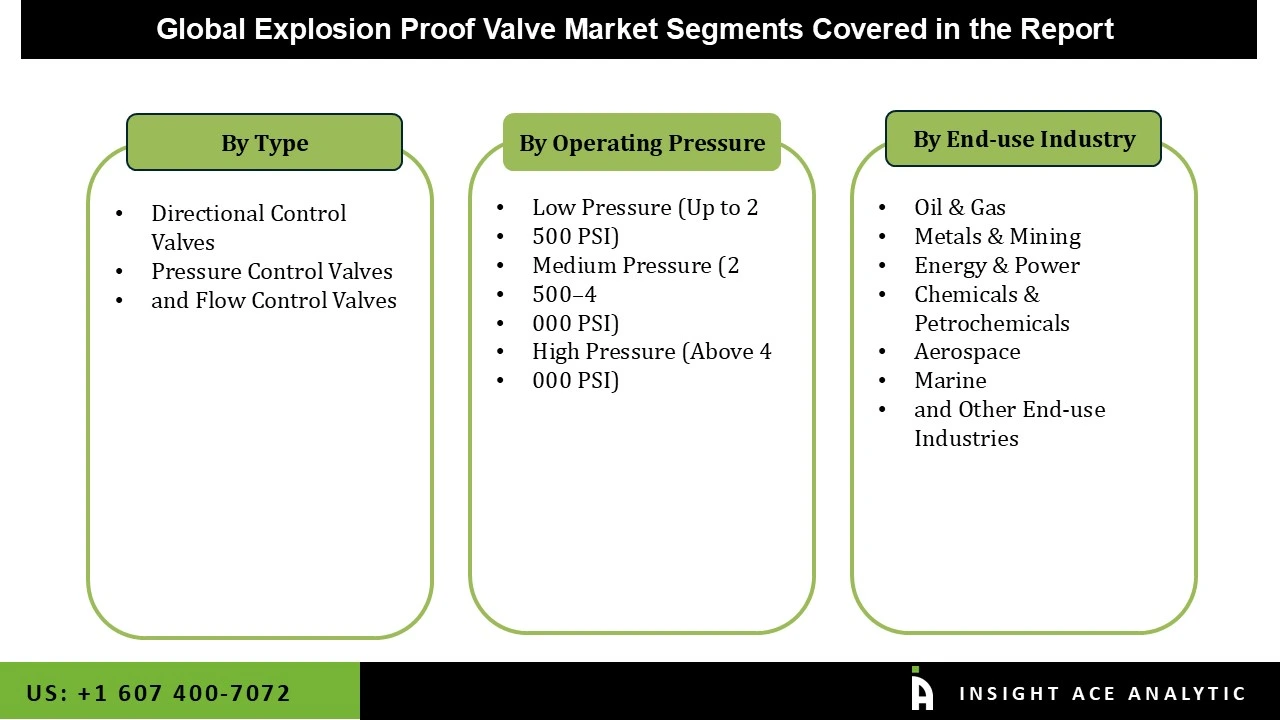
The explosion proof valve market is segmented by type, operating pressure, and end-use industry. By type, the market is segmented into directional control valves, pressure control valves and flow control valves. By operating pressure, the market is segmented into low pressure (up to 2500 psi), medium pressure (2500-4000 psi), and high pressure (above 4000 psi). By end-use industry, the market is segmented into oil & gas, metals & mining, energy & power, chemicals & petrochemicals, aerospace, marine and other end-use industries.
By Type, the Directional Control Valves Segment is expected to drive the explosion-proof valve Market.
The Directional Control Valves category led the Explosion Proof Valve market in 2024. This convergence is due to its crucial function in controlling fluid routes in hazardous situations, such as directional control valves. They are the most commonly used type because of their dependability, versatility across many applications, and significance in guaranteeing safe system operations. Industries that prioritise operational safety and precision control under strict compliance standards contribute to the demand.
Oil & Gas Segment by End-use Industry is Growing at the Highest Rate in the Explosion-Proof Valve Market
The largest and fastest-growing End-use Industry is Oil & Gas, a trend driven by its substantial activities in hazardous and high-risk areas. Strong demand is maintained by the industry's requirement for dependable flow control, strict adherence to safety regulations, and continuous production cycles. Its dominant position in adoption is further reinforced by ongoing exploration efforts and infrastructural investment.
Regionally, North America is leading the explosion-proof valve Market.
North America dominated the explosion-proof valve market in 2024, with the United States serving as the primary catalyst for growth. Rigorous safety standards in the mining, chemical, and oil and gas industries generate substantial demand for certified equipment. Organizations are required to utilize ATEX/IECEx-compliant valves to adhere to compliance regulations. Large refineries, shale gas initiatives, and sophisticated manufacturing plants guarantee consistent and dependable demand. This regulated environment confers upon North America the largest market share.
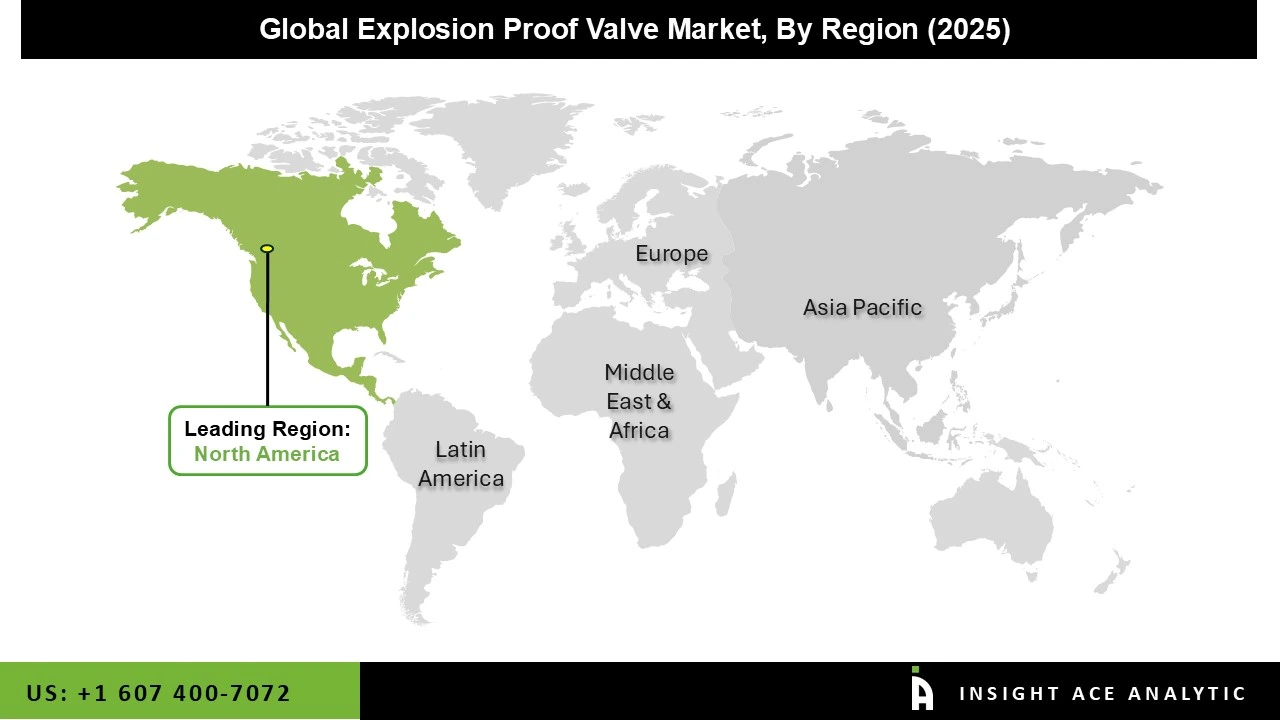
Asia-Pacific represents the most rapidly expanding market for explosion-proof valves, attributable to swift industrial development. Significant expansions in power generation, chemical manufacturing, and hydrocarbon refining capacities necessitate the use of certified safety equipment. Governments are implementing more rigorous safety regulations, while multinational corporations require systems that adhere to international standards. This combination propels dynamic regional development.
Recent Developments:
- November 2024: Hydman was purchased by Bucher Industries AG (Switzerland) through its subsidiary Bucher Hydraulics GmbH. Bucher Hydraulics GmbH's position in the Nordics is strengthened by this acquisition, which also makes it possible for the business to assist local clients even more closely. The company will be able to provide more creative system-based solutions and enhance its overall service offering throughout Europe by fusing Bucher's worldwide skills with Hydman's knowledge.
Explosion Proof Valve Market Report Scope :
Segmentation of Explosion Proof Valve Market :
Explosion Proof Valve Market by Type-
· Directional Control Valves
· Pressure Control Valves
· Flow Control Valves
Explosion Proof Valve Market by Operating Pressure-
· Low Pressure (Up to 200 PSI)
· Medium Pressure (2500-4000 PSI)
· High Pressure (Above 4000 PSI)
Explosion Proof Valve Market by End-use Industry-
· Oil & Gas
· Metals & Mining
· Energy & Power
· Chemicals & Petrochemicals
· Aerospace
· Marine
· Other End-use Industries
Explosion Proof Valve Market by Region-
North America-
· The US
· Canada
Europe-
· Germany
· The UK
· France
· Italy
· Spain
· Rest of Europe
Asia-Pacific-
· China
· Japan
· India
· South Korea
· Southeast Asia
· Rest of Asia Pacific
Latin America-
· Brazil
· Argentina
· Mexico
· Rest of Latin America
Middle East & Africa-
· GCC Countries
· South Africa
· Rest of the Middle East and Africa
Research Design and Approach
This study employed a multi-step, mixed-method research approach that integrates:
- Secondary research
- Primary research
- Data triangulation
- Hybrid top-down and bottom-up modelling
- Forecasting and scenario analysis
This approach ensures a balanced and validated understanding of both macro- and micro-level market factors influencing the market.
Secondary Research
Secondary research for this study involved the collection, review, and analysis of publicly available and paid data sources to build the initial fact base, understand historical market behaviour, identify data gaps, and refine the hypotheses for primary research.
Sources Consulted
Secondary data for the market study was gathered from multiple credible sources, including:
- Government databases, regulatory bodies, and public institutions
- International organizations (WHO, OECD, IMF, World Bank, etc.)
- Commercial and paid databases
- Industry associations, trade publications, and technical journals
- Company annual reports, investor presentations, press releases, and SEC filings
- Academic research papers, patents, and scientific literature
- Previous market research publications and syndicated reports
These sources were used to compile historical data, market volumes/prices, industry trends, technological developments, and competitive insights.

Primary Research
Primary research was conducted to validate secondary data, understand real-time market dynamics, capture price points and adoption trends, and verify the assumptions used in the market modelling.
Stakeholders Interviewed
Primary interviews for this study involved:
- Manufacturers and suppliers in the market value chain
- Distributors, channel partners, and integrators
- End-users / customers (e.g., hospitals, labs, enterprises, consumers, etc., depending on the market)
- Industry experts, technology specialists, consultants, and regulatory professionals
- Senior executives (CEOs, CTOs, VPs, Directors) and product managers
Interview Process
Interviews were conducted via:
- Structured and semi-structured questionnaires
- Telephonic and video interactions
- Email correspondences
- Expert consultation sessions
Primary insights were incorporated into demand modelling, pricing analysis, technology evaluation, and market share estimation.
Data Processing, Normalization, and Validation
All collected data were processed and normalized to ensure consistency and comparability across regions and time frames.
The data validation process included:
- Standardization of units (currency conversions, volume units, inflation adjustments)
- Cross-verification of data points across multiple secondary sources
- Normalization of inconsistent datasets
- Identification and resolution of data gaps
- Outlier detection and removal through algorithmic and manual checks
- Plausibility and coherence checks across segments and geographies
This ensured that the dataset used for modelling was clean, robust, and reliable.
Market Size Estimation and Data Triangulation
Bottom-Up Approach
The bottom-up approach involved aggregating segment-level data, such as:
- Company revenues
- Product-level sales
- Installed base/usage volumes
- Adoption and penetration rates
- Pricing analysis
This method was primarily used when detailed micro-level market data were available.

Top-Down Approach
The top-down approach used macro-level indicators:
- Parent market benchmarks
- Global/regional industry trends
- Economic indicators (GDP, demographics, spending patterns)
- Penetration and usage ratios
This approach was used for segments where granular data were limited or inconsistent.
Hybrid Triangulation Approach
To ensure accuracy, a triangulated hybrid model was used. This included:
- Reconciling top-down and bottom-up estimates
- Cross-checking revenues, volumes, and pricing assumptions
- Incorporating expert insights to validate segment splits and adoption rates
This multi-angle validation yielded the final market size.
Forecasting Framework and Scenario Modelling
Market forecasts were developed using a combination of time-series modelling, adoption curve analysis, and driver-based forecasting tools.
Forecasting Methods
- Time-series modelling
- S-curve and diffusion models (for emerging technologies)
- Driver-based forecasting (GDP, disposable income, adoption rates, regulatory changes)
- Price elasticity models
- Market maturity and lifecycle-based projections
Scenario Analysis
Given inherent uncertainties, three scenarios were constructed:
- Base-Case Scenario: Expected trajectory under current conditions
- Optimistic Scenario: High adoption, favourable regulation, strong economic tailwinds
- Conservative Scenario: Slow adoption, regulatory delays, economic constraints
Sensitivity testing was conducted on key variables, including pricing, demand elasticity, and regional adoption.
Request Customization
Add countries, segments, company profiles, or extend forecast — free 10% customization with purchase.
Customize This Report →Enquire Before Buying
Speak with our analyst team about scope, methodology, pricing, or deliverable formats.
Enquire Now →Frequently Asked Questions
Global Explosion Proof Valve Market is valued at US$ 1.23 Bn in 2024 and it is expected to reach US$ 1.70 Bn by 2034, with a CAGR of 3.7% during the forecast period of 2025-2034..
The major players in the Explosion Proof Valve market are Parker Hannifin Corp, Bosch Rexroth AG, Danfoss, Daikin Industries, Ltd., Emerson Electric Co., Dana Limited, Kawasaki Heavy Industries, Ltd., Moog Inc., Rotork PLC, Bucher Industries AG, Yuken Kogyo Co., Ltd., Hawe Hydraulik SE, Hydac International GmBH., Argo-Hytos Group AG, and Atos SPA.
The primary Explosion Proof Valve market segments are Type, Operating Pressure, and End-use Industry.
North America leads the market for Explosion Proof Valve due to the widespread use of smartphones and the advanced healthcare system.