Solar Energy Storage Market Size, Share & Trends Analysis Report By Composition (Lead-Acid, Lithium-on), By Capacity (?50 kw, 51 to 250kw, 251 to 500kw, 501 to 1000kw, 1001 to 2500kw, 2501 to 5000kw, 5001 to 10000kw, >100000), By Installation, By Application, By Region, And By Segment Forecasts, 2025-2034

Report Id: 2083 Pages: 180 Last Updated: 14 May 2025 Format: PDF / PPT / Excel / Power BI
Share With : linkedin twitter facebook

Global Solar Energy Storage Market Size is valued at USD 93.3 Bn in 2024 and is predicted to reach USD 475.3 Bn by the year 2034 at a 17.8% CAGR during the forecast period for 2025-2034.

The process of collecting and storing energy generated by solar panels or solar photovoltaic (PV) systems for later use is referred to as solar energy storage. Solar energy is a renewable & sustainable, and environment-friendly energy source, although it is intermittent and is affected by weather and time of day. Solar energy storage systems are intended to solve this intermittent nature by storing extra energy when the sun shines and making it available for use when the sun is not producing electricity, such as at night or on cloudy days.

Solar Energy Storage Market

The forthcoming years are expected to influence the energy storage market due to the progression of the renewable energy domain, favourable government policies and programs for energy storage systems (ESS), and improved economics of energy storage. 

However, a potential impediment to market growth soon is the discord between the demand and supply of essential raw materials like cobalt, lithium, and graphite.

Additionally, in the (C&I) sector, the adoption of renewable energy sources for powering buildings is rising. Yet, the intermittency of renewable energy poses reliability challenges for the C&I sector's energy needs, leading to underutilizing these resources. This trend is likely to drive the increased adoption of energy storage systems within the C&I sector, aiming to enhance the integration of renewable energy. This shift creates substantial opportunities for energy storage system providers in the forthcoming times.

Competitive Landscape

Some Major Key Players In The Solar Energy Storage Market:

  • Samsung SDI Co Ltd
  • ABB
  • General Electric Company
  • Tesla, Inc
  • AEG Power Solutions
  • eSolar Inc.
  • Abengoa S.A.
  • BrightSource Energy, Inc.
  • ACCIONA, S.A. (Spain)
  • EVERGREEN SOLAR INC.
  • Alpha Technologies
  • Solor Poer Rocks LLC
  • Helio power
  • MA Solar Technology
  • SolarEdge Technologies,
  • Primus Power,
  • Maxwell Technologies,
  • Siemens Energy,
  • Schneider Electric
  • LG Electronics,
  • Leclanché,
  • EnerSys,
  • Fluence,
  • Saft,
  • Uniper,
  • Johnson Controls,
  • Honeywell International,
  • Toshiba Corporation
  • Huawei Technologies
  • Others

Recent Developments:

  • In July 2022, GE Vernova's Solar & Storage Solutions division and Fortune Electric entered into a Memorandum of Understanding (MoU) with the objective of providing Battery Energy Storage System solutions in Taiwan. The activation of Taiwan's energy storage sector was facilitated by the contributions of GE Vernova and Fortune Electric, hence facilitating the provision of cleaner energy to the population of 23 Bn individuals in the region.
  • In Sept. 2021, Fluence and ESB recently disclosed their collaboration on a project involving the implementation of an energy storage system in several locations in Europe. The project consists of two facilities, one with a capacity of 75 MW and a storage capacity of 150 MWh, situated at ESB's plant at Poolbeg, Dublin. The second facility, located in South Wall, Dublin, has a capacity of 30 MW and a storage capacity of 60 MWh. This project facilitated the company in broadening its project pipeline and bolstering its market standing within the solar energy storage industry.

Market Segmentation:

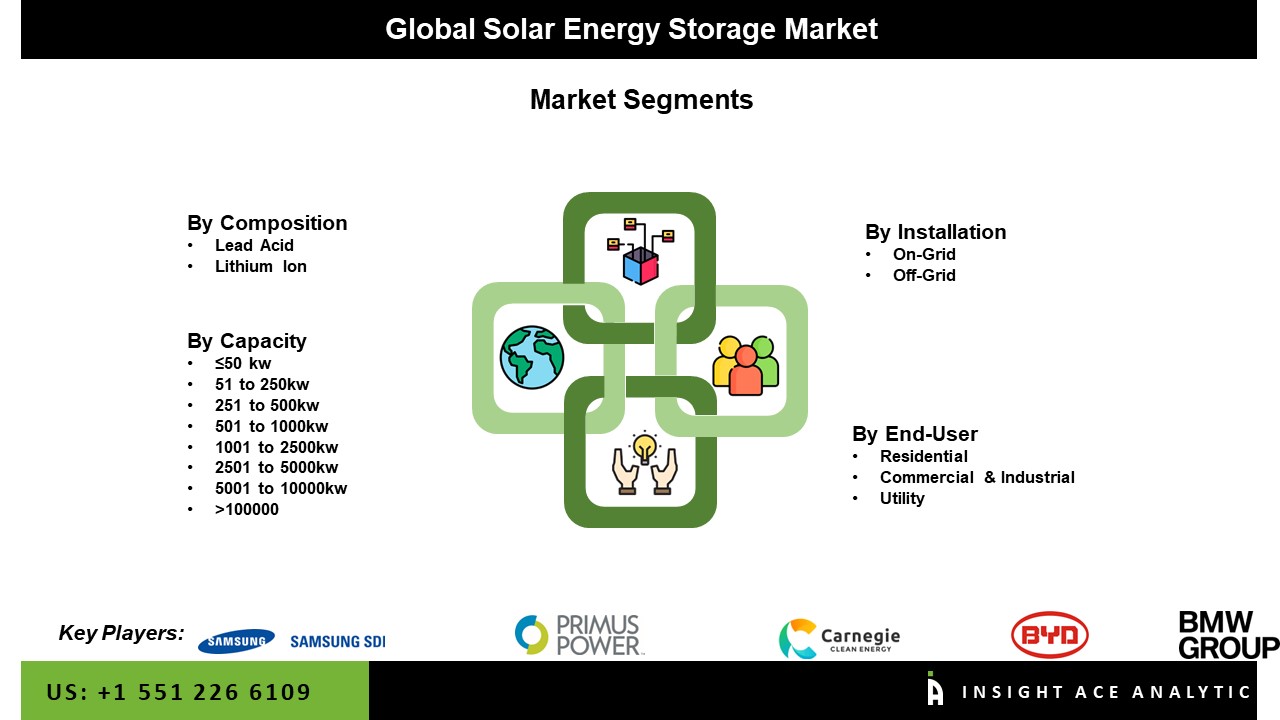
The solar energy storage market is segmented based On Composition, Capacity, Installation And Application. Based on composition, the solar energy storage market is segmented as lead-acid and lithium-ion. By capacity, the solar energy storage market is segmented into 100000. By installation, the market is segmented into off-grid and on-grid. The market is segmented by Applicaiton into residential, commercial, industrial, and utility.

Based On Installations, The Off-Grid Segment Is A Major Contributor To The Solar Energy Storage Market. 

The off-grid category will hold a major share of the global solar energy storage market. Functioning autonomously from the main grid and equipped with solar power-storing batteries, these systems possess characteristics that make them well-suited for remote locations, providing electricity to rural areas, offering cost-effective solutions, and ensuring power backup capabilities. These attributes collectively contribute to the favourable expansion of the global market.

The Lead-Acid Segment Witnessed Growth At A Rapid Rate.

The lead-acid segment is projected to grow rapidly in the global Solar Energy Storage market. This battery comprises a porous lead negative electrode for formation and dissolution alongside a lead oxide positive electrode. It operates based on the earliest rechargeable battery technology and finds multiple uses, including power storage systems and serving as the ignition power source for vehicles. Its popularity stems from its affordability, capacity for handling significant currents, resilience to adverse conditions, and ability to withstand overcharging. As a result of these characteristics, the market demand for this battery type is exceptionally high.

The North America Solar Energy Storage Market Holds A Significant Regional Revenue Share.

The North American solar energy storage market is expected to register the highest market share. Some countries are building essential infrastructure networks and contend with unreliable or constrained power grids. In parallel, swift population expansion and urbanization are notable trends in the developing regions, leading to an escalated demand for electricity. In addition, Asia Pacific is estimated to grow rapidly in the global Solar Energy Storage market. Within this region, two primary categories of power grids exist, each possessing distinct attributes and prospects for energy storage systems, along with other major urban centres boasting sophisticated grids that effectively leverage cutting-edge technologies.

Solar Energy Storage Market Report Scope

Report Attribute Specifications
Market Size Value In 2024 USD 93.3 Bn
Revenue Forecast In 2034 USD 475.3 Bn
Growth Rate CAGR CAGR of 17.8% from 2025 to 2034
Quantitative Units Representation of revenue in US$ Bn and CAGR from 2025 to 2034
Historic Year 2021 to 2024
Forecast Year 2025-2034
Report Coverage The forecast of revenue, the position of the company, the competitive market structure, growth prospects, and trends
Segments Covered By Composition, By Capacity, By Installation, By Application
Regional Scope North America; Europe; Asia Pacific; Latin America; Middle East & Africa
Country Scope U.S.; Canada; U.K.; Germany; China; India; Japan; Brazil; Mexico; France; Italy; Spain; South Korea; South East Asia
Competitive Landscape Samsung SDI Co Ltd, ABB, General Electric Company, Tesla, Inc, AEG Power Solutions, eSolar Inc., Abengoa S.A., BrightSource Energy, Inc., ACCIONA, S.A. (Spain), EVERGREEN SOLAR INC., Alpha Technologies, Solor Poer Rocks LLC, Helio power, MA Solar Technology, SolarEdge Technologies, Primus Power,Maxwell Technologies, Siemens Energy, Schneider Electric, LG Electronics, Leclanché, EnerSys, Fluence, Saft, Uniper, Johnson Controls, Honeywell International, Toshiba Corporation, Huawei Technologies, and Others
Customization Scope Free customization report with the procurement of the report, Modifications to the regional and segment scope. Particular Geographic competitive landscape.
Pricing And Available Payment Methods Explore pricing alternatives that are customized to your particular study requirements.

Segmentation of Solar Energy Storage Market-

Solar Energy Storage Market By Composition

  • Lead-Acid
  • Lithium-Ion

Solar Energy Storage Market Seg

Solar Energy Storage Market By Capacity

  • ≤50 kw
  • 51 to 250kw
  • 251 to 500kw
  • 501 to 1000kw
  • 1001 to 2500kw
  • 2501 to 5000kw
  • 5001 to 10000kw
  • >100000

Solar Energy Storage Market By Installation

  • Off-grid
  • On-grid

Solar Energy Storage Market By Application

  • Residential
  • Industrial & Commercial
  • Utility

Solar Energy Storage Market By Region-

North America-

  • The US
  • Canada

Europe-

  • Germany
  • The UK
  • France
  • Italy
  • Spain
  • Rest of Europe

Asia-Pacific-

  • China
  • Japan
  • India
  • South Korea
  • Southeast Asia
  • Rest of Asia Pacific

Latin America-

  • Brazil
  • Mexico
  • Argentina
  • Rest of Latin America

 Middle East & Africa-

  • GCC Countries
  • South Africa
  • Rest of Middle East and Africa

Need specific information/chapter from the report of the custom data table, graph or complete report? Tell us more.

Research Design and Approach

This study employed a multi-step, mixed-method research approach that integrates:

  • Secondary research
  • Primary research
  • Data triangulation
  • Hybrid top-down and bottom-up modelling
  • Forecasting and scenario analysis

This approach ensures a balanced and validated understanding of both macro- and micro-level market factors influencing the market.

Secondary Research

Secondary research for this study involved the collection, review, and analysis of publicly available and paid data sources to build the initial fact base, understand historical market behaviour, identify data gaps, and refine the hypotheses for primary research.

Sources Consulted

Secondary data for the market study was gathered from multiple credible sources, including:

  • Government databases, regulatory bodies, and public institutions
  • International organizations (WHO, OECD, IMF, World Bank, etc.)
  • Commercial and paid databases
  • Industry associations, trade publications, and technical journals
  • Company annual reports, investor presentations, press releases, and SEC filings
  • Academic research papers, patents, and scientific literature
  • Previous market research publications and syndicated reports

These sources were used to compile historical data, market volumes/prices, industry trends, technological developments, and competitive insights.
Secondary Research

Primary Research

Primary research was conducted to validate secondary data, understand real-time market dynamics, capture price points and adoption trends, and verify the assumptions used in the market modelling.

Stakeholders Interviewed

Primary interviews for this study involved:

  • Manufacturers and suppliers in the market value chain
  • Distributors, channel partners, and integrators
  • End-users / customers (e.g., hospitals, labs, enterprises, consumers, etc., depending on the market)
  • Industry experts, technology specialists, consultants, and regulatory professionals
  • Senior executives (CEOs, CTOs, VPs, Directors) and product managers

Interview Process

Interviews were conducted via:

  • Structured and semi-structured questionnaires
  • Telephonic and video interactions
  • Email correspondences
  • Expert consultation sessions

Primary insights were incorporated into demand modelling, pricing analysis, technology evaluation, and market share estimation.

Data Processing, Normalization, and Validation

All collected data were processed and normalized to ensure consistency and comparability across regions and time frames.

The data validation process included:

  • Standardization of units (currency conversions, volume units, inflation adjustments)
  • Cross-verification of data points across multiple secondary sources
  • Normalization of inconsistent datasets
  • Identification and resolution of data gaps
  • Outlier detection and removal through algorithmic and manual checks
  • Plausibility and coherence checks across segments and geographies

This ensured that the dataset used for modelling was clean, robust, and reliable.

Market Size Estimation and Data Triangulation

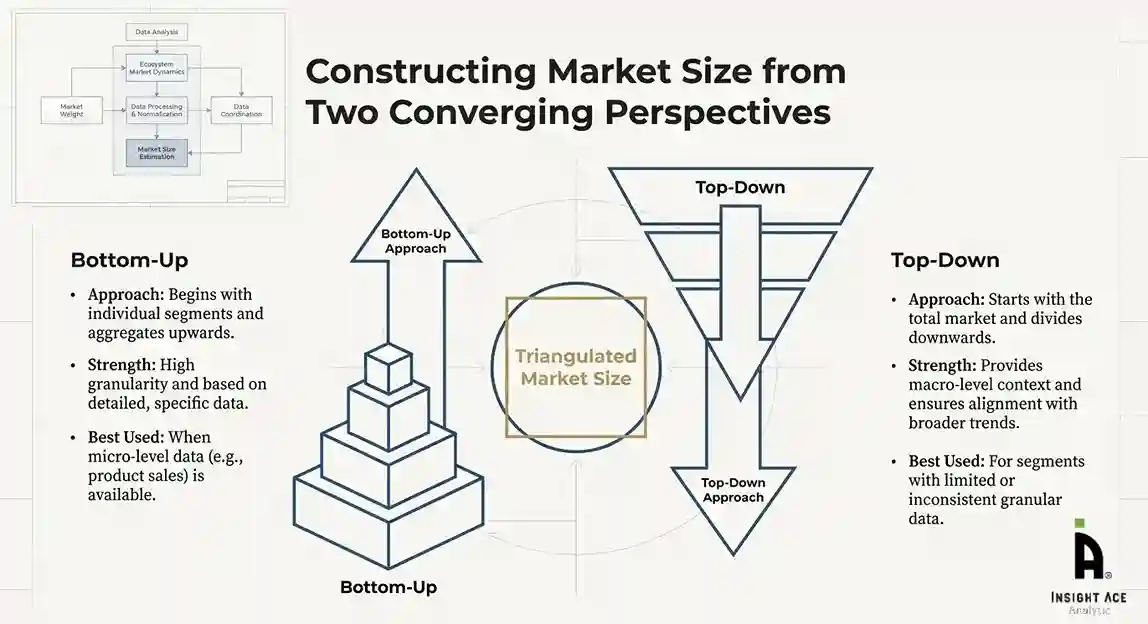
Bottom-Up Approach

The bottom-up approach involved aggregating segment-level data, such as:

  • Company revenues
  • Product-level sales
  • Installed base/usage volumes
  • Adoption and penetration rates
  • Pricing analysis

This method was primarily used when detailed micro-level market data were available.
Bottom Up Approach

Top-Down Approach

The top-down approach used macro-level indicators:

  • Parent market benchmarks
  • Global/regional industry trends
  • Economic indicators (GDP, demographics, spending patterns)
  • Penetration and usage ratios

This approach was used for segments where granular data were limited or inconsistent.

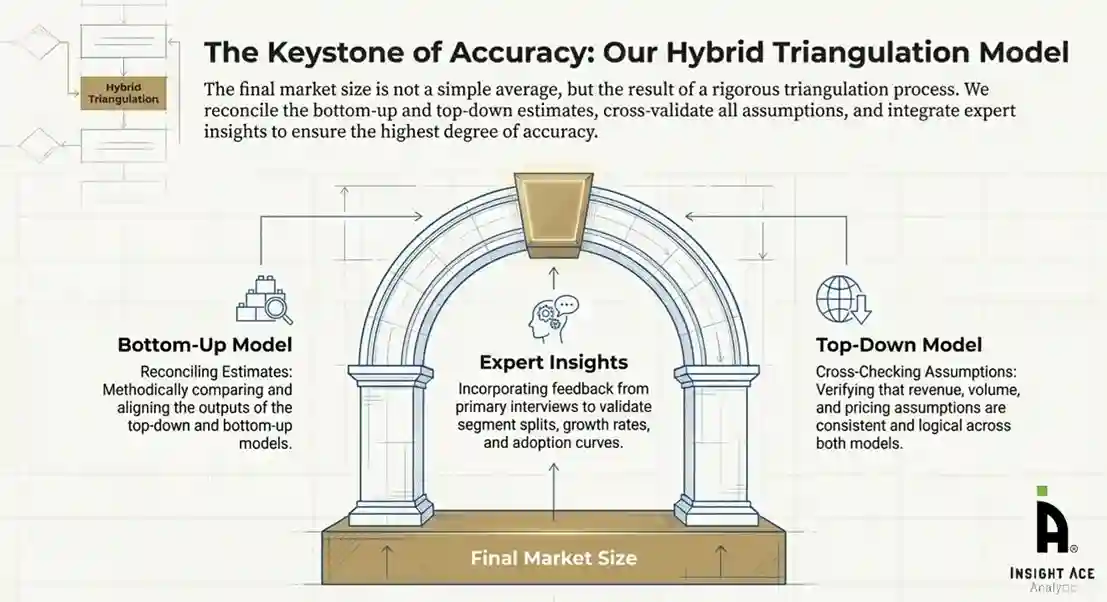
Hybrid Triangulation Approach

To ensure accuracy, a triangulated hybrid model was used. This included:

  • Reconciling top-down and bottom-up estimates
  • Cross-checking revenues, volumes, and pricing assumptions
  • Incorporating expert insights to validate segment splits and adoption rates

This multi-angle validation yielded the final market size.

Forecasting Framework and Scenario Modelling

Market forecasts were developed using a combination of time-series modelling, adoption curve analysis, and driver-based forecasting tools.

Forecasting Methods

  • Time-series modelling
  • S-curve and diffusion models (for emerging technologies)
  • Driver-based forecasting (GDP, disposable income, adoption rates, regulatory changes)
  • Price elasticity models
  • Market maturity and lifecycle-based projections

Scenario Analysis

Given inherent uncertainties, three scenarios were constructed:

  • Base-Case Scenario: Expected trajectory under current conditions
  • Optimistic Scenario: High adoption, favourable regulation, strong economic tailwinds
  • Conservative Scenario: Slow adoption, regulatory delays, economic constraints

Sensitivity testing was conducted on key variables, including pricing, demand elasticity, and regional adoption.


Name field cannot be blank!
Email field cannot be blank!(Use email format)
Designation field cannot be blank!
Company field cannot be blank!
Contact No field cannot be blank!
Message field cannot be blank!
2653
Security Code field cannot be blank!

Frequently Asked Questions

Global Solar Energy Storage Market Size is valued at USD 93.3 Bn in 2024 and is predicted to reach USD 475.3 Bn by the year 2034

Global Solar Energy Storage Market is expected to grow at a 17.8% CAGR during the forecast period for 2025-2034

Schneider Electric, LG Electronics, Leclanché, EnerSys, Fluence, Saft, Uniper, Johnson Controls, Honeywell International, Toshiba Corporation, Huawei

Composition, Capacity, Installation, and Application are the key segments of the Solar Energy Storage Market.

North American region is leading the Solar Energy Storage Market.
Get Sample Report Enquiry Before Buying