Single-Cell Bioinformatics Software and Services Market Size, Share & Trends Analysis Report By Product, By Application (Oncology, Immunology, Neurology, Non-invasive Prenatal Diagnosis (NIPD), Microbiology, Other Applications), By End-User, By Region, And By Segment Forecasts, 2025-2034

Report Id: 1347 Pages: 185 Last Updated: 14 May 2025 Format: PDF / PPT / Excel / Power BI
Share With : linkedin twitter facebook

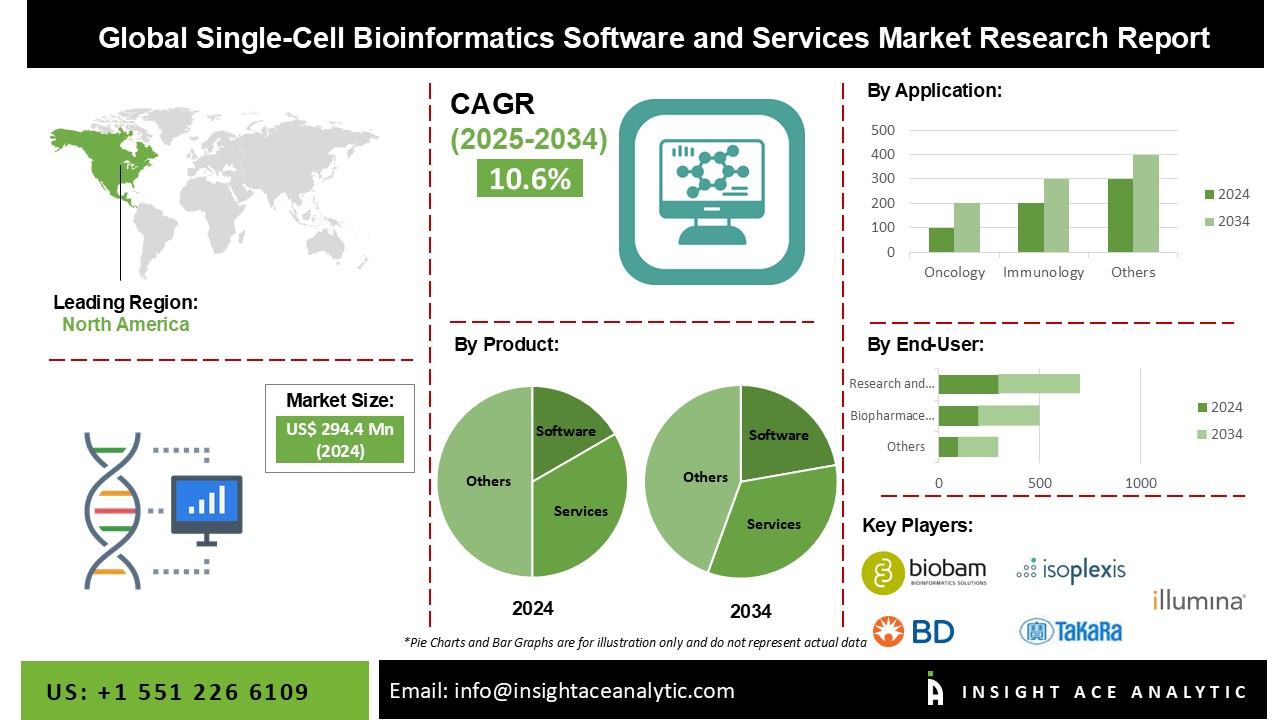
Global Single-Cell Bioinformatics Software and Services Market Size is valued at USD 294.4 Million in 2024 and is predicted to reach USD 802.8 Million by the year 2034 at a 10.6% CAGR during the forecast period for 2025-2034.

Key Industry Insights & Findings from the Report:

  • Government and private investments in life sciences research, particularly in areas related to understanding complex biological systems at the single-cell level, are contributing to the growth of the market.
  • Bioinformatics platforms that facilitate the integration and analysis of multi-omics data at the single-cell level are in high demand, driving market growth.
  • North America dominated the market and accounted for a global revenue share in 2024.
  • With the availability of bioinformatics software for single-cell analysis, many tools require expertise in programming and computational biology, which might pose a barrier to adoption for researchers without specialized training.

Single-Cell Bioinformatics Software and Services Market

The single-Cell bioinformatics tool enables researchers to easily identify and explore subpopulations and differentially expressed genes while generating publication-ready figures. The sequencing software provides transcriptional profiling of numerous individual cells. This level of comprehensive throughput analysis enables researchers to comprehend, at the level of a single cell, which genes are expressed, in what amounts, and how they vary across thousands of cells in a heterogeneous sample. It will detect single-Cells genomes, transcriptomes, and other multi-omics. The software can show the differences and evolutionary relationships of various cells.

Factors responsible for the market growth are fast development in Single-Cell Technologies and Advancements in disease diagnosis and drug Discovery. In addition, biopharmaceutical companies are continuously investing in single-Cell sequencing research. Developers are updating their technologies for more detailed and user-friendly, which will boost the rapid growth of the single-Cell bioinformatics software and services market. In Jan 2022, Illumina Enters Co-Development Partnership with SomaLogic will Accelerate Next-Generation Sequencing into the Fastest-Growing Area of the Proteomics Market with Ultra-high Throughput, Ultra-high Plexity Workflow. The competition in sequencing software services is boosting the market's growth due to decreasing sequencing costs.

However, Barriers to Carry Out Effective Single-Cell Analysis, Analytical Challenges in Metabolite Analysis, and Lack of Spatial-Temporal Context are market growth restrainers. High capital requirements and lack of infrastructure and expertise are challenges in front of the single-Cell bioinformatics services market. On the other hand, the market also has some opportunities in the coming years as expansions continuously go into new research applications and product portfolios.

Competitive Landscape

Some Major Key Players In The Single-Cell Bioinformatics Software And Services Market:

  • Illumina, Inc.,
  • QIAGEN N.V.,
  • BD,
  • PacBio,
  • Fluidigm Corporation,
  • NanoString,
  • Takara Bio Inc.,
  • BGI,
  • Oxford Nanopore Technologies plc.,
  • Partek Incorporated,
  • Akoya Biosciences, Inc.,
  • IsoPlexis,
  • Scipio Bioscience,
  • Scailyte,
  • BioBam Spain,

Market Segmentation

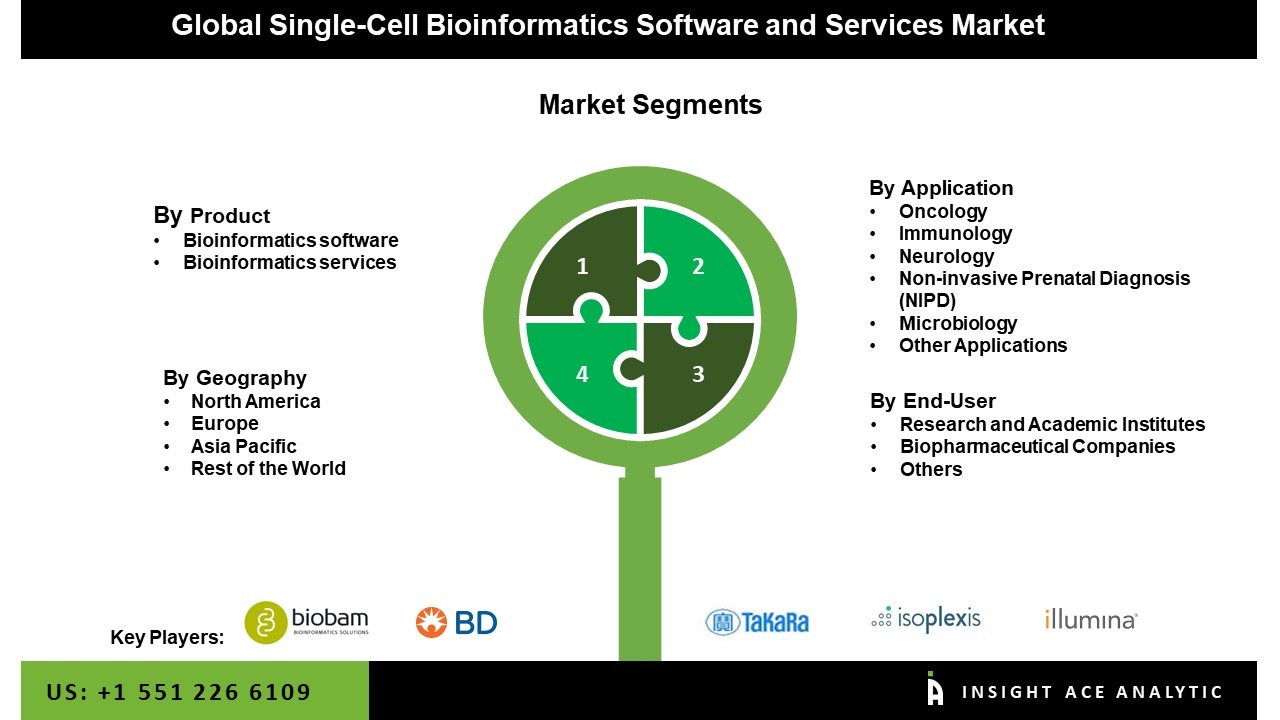
Products, applications, and end-user are the segments covered in the Global Single-Cell Bioinformatics Software and Services Market. The product segment includes bioinformatics software and bioinformatics services, which the software market will lead the segment due to competition in service providers. By application, this bioinformatics market is divided into Oncology, Immunology, Neurology, Non-invasive Prenatal Diagnosis (NIPD), Microbiology, and Other Applications. Oncological applications are increasing as several patients have cancer. Research and Academic Institutes, Biopharmaceutical Companies, and Others are subsegments of the End-User segment.

North America and Europe generate the highest revenue due to research and development advancements in the single-cell analysis services market. The demand for single-Cell RNA sequencing is more elevated in European countries, which will continue in the coming forecasting years.

Recent Developments:

  • In April 2024, Takara Bio USA, Inc., the ShastaTM Single-Cell System a fully owned subsidiary of Takara Bio Inc.—was introduced. It is an automated, high-throughput NGS solution with well-validated chemistry and user-friendly bioinformatics tools that facilitate the discovery of novel biomarkers for oncology research.

Single-Cell Bioinformatics Software and Services Market Report Scope

Report Attribute Specifications
Market Size Value In 2024 USD 294.4 Million
Revenue Forecast In 2034 USD 802.8 Million
Growth Rate CAGR CAGR of 10.6% from 2025 to 2034
Quantitative Units Representation of revenue in US$ Mn,and CAGR from 2025 to 2034
Historic Year 2021 to 2024
Forecast Year 2025-2034
Report Coverage The forecast of revenue, the position of the company, the competitive market structure, growth prospects, and trends
Segments Covered Product, Application, End-User
Regional Scope North America; Europe; Asia Pacific; Latin America; Middle East & Africa
Country Scope U.S.; Canada; U.K.; Germany; China; India; Japan; Brazil; Mexico ;The UK; France; Italy; Spain; China; Japan; India; South Korea; South East Asia; South Korea; South East Asia
Competitive Landscape Illumina, Inc., QIAGEN N.V., BD., PacBio, Fluidigm Corporation, NanoString, Takara Bio Inc., BGI, Oxford Nanopore Technologies plc., Partek, Incorporated, Akoya Biosciences, Inc., IsoPlexis, Scipio Bioscience, Scailyte, BioBam Spain, and other.
Customization Scope Free customization report with the procurement of the report, Modifications to the regional and segment scope. Particular Geographic competitive landscape.
Pricing And Available Payment Methods Explore pricing alternatives that are customized to your particular study requirements.

Segmentation Of Single-Cell Bioinformatics Software And Services Market

Global Single-Cell Bioinformatics Software and Services Market , by Product

  • Bioinformatics Software
  • Bioinformatics Services

single cell bioinformatics

Global Single-Cell Bioinformatics Software and Services Market , by Application,

  • Oncology
  • Immunology
  • Neurology
  • Non-invasive Prenatal Diagnosis (NIPD)
  • Microbiology
  • Other Applications

Global Single-Cell Bioinformatics Software and Services Market , by End-Users

  • Research and Academic Institutes
  • Biopharmaceutical Companies
  • Others

Global Single-Cell Bioinformatics Software and Services Market , by Region,

  • North America
  • Europe
  • Asia Pacific
  • Latin America
  • Middle East & Africa

North America Single-Cell Bioinformatics Software and Services Market , by Country

  • U.S.
  • Canada

Europe Single-Cell Bioinformatics Software and Services Market , by Country,

  • Germany
  • France
  • Italy
  • Spain
  • Russia
  • Rest of Europe

Asia Pacific Single-Cell Bioinformatics Software and Services Market , by Country

  • India
  • China
  • Japan
  • South Korea
  • Australia & New Zealand

Latin America Single-Cell Bioinformatics Software and Services Market , by Country

  • Brazil
  • Mexico
  • Rest of Latin America

Middle East & Africa Single-Cell Bioinformatics Software and Services Market , by Country

  • GCC Countries
  • South Africa
  • Rest of Middle East & Africa

Need specific information/chapter from the report of the custom data table, graph or complete report? Tell us more.

Research Design and Approach

This study employed a multi-step, mixed-method research approach that integrates:

  • Secondary research
  • Primary research
  • Data triangulation
  • Hybrid top-down and bottom-up modelling
  • Forecasting and scenario analysis

This approach ensures a balanced and validated understanding of both macro- and micro-level market factors influencing the market.

Secondary Research

Secondary research for this study involved the collection, review, and analysis of publicly available and paid data sources to build the initial fact base, understand historical market behaviour, identify data gaps, and refine the hypotheses for primary research.

Sources Consulted

Secondary data for the market study was gathered from multiple credible sources, including:

  • Government databases, regulatory bodies, and public institutions
  • International organizations (WHO, OECD, IMF, World Bank, etc.)
  • Commercial and paid databases
  • Industry associations, trade publications, and technical journals
  • Company annual reports, investor presentations, press releases, and SEC filings
  • Academic research papers, patents, and scientific literature
  • Previous market research publications and syndicated reports

These sources were used to compile historical data, market volumes/prices, industry trends, technological developments, and competitive insights.

Secondary Research

Primary Research

Primary research was conducted to validate secondary data, understand real-time market dynamics, capture price points and adoption trends, and verify the assumptions used in the market modelling.

Stakeholders Interviewed

Primary interviews for this study involved:

  • Manufacturers and suppliers in the market value chain
  • Distributors, channel partners, and integrators
  • End-users / customers (e.g., hospitals, labs, enterprises, consumers, etc., depending on the market)
  • Industry experts, technology specialists, consultants, and regulatory professionals
  • Senior executives (CEOs, CTOs, VPs, Directors) and product managers

Interview Process

Interviews were conducted via:

  • Structured and semi-structured questionnaires
  • Telephonic and video interactions
  • Email correspondences
  • Expert consultation sessions

Primary insights were incorporated into demand modelling, pricing analysis, technology evaluation, and market share estimation.

Data Processing, Normalization, and Validation

All collected data were processed and normalized to ensure consistency and comparability across regions and time frames.

The data validation process included:

  • Standardization of units (currency conversions, volume units, inflation adjustments)
  • Cross-verification of data points across multiple secondary sources
  • Normalization of inconsistent datasets
  • Identification and resolution of data gaps
  • Outlier detection and removal through algorithmic and manual checks
  • Plausibility and coherence checks across segments and geographies

This ensured that the dataset used for modelling was clean, robust, and reliable.

Market Size Estimation and Data Triangulation

Bottom-Up Approach

The bottom-up approach involved aggregating segment-level data, such as:

  • Company revenues
  • Product-level sales
  • Installed base/usage volumes
  • Adoption and penetration rates
  • Pricing analysis

This method was primarily used when detailed micro-level market data were available.

Bottom Up Approach

Top-Down Approach

The top-down approach used macro-level indicators:

  • Parent market benchmarks
  • Global/regional industry trends
  • Economic indicators (GDP, demographics, spending patterns)
  • Penetration and usage ratios

This approach was used for segments where granular data were limited or inconsistent.

Hybrid Triangulation Approach

To ensure accuracy, a triangulated hybrid model was used. This included:

  • Reconciling top-down and bottom-up estimates
  • Cross-checking revenues, volumes, and pricing assumptions
  • Incorporating expert insights to validate segment splits and adoption rates

This multi-angle validation yielded the final market size.

Forecasting Framework and Scenario Modelling

Market forecasts were developed using a combination of time-series modelling, adoption curve analysis, and driver-based forecasting tools.

Forecasting Methods

  • Time-series modelling
  • S-curve and diffusion models (for emerging technologies)
  • Driver-based forecasting (GDP, disposable income, adoption rates, regulatory changes)
  • Price elasticity models
  • Market maturity and lifecycle-based projections

Scenario Analysis

Given inherent uncertainties, three scenarios were constructed:

  • Base-Case Scenario: Expected trajectory under current conditions
  • Optimistic Scenario: High adoption, favourable regulation, strong economic tailwinds
  • Conservative Scenario: Slow adoption, regulatory delays, economic constraints

Sensitivity testing was conducted on key variables, including pricing, demand elasticity, and regional adoption.


Name field cannot be blank!
Email field cannot be blank!(Use email format)
Designation field cannot be blank!
Company field cannot be blank!
Contact No field cannot be blank!
Message field cannot be blank!
2513
Security Code field cannot be blank!

Frequently Asked Questions

Illumina, Inc., QIAGEN N.V., BD., PacBio, Fluidigm Corporation, NanoString, Takara Bio Inc., BGI, Oxford Nanopore Technologies plc., Partek, others

Single-Cell Bioinformatics Software and Services Market Size is valued at USD 294.4 Million in 2024 and is predicted to reach USD 802.8 Million by the

Single-Cell Bioinformatics Software and Services Market is expected to grow at a 10.6% CAGR during the forecast period for 2025-2034.

Product, Application and End-User are the key segments of the Single-Cell Bioinformatics Software and Services Market.

North America region is leading the Single-Cell Bioinformatics Software and Services Market.
Get Sample Report Enquiry Before Buying