Regenerative Aesthetics Exosome Products Market Size, Share & Trends Analysis Distribution by Application (Skin Rejuvenation, Hair Restoration, Scar Reduction and Wound Healing, Anti-Inflammatory Treatments, Others), By Biological Source, By Product Format, End User (Aesthetic Clinics, Home Use, Dermatology Clinics), and Segment Forecasts, 2025-2034
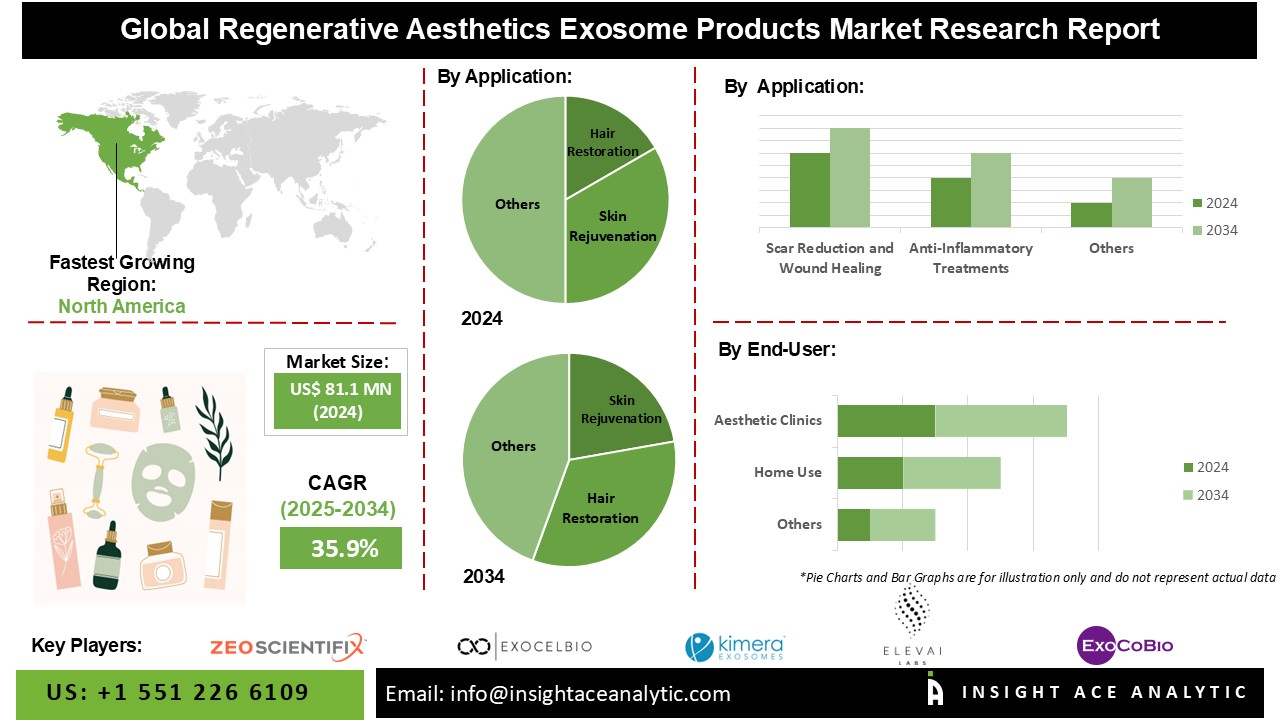
Global Regenerative Aesthetics Exosome Products Market Size is valued at USD 81.1 Million in 2024 and is predicted to reach USD 1689.7 Million by the year 2034 at a 35.9% CAGR during the forecast period for 2025-2034.
Regenerative aesthetics exosome products represent a cutting-edge advancement in skin rejuvenation and hair restoration, offering a minimally invasive approach. These nano-sized extracellular vesicles derived from stem cells contain a potent blend of growth factors, peptides, coenzymes, minerals, amino acids, and vitamins. Applied topically, they enhance skin health by boosting collagen and elastin production, improving oxygenation, and enhancing nutrition. When used alongside procedures such as microneedling, they effectively diminish fine lines, wrinkles, age spots, and redness while enhancing skin hydration and brightness. Unlike platelet-rich plasma (PRP) treatments, exosome products require no blood draws or specialized equipment, offering a more concentrated and streamlined solution.
Clinically proven formulations like Benev's Exosome Regenerative Complex and Exosome Regenerative Complex+ demonstrate efficacy in rejuvenating both skin and scalp tissue by addressing fundamental causes of ageing and fostering intercellular communication, thereby presenting a promising alternative to conventional aesthetic therapies. The regenerative aesthetics exosome products market is propelled by increasing demand for natural, minimally invasive solutions in skin rejuvenation. As awareness of regenerative medicine grows among consumers, there is a burgeoning market for exosome-based aesthetic products anticipated to expand swiftly.
Competitive Landscape
Some of the Key Players in Regenerative Aesthetics Exosome Products Market:
· BENEV
· EXOCEL BIO
· Kimera Labs
· ELEVAI Labs, Inc.
· ExoCoBio, Inc.
· ANTEAGE
· Laboratorio Innoaesthetics, S.L.U.
· ZEO ScientifiX, Inc.
· Rion Aesthetics, Inc.
· Vytrus Biotech
· Croma Pharma
· RESILIÉLLE COSMETICS LLC
· Exoceuticals
· LA EXO
· JuveXo
· PrimaCure
· Cartessa Aesthetics
· DP Derm
· MCCM Medical Cosmetics
· Morphiya
· Advancexo
· Rixin Cosmetics
· Mibelle Biochemistry
· Creative Biolabs
· Exosomes Cosmetics
· Snow Fox
· Beekman 1802
· Swiss Perfection
· Wigmore Medical
· Thea Janus
Market Segmentation:
The regenerative aesthetics exosome products market is segmented by application and end user. Acording to the application the market is segmented into skin rejuvenation, hair restoration, scar reduction and wound healing, anti-inflammatory treatments, others(combination therapies, etc.) By end user market is categorized into aesthetic clinics, home use, dermatology clinics. THe home use segment is further classified into Retail Channels and E-commerce Platform.
Skin Rejuvenation Segment Is Expected To Dominate The Regenerative Aesthetics Exosome Products Market
Skin rejuvenation stands out as the primary driver of the regenerative aesthetics exosome products market due to several key factors. Exosomes have demonstrated notable efficacy in enhancing skin health by boosting collagen and elastin production, reducing fine lines & wrinkles, and improving skin elasticity. They also facilitate improved skin oxygenation, nutrition, and overall rejuvenation, particularly when integrated with procedures like microneedling to further diminish age spots and redness and enhance hydration. As the demand for minimally invasive, natural solutions for ageing skin increases, exosome-based products offer a compelling alternative to traditional aesthetic treatments like fillers and Botox. Supported by clinical evidence showing their ability to counteract dermal fibroblast senescence and stimulate skin regeneration, products such as Exosome Regenerative Complex are validated options in the market.
The Aesthetic Clinics Segment Is Growing At The Highest Rate In The Regenerative Aesthetics Exosome Products Market.
The aesthetic clinics segment is emerging as the fastest-growing category in the medical aesthetics market, driven by several key factors. Clinics, hospitals, and medical spas have seen significant adoption of advanced systems and technologies, enhancing patient care and early disease detection. This trend is fueled by the digitization of patient workflows and an increase in aesthetic procedures performed in these settings. There is also a rising need for minimally invasive procedures such as botulinum toxin as well as dermal fillers, which offer benefits like reduced side effects, shorter recovery times, and less discomfort. This growing preference for non-invasive treatments contributes to the accelerated growth of the aesthetic clinic's segment within the medical aesthetics industry.
Regionally, North America Led the Regenerative Aesthetics Exosome Products Market.
In North America, particularly in the United States and Canada, the medical aesthetics market is led by a combination of factors. The region's dominance is fueled by the rising demand for least invasive cosmetic procedures and the robust healthcare infrastructure in both countries. The United States, in particular, benefits from the significant popularity of cosmetic procedures, encompassing both surgical and non-surgical options. This demand is further bolstered by a large pool of highly qualified plastic surgeons specializing in diverse medical aesthetic procedures. Additionally, the increasing number of clinics across the region contributes to the market's growth, reflecting a strong preference for advanced aesthetic treatments among consumers.
Recent Developments:
- In May 2024, Elevai Labs, Inc. launched two new wholly owned subsidiaries, Elevai Biosciences, Inc., and Elevai Skincare, Inc., signalling a strategic pivot towards advancing next-generation aesthetic medicines and enhancing the economic outlook of its exosome skincare brand.
- In July 2023, ExoCoBio, a global leader in exosome-based regenerative aesthetics, successfully acquired a majority stake in BENEV, a prominent U.S.-based medical aesthetic company.
Regenerative Aesthetics Exosome Products Market Report Scope
| Report Attribute | Specifications |
| Market size value in 2024 | USD 81.1 Million |
| Revenue forecast in 2034 | USD 1689.7 Million |
| Growth Rate CAGR | CAGR of 35.9% from 2025 to 2034 |
| Quantitative Units | Representation of revenue in US$ Mn and CAGR from 2025 to 2034 |
| Historic Year | 2021 to 2024 |
| Forecast Year | 2025-2034 |
| Report Coverage | The forecast of revenue, the position of the company, the competitive market structure, growth prospects, and trends |
| Segments Covered | By Application, By End User, By Biological Source, By Product Format and By Region |
| Regional Scope | North America; Europe; Asia Pacific; Latin America; Middle East & Africa |
| Country Scope | U.S.; Canada; U.K.; Germany; China; India; Japan; Brazil; Mexico; France; Italy; Spain; South Korea; Southeast Asia |
| Competitive Landscape | BENEV, EXOCEL BIO, Kimera Labs, ELEVAI Labs, Inc., ExoCoBio Inc., ANTEAGE, Laboratorio Innoaesthetics, S.L.U., ZEO ScientifiX, Inc., Rion Aesthetics, Inc., Cosmedicine Co., Ltd., Other Prominent Players |
| Customization Scope | Free customization report with the procurement of the report, Modifications to the regional and segment scope. Geographic competitive landscape. |
| Pricing and Available Payment Methods | Explore pricing alternatives that are customized to your particular study requirements. |
Segmentation of Regenerative Aesthetics Exosome Products Market -
Regenerative Aesthetics Exosome Products Market by Application-
- Skin Rejuvenation
- Hair Restoration
- Scar Reduction and Wound Healing
- Anti-Inflammatory Treatments
- Others (Combination Therapies, etc.)
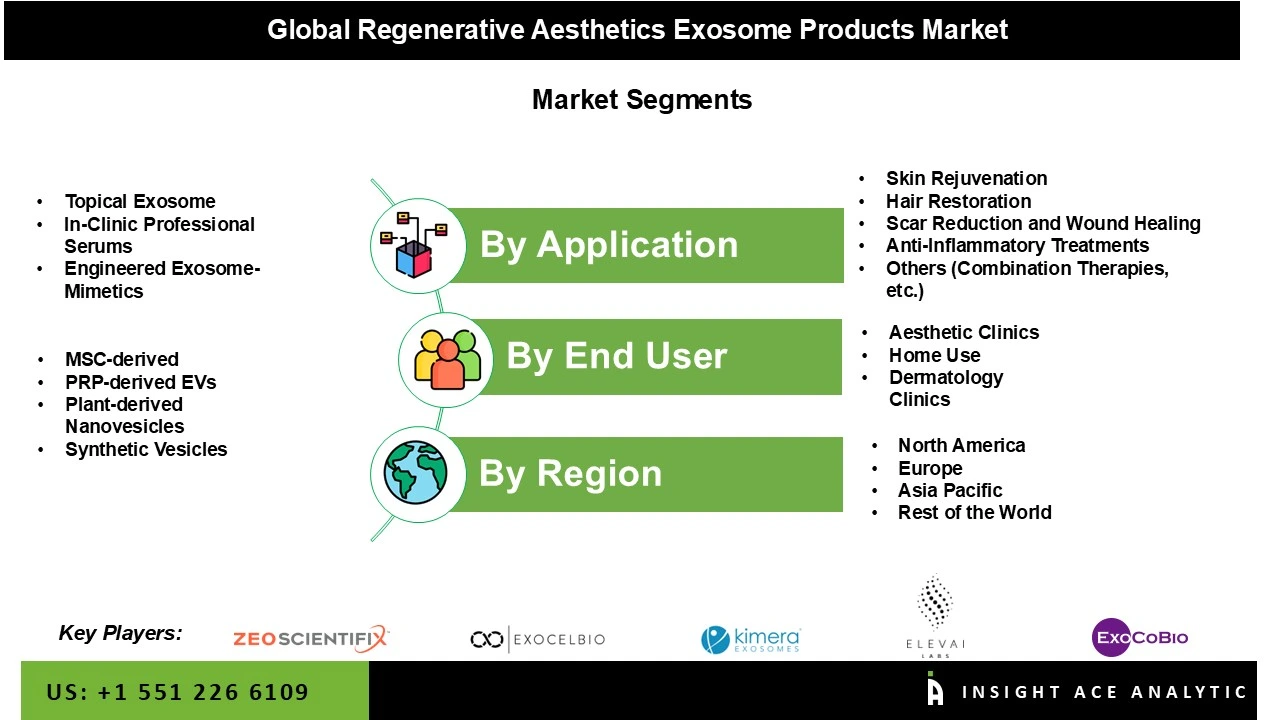
Regenerative Aesthetics Exosome Products Market by End User -
- Aesthetic Clinics
- Home Use
- Dermatology Clinics
Regenerative Aesthetics Exosome Products Market By Product Format
- Topical Exosome/EV Skincare
- In-Clinic Professional Serums
- Engineered Exosome-Mimetics / Conditioned-Media Derivatives
Regenerative Aesthetics Exosome Products Market By Biological Source
- MSC-derived
- Platelet-/PRP-derived EVs
- Plant-derived Nanovesicles
- Synthetic / Engineered Vesicles
Regenerative Aesthetics Exosome Products Market by Region-
North America-
- The US
- Canada
- Mexico
Europe-
- Germany
- The UK
- France
- Italy
- Spain
- Rest of Europe
Asia-Pacific-
- China
- Japan
- India
- South Korea
- Southeast Asia
- Rest of Asia Pacific
Latin America-
- Brazil
- Argentina
- Rest of Latin America
Middle East & Africa-
- GCC Countries
- South Africa
- Rest of the Middle East and Africa
Research Design and Approach
This study employed a multi-step, mixed-method research approach that integrates:
- Secondary research
- Primary research
- Data triangulation
- Hybrid top-down and bottom-up modelling
- Forecasting and scenario analysis
This approach ensures a balanced and validated understanding of both macro- and micro-level market factors influencing the market.
Secondary Research
Secondary research for this study involved the collection, review, and analysis of publicly available and paid data sources to build the initial fact base, understand historical market behaviour, identify data gaps, and refine the hypotheses for primary research.
Sources Consulted
Secondary data for the market study was gathered from multiple credible sources, including:
- Government databases, regulatory bodies, and public institutions
- International organizations (WHO, OECD, IMF, World Bank, etc.)
- Commercial and paid databases
- Industry associations, trade publications, and technical journals
- Company annual reports, investor presentations, press releases, and SEC filings
- Academic research papers, patents, and scientific literature
- Previous market research publications and syndicated reports
These sources were used to compile historical data, market volumes/prices, industry trends, technological developments, and competitive insights.

Primary Research
Primary research was conducted to validate secondary data, understand real-time market dynamics, capture price points and adoption trends, and verify the assumptions used in the market modelling.
Stakeholders Interviewed
Primary interviews for this study involved:
- Manufacturers and suppliers in the market value chain
- Distributors, channel partners, and integrators
- End-users / customers (e.g., hospitals, labs, enterprises, consumers, etc., depending on the market)
- Industry experts, technology specialists, consultants, and regulatory professionals
- Senior executives (CEOs, CTOs, VPs, Directors) and product managers
Interview Process
Interviews were conducted via:
- Structured and semi-structured questionnaires
- Telephonic and video interactions
- Email correspondences
- Expert consultation sessions
Primary insights were incorporated into demand modelling, pricing analysis, technology evaluation, and market share estimation.
Data Processing, Normalization, and Validation
All collected data were processed and normalized to ensure consistency and comparability across regions and time frames.
The data validation process included:
- Standardization of units (currency conversions, volume units, inflation adjustments)
- Cross-verification of data points across multiple secondary sources
- Normalization of inconsistent datasets
- Identification and resolution of data gaps
- Outlier detection and removal through algorithmic and manual checks
- Plausibility and coherence checks across segments and geographies
This ensured that the dataset used for modelling was clean, robust, and reliable.
Market Size Estimation and Data Triangulation
Bottom-Up Approach
The bottom-up approach involved aggregating segment-level data, such as:
- Company revenues
- Product-level sales
- Installed base/usage volumes
- Adoption and penetration rates
- Pricing analysis
This method was primarily used when detailed micro-level market data were available.
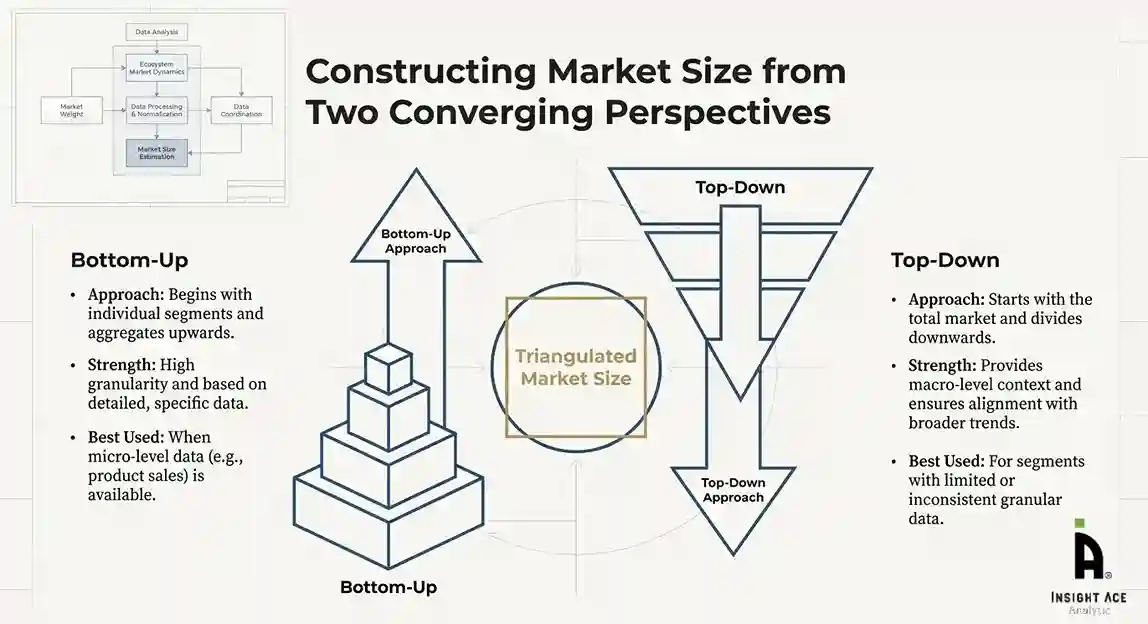
Top-Down Approach
The top-down approach used macro-level indicators:
- Parent market benchmarks
- Global/regional industry trends
- Economic indicators (GDP, demographics, spending patterns)
- Penetration and usage ratios
This approach was used for segments where granular data were limited or inconsistent.
Hybrid Triangulation Approach
To ensure accuracy, a triangulated hybrid model was used. This included:
- Reconciling top-down and bottom-up estimates
- Cross-checking revenues, volumes, and pricing assumptions
- Incorporating expert insights to validate segment splits and adoption rates
This multi-angle validation yielded the final market size.
Forecasting Framework and Scenario Modelling
Market forecasts were developed using a combination of time-series modelling, adoption curve analysis, and driver-based forecasting tools.
Forecasting Methods
- Time-series modelling
- S-curve and diffusion models (for emerging technologies)
- Driver-based forecasting (GDP, disposable income, adoption rates, regulatory changes)
- Price elasticity models
- Market maturity and lifecycle-based projections
Scenario Analysis
Given inherent uncertainties, three scenarios were constructed:
- Base-Case Scenario: Expected trajectory under current conditions
- Optimistic Scenario: High adoption, favourable regulation, strong economic tailwinds
- Conservative Scenario: Slow adoption, regulatory delays, economic constraints
Sensitivity testing was conducted on key variables, including pricing, demand elasticity, and regional adoption.
Request Customization
Add countries, segments, company profiles, or extend forecast — free 10% customization with purchase.
Customize This Report →Enquire Before Buying
Speak with our analyst team about scope, methodology, pricing, or deliverable formats.
Enquire Now →Frequently Asked Questions
Regenerative Aesthetics Exosome Products Market Size is predicted to grow at an 35.9% CAGR during the forecast period for 2025-2034
Laboratorio Innoaesthetics, S.L.U., ZEO ScientifiX, Inc., Rion Aesthetics, Inc., Cosmedicine Co., Ltd., Other Prominent Players
By Application, By End User, By Biological Source, By Product Format and By Region are the key segments of the Regenerative Aesthetics Exosome Products Market.
Regenerative Aesthetics Exosome Products Market Size is valued at USD 81.1 Million in 2024 and is predicted to reach USD 1689.7 Million by the year 20
North American region is leading the Regenerative Aesthetics Exosome Products Market