Physician Office Diagnostic Market Size, Share & Trends Analysis Report By Product Type (Point-of-Care Testing (POCT) Devices, Clinical Chemistry Analyzers, Immunoassay Systems, Molecular Diagnostics, Urinalysis Systems), By End-User, By Application, By Region, And By Segment Forecasts, 2025-2034
Physician Office Diagnostic Market Size is valued at USD 118.1 Bn in 2024 and is predicted to reach USD 407.2 Bn by the year 2034 at a 13.3% CAGR during the forecast period for 2025-2034.
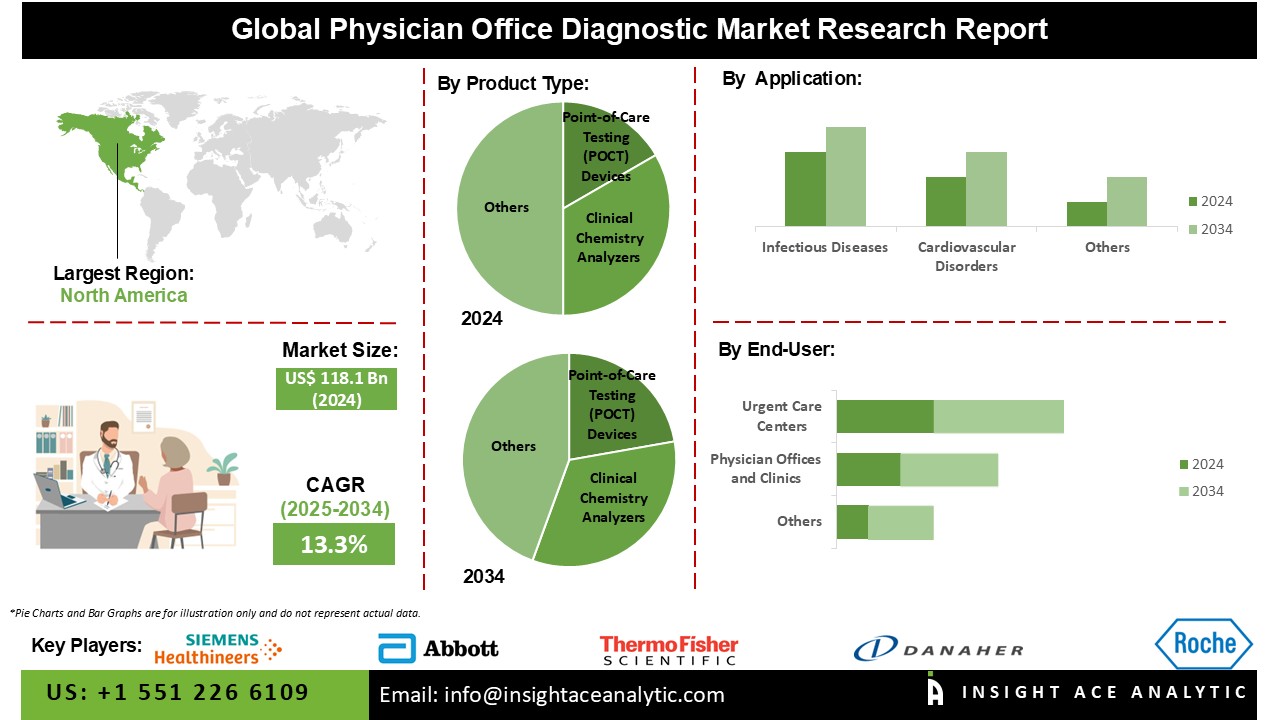
Physician office laboratories are increasingly being utilized by independent practises to effectively handle the expanding patient population afflicted with chronic medical ailments. By adopting this approach, practises are also strategically positioned to thrive within value-based care (VBC) programmes and quality payment programmes (QPPs) that incentivize practises for effectively maintaining patients' health and minimizing costly hospital emergency room visits.
To accomplish the two goals, it is imperative for healthcare providers to implement appropriate measures that guarantee the provision of diagnostic laboratory testing of significant value to patients with chronic medical illnesses and those who are at a heightened risk of nonadherence to such tests. These tests are normally carried out by healthcare professionals such as physicians, nurses, and medical technicians.
The rising occurrence of chronic diseases such as diabetes, cardiovascular disease, and infectious diseases is driving up demand for diagnostic testing in doctor's offices. Timely diagnosis and monitoring are critical for properly managing these disorders. The emphasis on preventive healthcare has resulted in an emphasis on early detection and monitoring. This, in turn, increases the demand for diagnostic tests at medical offices to uncover health issues before they develop.
However, certain diagnostic tests and testing supplies were unavailable due to disruptions in worldwide supply chains. Shortages of testing reagents, swabs, and other supplies hampered medical offices' ability to complete tests. Moreover, the economic issues created by the pandemic resulted in financial limits for both healthcare professionals and patients.
Competitive Landscape
Some Major Key Players In The Physician Office Diagnostic Market:
- F. Hoffmann-La Roche Ltd
- Siemens Healthineers AG
- Abbott Laboratories
- Thermo Fisher Scientific Inc.
- Danaher Corporation
- Sysmex Corporation
- Becton, Dickinson and Company
- Bio-Rad Laboratories, Inc.
- Quidel Corporation
- Hologic, Inc.
- Ortho Clinical Diagnostics
- Beckman Coulter, Inc. (a subsidiary of Danaher Corporation)
- BioMérieux SA
- Trinity Biotech plc
- EKF Diagnostics Holdings plc.
Market Segmentation:
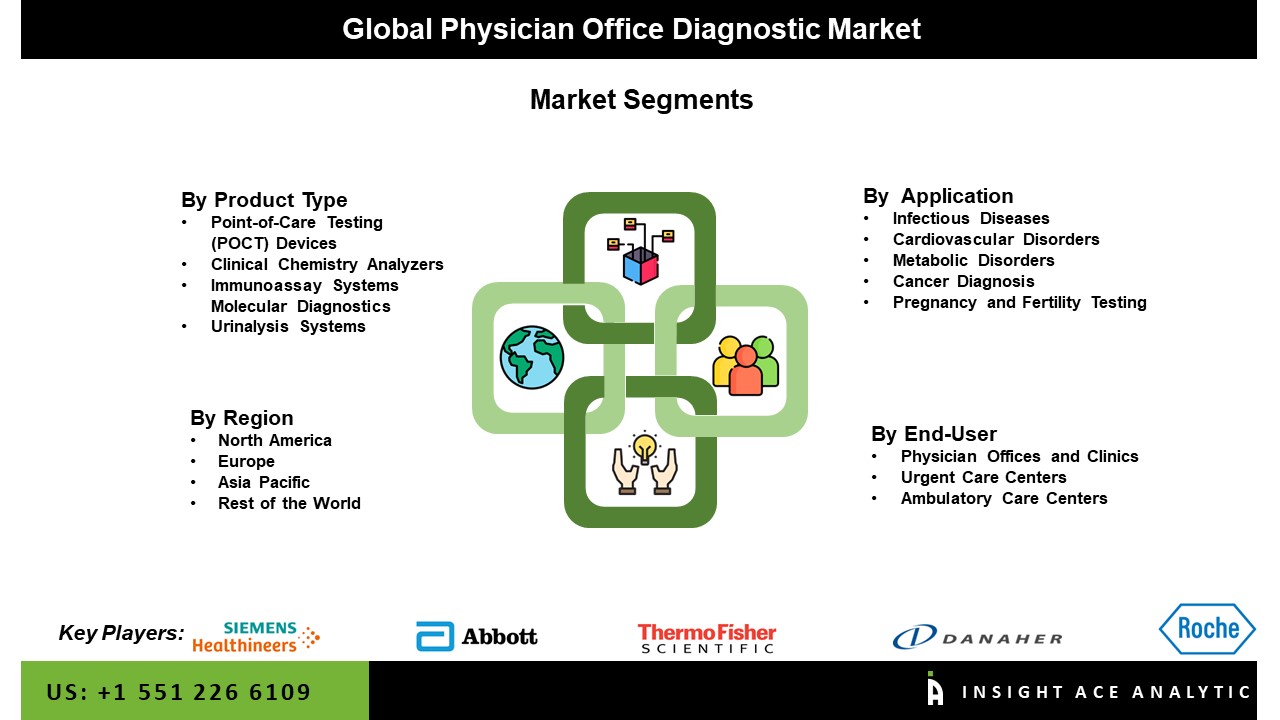
The Physician Office Diagnostic Market is segmented on the basis of product type, end-user and application. As per the product type, the market is segmented as Point-of-Care Testing (POCT) Devices, Clinical Chemistry Analyzers, Immunoassay Systems, Molecular Diagnostics, and Urinalysis Systems. The end-user segment includes Physician Offices and Clinics, Urgent Care Centers, and Ambulatory Care Centers. According to the application segment, the market is divided into Infectious Diseases, Cardiovascular Disorders, Metabolic Disorders, Cancer Diagnosis, and Pregnancy and Fertility Testing
Based On Product Type, The Point-Of-Care Testing (POCT) Devices Segment Is Accounted As A Major Contributor In The Physician Office Diagnostic Market
The Point-of-Care Testing (POCT) Devices category is expected to hold a major share in the global Physician Office Diagnostic Market in 2022. Point-of-care testing is becoming increasingly popular in physician offices and other primary care settings. Point-of-care testing allows for rapid diagnosis and prompt availability of test findings, allowing for swift medical decisions and treatment commencement. The need for faster and more convenient diagnostic options, particularly in emergency rooms, primary care clinics, and remote or resource-limited settings, is driving this need.
Physician Offices And Clinics Segment Witness Growth At A Rapid Rate
The Physician Offices and Clinics segment is projected to grow at a rapid rate in the global Physician Office Diagnostic Market. Preventive healthcare and early disease identification are becoming increasingly important. Physician office diagnostics are critical in identifying diseases and risk factors early, allowing for timely action and improved patient outcomes. Preventive healthcare practices, such as routine screenings and diagnostic testing, are being encouraged to lessen the burden of chronic diseases and the associated healthcare expenses.
In The Region, The North America Physician Office Diagnostic Market Holds A Significant Revenue Share.
The North America Physician Office Diagnostic Market is expected to record the major market share in terms of revenue in the near future. Due to its well-established and advanced healthcare system, North America is a significant market for physician office diagnostics. The region is distinguished by high rates of adoption of new diagnostic technology, significant investment in healthcare R&D, and favorable reimbursement systems.
The presence of important industry participants in the region, as well as a proactive attitude to preventative care, contribute to the development of the physician office diagnostic market. The physician office diagnostic market is expanding rapidly in the Asia-Pacific region. Factors such as rising healthcare expenditure, increased awareness of early disease detection, and improved access to healthcare services are driving market growth. Because of their enormous population bases, expanding healthcare spending, and increasing need for point-of-care testing solutions, countries such as India, Japan and China are important contributors to market growth.
Physician Office Diagnostic Market Report Scope
| Report Attribute | Specifications |
| Market Size Value In 2024 | USD 118.1 Bn |
| Revenue Forecast In 2034 | USD 407.2 Bn |
| Growth Rate CAGR | CAGR of 13.3% from 2025 to 2034 |
| Quantitative Units | Representation of revenue in US$ Million and CAGR from 2025 to 2034 |
| Historic Year | 2021 to 2024 |
| Forecast Year | 2025-2034 |
| Report Coverage | The forecast of revenue, the position of the company, the competitive market structure, growth prospects, and trends |
| Segments Covered | By Product Type, Application, End-User |
| Regional Scope | North America; Europe; Asia Pacific; Latin America; Middle East & Africa |
| Country Scope | U.S.; Canada; U.K.; Germany; China; India; Japan; Brazil; Mexico ;The UK; France; Italy; Spain; South Korea; South East Asia |
| Competitive Landscape | F. Hoffmann-La Roche Ltd, Siemens Healthineers AG, Abbott Laboratories, Thermo Fisher Scientific Inc., Danaher Corporation, Sysmex Corporation, Becton, Dickinson and Company, Bio-Rad Laboratories, Inc., Quidel Corporation, Hologic, Inc., Ortho Clinical Diagnostics, Beckman Coulter, Inc. (a subsidiary of Danaher Corporation), BioMérieux SA, Trinity Biotech plc, EKF Diagnostics Holdings plc. |
| Customization Scope | Free customization report with the procurement of the report, Modifications to the regional and segment scope. Particular Geographic competitive landscape. |
| Pricing And Available Payment Methods | Explore pricing alternatives that are customized to your particular study requirements. |
Segmentation of Physician Office Diagnostic Market-
Physician Office Diagnostic Market By Product Type-
- Point-of-Care Testing (POCT) Devices
- Clinical Chemistry Analyzers
- Immunoassay Systems
- Molecular Diagnostics
- Urinalysis Systems
Physician Office Diagnostic Market By End-User-
- Physician Offices and Clinics
- Urgent Care Centers
- Ambulatory Care Centers
Physician Office Diagnostic Market By Application-
- Infectious Diseases
- Cardiovascular Disorders
- Metabolic Disorders
- Cancer Diagnosis
- Pregnancy and Fertility Testing
Physician Office Diagnostic Market By Region-
North America-
- The US
- Canada
Europe-
- Germany
- The UK
- France
- Italy
- Spain
- Rest of Europe
Asia-Pacific-
- China
- Japan
- India
- South Korea
- South East Asia
- Rest of Asia Pacific
Latin America-
- Brazil
- Argentina
- Mexico
- Rest of Latin America
Middle East & Africa-
- GCC Countries
- South Africa
- Rest of the Middle East and Africa
Research Design and Approach
This study employed a multi-step, mixed-method research approach that integrates:
- Secondary research
- Primary research
- Data triangulation
- Hybrid top-down and bottom-up modelling
- Forecasting and scenario analysis
This approach ensures a balanced and validated understanding of both macro- and micro-level market factors influencing the market.
Secondary Research
Secondary research for this study involved the collection, review, and analysis of publicly available and paid data sources to build the initial fact base, understand historical market behaviour, identify data gaps, and refine the hypotheses for primary research.
Sources Consulted
Secondary data for the market study was gathered from multiple credible sources, including:
- Government databases, regulatory bodies, and public institutions
- International organizations (WHO, OECD, IMF, World Bank, etc.)
- Commercial and paid databases
- Industry associations, trade publications, and technical journals
- Company annual reports, investor presentations, press releases, and SEC filings
- Academic research papers, patents, and scientific literature
- Previous market research publications and syndicated reports
These sources were used to compile historical data, market volumes/prices, industry trends, technological developments, and competitive insights.

Primary Research
Primary research was conducted to validate secondary data, understand real-time market dynamics, capture price points and adoption trends, and verify the assumptions used in the market modelling.
Stakeholders Interviewed
Primary interviews for this study involved:
- Manufacturers and suppliers in the market value chain
- Distributors, channel partners, and integrators
- End-users / customers (e.g., hospitals, labs, enterprises, consumers, etc., depending on the market)
- Industry experts, technology specialists, consultants, and regulatory professionals
- Senior executives (CEOs, CTOs, VPs, Directors) and product managers
Interview Process
Interviews were conducted via:
- Structured and semi-structured questionnaires
- Telephonic and video interactions
- Email correspondences
- Expert consultation sessions
Primary insights were incorporated into demand modelling, pricing analysis, technology evaluation, and market share estimation.
Data Processing, Normalization, and Validation
All collected data were processed and normalized to ensure consistency and comparability across regions and time frames.
The data validation process included:
- Standardization of units (currency conversions, volume units, inflation adjustments)
- Cross-verification of data points across multiple secondary sources
- Normalization of inconsistent datasets
- Identification and resolution of data gaps
- Outlier detection and removal through algorithmic and manual checks
- Plausibility and coherence checks across segments and geographies
This ensured that the dataset used for modelling was clean, robust, and reliable.
Market Size Estimation and Data Triangulation
Bottom-Up Approach
The bottom-up approach involved aggregating segment-level data, such as:
- Company revenues
- Product-level sales
- Installed base/usage volumes
- Adoption and penetration rates
- Pricing analysis
This method was primarily used when detailed micro-level market data were available.

Top-Down Approach
The top-down approach used macro-level indicators:
- Parent market benchmarks
- Global/regional industry trends
- Economic indicators (GDP, demographics, spending patterns)
- Penetration and usage ratios
This approach was used for segments where granular data were limited or inconsistent.
Hybrid Triangulation Approach
To ensure accuracy, a triangulated hybrid model was used. This included:
- Reconciling top-down and bottom-up estimates
- Cross-checking revenues, volumes, and pricing assumptions
- Incorporating expert insights to validate segment splits and adoption rates
This multi-angle validation yielded the final market size.
Forecasting Framework and Scenario Modelling
Market forecasts were developed using a combination of time-series modelling, adoption curve analysis, and driver-based forecasting tools.
Forecasting Methods
- Time-series modelling
- S-curve and diffusion models (for emerging technologies)
- Driver-based forecasting (GDP, disposable income, adoption rates, regulatory changes)
- Price elasticity models
- Market maturity and lifecycle-based projections
Scenario Analysis
Given inherent uncertainties, three scenarios were constructed:
- Base-Case Scenario: Expected trajectory under current conditions
- Optimistic Scenario: High adoption, favourable regulation, strong economic tailwinds
- Conservative Scenario: Slow adoption, regulatory delays, economic constraints
Sensitivity testing was conducted on key variables, including pricing, demand elasticity, and regional adoption.
Request Customization
Add countries, segments, company profiles, or extend forecast — free 10% customization with purchase.
Customize This Report →Enquire Before Buying
Speak with our analyst team about scope, methodology, pricing, or deliverable formats.
Enquire Now →Frequently Asked Questions
Physician Office Diagnostic Market Size is valued at USD 118.1 Bn in 2024 and is predicted to reach USD 407.2 Bn by the year 2034
The Physician Office Diagnostic Market is expected to grow at a 13.3% CAGR during the forecast period for 2025-2034.
. Hoffmann-La Roche Ltd, Siemens Healthineers AG, Abbott Laboratories, Thermo Fisher Scientific Inc., Danaher Corporation, Sysmex Corporation, Becton,
Physician Office Diagnostic Market is segmented on the basis of product type, end-user and application.
North America region is leading the Physician Office Diagnostic Market.