Ocean Carbon Removal Market Size, Share & Trends Analysis Distribution by Technology (Direct Air Capture, Biochar, Enhanced Mineralization, Ocean Alkalization, Others) and Segment Forecasts, 2025-2034
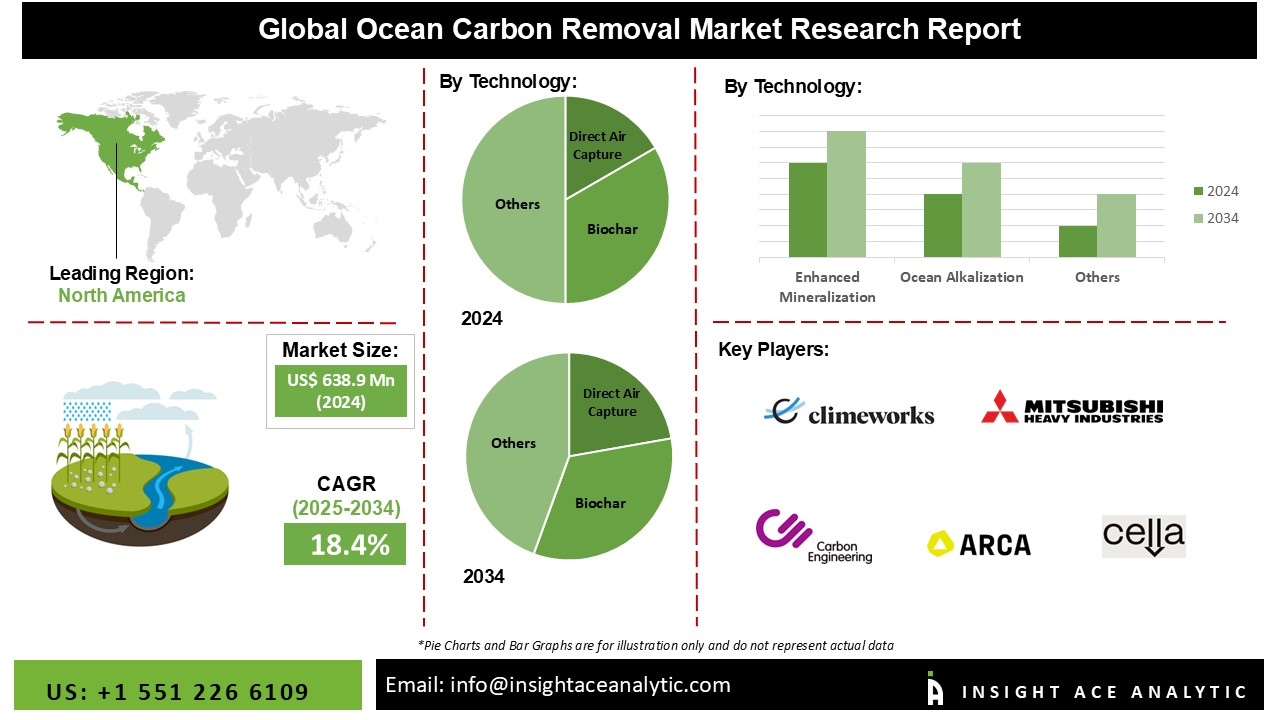
Global Ocean Carbon Removal Market Size is valued at USD 638.9 Mn in 2024 and is predicted to reach USD 3435.3 Mn by the year 2034 at an 18.4% CAGR during the forecast period for 2025-2034.
Ocean Carbon Removal (OCR) refers to a range of innovative methods and technologies designed to enhance the ocean's natural ability to absorb and store atmospheric CO?, addressing the urgent need for large-scale carbon sequestration. These include DOC-direct ocean capture (direct seawater electrochemical removal of dissolved CO?), marine algal cultivation (macroalgae absorb CO? during photosynthesis and can provide biofuels as well as other products), and ocean alkalinity enhancement (addition of alkaline substances into seawater to enhance its ability to absorb more CO?). These methods would tap into the natural role the ocean has played-the largest carbon sink on Earth-to provide scalable solutions to address climate change impacts while fixing problems like ocean acidification.
The applications of OCR technologies vary from climate mitigation, such as helping to achieve set international climate targets by extracting CO? from the atmosphere, to restoring ocean health by lowering acidity for more robust marine ecosystems like coral reefs. Captured CO? can also assist industrial uses, such as the generation of synthetic fuels or neutralization of waste. Projecting to remove 100–1000 gigatons of CO? during this century, IPCC: the future application of OCR stands as a veritable complement to traditional emission reduction strategies, enormously harnessing the ocean's vast potential for carbon sequestration.
Competitive Landscape
Some of the Key Players in Ocean Carbon Removal Market:
- Climeworks AG
- Thermostat
- Carbon Engineering Ltd
- Mitsubishi Heavy Industries
- Cella Mineral Storage
- Arca Climate
- Carbon Clean Solutions
- Equinor Carbofex Ltd
- Carbon Cure Technologies Inc
- Blue Planet System
- Bessume Energy AB
Market Segmentation:
The Ocean Carbon Removal market is segmented by technology. By technology the market is segmented into direct air capture, biochar, enhanced mineralization, ocean alkalization, others.
Direct Air Capture (DAC) is Expected to Drive the Ocean Carbon Removal Market
Direct Air Capture (DAC) is a key driver in the Ocean Carbon Removal (OCR) market, integrating innovative technologies with oceanic systems to enhance carbon dioxide (CO?) sequestration. Recent developments of direct air capture include adaptation of atmospheric capture techniques for dissolved CO? in seawater utilizing electrochemical processes for removal. Although historically expensive, technologies are reducing DAC costs to a level of $100 per ton, making it easier to deploy on the open ocean while not competing for land. Increased regulatory support and investment, in addition to companies like Global Thermostat and Captura, is picking up its pace of adoption. Moreover, DAC enhances oceanic carbon storage, complementing natural processes by alleviating ocean acidification while delivering a vital, multi-faceted solution for climate mitigation.
Regionally, North America Led the Ocean Carbon Removal Market.
Ocean Carbon Removal market is led by North America and the United States, mainly because of large investments in this region, innovative strategies by the companies, and a somewhat conducive regulatory environment. The U.S. Department of Energy has been extremely prompt in investing large funds, such as the $36 million in marine carbon dioxide removal projects. The region is home to key players like Brilliant Planet, Captura, and Ebb Carbon, besides research hubs and academic collaborations that drive the innovation of technology. Favorable regulations and climate action policies push the industries towards carbon removal solutions. These factors ultimately help North America move ahead as a leader in OCR advancements while accelerating growth in its market.
Ocean Carbon Removal Market Report Scope
| Report Attribute | Specifications |
| Market Size Value In 2024 | USD 638.9 Mn |
| Revenue Forecast In 2034 | USD 3435.3 Mn |
| Growth Rate CAGR | CAGR of 18.4% from 2025 to 2034 |
| Quantitative Units | Representation of revenue in US$ Bn and CAGR from 2025 to 2034 |
| Historic Year | 2021 to 2024 |
| Forecast Year | 2025-2034 |
| Report Coverage | The forecast of revenue, the position of the company, the competitive market structure, growth prospects, and trends |
| Segments Covered | By Technology and By Region |
| Regional Scope | North America; Europe; Asia Pacific; Latin America; Middle East & Africa |
| Country Scope | U.S.; Canada; U.K.; Germany; China; India; Japan; Brazil; Mexico; France; Italy; Spain; South Korea; Southeast Asia |
| Competitive Landscape | Climeworks AG, Thermostat, Carbon Engineering Ltd, Mitsubishi Heavy Industries, Cella Mineral Storage, Arca Climate, Carbon Clean Solutions, Equinor Carbofex Ltd, Carbon Cure Technologies Inc, Blue Planet System, Bessume Energy AB |
| Customization Scope | Free customization report with the procurement of the report, Modifications to the regional and segment scope. Geographic competitive landscape. |
| Pricing and Available Payment Methods | Explore pricing alternatives that are customized to your particular study requirements. |
Segmentation of Ocean Carbon Removal Market-
By Technology
- Direct Air Capture (DAC)
- Biochar
- Enhanced Mineralization
- Ocean Alkalization
- Other Emerging Technologies
(e.g., seaweed cultivation, ocean fertilization, hybrid approaches)

By Application
- Carbon Credit Trading & Offsetting
- Industrial Utilization (chemicals, fuels, building materials)
- Climate Mitigation Programs
- Research & Pilot Projects
By End User
- Government & Regulatory Agencies
- Energy & Utility Companies
- Industrial & Manufacturing Companies
- Non-Governmental Organizations (NGOs) & Research Institutes
- Carbon Credit Buyers / Corporate Sustainability Programs
By Deployment Type
- Pilot & Demonstration Projects
- Commercial-Scale Projects
- Integrated Carbon Removal Facilities
Research Design and Approach
This study employed a multi-step, mixed-method research approach that integrates:
- Secondary research
- Primary research
- Data triangulation
- Hybrid top-down and bottom-up modelling
- Forecasting and scenario analysis
This approach ensures a balanced and validated understanding of both macro- and micro-level market factors influencing the market.
Secondary Research
Secondary research for this study involved the collection, review, and analysis of publicly available and paid data sources to build the initial fact base, understand historical market behaviour, identify data gaps, and refine the hypotheses for primary research.
Sources Consulted
Secondary data for the market study was gathered from multiple credible sources, including:
- Government databases, regulatory bodies, and public institutions
- International organizations (WHO, OECD, IMF, World Bank, etc.)
- Commercial and paid databases
- Industry associations, trade publications, and technical journals
- Company annual reports, investor presentations, press releases, and SEC filings
- Academic research papers, patents, and scientific literature
- Previous market research publications and syndicated reports
These sources were used to compile historical data, market volumes/prices, industry trends, technological developments, and competitive insights.

Primary Research
Primary research was conducted to validate secondary data, understand real-time market dynamics, capture price points and adoption trends, and verify the assumptions used in the market modelling.
Stakeholders Interviewed
Primary interviews for this study involved:
- Manufacturers and suppliers in the market value chain
- Distributors, channel partners, and integrators
- End-users / customers (e.g., hospitals, labs, enterprises, consumers, etc., depending on the market)
- Industry experts, technology specialists, consultants, and regulatory professionals
- Senior executives (CEOs, CTOs, VPs, Directors) and product managers
Interview Process
Interviews were conducted via:
- Structured and semi-structured questionnaires
- Telephonic and video interactions
- Email correspondences
- Expert consultation sessions
Primary insights were incorporated into demand modelling, pricing analysis, technology evaluation, and market share estimation.
Data Processing, Normalization, and Validation
All collected data were processed and normalized to ensure consistency and comparability across regions and time frames.
The data validation process included:
- Standardization of units (currency conversions, volume units, inflation adjustments)
- Cross-verification of data points across multiple secondary sources
- Normalization of inconsistent datasets
- Identification and resolution of data gaps
- Outlier detection and removal through algorithmic and manual checks
- Plausibility and coherence checks across segments and geographies
This ensured that the dataset used for modelling was clean, robust, and reliable.
Market Size Estimation and Data Triangulation
Bottom-Up Approach
The bottom-up approach involved aggregating segment-level data, such as:
- Company revenues
- Product-level sales
- Installed base/usage volumes
- Adoption and penetration rates
- Pricing analysis
This method was primarily used when detailed micro-level market data were available.

Top-Down Approach
The top-down approach used macro-level indicators:
- Parent market benchmarks
- Global/regional industry trends
- Economic indicators (GDP, demographics, spending patterns)
- Penetration and usage ratios
This approach was used for segments where granular data were limited or inconsistent.
Hybrid Triangulation Approach
To ensure accuracy, a triangulated hybrid model was used. This included:
- Reconciling top-down and bottom-up estimates
- Cross-checking revenues, volumes, and pricing assumptions
- Incorporating expert insights to validate segment splits and adoption rates
This multi-angle validation yielded the final market size.
Forecasting Framework and Scenario Modelling
Market forecasts were developed using a combination of time-series modelling, adoption curve analysis, and driver-based forecasting tools.
Forecasting Methods
- Time-series modelling
- S-curve and diffusion models (for emerging technologies)
- Driver-based forecasting (GDP, disposable income, adoption rates, regulatory changes)
- Price elasticity models
- Market maturity and lifecycle-based projections
Scenario Analysis
Given inherent uncertainties, three scenarios were constructed:
- Base-Case Scenario: Expected trajectory under current conditions
- Optimistic Scenario: High adoption, favourable regulation, strong economic tailwinds
- Conservative Scenario: Slow adoption, regulatory delays, economic constraints
Sensitivity testing was conducted on key variables, including pricing, demand elasticity, and regional adoption.
Request Customization
Add countries, segments, company profiles, or extend forecast — free 10% customization with purchase.
Customize This Report →Enquire Before Buying
Speak with our analyst team about scope, methodology, pricing, or deliverable formats.
Enquire Now →Frequently Asked Questions
Ocean Carbon Removal Market Size is valued at USD 638.9 Mn in 2024 and is predicted to reach USD 3435.3 Mn by the year 2034
Ocean Carbon Removal Market is expected to grow at an 18.4% CAGR during the forecast period for 2025-2034
Climeworks AG, Thermostat, Carbon Engineering Ltd, Mitsubishi Heavy Industries, Cella Mineral Storage, Arca Climate, Carbon Clean Solutions, Equinor C
Technology is the key segments of the Ocean Carbon Removal Market.
North American region is leading the Ocean Carbon Removal Market.