



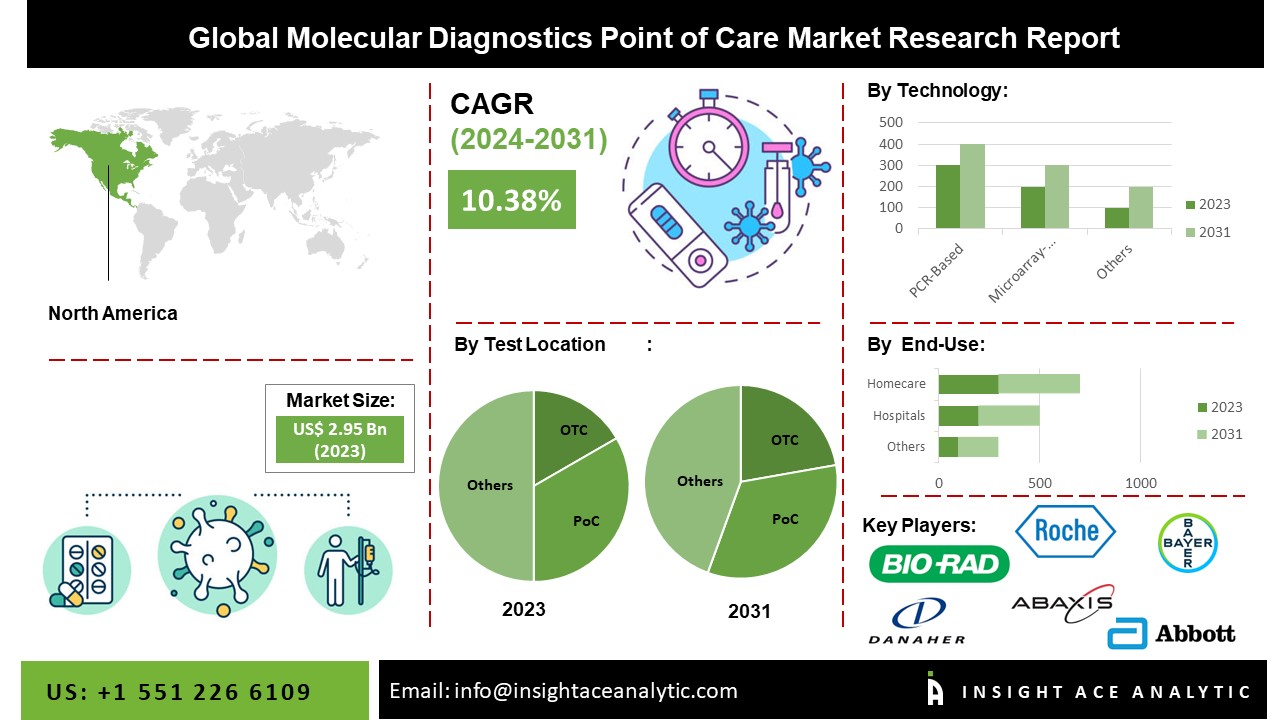
The Molecular Diagnostics Point of Care Market Size is valued at USD 2.95 Billion in 2023 and is predicted to reach USD 6.42 Billion by the year 2031 at a 10.38 % CAGR during the forecast period for 2024-2031.
Key Industry Insights & Findings from the Report:
Medical professionals use tests known as molecular diagnostics point of care to identify and diagnose infectious disorders. Hematology, fertility, infectious diseases, pregnancy, urinalysis testing kits, and glucose and cardiometabolic monitoring equipment are all included. In addition to monitoring hemoglobin and fecal occult blood, molecular diagnostics point of care is frequently used to identify infectious agents, gastrointestinal diseases, and minimal residual disease and to assess a patient's capacity to metabolize a given medicine or class of drugs. These tests provide quicker answers, lessen difficulties brought on by improper care, and enhance infection prevention techniques.
The global spread of infectious diseases is expanding, which is good news for the market. Another element driving expansion is the increasing need for PCR test kits to properly manage and control the spread of COVID-19. Additionally, the development of user-friendly, low-cost, and highly sensitive molecular diagnostic tests using downsizing, nanotechnology, and microfluidics is accelerating the market's expansion.
Moreover, numerous government initiatives to enhance molecular diagnostic capabilities and healthcare infrastructure favourably affect market growth. In addition, the market is anticipated to grow due to recent breakthroughs in cloud-connected POC diagnostic technologies, rapid progress in deoxyribonucleic acid (DNA) sequencing, and growing public awareness of advanced therapeutic and diagnostic testing.
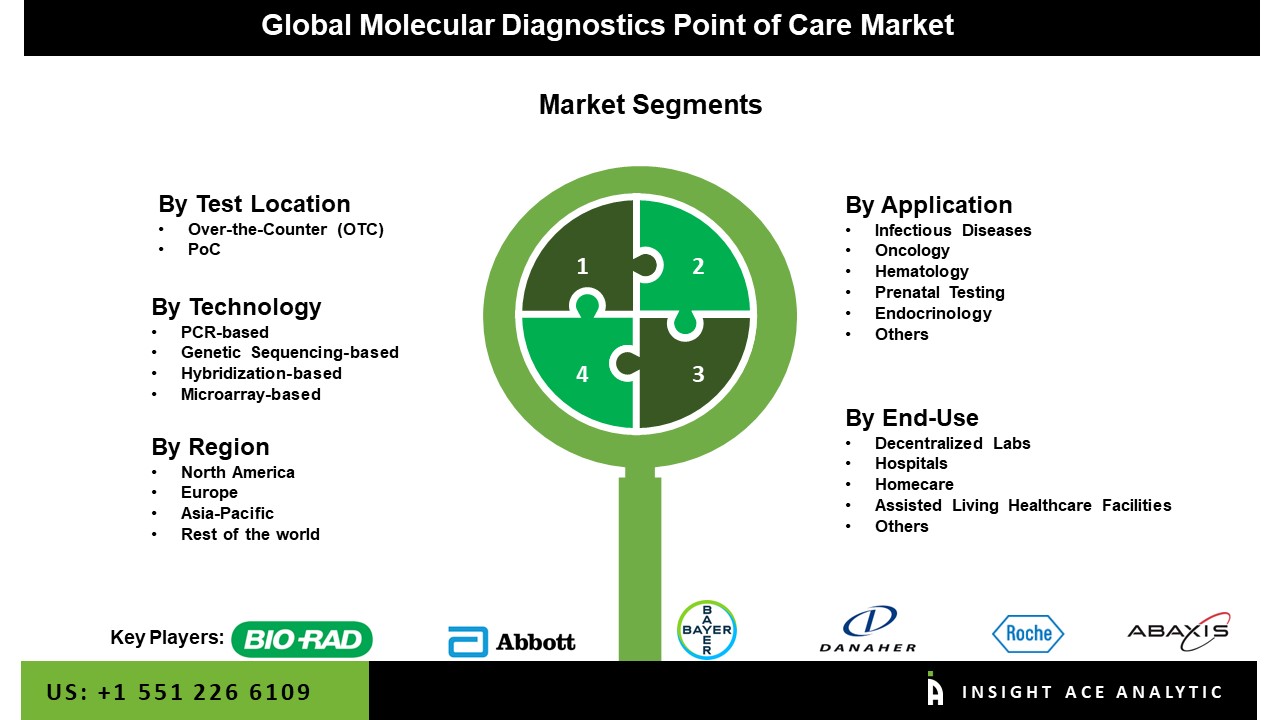
The molecular diagnostics point-of-care market is segmented on test location, technology, application and end-use. Based on test location, the market is segmented into over-the-counter (OTC) and PoC. Based on the technology, the market is categorized into PCR-based, genetic sequencing-based, hybridization-based and microarray-based. Based on the application, the market is segmented into infectious diseases, oncology, hematology, prenatal testing, endocrinology and others. Based on end-use, the market is categorized into decentralized labs, hospitals, homecare and assisted living healthcare facilities and others.
The over-the-counter (OTC) category dominated the market in 2021. Compared to POC testing, OTC tests are more adaptable and portable when used in homes and supportive living institutions. In most instances, patients and unqualified personnel make up the majority of OTC users. Additionally, a few of these test instruments are exempt from CLIA, allowing users to utilize them in settings other than laboratories. OTC tests are anticipated to generate more money during the forecasted period due to their simplicity, usefulness, and higher acceptance rate.
The PCR-based category dominated the market in 2021. The commercialization of PoC tests, which provide quick real-time PCR analysis with excellent precision for infectious illnesses like H1N1 and influenza, is driving the market. NGS-based molecular testing close to the patient is anticipated to increase significantly during the projected period due to numerous industry breakthroughs. This part is expected to be successful because of cutting-edge technological advancements that enable accurate genetic testing and quick diagnosis at the treatment site. Quick DNA analysis is anticipated to have significant expansion in the following years due to key industry competitors' ongoing development and R&D.
The North American molecular diagnostics point-of-care market is expected to register the highest market share in revenue in the near future. The rising incidence of infectious diseases, increasing CLIA product approvals, and expanding legislative measures are driving this market's expansion in North America. The ongoing efforts of major market players to strengthen their position are a crucial contributing factor. Several clinical trials will contribute to market growth throughout the projection period due to the diversity and precision of contemporary molecular tests. In addition, Asia Pacific is projected to grow rapidly in the global molecular diagnostics point-of-care market. The Asia Pacific molecular diagnostics point-of-care market is driven by factors including the aging population's increased prevalence of chronic diseases, a lack of highly developed central laboratory testing services, the growth of major market players in this region, and the potential cost-effectiveness of molecular diagnostics point-of-care.
| Report Attribute | Specifications |
| Market Size Value In 2023 | USD 2.95 Billion |
| Revenue Forecast In 2031 | USD 6.42 Billion |
| Growth Rate CAGR | CAGR of 10.38% from 2024 to 2031 |
| Quantitative Units | Representation of revenue in US$ Billion and CAGR from 2024 to 2031 |
| Historic Year | 2019 to 2023 |
| Forecast Year | 2024-2031 |
| Report Coverage | The forecast of revenue, the position of the company, the competitive market structure, growth prospects, and trends |
| Segments Covered | Test Location, Technology, Application, End-Use |
| Regional Scope | North America; Europe; Asia Pacific; Latin America; Middle East & Africa |
| Country Scope | U.S.; Canada; U.K.; Germany; China; India; Japan; Brazil; Mexico ;The UK; France; Italy; Spain; China; Japan; India; South Korea; South East Asia; South Korea; South East Asia |
| Competitive Landscape | Abbott Laboratories, Bayer Healthcare, Roche Diagnostics, Bio-Rad Laboratories, Danaher Corporation, BioMerieux, Dako, Abaxis Inc., OraSure Technologies Inc. and Nipro Diagnostics. |
| Customization Scope | Free customization report with the procurement of the report, Modifications to the regional and segment scope. Particular Geographic competitive landscape. |
| Pricing And Available Payment Methods | Explore pricing alternatives that are customized to your particular study requirements. |
By Test Location-
By Technology-
By Application-
By End-Use
By Region-
North America-
Europe-
Asia-Pacific-
Latin America-
Middle East & Africa-
This study employed a multi-step, mixed-method research approach that integrates:
This approach ensures a balanced and validated understanding of both macro- and micro-level market factors influencing the market.
Secondary research for this study involved the collection, review, and analysis of publicly available and paid data sources to build the initial fact base, understand historical market behaviour, identify data gaps, and refine the hypotheses for primary research.
Secondary data for the market study was gathered from multiple credible sources, including:
These sources were used to compile historical data, market volumes/prices, industry trends, technological developments, and competitive insights.

Primary research was conducted to validate secondary data, understand real-time market dynamics, capture price points and adoption trends, and verify the assumptions used in the market modelling.
Primary interviews for this study involved:
Interviews were conducted via:
Primary insights were incorporated into demand modelling, pricing analysis, technology evaluation, and market share estimation.
All collected data were processed and normalized to ensure consistency and comparability across regions and time frames.
The data validation process included:
This ensured that the dataset used for modelling was clean, robust, and reliable.
The bottom-up approach involved aggregating segment-level data, such as:
This method was primarily used when detailed micro-level market data were available.

The top-down approach used macro-level indicators:
This approach was used for segments where granular data were limited or inconsistent.
To ensure accuracy, a triangulated hybrid model was used. This included:
This multi-angle validation yielded the final market size.
Market forecasts were developed using a combination of time-series modelling, adoption curve analysis, and driver-based forecasting tools.
Given inherent uncertainties, three scenarios were constructed:
Sensitivity testing was conducted on key variables, including pricing, demand elasticity, and regional adoption.