Medical Stick-to-Skin Adhesives Market Size, Share & Trends Analysis Report By Product (Acrylic-Based, Silicone-Based, Rubber-Based, Hydrogel-based, Others), By Backing Material (Paper, Fabric, Plastic, Other Materials), By Material Type (Electrode Adhesives, Transdermal Drug Delivery Adhesives, Specialized Adhesives), By Application, By End User, By Region, And By Segment Forecasts, 2025-2034
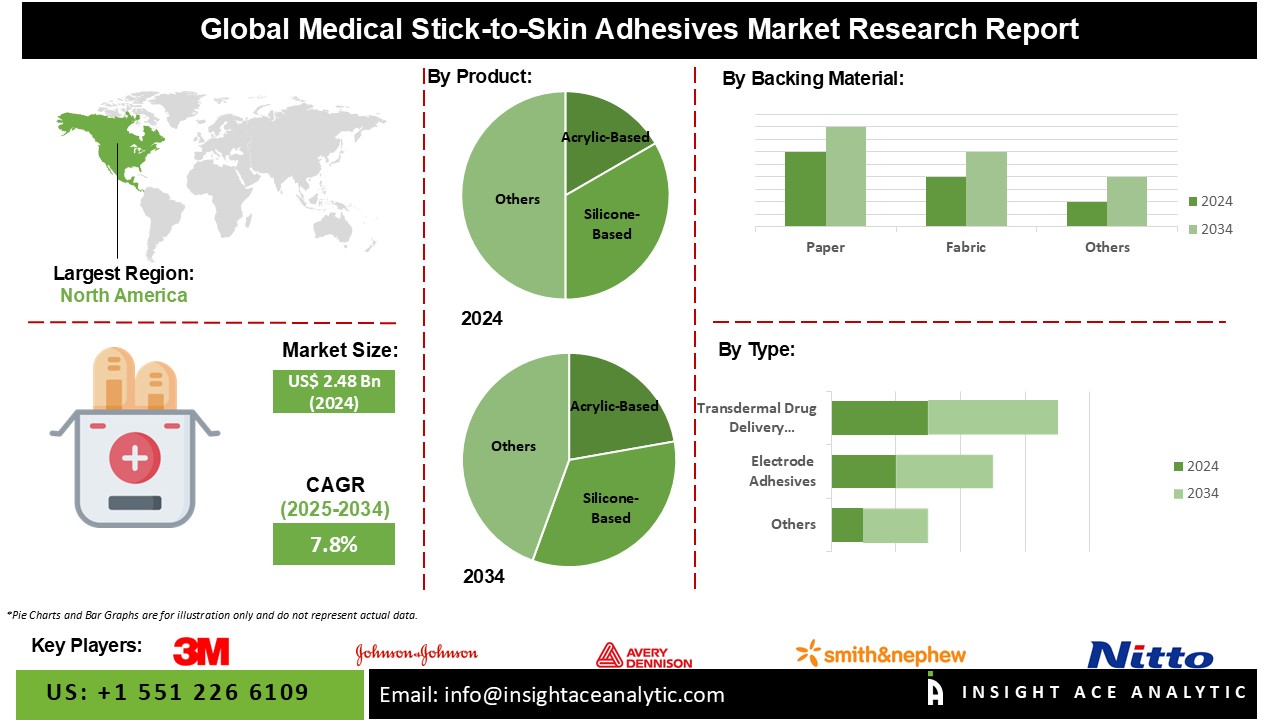
Medical Stick-to-Skin Adhesives Market Size is valued at USD 2.48 Bn in 2024 and is predicted to reach USD 5.18 Bn by the year 2034 at a 7.8% CAGR during the forecast period for 2025-2034.
Medical adhesives are designed to attach wearables to the skin securely for their specific purposes. Wear-time devices can be more intricate and have longer durations thanks to stick-to-skin adhesives' enhanced convenience and flexibility. The great thing about medical stick-to-skin adhesives in MIS is that they can shape themselves to fit the skin perfectly, ensuring a tight and safe closure. Having this in place is crucial for minimally invasive surgeries that involve sensitive body parts, like those involving the face or the abdomen (laparoscopic surgery). With the rise of improved medical stick-to-skin adhesives and the widespread use of MIS, the market is expected to experience significant growth. There will be plenty of room for growth and innovation in this quickly developing adhesive market as MIS keeps gaining popularity. Furthermore, the medical adhesive market is expected to experience expansion due to the anticipated increase in the medical implant industry.
However, the market growth is hampered by the lack of awareness criteria for the safety and health of medical stick-to-skin adhesives and the product's inability to prevent fog in environments with dramatic temperature fluctuations or high medical stick-to-skin, medical stick-to-skin adhesives also have issues in terms of safety. Adverse responses to these adhesives are uncommon, but they do happen. The improper application of the adhesives also poses the danger of skin irritation and infection. Because of these risks, doctors and patients may be reluctant to employ stick-to-skin adhesives for medical purposes. Due to the COVID-19 pandemic, which has affected the worldwide market and forced the closure of numerous factories to protect their personnel from contracting the virus, the expansion of the industry may be hindered.
Competitive Landscape
Some Major Key Players In The Medical Stick-to-Skin Adhesives Market:
- 3M Company (US)
- Scapa Healthcare (Mativ Holdings, Inc.) (UK)
- Johnson & Johnson (US)
- Avery Dennison Corporation (US)
- Smith & Nephew PLC (UK)
- Nitto Denko Corporation (Japan)
- DuPont de Nemours, Inc. (US)
- Medtronic Plc (Ireland)
- Braun Melsungen AG (Germany)
- Henkel AG & Co. KGaA (Germany)
- Gelita Medical (Germany)
- Lohmann & Rauscher (Germany)
- Advanced Medical Solutions Group plc (UK)
- Nichiban Co., Ltd. (Japan)
- Polymer Science, Inc. (US)
- Adhezion Biomedical, LLC (US)
- MBK Tape Solutions (Boyd) (US)
- Tapecon, Inc. (US)
- Chemence Medical, Inc. (US)
- Parafix (UK)
- Berry Global Inc. (US)
- DermaMed Coatings Company, LLC (US)
- Paul Hartmann AG (Germany)
- Mactac (US)
- Sekisui Kasei Co., Ltd. (Japan)
- Shurtape Technologies, LLC (US)
- Adhesives Research, Inc. (US)
- Others
Market Segmentation:
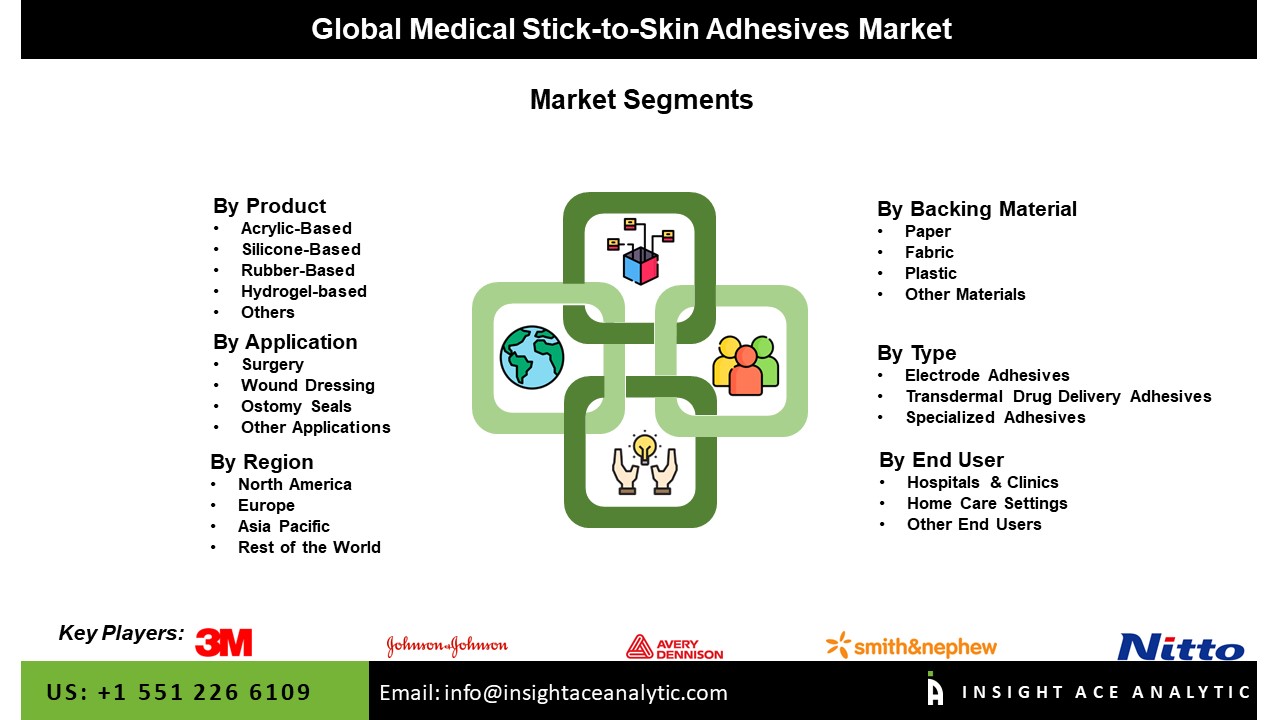
The medical stick-to-skin adhesives market is segmented based on product, material type, backing material, application, and end user. The product segment comprises acrylic, silicone, rubber, and water-based. By material type, the market is segmented into electrode, Transdermal Drug Delivery Adhesives and specialized. As per the backing material the market is segmented into Paper, Fabric, Plastic and Other Materials. The application segment consists of surgery, wound care, and ostomy seals. By end user, the market is segmented into hospital and homecare.
Based On The Product, The Acrylic Medical Stick-To-Skin Adhesives Market Segment Is A Major Contributor To The Medical Stick-To-Skin Adhesives Market.
The acrylic medical stick-to-skin adhesives market is expected to hold a major global market share in 2022. acrylics are used in various healthcare applications, from wound care and transdermal medication delivery systems to wearable medical devices. These adhesives are notable for their biocompatibility, incredible bonding properties, and long-term durability. Because they are both strong and easy to remove, acrylic adhesives are a great choice for use on delicate skin.
Specialized Segment To Witness Growth At A Rapid Rate.
The specialized industry makes up the bulk of medical stick-to-skin adhesives usage because wound dressings rely heavily on specialized adhesives, which help with things like moisture control and mild skin adherence, which in turn improve healing results and patient comfort, especially in countries like the US, Germany, China, the UK, India.
In The Region, The North American Medical Stick-To-Skin Adhesives Market Holds A Significant Revenue Share.
The North American medical stick-to-skin adhesives market is expected to record the maximum market revenue share in the near future. It can be attributed to the highly developed healthcare system, substantial public and private investment in healthcare, an ageing population, and influential figures in the area. In addition, Asia Pacific is estimated to grow rapidly in the global medical stick-to-skin adhesives market because more people need access to healthcare as the population continues to grow. Government spending on healthcare is likely to climb steadily over the projected period, which is good news for the medical adhesive market in the region.
Recent Developments:
- In October 2023, DuPont unveiled its latest product, the DuPont™ Liveo™ MG 7-9960 Soft Skin Adhesive. The high-adhesion, low-cyclic silicone soft skin adhesive (SSA) is specifically developed for advanced wound care dressings and for securely attaching medical devices to the skin for extended periods of time while ensuring easy and gentle removal.
- In Feb 2023, 3M introduced a novel medical adhesive named 3M™ Medical Tape 4578, capable of adhering to the skin for a duration of 28 days. Prior to 2022, prolonged medical adhesives were commonly utilized with a maximum duration of 14 days. Extended usage duration of gadgets and monitors resulted in decreased expenses, increased data collection for improved decision-making, and minimized patient disturbance.
Medical Stick-to-Skin Adhesives Market Report Scope
| Report Attribute | Specifications |
| Market Size Value In 2024 | USD 2.48 Bn |
| Revenue Forecast In 2034 | USD 5.18 Bn |
| Growth Rate CAGR | CAGR of 7.8% from 2025 to 2034 |
| Quantitative Units | Representation of revenue in US$ Bn and CAGR from 2025 to 2034 |
| Historic Year | 2021 to 2024 |
| Forecast Year | 2025-2034 |
| Report Coverage | The forecast of revenue, the position of the company, the competitive market structure, growth prospects, and trends |
| Segments Covered | By Product, By Backing Material, By Material Type, By Application, By End User |
| Regional Scope | North America; Europe; Asia Pacific; Latin America; Middle East & Africa |
| Country Scope | U.S.; Canada; U.K.; Germany; China; India; Japan; Brazil; Mexico; France; Italy; Spain; South East Asia; South Korea |
| Competitive Landscape | 3M Company (US), Scapa Healthcare (Mativ Holdings, Inc.) (UK), Johnson & Johnson (US), Avery Dennison Corporation (US), Smith & Nephew PLC (UK), Nitto Denko Corporation (Japan), DuPont de Nemours, Inc. (US), Medtronic Plc (Ireland), B. Braun Melsungen AG (Germany), Henkel AG & Co. KGaA (Germany), Gelita Medical (Germany), Lohmann & Rauscher (Germany), Advanced Medical Solutions Group plc (UK), Nichiban Co., Ltd. (Japan), Polymer Science, Inc. (US), Adhezion Biomedical, LLC (US), MBK Tape Solutions (Boyd) (US), Tapecon, Inc. (US), Chemence Medical, Inc. (US), Parafix (UK), Berry Global Inc. (US), DermaMed Coatings Company, LLC (US), Paul Hartmann AG (Germany), Mactac (US), Sekisui Kasei Co., Ltd. (Japan), Shurtape Technologies, LLC (US) and Adhesives Research, Inc. (US). |
| Customization Scope | Free customization report with the procurement of the report and modifications to the regional and segment scope. Particular Geographic competitive landscape. |
| Pricing And Available Payment Methods | Explore pricing alternatives that are customized to your particular study requirements. |
Segmentation of Medical Stick-to-Skin Adhesives Market-
Medical Stick-to-Skin Adhesives Market By Product-
- Acrylic-Based
- Silicone-Based
- Rubber-Based
- Hydrogel-based
- Others
Medical Stick-to-Skin Adhesives Market By Backing Material
- Paper
- Fabric
- Plastic
- Other Materials
Medical Stick-to-Skin Adhesives Market By Material Type
- Electrode Adhesives
- Transdermal Drug Delivery Adhesives
- Specialized Adhesives
Medical Stick-to-Skin Adhesives Market By Application
- Surgery
- Wound Dressing
- Ostomy Seals
- Other Applications
Medical Stick-to-Skin Adhesives Market By End User
- Hospitals & Clinics
- Home Care Settings
- Other End Users
Medical Stick-to-Skin Adhesives Market By Region-
North America-
- The US
- Canada
Europe-
- Germany
- The UK
- France
- Italy
- Spain
- Rest of Europe
Asia-Pacific-
- China
- Japan
- India
- South Korea
- Southeast Asia
- Rest of Asia Pacific
Latin America-
- Brazil
- Argentina
- Mexico
- Rest of Latin America
Middle East & Africa-
- GCC Countries
- South Africa
- Rest of the Middle East and Africa
Research Design and Approach
This study employed a multi-step, mixed-method research approach that integrates:
- Secondary research
- Primary research
- Data triangulation
- Hybrid top-down and bottom-up modelling
- Forecasting and scenario analysis
This approach ensures a balanced and validated understanding of both macro- and micro-level market factors influencing the market.
Secondary Research
Secondary research for this study involved the collection, review, and analysis of publicly available and paid data sources to build the initial fact base, understand historical market behaviour, identify data gaps, and refine the hypotheses for primary research.
Sources Consulted
Secondary data for the market study was gathered from multiple credible sources, including:
- Government databases, regulatory bodies, and public institutions
- International organizations (WHO, OECD, IMF, World Bank, etc.)
- Commercial and paid databases
- Industry associations, trade publications, and technical journals
- Company annual reports, investor presentations, press releases, and SEC filings
- Academic research papers, patents, and scientific literature
- Previous market research publications and syndicated reports
These sources were used to compile historical data, market volumes/prices, industry trends, technological developments, and competitive insights.

Primary Research
Primary research was conducted to validate secondary data, understand real-time market dynamics, capture price points and adoption trends, and verify the assumptions used in the market modelling.
Stakeholders Interviewed
Primary interviews for this study involved:
- Manufacturers and suppliers in the market value chain
- Distributors, channel partners, and integrators
- End-users / customers (e.g., hospitals, labs, enterprises, consumers, etc., depending on the market)
- Industry experts, technology specialists, consultants, and regulatory professionals
- Senior executives (CEOs, CTOs, VPs, Directors) and product managers
Interview Process
Interviews were conducted via:
- Structured and semi-structured questionnaires
- Telephonic and video interactions
- Email correspondences
- Expert consultation sessions
Primary insights were incorporated into demand modelling, pricing analysis, technology evaluation, and market share estimation.
Data Processing, Normalization, and Validation
All collected data were processed and normalized to ensure consistency and comparability across regions and time frames.
The data validation process included:
- Standardization of units (currency conversions, volume units, inflation adjustments)
- Cross-verification of data points across multiple secondary sources
- Normalization of inconsistent datasets
- Identification and resolution of data gaps
- Outlier detection and removal through algorithmic and manual checks
- Plausibility and coherence checks across segments and geographies
This ensured that the dataset used for modelling was clean, robust, and reliable.
Market Size Estimation and Data Triangulation
Bottom-Up Approach
The bottom-up approach involved aggregating segment-level data, such as:
- Company revenues
- Product-level sales
- Installed base/usage volumes
- Adoption and penetration rates
- Pricing analysis
This method was primarily used when detailed micro-level market data were available.

Top-Down Approach
The top-down approach used macro-level indicators:
- Parent market benchmarks
- Global/regional industry trends
- Economic indicators (GDP, demographics, spending patterns)
- Penetration and usage ratios
This approach was used for segments where granular data were limited or inconsistent.
Hybrid Triangulation Approach
To ensure accuracy, a triangulated hybrid model was used. This included:
- Reconciling top-down and bottom-up estimates
- Cross-checking revenues, volumes, and pricing assumptions
- Incorporating expert insights to validate segment splits and adoption rates
This multi-angle validation yielded the final market size.
Forecasting Framework and Scenario Modelling
Market forecasts were developed using a combination of time-series modelling, adoption curve analysis, and driver-based forecasting tools.
Forecasting Methods
- Time-series modelling
- S-curve and diffusion models (for emerging technologies)
- Driver-based forecasting (GDP, disposable income, adoption rates, regulatory changes)
- Price elasticity models
- Market maturity and lifecycle-based projections
Scenario Analysis
Given inherent uncertainties, three scenarios were constructed:
- Base-Case Scenario: Expected trajectory under current conditions
- Optimistic Scenario: High adoption, favourable regulation, strong economic tailwinds
- Conservative Scenario: Slow adoption, regulatory delays, economic constraints
Sensitivity testing was conducted on key variables, including pricing, demand elasticity, and regional adoption.
Request Customization
Add countries, segments, company profiles, or extend forecast — free 10% customization with purchase.
Customize This Report →Enquire Before Buying
Speak with our analyst team about scope, methodology, pricing, or deliverable formats.
Enquire Now →Frequently Asked Questions
Medical Stick-to-Skin Adhesives Market Size is valued at USD 2.48 Bn in 2024 and is predicted to reach USD 5.18 Bn by the year 2034
Medical Stick-to-Skin Adhesives Market is expected to grow at a 7.8% CAGR during the forecast period for 2025-2034.
DermaMed Coatings Company, LLC (US), Paul Hartmann AG (Germany), Mactac (US), Sekisui Kasei Co., Ltd. (Japan), Shurtape Technologies, LLC (US) and Adh
medical stick-to-skin adhesives market is segmented based on product, material type, backing material, application, and end user.
North America region is leading the medical stick-to-skin adhesives market.