Mastectomy Reconstruction Implants Market Market Size, Share & Trends Analysis Report by product (Two-Stage Implant Reconstruction {Tissue Expanders with Acellular Dermal Matrix [ADM]} [Prepectoral Breast Reconstruction Surgery, and Sub-pectoral Breast Reconstruction Surgery], and Direct-to-Implant Reconstruction), End User(Hospitals, Cosmetology Clinics, Ambulatory Surgical Centers, and Medical Spas), Region And Segment Forecasts, 2023-2031
The Global Mastectomy Reconstruction Implants Market Size is valued at 1.92 billion in 2022 and is predicted to reach 3.99 billion by the year 2031 at a 8.61% CAGR during the forecast period for 2023-2031.
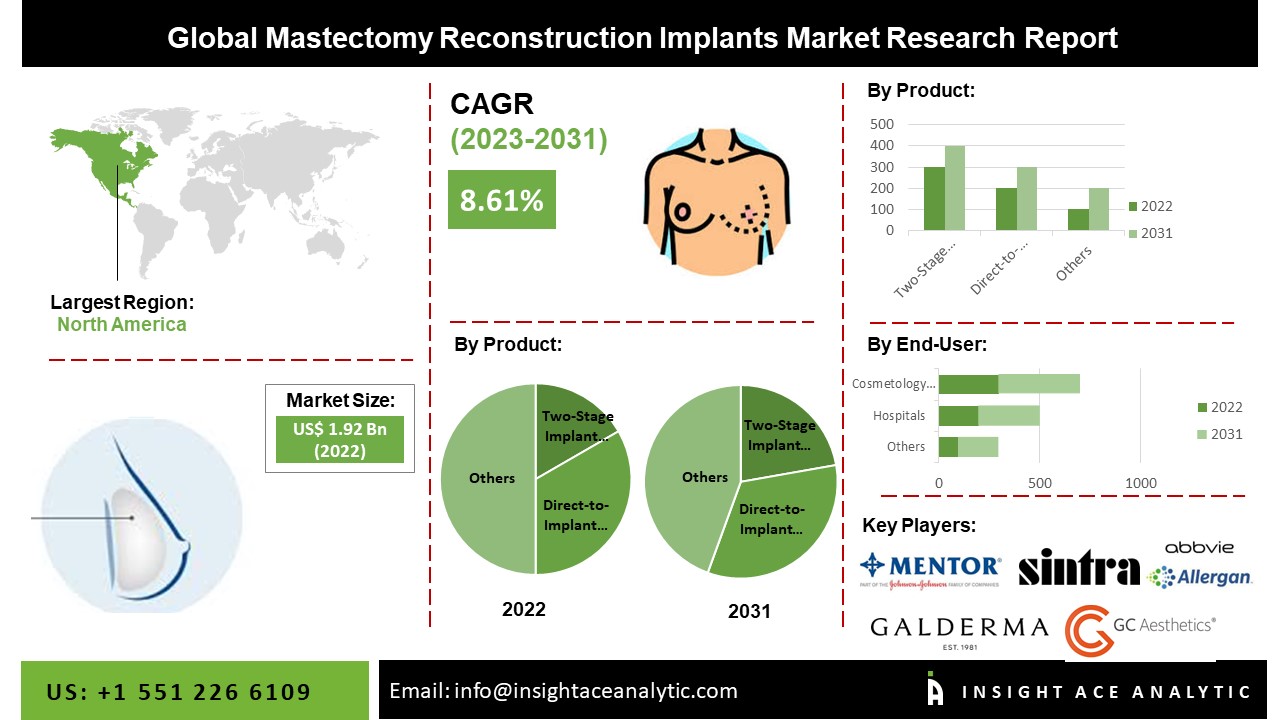
The primary element propelling the market in this domain is anticipated to be the rising importance placed on physical appearance. Mastectomy reconstruction surgeries are projected to become more popular due to the rising incidence of obesity and cancer.
The market for mastectomy reconstruction is expanding due to rising healthcare expenses, the prevalence of hereditary disorders in women, and government backing. The increase in patients choosing contralateral preventive mastectomy in unilateral, early-stage breast cancer is primarily responsible for the rise in mastectomies. This has increased the demand for mastectomy reconstruction treatments and the goods used in those procedures.
The mastectomy reconstruction industry is expanding mostly due to rising self-awareness and concerns about appearance, yet factors like the availability of alternatives could restrain market expansion.
Moreover, the robust research funding is another factor driving the increase of the market share for mastectomy reconstruction. Vendors and research institutions have conducted extensive studies and developed non-therapeutic procedures, including mastectomy reconstruction, to treat the indication. Additionally, the availability of alternatives will pose a significant obstacle to expanding the worldwide mastectomy reconstruction market share. Due to the growing popularity of alternatives such as padded bras and breast shapes among breast cancer patients, as well as treatments like skin grafting or autologous reconstruction, the global market for mastectomy reconstruction is experiencing difficulties.
Competitive Landscape:
Some of the Mastectomy Reconstruction Implants market players are:
- Mentor Worldwide LLC (Johnson & Johnson) (US)
- Allergan Aesthetics Inc. (an AbbVie company) (US)
- Ideal Implant Incorporated (US)
- Sabin (France)
- GC Aesthetics (Ireland)
- POLYTECH Health & Aesthetics (Germany)
- Sentra (US)
- Integra Lifesciences (US)
- RTI Surgical Holdings (US)
- Establishment Labs S.A. (US)
- Slimed (Brazil)
Market Segmentation:
The mastectomy reconstruction implants market is segmented based on product and end users. Based on the product, the mastectomy reconstruction implants market is segmented into two-stage and direct-to-implant reconstruction. The mastectomy reconstruction implants marketers.
Based On The Product, The Direct-To-Implant Reconstruction Segment Is A Major Contributor To The Mastectomy Reconstruction Implants Market
The category will hold a major share of the global Mastectomy Reconstruction Implants market 2022. A breast implant is directly inserted during mastectomy surgery using the direct-to-implant reconstruction approach, eliminating the need for tissue expanders. This method has become more popular recently since it provides some benefits over conventional two-stage rebuilding techniques. Direct-to-implant reconstruction has grown in importance as a treatment option for mastectomy patients. After the breast tissue is removed, a permanent breast implant is placed immediately, eliminating the necessity for a second surgery to swap tissue expanders for implants.
The Cosmetology Clinics Segment Witnessed Growth At A Rapid Rate
The cosmetology clinics segment is projected to grow rapidly in the global mastectomy reconstruction implants market. Cosmetology clinics offer thorough post-operative care to guarantee healthy recovery and the best outcomes. To track the development of the reconstruction and manage any issues or complications that might arise, they provide continuing care and follow-up sessions.
The growth of cosmetology clinics in the market for mastectomy reconstruction implants reflects the rising demand for mastectomy reconstruction services that are specialized and visually pleasing. These clinics support the general development of the industry by catering to the demands and preferences of patients searching for attractive and natural-looking results.
The North America Mastectomy Reconstruction Implants Market Holds A Significant Revenue Share In The Region
The North America mastectomy reconstruction implants market is projected to register the highest market share. The expansion of businesses making acellular dermal matrices and breast implants, as well as the persistent increase in the prevalence of breast cancer, all contribute to the market's expansion in the area. The rising popularity of mastectomy reconstruction treatments influences the North American breast implant market. In addition, Asia Pacific is projected to grow rapidly in the global mastectomy reconstruction implants market.
The significant increase in breast augmentation treatments is partly responsible for this region's high share. Additionally, the market expansion in the region would be further boosted by the quickening acceptance of cosmetic operations. The availability of reimbursement plans for mastectomy reconstruction is also helping the Asia Pacific mastectomy reconstruction business.
Mastectomy Reconstruction Implants Market Report Scope:
| Report Attribute | Specifications |
| Market Size Value In 2022 | USD 1.92 Bn |
| Revenue Forecast In 2031 | USD 3.99 Bn |
| Growth Rate CAGR | CAGR of 8.61 % from 2023 to 2031 |
| Quantitative Units | Representation of revenue in US$ Bn and CAGR from 2023 to 2031 |
| Historic Year | 2019 to 2022 |
| Forecast Year | 2023-2031 |
| Report Coverage | The forecast of revenue, the position of the company, the competitive market structure, growth prospects, and trends |
| Segments Covered | Type Of Technology, Product, Application, And End User |
| Regional Scope | North America; Europe; Asia Pacific; Latin America; Middle East & Africa |
| Country Scope | U.S.; Canada; U.K.; Germany; China; India; Japan; Brazil; Mexico; The UK; France; Italy; Spain; China; Japan; India; South Korea; South East Asia; South Korea; South East Asia |
| Competitive Landscape | Mentor Worldwide LLC (Johnson & Johnson) (US), Allergan Aesthetics Inc. (an AbbVie company) (US), Ideal Implant Incorporated (US), Sabin (France), GC Aesthetics (Ireland), POLYTECH Health & Aesthetics (Germany), Sentra (US), Integra Lifesciences (US), RTI Surgical Holdings (US), Establishment Labs S.A. (US) and Slimed (Brazil) |
| Customization Scope | Free customization report with the procurement of the report, Modifications to the regional and segment scope. Particular Geographic competitive landscape. |
| Pricing and Available Payment Methods | Explore pricing alternatives that are customized to your particular study requirements. |
Segmentation of Mastectomy Reconstruction Implants Market-
By Product-
- Two Stage Implant Reconstruction
- Direct to implant reconstruction
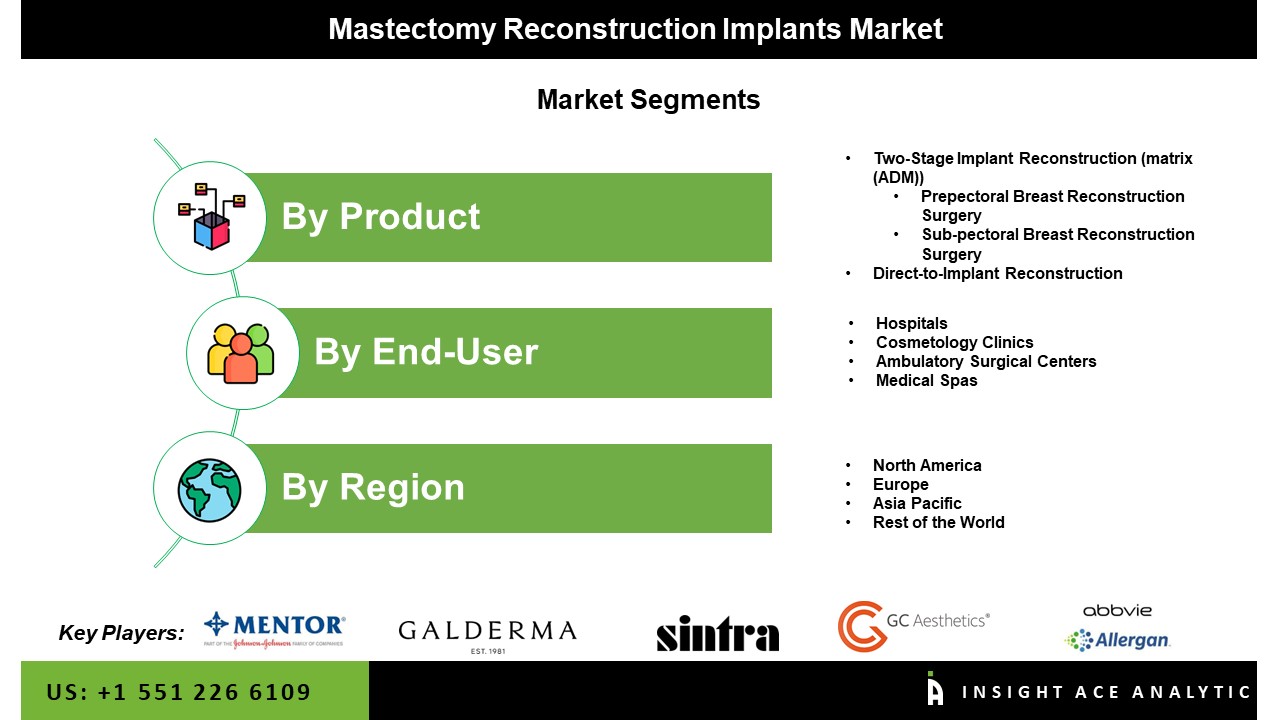
By End User-
- Hospitals
- Cosmetology Clinics
- Ambulatory Surgical Centers
- Medical spas
By Region-
North America-
- The US
- Canada
- Mexico
Europe-
- Germany
- The UK
- France
- Italy
- Spain
- Rest of Europe
Asia-Pacific-
- China
- Japan
- India
- South Korea
- South East Asia
- Rest of Asia Pacific
Latin America-
- Brazil
- Argentina
- Rest of Latin America
Middle East & Africa-
- GCC Countries
- South Africa
- Rest of Middle East and Africa
Research Design and Approach
This study employed a multi-step, mixed-method research approach that integrates:
- Secondary research
- Primary research
- Data triangulation
- Hybrid top-down and bottom-up modelling
- Forecasting and scenario analysis
This approach ensures a balanced and validated understanding of both macro- and micro-level market factors influencing the market.
Secondary Research
Secondary research for this study involved the collection, review, and analysis of publicly available and paid data sources to build the initial fact base, understand historical market behaviour, identify data gaps, and refine the hypotheses for primary research.
Sources Consulted
Secondary data for the market study was gathered from multiple credible sources, including:
- Government databases, regulatory bodies, and public institutions
- International organizations (WHO, OECD, IMF, World Bank, etc.)
- Commercial and paid databases
- Industry associations, trade publications, and technical journals
- Company annual reports, investor presentations, press releases, and SEC filings
- Academic research papers, patents, and scientific literature
- Previous market research publications and syndicated reports
These sources were used to compile historical data, market volumes/prices, industry trends, technological developments, and competitive insights.

Primary Research
Primary research was conducted to validate secondary data, understand real-time market dynamics, capture price points and adoption trends, and verify the assumptions used in the market modelling.
Stakeholders Interviewed
Primary interviews for this study involved:
- Manufacturers and suppliers in the market value chain
- Distributors, channel partners, and integrators
- End-users / customers (e.g., hospitals, labs, enterprises, consumers, etc., depending on the market)
- Industry experts, technology specialists, consultants, and regulatory professionals
- Senior executives (CEOs, CTOs, VPs, Directors) and product managers
Interview Process
Interviews were conducted via:
- Structured and semi-structured questionnaires
- Telephonic and video interactions
- Email correspondences
- Expert consultation sessions
Primary insights were incorporated into demand modelling, pricing analysis, technology evaluation, and market share estimation.
Data Processing, Normalization, and Validation
All collected data were processed and normalized to ensure consistency and comparability across regions and time frames.
The data validation process included:
- Standardization of units (currency conversions, volume units, inflation adjustments)
- Cross-verification of data points across multiple secondary sources
- Normalization of inconsistent datasets
- Identification and resolution of data gaps
- Outlier detection and removal through algorithmic and manual checks
- Plausibility and coherence checks across segments and geographies
This ensured that the dataset used for modelling was clean, robust, and reliable.
Market Size Estimation and Data Triangulation
Bottom-Up Approach
The bottom-up approach involved aggregating segment-level data, such as:
- Company revenues
- Product-level sales
- Installed base/usage volumes
- Adoption and penetration rates
- Pricing analysis
This method was primarily used when detailed micro-level market data were available.

Top-Down Approach
The top-down approach used macro-level indicators:
- Parent market benchmarks
- Global/regional industry trends
- Economic indicators (GDP, demographics, spending patterns)
- Penetration and usage ratios
This approach was used for segments where granular data were limited or inconsistent.
Hybrid Triangulation Approach
To ensure accuracy, a triangulated hybrid model was used. This included:
- Reconciling top-down and bottom-up estimates
- Cross-checking revenues, volumes, and pricing assumptions
- Incorporating expert insights to validate segment splits and adoption rates
This multi-angle validation yielded the final market size.
Forecasting Framework and Scenario Modelling
Market forecasts were developed using a combination of time-series modelling, adoption curve analysis, and driver-based forecasting tools.
Forecasting Methods
- Time-series modelling
- S-curve and diffusion models (for emerging technologies)
- Driver-based forecasting (GDP, disposable income, adoption rates, regulatory changes)
- Price elasticity models
- Market maturity and lifecycle-based projections
Scenario Analysis
Given inherent uncertainties, three scenarios were constructed:
- Base-Case Scenario: Expected trajectory under current conditions
- Optimistic Scenario: High adoption, favourable regulation, strong economic tailwinds
- Conservative Scenario: Slow adoption, regulatory delays, economic constraints
Sensitivity testing was conducted on key variables, including pricing, demand elasticity, and regional adoption.
Request Customization
Add countries, segments, company profiles, or extend forecast — free 10% customization with purchase.
Customize This Report →Enquire Before Buying
Speak with our analyst team about scope, methodology, pricing, or deliverable formats.
Enquire Now →Frequently Asked Questions
Mastectomy Reconstruction Implants Market Size is valued at 1.92 billion in 2022 and is predicted to reach 3.99 billion by the year 2031
Mastectomy Reconstruction Implants Market expected to grow at a 8.61% CAGR during the forecast period for 2023-2031
Mentor Worldwide LLC (Johnson & Johnson) (US), Allergan Aesthetics Inc. (an AbbVie company) (US), Ideal Implant Incorporated (US), Sabin (France), GC