Lithium Iron Phosphate Batteries Market Size, Share & Trends Analysis Report By Cell Type (Prismatic Cells, Cylindrical Cells, Pouch Cells), By Voltage (Low (below 12V), Medium (12V–36V), High (above 36V), By Capacity (Below 50 kWh, 50–200 kWh, Above 200 kWh), By Application (Electric Vehicles (EVs) & Hybrid Electric Vehicles (HEVs), Stationary Energy Storage Systems (ESS) , Consumer Electronics, Power Tools & Industrial Equipment , Marine / Off-grid / Aerospace / Others), By Chemical Integration, By End User, By Region and By Segments Forecasts 2024-2031
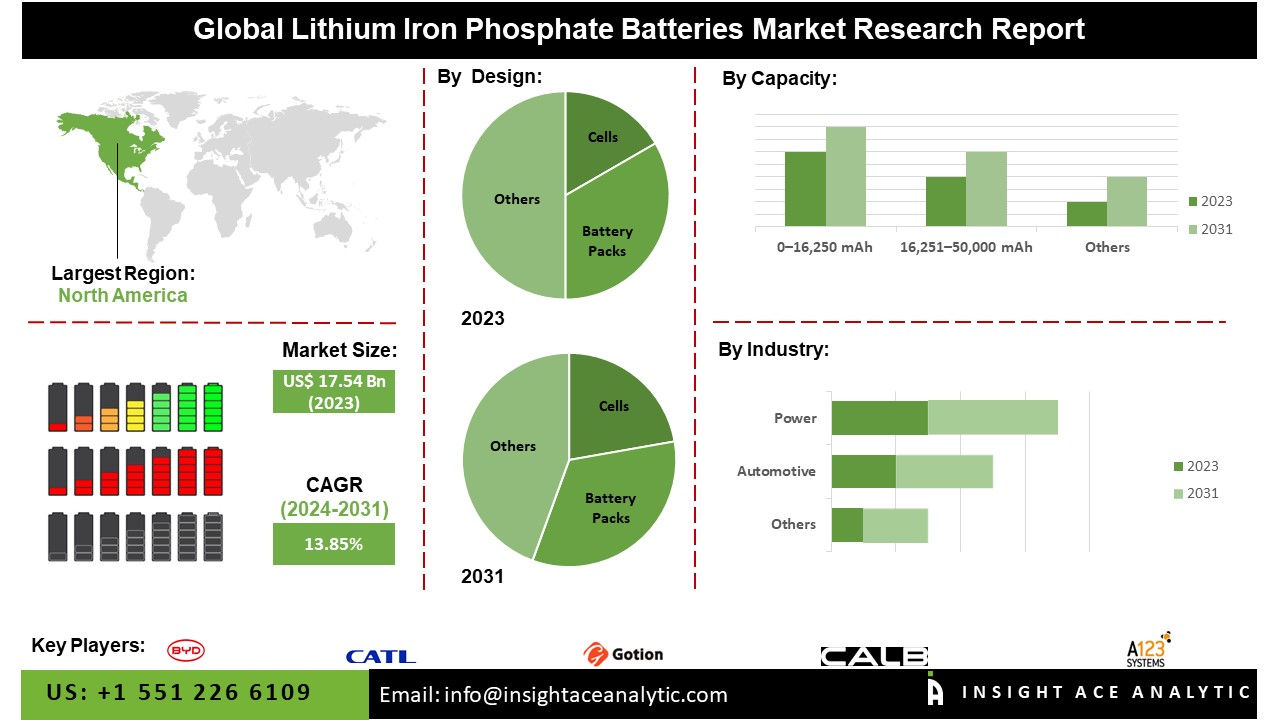
Global Lithium Iron Phosphate Batteries Market Size is valued at USD 17.54 Bn in 2023 and is predicted to reach USD 48.95 Bn by the year 2031 at a 13.85% CAGR during the forecast period for 2024-2031.
Lithium iron phosphate (LFP) battery is a popular form of lithium-ion rechargeable battery that may be rapidly charged and discharged. Power density, voltage, energy density, cycle life, discharge rate, temperature, and safety are all improved with LFP battery packs. Industrial adoption of LFP batteries can be partly attributed to the government's efforts to rein in rising pollution levels through rigorous regulation.
Energy companies worldwide are investing in renewable energy generation and storage facilities. LFP batteries are increasingly used in grids and energy storage devices because of their inexpensive price, low self-discharge rate, and small installation footprint. These batteries are superior to others because they can withstand higher temperatures, making them useful in thermal control and other out-of-the-way places. Furthermore, rising global demand for electric vehicles and energy storage is expected to create substantial growth opportunities for the lithium-iron phosphate batteries market throughout the forecast period. Manufacturers of lithium-iron phosphate batteries are increasingly valuing novel, custom-fit solutions to cut costs and boost output.
However, the market growth is hampered by the high-cost criteria for the safety and health of the lithium iron phosphate batteries market and the product's inability to prevent fog in environments with dramatic temperature fluctuations or high humidity lithium iron phosphate batteries market. The expansion of LFP batteries is predicted to be hampered by the rising demand for other batteries, such as lead-acid batteries, sodium-nickel chloride batteries, flow batteries, and lithium-air batteries in consumer electronics, electric vehicles, and energy storage systems. The emergence of novel energy technologies like flywheel batteries also restricts market expansion. As COVID-19 has spread, it has impeded the development of LFP batteries. Because of the serious interruptions to industry and the global economy brought on by the epidemic, the demand for LFP batteries has been steadily decreasing.
Competitive Landscape
Some Major Key Players In The Lithium Iron Phosphate Batteries Market:
- Contemporary Amperex Technology Co., Limited (CATL)
- BYD Company Limited
- Gotion High-Tech Co., Ltd.
- EVE Energy Co., Ltd.
- CALB (China Aviation Lithium Battery Co., Ltd.)
- LG Energy Solution Ltd.
- Samsung SDI Co., Ltd.
- Tesla, Inc.
- A123 Systems LLC
- K2 Energy Solutions Inc.
- Farasis Energy Inc.
- Svolt Energy Technology Co., Ltd.
- REPT Battery Co., Ltd.
- HiNa Battery Technology Co., Ltd.
- Sunwoda Electronic Co., Ltd.
- Phylion Battery Co., Ltd.
- Lithium Werks B.V.
- EnerSys
- Valence Technology Inc.
- Simpliphi Power (Briggs & Stratton)
- American Battery Factory (ABF)
- Ufine Battery (Dongguan Ufine Electronic Technology Co., Ltd.)
- Shenzhen Bestray New Energy Co., Ltd.
- Must Energy (Guangdong) Technology Co., Ltd.
- OptimumNano Energy Co., Ltd.
- Panasonic Corporation
- Hitachi Energy Ltd.
- Molicel (E-One Moli Energy Corp.)
- Lithium Australia Ltd.
- Fortum Recycling & Battery Solutions
- Enertech International Inc.
- Stellantis N.V.
- VinFast Energy (Vingroup)
- Amperex Technology Limited (ATL)
- Li-Time Energy
- Others
Market Segmentation:
The lithium iron phosphate batteries market is categorised based on Design, Industry, application, Capacity and voltage. As per the Design, the market is segmented into Cell and Battery Pack. According to voltage, the market is divided into Low (Below 12 V), Medium (12-36 V), and High (Above 36 V). The Capacity segment comprises (0–16,250 MAH, 16,251–50,000 MAH, 50,001–100,000 MAH, 100,001–540,000 MAH). In comparison, the Application segment consists of Portable and Stationary. As per the Industry segment, the market is divided into Automotive (Battery Electric Vehicle (BEV), Plug-In Hybrid Electric Vehicle (PHEV), 2- & 3-wheelers, Hybrid Electric Vehicle (HEV), Bus & Truck), Power (Stationary, Residential), Industrial (Forklifts, Mining Equipment, Construction Equipment), Consumer Electronics (UPS, Camping Equipment, Others), Aerospace, Marine (Commercial, Tourism, Navy), Others (Telecommunications, Medical)).
Based On The Type, The Power Lithium Iron Phosphate Batteries Market Segment Is Accounted As A Major Contributor To The Lithium Iron Phosphate Batteries Market.
The power lithium iron phosphate batteries market is expected to hold a highest global market share in 2024. The power sector is actively researching renewable energy generation and storage options. Smart grid technology is used to generate, regulate, and distribute this stored energy. Lithium iron phosphate batteries are increasingly used in smart grids and renewable energy storage systems due to their many advantageous properties.
Portable Segment To Witness Growth At A Rapid Rate.
The portable industry makes up the bulk of lithium iron phosphate battery usage because of the increasing use of these batteries in cars. When building electric or hybrid electric vehicles, the auto industry frequently uses LifePO4 batteries, especially in countries like the US, Germany, the UK, China, and India.
In The Region, The North American Lithium Iron Phosphate Batteries Market Holds A Significant Revenue Share.
The North American lithium iron phosphate batteries market is expected to record the maximum market share in revenue in the near future. It can be attributed to because all the major producers are located here. Growth in the region is likely if the government adopts an upbeat stance and offers incentives. As the market for EVs grows, so too will the demand for LFP batteries. In addition, Asia Pacific is projected to grow rapidly in the global lithium iron phosphate batteries market because of the increasing demand for zero-emission vehicles as the demand for electronics like smartphones, laptops, and power tools grows globally.
Recent Developments:
- In March 2023, CATL and the BAIC Group signed a strategic agreement to collaborate commercially and share cutting-edge technologies. CATL will supply BAIC Group with competitive EV battery goods and services and assist in the development and production of BAIC Group's electric vehicles under the terms of the agreement.
- In July 2023, Gotion, Inc. and Edison Power Co., Ltd. partnered to promote renewable energy in Japan, grow the market for big storage batteries, and recycle used batteries. Moreover, the organization will collaborate with Edison Power to launch an LFP battery recycling system in Japan.
Lithium Iron Phosphate Batteries Market Report Scope:
| Report Attribute | Specifications |
| Market Size Value In 2023 | USD 17.54 Bn |
| Revenue Forecast In 2031 | USD 48.95 Bn |
| Growth Rate CAGR | CAGR of 13.85 % from 2024 to 2031 |
| Quantitative Units | Representation of revenue in US$ Million and CAGR from 2024 to 2031 |
| Historic Year | 2019 to 2023 |
| Forecast Year | 2024-2031 |
| Report Coverage | The forecast of revenue, the position of the company, the competitive market structure, growth prospects, and trends |
| Segments Covered | Cell Type, End User, Battery Cell Chemistry & Integration, Capacity Range, Voltage and Application |
| Regional Scope | North America; Europe; Asia Pacific; Latin America; Middle East & Africa |
| Country Scope | U.S.; Canada; U.K.; Germany; China; India; Japan; Brazil; Mexico; The UK; France; Italy; Spain; China; Japan; India; South Korea; South East Asia; South Korea; South East Asia |
| Competitive Landscape | Contemporary Amperex Technology Co., Limited (CATL), BYD Company Limited, Gotion High-Tech Co., Ltd., EVE Energy Co., Ltd., CALB (China Aviation Lithium Battery Co., Ltd.), LG Energy Solution Ltd., Samsung SDI Co., Ltd., Tesla, Inc., A123 Systems LLC, K2 Energy Solutions Inc., Farasis Energy Inc., Svolt Energy Technology Co., Ltd., REPT Battery Co., Ltd., HiNa Battery Technology Co., Ltd., Sunwoda Electronic Co., Ltd., Phylion Battery Co., Ltd., Lithium Werks B.V., EnerSys, Valence Technology Inc., Simpliphi Power (Briggs & Stratton), American Battery Factory (ABF), Ufine Battery (Dongguan Ufine Electronic Technology Co., Ltd.), Shenzhen Bestray New Energy Co., Ltd., Must Energy (Guangdong) Technology Co., Ltd., OptimumNano Energy Co., Ltd., Panasonic Corporation, Hitachi Energy Ltd., Molicel (E-One Moli Energy Corp.), Lithium Australia Ltd., Fortum Recycling & Battery Solutions, Enertech International Inc., Stellantis N.V., VinFast Energy (Vingroup), Amperex Technology Limited (ATL), Li-Time Energy |
| Customization Scope | Free customization report with the procurement of the report and modifications to the regional and segment scope. Particular Geographic competitive landscape. |
| Pricing And Available Payment Methods | Explore pricing alternatives that are customized to your particular study requirements. |
Segmentation of Lithium Iron Phosphate Batteries Market-
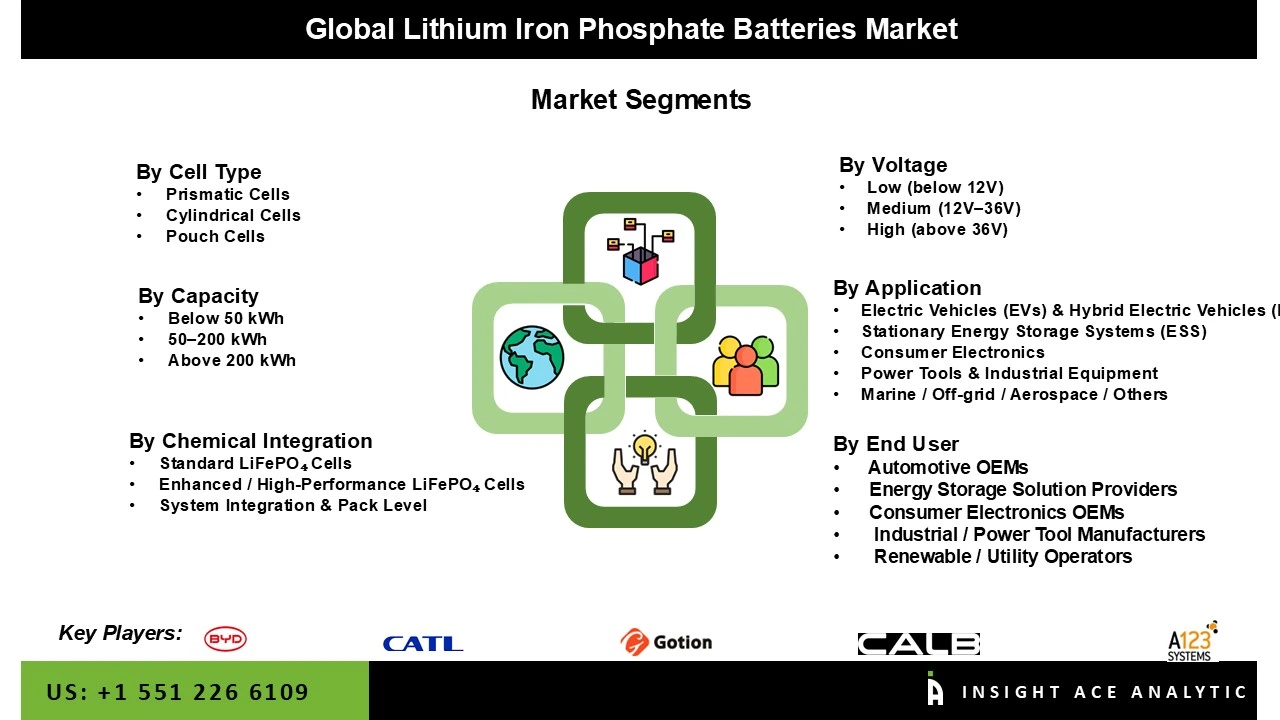
Lithium Iron Phosphate Batteries Market By Cell Type:
- Prismatic Cells
- Cylindrical Cells
- Pouch Cells
Lithium Iron Phosphate Batteries Market By Voltage
- Low (Below 12 V)
- Medium (12-36 V)
- High (Above 36 V)
Lithium Iron Phosphate Batteries Market By Capacity
- Below 50 kWh
- 50–200 kWh
- Above 200 kWh
Lithium Iron Phosphate Batteries Market By Application
- Electric Vehicles (EVs) & Hybrid Electric Vehicles (HEVs)
-
- Passenger Cars
- Commercial Vehicles
- Two-/Three-Wheelers
- Special Purpose Vehicles
- Stationary Energy Storage Systems (ESS)
-
- Residential Storage
- Commercial & Industrial Storage
- Utility-Scale / Grid Storage
- Consumer Electronics
-
- Laptops / Tablets
- Power Banks / UPS
- Drones / Wearables
- Power Tools & Industrial Equipment
-
- Cordless Tools
- Robotics / Automation Systems
- Marine / Off-grid / Aerospace / Others
Lithium Iron Phosphate Batteries Market By Chemical Integration-
- Standard LiFePO₄ Cells
- Enhanced / High-Performance LiFePO₄ Cells
- System Integration & Pack Level
Lithium Iron Phosphate Batteries Market By End User-
- Automotive OEMs
- Energy Storage Solution Providers
- Consumer Electronics OEMs
- Industrial / Power Tool Manufacturers
- Renewable / Utility Operators
Lithium Iron Phosphate Batteries Market By Region-
North America-
- The US
- Canada
- Mexico
Europe-
- Germany
- The UK
- France
- Italy
- Spain
- Rest of Europe
Asia-Pacific-
- China
- Japan
- India
- South Korea
- South East Asia
- Rest of Asia Pacific
Latin America-
- Brazil
- Argentina
- Rest of Latin America
Middle East & Africa-
- GCC Countries
- South Africa
- Rest of the Middle East and Africa
Research Design and Approach
This study employed a multi-step, mixed-method research approach that integrates:
- Secondary research
- Primary research
- Data triangulation
- Hybrid top-down and bottom-up modelling
- Forecasting and scenario analysis
This approach ensures a balanced and validated understanding of both macro- and micro-level market factors influencing the market.
Secondary Research
Secondary research for this study involved the collection, review, and analysis of publicly available and paid data sources to build the initial fact base, understand historical market behaviour, identify data gaps, and refine the hypotheses for primary research.
Sources Consulted
Secondary data for the market study was gathered from multiple credible sources, including:
- Government databases, regulatory bodies, and public institutions
- International organizations (WHO, OECD, IMF, World Bank, etc.)
- Commercial and paid databases
- Industry associations, trade publications, and technical journals
- Company annual reports, investor presentations, press releases, and SEC filings
- Academic research papers, patents, and scientific literature
- Previous market research publications and syndicated reports
These sources were used to compile historical data, market volumes/prices, industry trends, technological developments, and competitive insights.

Primary Research
Primary research was conducted to validate secondary data, understand real-time market dynamics, capture price points and adoption trends, and verify the assumptions used in the market modelling.
Stakeholders Interviewed
Primary interviews for this study involved:
- Manufacturers and suppliers in the market value chain
- Distributors, channel partners, and integrators
- End-users / customers (e.g., hospitals, labs, enterprises, consumers, etc., depending on the market)
- Industry experts, technology specialists, consultants, and regulatory professionals
- Senior executives (CEOs, CTOs, VPs, Directors) and product managers
Interview Process
Interviews were conducted via:
- Structured and semi-structured questionnaires
- Telephonic and video interactions
- Email correspondences
- Expert consultation sessions
Primary insights were incorporated into demand modelling, pricing analysis, technology evaluation, and market share estimation.
Data Processing, Normalization, and Validation
All collected data were processed and normalized to ensure consistency and comparability across regions and time frames.
The data validation process included:
- Standardization of units (currency conversions, volume units, inflation adjustments)
- Cross-verification of data points across multiple secondary sources
- Normalization of inconsistent datasets
- Identification and resolution of data gaps
- Outlier detection and removal through algorithmic and manual checks
- Plausibility and coherence checks across segments and geographies
This ensured that the dataset used for modelling was clean, robust, and reliable.
Market Size Estimation and Data Triangulation
Bottom-Up Approach
The bottom-up approach involved aggregating segment-level data, such as:
- Company revenues
- Product-level sales
- Installed base/usage volumes
- Adoption and penetration rates
- Pricing analysis
This method was primarily used when detailed micro-level market data were available.

Top-Down Approach
The top-down approach used macro-level indicators:
- Parent market benchmarks
- Global/regional industry trends
- Economic indicators (GDP, demographics, spending patterns)
- Penetration and usage ratios
This approach was used for segments where granular data were limited or inconsistent.
Hybrid Triangulation Approach
To ensure accuracy, a triangulated hybrid model was used. This included:
- Reconciling top-down and bottom-up estimates
- Cross-checking revenues, volumes, and pricing assumptions
- Incorporating expert insights to validate segment splits and adoption rates
This multi-angle validation yielded the final market size.
Forecasting Framework and Scenario Modelling
Market forecasts were developed using a combination of time-series modelling, adoption curve analysis, and driver-based forecasting tools.
Forecasting Methods
- Time-series modelling
- S-curve and diffusion models (for emerging technologies)
- Driver-based forecasting (GDP, disposable income, adoption rates, regulatory changes)
- Price elasticity models
- Market maturity and lifecycle-based projections
Scenario Analysis
Given inherent uncertainties, three scenarios were constructed:
- Base-Case Scenario: Expected trajectory under current conditions
- Optimistic Scenario: High adoption, favourable regulation, strong economic tailwinds
- Conservative Scenario: Slow adoption, regulatory delays, economic constraints
Sensitivity testing was conducted on key variables, including pricing, demand elasticity, and regional adoption.
Request Customization
Add countries, segments, company profiles, or extend forecast — free 10% customization with purchase.
Customize This Report →Enquire Before Buying
Speak with our analyst team about scope, methodology, pricing, or deliverable formats.
Enquire Now →Frequently Asked Questions
Lithium Iron Phosphate Batteries Market Size is valued at USD 17.54 Bn in 2023 and is predicted to reach USD 48.95 Bn by the year 2031
Lithium Iron Phosphate Batteries Market is expected to grow at a 13.8% CAGR during the forecast period for 2024-2031.
Phosphate Batteries Market ky players are Contemporary Amperex Technology Co., Limited (CATL), BYD Company Limited, Gotion High-Tech Co., Ltd., EVE Energy Co., Ltd., CALB (China Aviation Lithium Battery Co., Ltd.), LG Energy Solution Ltd., Samsung SDI Co., Ltd., Tesla, Inc., A123 Systems LLC, K2 Energy Solutions Inc., Farasis Energy Inc., Svolt Energy Technology Co., Ltd., REPT Battery Co., Ltd., HiNa Battery Technology Co., Ltd., Sunwoda Electronic Co., Ltd., Phylion Battery Co., Ltd., Lithium Werks B.V., EnerSys, Valence Technology Inc., Simpliphi Power (Briggs & Stratton), American Battery Factory (ABF), Ufine Battery (Dongguan Ufine Electronic Technology Co., Ltd.), Shenzhen Bestray New Energy Co., Ltd., and Others
Cell Type, End User, Battery Cell Chemistry & Integration, Capacity Range, Voltage and Application are the key segments of the Lithium Iron Phosphate Batteries Market.