Hydrogen Vehicles Market, Share & Trends Analysis Report, By Technology (PAFC (Phosphoric Acid Fuel Cell), DMFC (Direct Methanol Fuel Cell), and PEMFC (Proton Exchange Membrane Fuel Cell)), By Fuel Capacity, By Vehicle Category, and By Region, and Segment Forecasts, 2023-2031
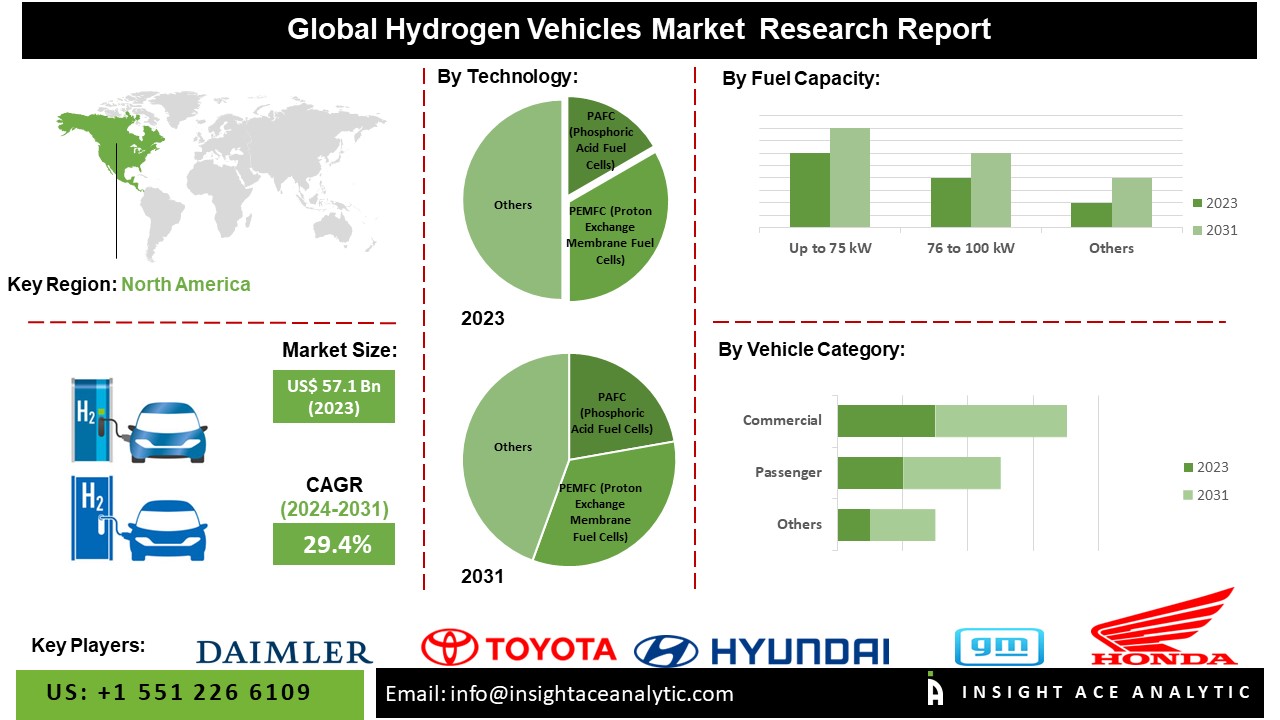
The Hydrogen Vehicles Market Size is valued at USD 57.1 Bn in 2023 and is predicted to reach USD 427.3 Bn by the year 2031 at a 29.4% CAGR during the forecast period for 2024-2031.
The world of science is moving toward environmentally friendly energy sources due to the harmful effects of emissions from conventional fuel cars. Among the various options, hydrogen is an ideal renewable energy source for powering vehicles. As an energy carrier, hydrogen can transport enormous amounts of energy, similar to electricity. Fuel cell electric vehicles (FCEVs) use this electricity to power an electric motor, much like all-electric vehicles. However, unlike other electric cars that rely solely on batteries, FCEVs generate electricity using hydrogen-powered fuel cells. This process involves a chemical reaction between hydrogen and oxygen, producing electricity and emitting only water vapor as a byproduct. This makes FCEVs a clean and efficient alternative for sustainable transportation.
For instance, emerging countries like India (2023) have introduced national hydrogen policies that focus on the development and infrastructure of hydrogen, including vehicles. These policies set the stage for future regulations. The Mission will enable India to take the lead in green hydrogen technology and market share, significantly reduce its dependency on imports of fossil fuels, and decarbonize the economy. Additionally, the European Parliament approved A resolution highlighting the potential of hydrogen for energy-intensive industry, transportation, and seasonal energy storage in July 2020.
Competitive Landscape
Some of the Major Key Players in the Hydrogen Vehicles Market are
- AB Volvo
- Audi AG
- Ballard Power System
- BMW AG
- DAF
- Daimler AG
- FAW
- FuelCell Energy Inc.
- General Motors
- GM Hydrogenics
- Hinduja Group
- Honda Motor Company Ltd.
- Hydrogen Vehicle Systems Ltd (HVS)
- Hyperion Motors
- Hyundai Motor Company
- Hyzon Motors Inc.
- MAN SE
- Mercedes-Benz
- Nikola Motors
- Riversimple
- SAIC Motors
- Tevva Motors Limited.
- Toyota Motor Corporation
- Yutong
- Other Prominent Players
Market Segmentation:
The market is segmented based on the type of technology, type of fuel capacity, and vehicle capacity. Based on the technology, they segmented into PAFC (Phosphoric Acid Fuel Cells), DMFC (Direct Methanol Fuel Cells), and PEMFC (Proton Exchange Membrane Fuel Cells). By fuel capacity, the segment is categorized into up to 75 kW, 76 to 100 kW, 101 to 150 kW, and above 150 kW. By Vehicle Category, the segmented into, passenger, commercial.
The PEMFC (Proton Exchange Membrane Fuel Cells) Segment is Expected to have the highest growth rate during the forecast period
Based on the technology, the market is categorized into PAFC (Phosphoric Acid Fuel Cells), DMFC (Direct Methanol Fuel Cells), and PEMFC (Proton Exchange Membrane Fuel Cells). Among these, the PEMFC (Proton Exchange Membrane Fuel Cells) Segment is Expected to have the highest growth rate during the forecast period. PEMFC technology is more mature and has been the focus of significant research and development, leading to improved durability, cost reduction, and overall performance. These advancements make PEMFCs the preferred choice for hydrogen vehicles. Additionally, the existing and planned hydrogen refueling infrastructure is primarily designed to support PEMFC-based vehicles, further driving the adoption of PEMFCs in the hydrogen vehicle market.
The Commercial Vehicle Segment Dominate The Market
Based on the vehicle category the market is segmented into passenger, and commercial. Among these, the commercial vehicle segment dominates the market. Environmental concerns, infrastructure development, technology developments, carmaker commitment, government assistance, pilot programs, demonstrations, and industry stakeholder collaborations contribute to the increasing acceptance of hydrogen-powered passenger automobiles. Hydrogen-powered passenger cars are driving the market's growth as a sustainable and effective form of transportation.
North America Have the Largest Market Share During Forecast Period
North America accounts for the largest share due to many leading companies and research institutions focused on advancing hydrogen fuel cell technology. Continuous R&D efforts have led to improvements in fuel cell efficiency, durability, and cost-effectiveness. North America has a growing awareness and demand for environmentally friendly transportation options. Many North American corporations and public sector entities are adopting hydrogen vehicles as part of their sustainability initiatives. This includes using hydrogen-powered buses, trucks, and fleet vehicles, which helps drive market growth.
Recent Developments:
- In April 2024, Ballard Power announced that its customer Wrightbus (https://wrightbus.com/), a UK-based bus manufacturer deploying hydrogen-powered buses in the UK and Europe, has placed multiple purchase orders totaling seventy FCmove®-HD hydrogen fuel cell engines. Ballard anticipates that the buses will go into operation in 2025 and that the fuel cell engines will be delivered in 2024. In Germany and the UK, hydrogen fuel cell motors will propel single- and double-decker buses.
- In May 2024, Toyota Motor North America (TMNA) declared that it would be calling its new North American Hydrogen Headquarters (H2HQ) the TMNA R&D California office. The new H2HQ's office space was recently remodeled for its teams working on everything from research and development to commercialization planning and sales of hydrogen-related products and technologies. Plans call for adding significant elements to the H2HQ facility, including a sustainable customer education center and a flexible microgrid.
Hydrogen Vehicles Market Report Scope
| Report Attribute | Specifications |
| Market Size Value In 2023 | USD 57.1 Bn |
| Revenue Forecast In 2031 | USD 427.3 Bn |
| Growth Rate CAGR | CAGR of 29.4% from 2024 to 2031 |
| Quantitative Units | Representation of revenue in US$ Bn and CAGR from 2024 to 2031 |
| Historic Year | 2019 to 2023 |
| Forecast Year | 2024-2031 |
| Report Coverage | The forecast of revenue, the position of the company, the competitive market structure, growth prospects, and trends |
| Segments Covered | By Technology, Fuel Capacity, And Vehicle Category |
| Regional Scope | North America; Europe; Asia Pacific; Latin America; Middle East & Africa |
| Country Scope | U.S.; Canada; U.K.; Germany; China; India; Japan; Brazil; Mexico; The UK; France; Italy; Spain; China; Japan; India; South Korea; Southeast Asia; South Korea; South East Asia |
| Competitive Landscape | Mercedes-Benz, GM Hydrogenics, DAF, Ballard Power System, Toyota Motor Corporation, Hinduja Group, Daimler AG, FuelCell Energy Inc. Hyundai Motor Company, Audi AG, BMW AG, General Motors, Honda Motor Company Ltd. |
| Customization Scope | Free customization report with the procurement of the report and modifications to the regional and segment scope. Particular Geographic competitive landscape. |
| Pricing and Available Payment Methods | Explore pricing alternatives that are customized to your particular study requirements. |
Segmentation of Hydrogen Vehicles Market
Global Hydrogen Vehicles Market - By Technology
- PAFC (Phosphoric Acid Fuel Cells)
- DMFC (Direct Methanol Fuel Cells)
- PEMFC (Proton Exchange Membrane Fuel Cells)
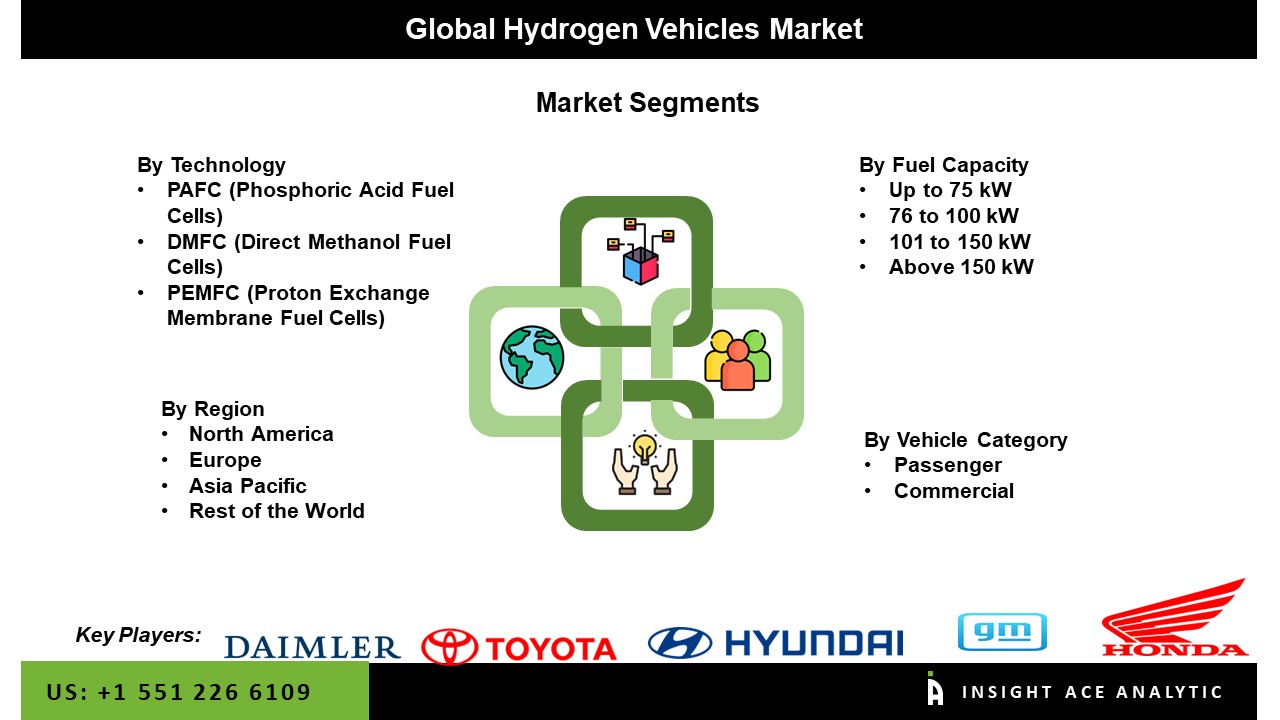
Global Hydrogen Vehicles Market – By Fuel Capacity
- Up to 75 kW
- 76 to 100 kW
- 101 to 150 kW
- Above 150 kW
Global Hydrogen Vehicles Market – By Vehicle Category
- Passenger
- Commercial
Global Hydrogen Vehicles Market – By Region
North America-
- The US
- Canada
- Mexico
Europe-
- Germany
- The UK
- France
- Italy
- Spain
- Rest of Europe
Asia-Pacific-
- China
- Japan
- India
- South Korea
- Southeast Asia
- Rest of Asia Pacific
Latin America-
- Brazil
- Argentina
- Rest of Latin America
Middle East & Africa-
- GCC Countries
- South Africa
- Rest of the Middle East and Africa
Research Design and Approach
This study employed a multi-step, mixed-method research approach that integrates:
- Secondary research
- Primary research
- Data triangulation
- Hybrid top-down and bottom-up modelling
- Forecasting and scenario analysis
This approach ensures a balanced and validated understanding of both macro- and micro-level market factors influencing the market.
Secondary Research
Secondary research for this study involved the collection, review, and analysis of publicly available and paid data sources to build the initial fact base, understand historical market behaviour, identify data gaps, and refine the hypotheses for primary research.
Sources Consulted
Secondary data for the market study was gathered from multiple credible sources, including:
- Government databases, regulatory bodies, and public institutions
- International organizations (WHO, OECD, IMF, World Bank, etc.)
- Commercial and paid databases
- Industry associations, trade publications, and technical journals
- Company annual reports, investor presentations, press releases, and SEC filings
- Academic research papers, patents, and scientific literature
- Previous market research publications and syndicated reports
These sources were used to compile historical data, market volumes/prices, industry trends, technological developments, and competitive insights.

Primary Research
Primary research was conducted to validate secondary data, understand real-time market dynamics, capture price points and adoption trends, and verify the assumptions used in the market modelling.
Stakeholders Interviewed
Primary interviews for this study involved:
- Manufacturers and suppliers in the market value chain
- Distributors, channel partners, and integrators
- End-users / customers (e.g., hospitals, labs, enterprises, consumers, etc., depending on the market)
- Industry experts, technology specialists, consultants, and regulatory professionals
- Senior executives (CEOs, CTOs, VPs, Directors) and product managers
Interview Process
Interviews were conducted via:
- Structured and semi-structured questionnaires
- Telephonic and video interactions
- Email correspondences
- Expert consultation sessions
Primary insights were incorporated into demand modelling, pricing analysis, technology evaluation, and market share estimation.
Data Processing, Normalization, and Validation
All collected data were processed and normalized to ensure consistency and comparability across regions and time frames.
The data validation process included:
- Standardization of units (currency conversions, volume units, inflation adjustments)
- Cross-verification of data points across multiple secondary sources
- Normalization of inconsistent datasets
- Identification and resolution of data gaps
- Outlier detection and removal through algorithmic and manual checks
- Plausibility and coherence checks across segments and geographies
This ensured that the dataset used for modelling was clean, robust, and reliable.
Market Size Estimation and Data Triangulation
Bottom-Up Approach
The bottom-up approach involved aggregating segment-level data, such as:
- Company revenues
- Product-level sales
- Installed base/usage volumes
- Adoption and penetration rates
- Pricing analysis
This method was primarily used when detailed micro-level market data were available.

Top-Down Approach
The top-down approach used macro-level indicators:
- Parent market benchmarks
- Global/regional industry trends
- Economic indicators (GDP, demographics, spending patterns)
- Penetration and usage ratios
This approach was used for segments where granular data were limited or inconsistent.
Hybrid Triangulation Approach
To ensure accuracy, a triangulated hybrid model was used. This included:
- Reconciling top-down and bottom-up estimates
- Cross-checking revenues, volumes, and pricing assumptions
- Incorporating expert insights to validate segment splits and adoption rates
This multi-angle validation yielded the final market size.
Forecasting Framework and Scenario Modelling
Market forecasts were developed using a combination of time-series modelling, adoption curve analysis, and driver-based forecasting tools.
Forecasting Methods
- Time-series modelling
- S-curve and diffusion models (for emerging technologies)
- Driver-based forecasting (GDP, disposable income, adoption rates, regulatory changes)
- Price elasticity models
- Market maturity and lifecycle-based projections
Scenario Analysis
Given inherent uncertainties, three scenarios were constructed:
- Base-Case Scenario: Expected trajectory under current conditions
- Optimistic Scenario: High adoption, favourable regulation, strong economic tailwinds
- Conservative Scenario: Slow adoption, regulatory delays, economic constraints
Sensitivity testing was conducted on key variables, including pricing, demand elasticity, and regional adoption.
Request Customization
Add countries, segments, company profiles, or extend forecast — free 10% customization with purchase.
Customize This Report →Enquire Before Buying
Speak with our analyst team about scope, methodology, pricing, or deliverable formats.
Enquire Now →Frequently Asked Questions
The Hydrogen Vehicles Market Size is valued at USD 57.1 Bn in 2023 and is predicted to reach USD 427.3 Bn by the year 2031
The Hydrogen Vehicles Market is estimated to grow at a 29.4% CAGR during the forecast period for 2024-2031.
Mercedes-Benz, GM Hydrogenics, DAF, Ballard Power System, Toyota Motor Corporation, Hinduja Group, Daimler AG, FuelCell Energy Inc., Hyundai Motor Com