



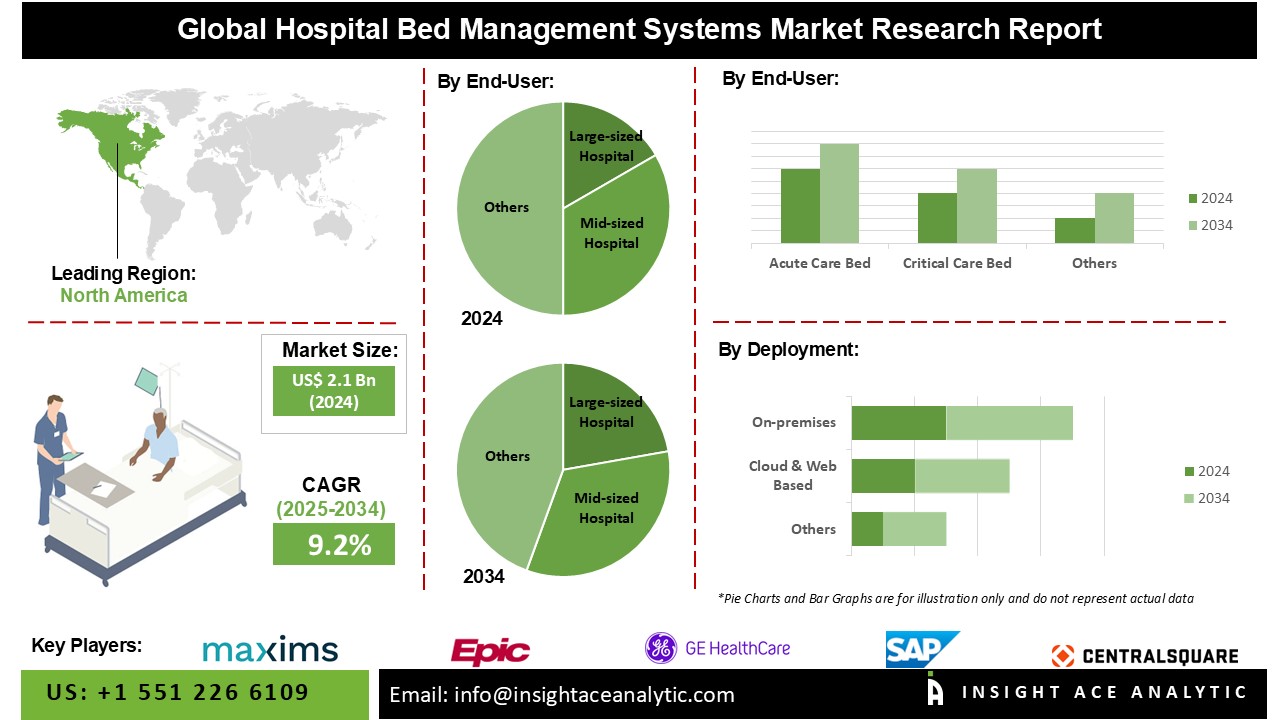
Global Hospital Bed Management Systems Market Size is valued at USD 2.1 Bn in 2024 and is predicted to reach USD 5.1 Bn by the year 2034 at a 9.2% CAGR during the forecast period for 2025-2034.
Hospital bed management systems are software and technology solutions that help healthcare facilities optimize the allocation and administration of hospital beds and other resources. These systems serve a crucial role in augmenting patient care, promoting operational efficiency, and ensuring healthcare providers' ability to successfully satisfy patient needs.
The primary factors responsible for market expansion are the rising occurrence of chronic and infectious diseases, the increasing geriatric population, and the increasing adoption of real-time bed management in hospitals. Furthermore, rising awareness of hospital-friendly and user-friendly software for smooth bed allotment operations, as well as an increase in the number of hospitals and clinics, are driving market expansion. As a result, there will be an increased need for hospital bed management systems in the near future. Furthermore, the hospital bed management system provides real-time information on bed availability with color codes and assists hospital staff in managing the growing number of patient admissions.
However, the COVID-19 pandemic has shown to be an unmatched global public health issue, affecting practically every industry and is projected to impact every industry's growth during the forecast period. Around the world, there have been several shifts in customer demand and behaviour, purchasing patterns, supply chain redirection, and significant government interventions.
Some Major Key Players In The Hospital Bed Management Systems Market:
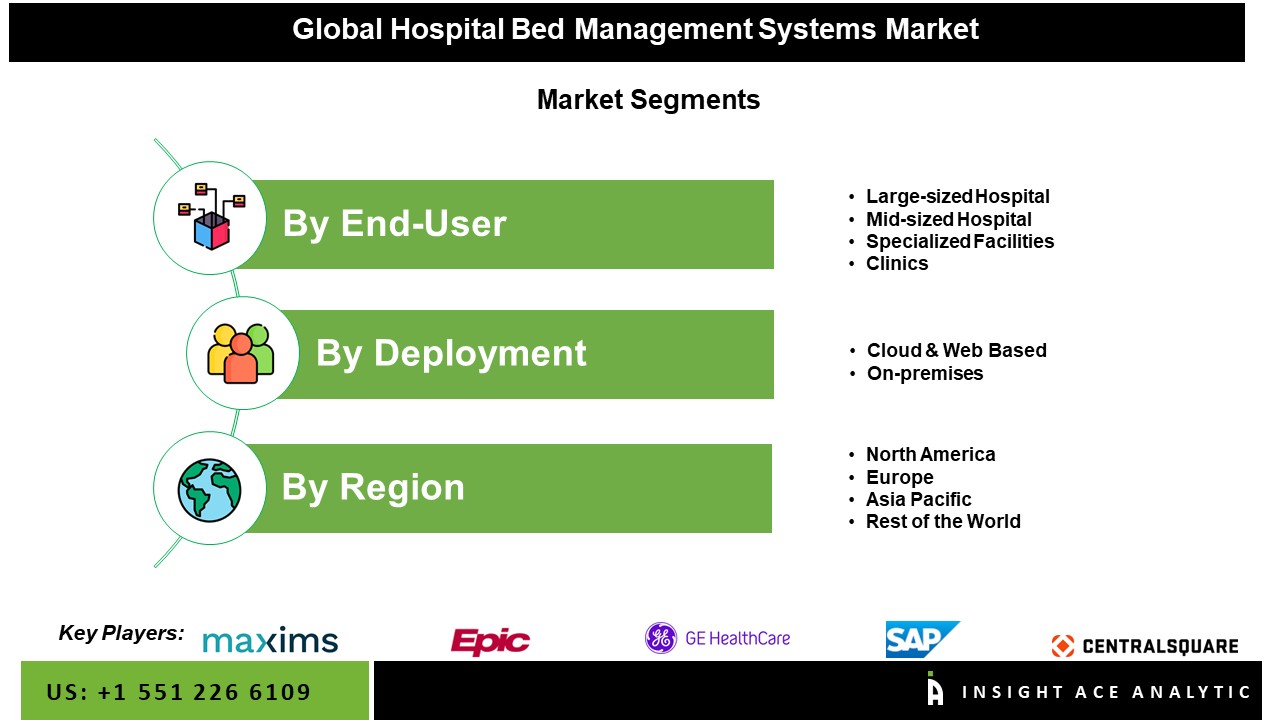
The Hospital Bed Management Systems Market is segmented based on End-Users and deployment. Based on End-Users, the market is segmented as Large-sized Hospital, Mid-sized Hospital, Specialized Facilities and Clinics. The deployment segment includes Cloud & Web Based and On-premises.
The Large-sized Hospital category is expected to hold a major share in the global Hospital Bed Management Systems Market in 2022. The increase is attributed to an increase in admissions at healthcare facilities. Large-sized hospitals have capacity to accomodate more number of patients hence bed mangament systems are in demand.
The segment, Cloud & Web is projected to grow rapidly in the global Hospital Bed Management Systems Market. The increased adoption of cloud solutions in clinics to improve efficacy and lower costs is related to the growth. Cloud solutions provide scalability, allowing healthcare organizations to effortlessly change or grow their software usage based on their needs. This flexibility enables them to better handle a growing hospital demand and serve a huge patient pool without considerable infrastructure investments. In addition, cloud computing allows for real-time data sharing, data modification, security, storage flexibility, and dependability. These factors contribute to the increasing popularity and demand for cloud-based hospital management systems, enabling healthcare organizations to streamline operations, improve patient care, and optimize resource utilization.
The North America Hospital Bed Management Systems Market is expected to record the maximum market share in revenue in the near future. This is due to the rapid acceptance of technologically advanced products. Factors such as well-established infrastructure, widespread implementation of hospital bed management systems, and the presence of key market competitors in the region are driving regional expansion.
The Asia Pacific area is expected to increase significantly during the projection period. End-user awareness of computerized maintenance management systems (CMMS) is developing, opening up new market prospects. Furthermore, several governments are spending heavily on cloud and related healthcare technologies to support digital transformation, potentially increasing the Asia Pacific market.
| Report Attribute | Specifications |
| Market Size Value In 2024 | USD 2.1 Bn |
| Revenue Forecast In 2034 | USD 5.1 Bn |
| Growth Rate CAGR | CAGR of 9.2% from 2025 to 2034 |
| Quantitative Units | Representation of revenue in US$ Bn and CAGR from 2025 to 2034 |
| Historic Year | 2021 to 2024 |
| Forecast Year | 2025-2034 |
| Report Coverage | The forecast of revenue, the position of the company, the competitive market structure, growth prospects, and trends |
| Segments Covered | By End-User, By Deployment |
| Regional Scope | North America; Europe; Asia Pacific; Latin America; Middle East & Africa |
| Country Scope | U.S.; Canada; U.K.; Germany; China; India; Japan; Brazil; Mexico ;The UK; France; Italy; Spain; China; Japan; India; South Korea; South East Asia; South Korea; South East Asia |
| Competitive Landscape | Epic Systems Corporation, GE Healthcare, CentralSquare Technologiesm, Advanced Data Systems, Lyngsoe Systems A/S, The Access Group, EMIS Health, TeleTracking Technologies, Inc., SAP, IMS MAXIMS, Blueberry Health, Wise Technologies Ltd., HospitalRun, Cognosys, Patient Focus Systems, SARU TECH, Others |
| Customization Scope | Free customization report with the procurement of the report, Modifications to the regional and segment scope. Particular Geographic competitive landscape. |
| Pricing And Available Payment Methods | Explore pricing alternatives that are customized to your particular study requirements. |
Hospital Bed Management Systems Market By End-Users-
Hospital Bed Management Systems Market By Deployment-
Hospital Bed Management Systems Market By Region-
North America-
Europe-
Asia-Pacific-
Latin America-
Middle East & Africa-
This study employed a multi-step, mixed-method research approach that integrates:
This approach ensures a balanced and validated understanding of both macro- and micro-level market factors influencing the market.
Secondary research for this study involved the collection, review, and analysis of publicly available and paid data sources to build the initial fact base, understand historical market behaviour, identify data gaps, and refine the hypotheses for primary research.
Secondary data for the market study was gathered from multiple credible sources, including:
These sources were used to compile historical data, market volumes/prices, industry trends, technological developments, and competitive insights.

Primary research was conducted to validate secondary data, understand real-time market dynamics, capture price points and adoption trends, and verify the assumptions used in the market modelling.
Primary interviews for this study involved:
Interviews were conducted via:
Primary insights were incorporated into demand modelling, pricing analysis, technology evaluation, and market share estimation.
All collected data were processed and normalized to ensure consistency and comparability across regions and time frames.
The data validation process included:
This ensured that the dataset used for modelling was clean, robust, and reliable.
The bottom-up approach involved aggregating segment-level data, such as:
This method was primarily used when detailed micro-level market data were available.

The top-down approach used macro-level indicators:
This approach was used for segments where granular data were limited or inconsistent.
To ensure accuracy, a triangulated hybrid model was used. This included:
This multi-angle validation yielded the final market size.
Market forecasts were developed using a combination of time-series modelling, adoption curve analysis, and driver-based forecasting tools.
Given inherent uncertainties, three scenarios were constructed:
Sensitivity testing was conducted on key variables, including pricing, demand elasticity, and regional adoption.