



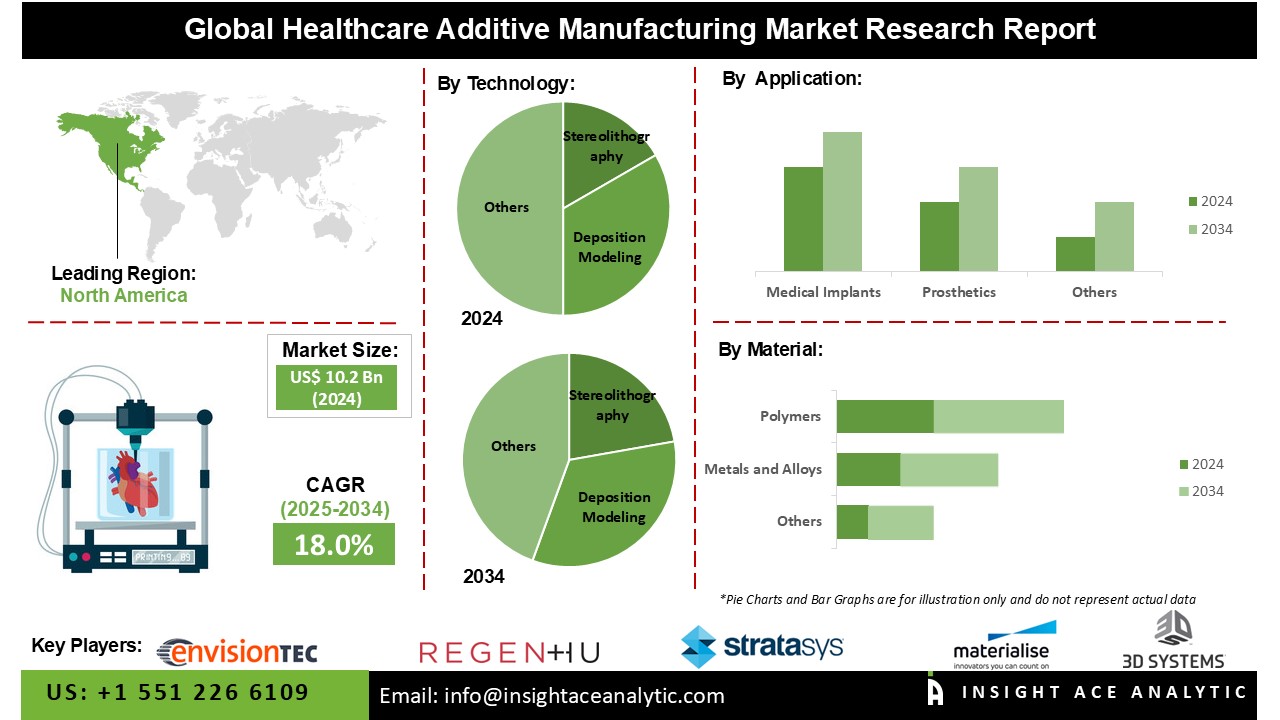
Global Healthcare Additive Manufacturing Market Size is valued at USD 10.2 Bn in 2024 and is predicted to reach USD 52.6 Bn by the year 2034 at a 18.0% CAGR during the forecast period for 2025-2034.
Healthcare additive manufacturing generates artificial human tissues, organs, and other medicinal structures using CAD software and additive manufacturing techniques. The demand for individualized care is fueling the expansion of the medical customization market. It is hoped that new technology, such as 3D printing, will make it cheaper to manufacture intricate medical supplies. The healthcare additive manufacturing market is anticipated to develop due to rising demand and unmet needs brought on by increased procedures and hospitalizations.
In addition, his additive manufacturing has several medical applications, including creating novel orthopaedic devices, fabricating individualized maxillofacial prostheses, and completing dental implants. Biomedical modelling and organ printing are two more fields that have taken notice of the technique. The shortage of trained workers is also slowing the expansion of the additive manufacturing industry in the healthcare sector.
Companies involved in the healthcare additive manufacturing market can anticipate substantial development prospects due to an increase in 3D usage printing in the healthcare sector. It drives expansion globally and is expected to boost market expansion in the coming years. Furthermore, increasing R&D activities and investments by prominent players are expected to create lucrative growth opportunities in revenue for players operating in the global healthcare additive manufacturing market over the forecast period.
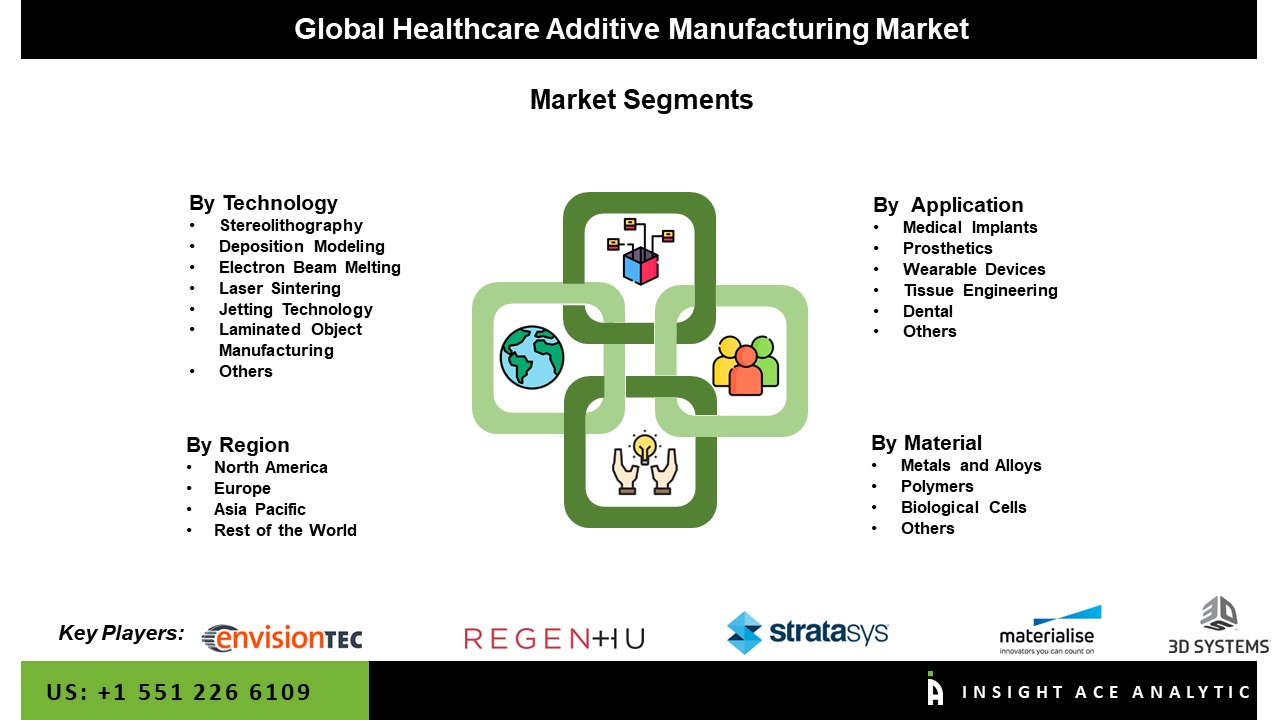
The healthcare additive manufacturing market is segmented based on Technology, Application and Material. Based on technology outlook, stereolithography, deposition modelling, electron beam melting, laser sintering, laminated object manufacturing, and others. As per the application, the market is segmented into medical implants, prosthetics, wearable devices, tissue engineering, and dental. By material, metals & alloys, steel, titanium, polymers, nylon, glass-filled polyamide, epoxy resins, photopolymers, plastics, biological cells and others.
The multifocal lenses healthcare additive manufacturing category is estimated to hold a major global market share in 2022. It is attributed to laser sintering because Laser sintering is a cutting-edge manufacturing method that welds together individual layers of material with the help of lasers. Practically speaking, LS is the method of choice for snap fittings, live hinges, and other mechanical couplings. The introduction of cutting-edge hardware, software, and materials has opened up this industry to a far larger number of biotech companies. It doesn't need any help getting an object together, and it can crank out numerous parts simultaneously.
The medical implants segment is projected to grow rapidly in the global healthcare additive manufacturing market. The growing elderly population drives up demand for joint replacement procedures. Spinal implants and other trauma-related products are in high demand, and the need for healthcare additive treatment, especially in countries such as the US, Germany, the UK, China, and India.
The North American healthcare additive manufacturing market is expected to record the maximum market share in revenue in the near future. It can be attributed to the rising elderly population, innovation in medical equipment design and the helpful rules set forth by the government. In addition, the presence of key market competitors and improvements in medical technology fuel expansion in the region's industries.
Also, Asia Pacific is projected to grow rapidly in the global healthcare additive manufacturing market because of the proliferation of the elderly population and their disposable income, low-cost generic alternatives, better healthcare facilities and growing financial support from the business and medical communities.
| Report Attribute | Specifications |
| Market Size Value In 2024 | USD 10.2 Bn |
| Revenue Forecast In 2034 | USD 52.6 Bn |
| Growth Rate CAGR | CAGR of 18.0% from 2025 to 2034 |
| Quantitative Units | Representation of revenue in US$ Bn and CAGR from 2025 to 2034 |
| Historic Year | 2021 to 2024 |
| Forecast Year | 2025-2034 |
| Report Coverage | The forecast of revenue, the position of the company, the competitive market structure, growth prospects, and trends |
| Segments Covered | By Technology, By Application, By Material |
| Regional Scope | North America; Europe; Asia Pacific; Latin America; Middle East & Africa |
| Country Scope | U.S.; Canada; U.K.; Germany; China; India; Japan; Brazil; Mexico ;The UK; France; Italy; Spain; South Korea; South East Asia |
| Competitive Landscape | 3D Systems, Inc., EnvisionTEC, RegenHU; Allevi, Inc., EOS GmbH, Materialise N.V, Stratasys Ltd., Nanoscribe GmbH, GPI Prototype, Manufacturing Services, LLC, 3T Additive Manufacturing Ltd., Fathom Manufacturing, General Electric Company. |
| Customization Scope | Free customization report with the procurement of the report, Modifications to the regional and segment scope. Particular Geographic competitive landscape. |
| Pricing And Available Payment Methods | Explore pricing alternatives that are customized to your particular study requirements. |
Healthcare Additive Manufacturing Market By Technology -
Healthcare Additive Manufacturing Market By Application -
Healthcare Additive Manufacturing Market By Material -
Healthcare Additive Manufacturing Market By Region-
North America-
Europe-
Asia-Pacific-
Latin America-
Middle East & Africa-
This study employed a multi-step, mixed-method research approach that integrates:
This approach ensures a balanced and validated understanding of both macro- and micro-level market factors influencing the market.
Secondary research for this study involved the collection, review, and analysis of publicly available and paid data sources to build the initial fact base, understand historical market behaviour, identify data gaps, and refine the hypotheses for primary research.
Secondary data for the market study was gathered from multiple credible sources, including:
These sources were used to compile historical data, market volumes/prices, industry trends, technological developments, and competitive insights.

Primary research was conducted to validate secondary data, understand real-time market dynamics, capture price points and adoption trends, and verify the assumptions used in the market modelling.
Primary interviews for this study involved:
Interviews were conducted via:
Primary insights were incorporated into demand modelling, pricing analysis, technology evaluation, and market share estimation.
All collected data were processed and normalized to ensure consistency and comparability across regions and time frames.
The data validation process included:
This ensured that the dataset used for modelling was clean, robust, and reliable.
The bottom-up approach involved aggregating segment-level data, such as:
This method was primarily used when detailed micro-level market data were available.

The top-down approach used macro-level indicators:
This approach was used for segments where granular data were limited or inconsistent.
To ensure accuracy, a triangulated hybrid model was used. This included:
This multi-angle validation yielded the final market size.
Market forecasts were developed using a combination of time-series modelling, adoption curve analysis, and driver-based forecasting tools.
Given inherent uncertainties, three scenarios were constructed:
Sensitivity testing was conducted on key variables, including pricing, demand elasticity, and regional adoption.