Viral and Non-Viral Vector Manufacturing Market Size, Share & Trends Analysis Report By Vector type (Viral Vector, Non-Viral Vector), By Disease (Cancer, Genetic Disease, Infectious Disease, Cardiovascular Disease, Other Diseases), By Application, By Region, And By Segment Forecasts, 2025-2034
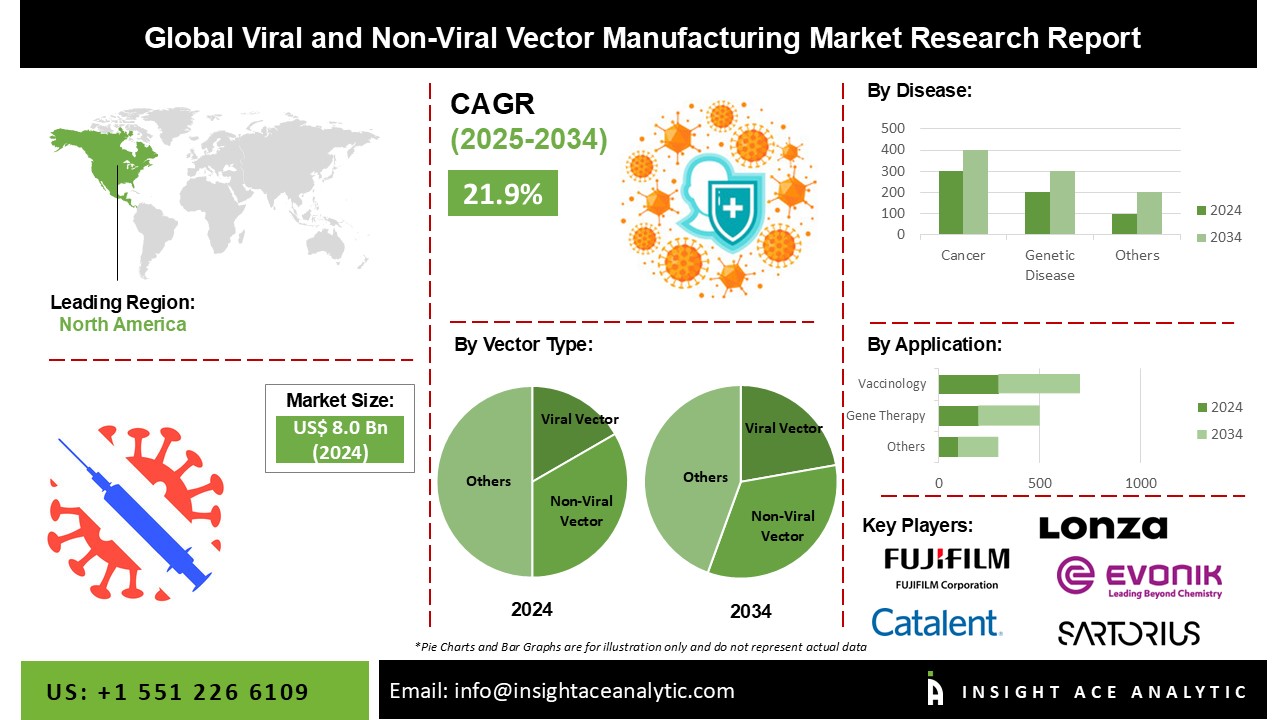
Global Viral and Non-Viral Vector Manufacturing Market Size is valued at USD 8.0 Billion in 2024 and is predicted to reach USD 56.8 Billion by the year 2034 at a 21.9% CAGR during the forecast period for 2025-2034.
Viral vectors are genetically modified viruses utilised as carriers for introducing exogenous genetic material into cells through their viral genome. In contrast, nonviral vectors encompass a range of chemical vectors, including inorganic particles, lipid-based vectors, polymer-based vectors, and peptide-based vectors, which also serve as vehicles for delivering foreign genetic material into cells.
Viral vectors are used to convey genetic material into cells and have become a popular method for gene transfer due to their high transfection effectiveness, sustained gene expression, and efficient gene delivery. Plasmid DNA is essential in the healthcare industry, as it is used as a therapeutic agent in gene therapy and the production of vaccine antigens.
The growing usage of gene therapy to treat viral infections such as adeno-associated viruses, poxviruses, herpes simplex viruses, and retroviruses is expected to boost gene therapy acceptance, which will help to push viral vector and plasmid DNA manufacturing market expansion. Furthermore, demand for viral vectors and plasmid DNA production is expected to rise in the next years due to the rising need for DNA treatments and cancer research R&D. The partnership focused on increasing the chromatographic separation of AAV-based vectors using several AAV types. As a result, such collaborations are expected to improve the manufacturing efficiency and scalability of gene therapies, allowing for the global availability of viral vectors and creating lucrative market opportunities. Gene treatments are being developed via viral vectors and plasmid DNA, which is one of the fastest expanding areas in advanced medicines.
Healthcare companies are developing DNA vectors for vaccine manufacturing. Many challenges affect the manufacturers of viral vectors and plasmid DNA whose products are in phase III clinical trials and commercial production of viral vectors. Many existing vector production technologies are inadequate in terms of productivity, efficiency, stability, and other factors.
- In Jan 2023, Charles River Laboratories and Rznomics, a South Korean biopharma, have engaged into a partnership to develop and manufacture viral vectors for a gene therapy to treat liver cancer. The technology of Rznomics employs an adenoviral vector that expresses a hTERT-targeting ribozyme to treat hepatocellular carcinoma patients, who account for 80% of primary liver cancer cases worldwide.
- In Dec 2022, The GMP lentivirus production service was developed by Creative Biogene to accelerate the advancement of gene and cell therapies. To certify the quality, safety, and consistency of clinical products for gene therapy clinical trials, Creative Biogene incorporates advanced lentiviral production technology and implements a comprehensive GMP programme. Creative Biogene has developed a patented method that demonstrates remarkable efficacy in the production of ultra-high titer lentiviral vectors, including those suitable for clinical applications.
Market Segmentation:
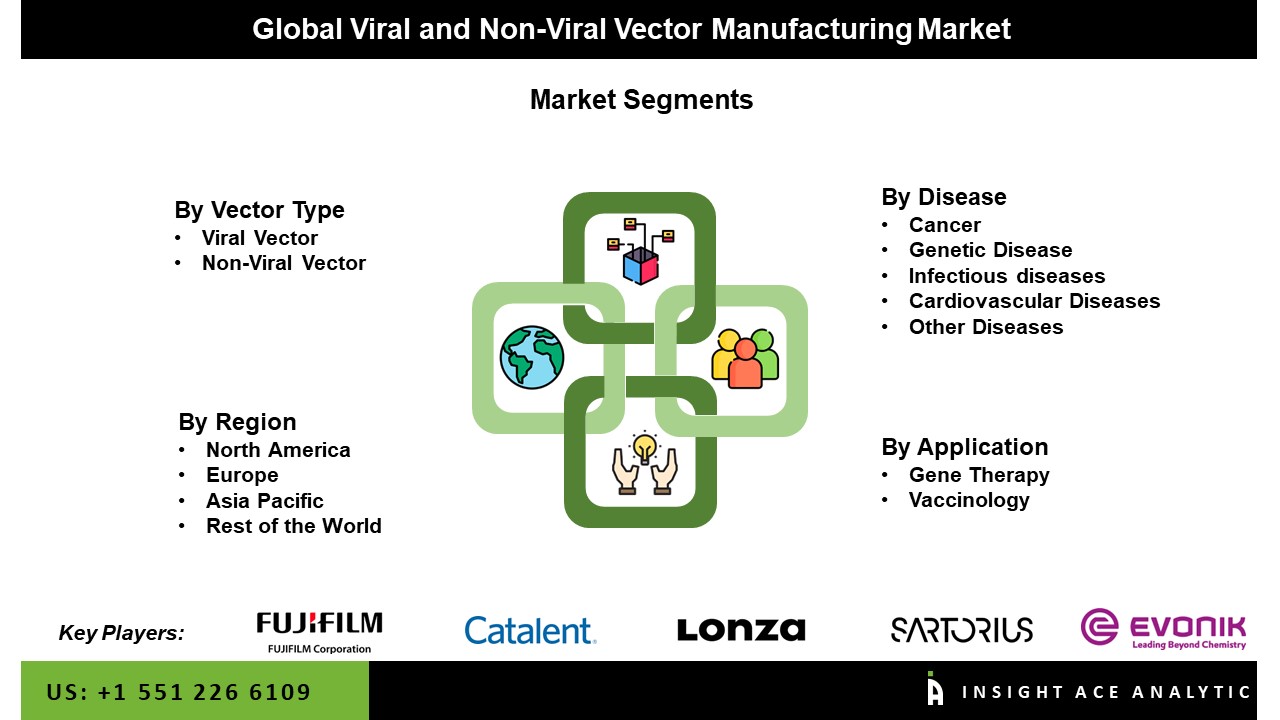
The Viral and Non-Viral Vector Manufacturing market is segmented based on vector type, diseases, and application. Based on vector type, the market is segmented as Viral Vector (Adenoviral Vector, Retroviral Vector, Adeno-Associated Viral Vector, Lentiviral Vector, Vaccinia Viral Vector, Other Viral Vector), Non-Viral Vectors, (Plasmid DNA, Lipid-Based Non-Viral Vector, Polymer-Based Non-Viral Vector, Other Non-Viral Vector (Peptide-Based and Hybrid/Combination)). Based on application, the market is categorized into gene therapy, vaccinology, cell therapy and other applications. The market is segmented based on diseases includes Cancer, Genetic Disorder, and Infectious diseases.
Based On Viral Vectors, The Non-Viral Vectors Segment Is Accounted As A Major Contributor In The Viral And Non-Viral Vector Manufacturing Market
The Non-Viral vectors category is expected to hold a significant share in the global Viral and Non-Viral Vector Manufacturing market in 2021. The COVID-19 viral vector vaccines use non-replicating viral vectors. The market will continue to increase as more non-viral vectors are used in vaccine development in the occurrence of a pandemic. According to a PubMed paper published in 2017, the development of non-viral DNA vectors has progressed substantially, particularly in the reduction of plasmid vector length. This factor is also playing a vital role in the segment's growth.
Vaccinology Segment Witnessed Growth At A Rapid Rate.
The vaccinology segment is projected to proliferate in the global Viral and Non-Viral Vector Manufacturing market. This is because viral vectors are regularly used in vaccine development due to their efficiency benefits. Positives include the ability to encourage a comprehensive immunological response, as well as the safety profiles and convenience of manufacture. Furthermore, the European Medicines Agency (EMA) has approved the use of AAV in clinical trials since it may express epitomal genes without integrating into the host genome. In addition, attempts to design and enhance immunization schedules will drive the development of novel vaccines, especially in countries such as the US, Germany, the UK, China, and India.
In The Region, The North America Viral And Non-Viral Vector Manufacturing Market Holds A Significant Revenue Share.
The North America Viral and Non-Viral Vector Manufacturing market is expected to register the highest market share in terms of revenue soon due to the presence of a significant number of research centres engaged in advanced therapy research and development. Furthermore, the construction of manufacturing units by competitors from other countries in North America is a driving force behind the region's market expansion. In addition, Asia Pacific is projected to grow at a rapid rate in the global Viral and Non-Viral Vector Manufacturing market. This is due to the creation of accelerated approval processes, the growing pool of patient population, growing private and government investments, and rising healthcare requirements. Furthermore, the unmet demands in the field of personalized medicine are driving the growing demand for viral vectors.
Competitive Landscape
Some major key players in the Viral and Non-Viral Vector Manufacturing Market:
- Boehringer Ingelheim,
- Catalent, Inc.,
- FUJIFILM Holdings Corporation,
- Danaher Corporation,
- Rescript Biotech Corporation,
- Lonza Group AG,
- Merck Kagan Inc.,
- Oxford Biomedical plc,
- Sartorius AG,
- Takara Bio Inc,
- Thermo Fisher Scientific Inc,
- Wuxi Optec,
- Acuities Therapeutic,
- Evonik Industries AG,
- Exiled, Inc.,
- Entos Pharmaceuticals,
- Genevant Sciences GmbH,
- T&T Scientific Corporation,
- Moderna, Inc
- CureVac N.V.
Viral and Non-Viral Vector Manufacturing Market Report Scope
| Report Attribute | Specifications |
| Market Size Value In 2024 | USD 8.0 Billion |
| Revenue Forecast In 2034 | USD 56.8 Billion |
| Growth Rate CAGR | CAGR of 21.9% from 2025 to 2034 |
| Quantitative Units | Representation of revenue in US$ Mn,and CAGR from 2025 to 2034 |
| Historic Year | 2021 to 2024 |
| Forecast Year | 2025-2034 |
| Report Coverage | The forecast of revenue, the position of the company, the competitive market structure, growth prospects, and trends |
| Segments Covered | By Vector type, By Disease, By Application |
| Regional Scope | North America; Europe; Asia Pacific; Latin America; Middle East & Africa |
| Country Scope | U.S.; Canada; U.K.; Germany; China; India; Japan; Brazil; Mexico ;The UK; France; Italy; Spain; China; Japan; India; South Korea; South East Asia; South Korea; South East Asia |
| Competitive Landscape | Boehringer Ingelheim, Catalent, Inc., FUJIFILM Holdings Corporation, Danaher Corporation, Rescript Biotech Corporation, Lonza Group AG, Merck Kagan Inc., Oxford Biomedical plc, Sartorius AG, Takara Bio Inc, Thermo Fisher Scientific Inc, Wuxi Optec, Acuities Therapeutic, Evonik Industries AG, Exiled, Inc., Entos Pharmaceuticals, Genevant Sciences GmbH, T&T Scientific Corporation, Moderna, Inc and CureVac N.V. |
| Customization Scope | Free customization report with the procurement of the report, Modifications to the regional and segment scope. Particular Geographic competitive landscape. |
| Pricing And Available Payment Methods | Explore pricing alternatives that are customized to your particular study requirements. |
Segmentation of Viral and Non-Viral Vector Manufacturing Market-
By Vector Type
- Viral Vector
- Adenoviral Vector
- Retroviral Vector
- Adeno-Associated Viral Vector
- Lentiviral Vector
- Vaccinia Viral Vector
- Other Viral Vector
- Non-Viral Vectors
- Plasmid DNA
- Lipid-Based Non-Viral Vector
- Polymer-Based Non-Viral Vector
- Other Non-Viral Vector (Peptide-Based and Hybrid/Combination)
By Disease
- Cancer
- Genetic Disease
- Infectious Disease
- Cardiovascular Disease
- Other Diseases
By Application
- Gene Therapy
- Viral Vector
- Non-Viral Vector
- Vaccinology
- Viral Vector
- Non-Viral Vector
- Cell Therapy
- Viral Vector
- Non-Viral Vector
- Other Applications
- Viral Vector
- Non-Viral Vector
By Region-
North America-
- The US
- Canada
- Mexico
Europe-
- Germany
- The UK
- France
- Italy
- Spain
- Rest of Europe
Asia-Pacific-
- China
- Japan
- India
- South Korea
- South East Asia
- Rest of Asia Pacific
Latin America-
- Brazil
- Argentina
- Rest of Latin America
Middle East & Africa-
- GCC Countries
- South Africa
Rest of Middle East and Africa
Research Design and Approach
This study employed a multi-step, mixed-method research approach that integrates:
- Secondary research
- Primary research
- Data triangulation
- Hybrid top-down and bottom-up modelling
- Forecasting and scenario analysis
This approach ensures a balanced and validated understanding of both macro- and micro-level market factors influencing the market.
Secondary Research
Secondary research for this study involved the collection, review, and analysis of publicly available and paid data sources to build the initial fact base, understand historical market behaviour, identify data gaps, and refine the hypotheses for primary research.
Sources Consulted
Secondary data for the market study was gathered from multiple credible sources, including:
- Government databases, regulatory bodies, and public institutions
- International organizations (WHO, OECD, IMF, World Bank, etc.)
- Commercial and paid databases
- Industry associations, trade publications, and technical journals
- Company annual reports, investor presentations, press releases, and SEC filings
- Academic research papers, patents, and scientific literature
- Previous market research publications and syndicated reports
These sources were used to compile historical data, market volumes/prices, industry trends, technological developments, and competitive insights.

Primary Research
Primary research was conducted to validate secondary data, understand real-time market dynamics, capture price points and adoption trends, and verify the assumptions used in the market modelling.
Stakeholders Interviewed
Primary interviews for this study involved:
- Manufacturers and suppliers in the market value chain
- Distributors, channel partners, and integrators
- End-users / customers (e.g., hospitals, labs, enterprises, consumers, etc., depending on the market)
- Industry experts, technology specialists, consultants, and regulatory professionals
- Senior executives (CEOs, CTOs, VPs, Directors) and product managers
Interview Process
Interviews were conducted via:
- Structured and semi-structured questionnaires
- Telephonic and video interactions
- Email correspondences
- Expert consultation sessions
Primary insights were incorporated into demand modelling, pricing analysis, technology evaluation, and market share estimation.
Data Processing, Normalization, and Validation
All collected data were processed and normalized to ensure consistency and comparability across regions and time frames.
The data validation process included:
- Standardization of units (currency conversions, volume units, inflation adjustments)
- Cross-verification of data points across multiple secondary sources
- Normalization of inconsistent datasets
- Identification and resolution of data gaps
- Outlier detection and removal through algorithmic and manual checks
- Plausibility and coherence checks across segments and geographies
This ensured that the dataset used for modelling was clean, robust, and reliable.
Market Size Estimation and Data Triangulation
Bottom-Up Approach
The bottom-up approach involved aggregating segment-level data, such as:
- Company revenues
- Product-level sales
- Installed base/usage volumes
- Adoption and penetration rates
- Pricing analysis
This method was primarily used when detailed micro-level market data were available.

Top-Down Approach
The top-down approach used macro-level indicators:
- Parent market benchmarks
- Global/regional industry trends
- Economic indicators (GDP, demographics, spending patterns)
- Penetration and usage ratios
This approach was used for segments where granular data were limited or inconsistent.
Hybrid Triangulation Approach
To ensure accuracy, a triangulated hybrid model was used. This included:
- Reconciling top-down and bottom-up estimates
- Cross-checking revenues, volumes, and pricing assumptions
- Incorporating expert insights to validate segment splits and adoption rates
This multi-angle validation yielded the final market size.
Forecasting Framework and Scenario Modelling
Market forecasts were developed using a combination of time-series modelling, adoption curve analysis, and driver-based forecasting tools.
Forecasting Methods
- Time-series modelling
- S-curve and diffusion models (for emerging technologies)
- Driver-based forecasting (GDP, disposable income, adoption rates, regulatory changes)
- Price elasticity models
- Market maturity and lifecycle-based projections
Scenario Analysis
Given inherent uncertainties, three scenarios were constructed:
- Base-Case Scenario: Expected trajectory under current conditions
- Optimistic Scenario: High adoption, favourable regulation, strong economic tailwinds
- Conservative Scenario: Slow adoption, regulatory delays, economic constraints
Sensitivity testing was conducted on key variables, including pricing, demand elasticity, and regional adoption.
Request Customization
Add countries, segments, company profiles, or extend forecast — free 10% customization with purchase.
Customize This Report →Enquire Before Buying
Speak with our analyst team about scope, methodology, pricing, or deliverable formats.
Enquire Now →Frequently Asked Questions
Viral and Non-Viral Vector Manufacturing Market Size is valued at USD 8.0 Billion in 2024 and is predicted to reach USD 56.8 Billion by the year 2034
Viral and Non-Viral Vector Manufacturing Market is expected to grow at a 21.9% CAGR during the forecast period for 2025-2034.
Boehringer Ingelheim, Catalent, Inc., FUJIFILM Holdings Corporation, Danaher Corporation, Rescript Biotech Corporation, Lonza Group AG, Merck Kagan In
Vector type, Disease and Application are the key segments of the Viral and Non-Viral Vector Manufacturing Market.
North America region is leading the Viral and Non-Viral Vector Manufacturing Market.