Oligonucleotide Synthesis, Modification, and Purification Services Market Size, Share & Trends Analysis Report By Product (Primers, Probes, DNA Oligos, RNA Oligos, Others), By Application (Therapeutic Applications (Neurological Disorders, Rare Diseases, Other Diseases), Research Applications (PCR, Sequencing, Other Research Applications), Diagnostic Applications), Type, End-users, By Region, And By Segment Forecasts, 2025-2034
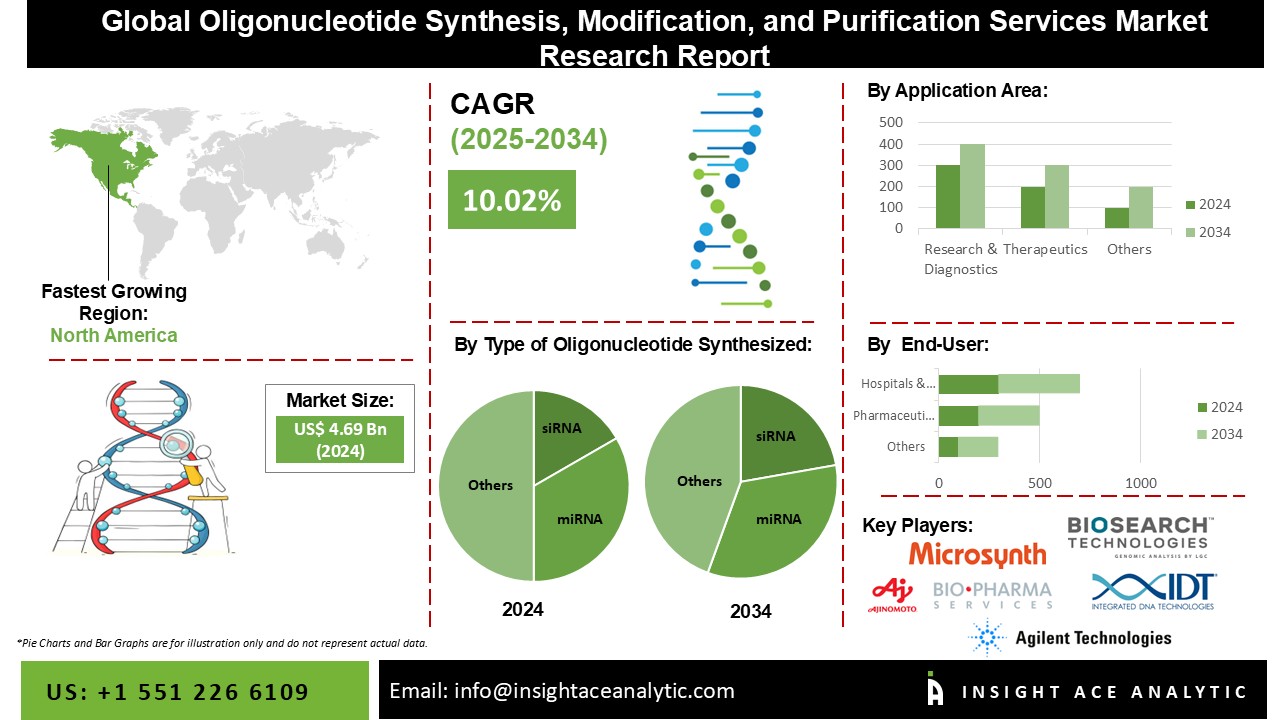
Oligonucleotide Synthesis, Modification, and Purification Services Market Size is valued at USD 4.69 billion in 2024 and is predicted to reach USD 12.27 billion by the year 2034 at a 10.02% CAGR during the forecast period for 2025-2034.
Key Industry Insights & Findings from the Report:
- The increasing focus on understanding genetic mechanisms and developing new therapies drives demand for oligonucleotide synthesis and related services.
- Companies investing in innovative synthesis platforms and purification techniques can capture a larger market share.
- North America dominated the market and accounted for a global revenue share in 2023.
- The cost of oligonucleotide synthesis can be significant, especially for custom or modified sequences. This expense may limit adoption, particularly for smaller research labs or organizations with limited budgets.
Synthetic DNA oligonucleotides are applied in a wide range of applications, from fundamental research to clinical diagnostics and biotherapeutics. Oligonucleotides are chemically synthesized molecular chains from nucleosides. Solid-phase synthesis is the most popular method used for oligonucleotides chemical synthesis. They have a variety of uses in biology, biochemistry, molecular diagnostics, genomics, forensics, and others. Selecting the suitable oligonucleotide synthesizer for application is critical to optimizing product quality while maintaining cost-effectiveness.
The primary elements boosting the growth of the oligonucleotide synthesis, modification, and purification services market include increasing demand for oligonucleotides, growing preference of patients toward personalized medicines, rising collaborations and mergers/acquisitions by manufacturers, and growing older population, and the high prevalence of chronic diseases. Apart from this, the need for high-quality oligos is increasing due to the increase in R&D activities. Therefore, biotech and pharmaceutical companies' increasing research and development activities to treat various viral infections, chronic diseases, and genetic disorders are expected to fuel market growth over the forecast years.
For instance, in July 2017, Nitto Denko Avecia Inc. (Avecia) opened a new oligonucleotide API manufacturing facility in Milford, MA. The expansion has added 20,000 sq. ft. of manufacturing and office space at the site and provided CGMP oligonucleotide manufacturing capacity up to 1.8 mol, bringing the site capacity to 3.0 mol. Also, this expansion has helped Avecia's clients to receive timely oligonucleotide API to advance their drug development programs in clinical trials. However, the low-quality oligonucleotide sequences, lack of technical requirements, and the complexities associated with the oligonucleotide synthesis may hamper the market growth.
Competitive Landscape
Some Of The Key Players In The Oligonucleotide Synthesis, Modification, and Purification Services Market:
- Agilent Technologies
- Ajinomoto Bio-Pharma Services
- CordenPharma
- Integrated DNA Technologies
- Kaneka Eurogentec
- LGC Biosearch Technologies
- Microsynth
- Merck
- Nitto Avecia
- Thermo Fisher Scientific
- TriLink BioTechnologies
- Creative Biolabs
- Ella Biotech
- Eurofins Genomics
- Future Synthesis
- Ribo Biotechnology
- STA Pharmaceutical
- GE Healthcare
- GeneDesign, Inc.
- Bio-synthesis Inc.
- Almac Group
- Sumitomo Chemical
- Axolabs (LGC Group)
- MilliporeSigma
- BioSpring
- ChemGenes
- BianoScience GmbH
- ATDBio Ltd
- Burkert UK Limited
- IBA Lifesciences GmbH
Market Segmentation
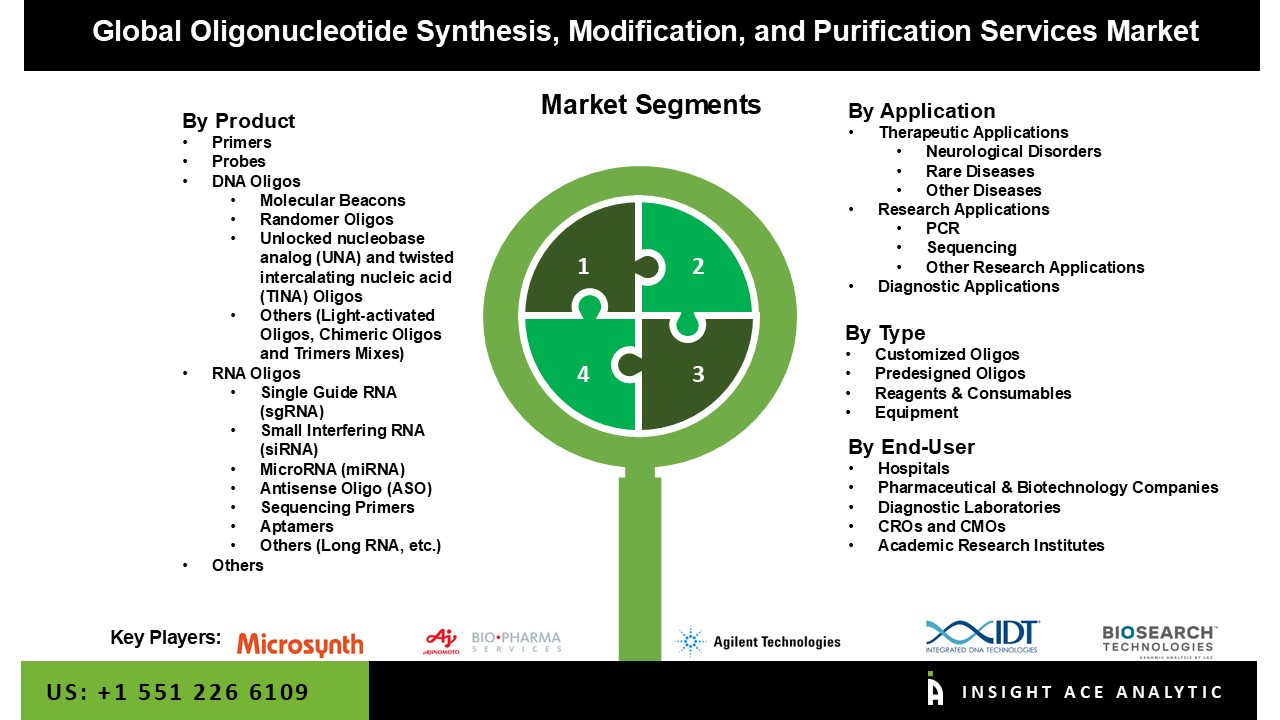
The Oligonucleotide Synthesis, Modification, and Purification Services Market is segmented into product, application, type, and end-users. By product, it includes primers, probes, and DNA oligos, such as molecular beacons, randomer oligos, and more specialized variants like unlocked nucleobase analog (UNA) and twisted intercalating nucleic acid (TINA) oligos, as well as other categories such as light-activated oligos and chimeric oligos. RNA oligos encompass single guide RNA (sgRNA), small interfering RNA (siRNA), microRNA (miRNA), antisense oligos (ASO), sequencing primers, and aptamers. Applications include therapeutic uses for conditions like neurological disorders, rare diseases, and other medical conditions, alongside research applications in PCR, sequencing, and diagnostics. The market is further divided by types into customized oligos, predesigned oligos, reagents & consumables, and equipment. End-users span across hospitals, pharmaceutical and biotechnology companies, diagnostic laboratories, CROs and CMOs, and academic research institutes.
The market is being examined throughout North America, Europe, Asia-Pacific, Latin America, the Middle East, and Africa. Due to increased R&D investments in pharma and biotech businesses to enhance oligonucleotide production and synthesis processes, North America is likely to have the largest share of this market throughout the forecast years, followed by Europe.
Recent Developments:
- In October 2023, Integrated DNA Technologies established a new production facility for therapeutic oligonucleotides in Iowa, USA. Customers will benefit from expanded research and manufacturing capabilities and knowledge provided by the 41,000 square foot facility.
The Oligonucleotide Synthesis, Modification, and Purification Services Market Report Scope
| Report Attribute | Specifications |
| Market Size Value In 2024 | USD 4.69 Bn |
| Revenue Forecast In 2034 | USD 12.27 Bn |
| Growth Rate CAGR | CAGR of 10.02% from 2025 to 2034 |
| Quantitative Units | Representation of revenue in US$ Billion and CAGR from 2025 to 2034 |
| Historic Year | 2021 to 2024 |
| Forecast Year | 2025-2034 |
| Report Coverage | The forecast of revenue, the position of the company, the competitive market structure, growth prospects, and trends |
| Segments Covered | By Product, Application, Type, and End-User |
| Regional Scope | North America; Europe; Asia Pacific; Latin America; Middle East & Africa |
| Country Scope | U.S.; Canada; U.K.; Germany; China; India; Japan; Brazil; Mexico ; France; Italy; Spain; South Korea; South East Asia |
| Competitive Landscape | Ajinomoto Bio-Pharma Services, Integrated DNA Technologies, Kaneka Eurogentec, LGC Biosearch Technologies, Microsynth, MilliporeSigma, BioSpring, CordenPharma, Nitto Denko Avecia, TriLink Biotechnologies, Eurofins Scientific SE, Thermo Fisher Scientific Inc., Agilent Technologies, Inc., GE Healthcare, GeneDesign, Inc., Bio-synthesis Inc., ATDBio Ltd, Burkert UK Limited, Almac Group, and Other Prominent Players |
| Customization Scope | Free customization report with the procurement of the report, Modifications to the regional and segment scope. Particular Geographic competitive landscape. |
| Pricing And Available Payment Methods | Explore pricing alternatives that are customized to your particular study requirements. |
Segmentation of Oligonucleotide Synthesis, Modification, and Purification Services Market
Oligonucleotide Synthesis, Modification, and Purification Services Market- by Product
- Primers
- Probes
- DNA Oligos
- Molecular Beacons
- Randomer Oligos
- Unlocked nucleobase analog (UNA) and twisted intercalating nucleic acid (TINA) Oligos
- Others (Light-activated Oligos, Chimeric Oligos and Trimers Mixes)
- RNA Oligos
- Single Guide RNA (sgRNA)
- Small Interfering RNA (siRNA)
- MicroRNA (miRNA)
- Antisense Oligo (ASO)
- Sequencing Primers
- Aptamers
- Others (Long RNA, etc.)
- Others
Oligonucleotide Synthesis, Modification, and Purification Services Market- Application
- Therapeutic Applications
- Neurological Disorders
- Rare Diseases
- Other Diseases
- Research Applications
- PCR
- Sequencing
- Other Research Applications
- Diagnostic Applications
Oligonucleotide Synthesis, Modification, and Purification Services Market- Type
- Customized Oligos
- Predesigned Oligos
- Reagents & Consumables
- Equipment
Oligonucleotide Synthesis, Modification, and Purification Services Market- End-users
- Hospitals
- Pharmaceutical & Biotechnology Companies
- Diagnostic Laboratories
- CROs and CMOs
- Academic Research Institutes
Global Oligonucleotide Synthesis, Modification, and Purification Services Market, by Region,
- North America
- Europe
- Asia Pacific
- Latin America
- Middle East & Africa
North America Oligonucleotide Synthesis, Modification, and Purification Services Market, by Country,
- U.S.
- Canada
Europe Oligonucleotide Synthesis, Modification, and Purification Services Market, by Country,
- Germany
- France
- Italy
- Spain
- Russia
- Rest of Europe
Asia Pacific Oligonucleotide Synthesis, Modification, and Purification Services Market, by Country,
- India
- China
- Japan
- South Korea
- Australia & New Zealand
Latin America Oligonucleotide Synthesis, Modification, and Purification Services Market, by Country,
- Brazil
- Mexico
- Rest of Latin America
Middle East & Africa Oligonucleotide Synthesis, Modification, and Purification Services Market, by Country,
- GCC Countries
- South Africa
- Rest of Middle East & Africa
- Company Overview
- Financial Performance
- Key Development
Research Design and Approach
This study employed a multi-step, mixed-method research approach that integrates:
- Secondary research
- Primary research
- Data triangulation
- Hybrid top-down and bottom-up modelling
- Forecasting and scenario analysis
This approach ensures a balanced and validated understanding of both macro- and micro-level market factors influencing the market.
Secondary Research
Secondary research for this study involved the collection, review, and analysis of publicly available and paid data sources to build the initial fact base, understand historical market behaviour, identify data gaps, and refine the hypotheses for primary research.
Sources Consulted
Secondary data for the market study was gathered from multiple credible sources, including:
- Government databases, regulatory bodies, and public institutions
- International organizations (WHO, OECD, IMF, World Bank, etc.)
- Commercial and paid databases
- Industry associations, trade publications, and technical journals
- Company annual reports, investor presentations, press releases, and SEC filings
- Academic research papers, patents, and scientific literature
- Previous market research publications and syndicated reports
These sources were used to compile historical data, market volumes/prices, industry trends, technological developments, and competitive insights.

Primary Research
Primary research was conducted to validate secondary data, understand real-time market dynamics, capture price points and adoption trends, and verify the assumptions used in the market modelling.
Stakeholders Interviewed
Primary interviews for this study involved:
- Manufacturers and suppliers in the market value chain
- Distributors, channel partners, and integrators
- End-users / customers (e.g., hospitals, labs, enterprises, consumers, etc., depending on the market)
- Industry experts, technology specialists, consultants, and regulatory professionals
- Senior executives (CEOs, CTOs, VPs, Directors) and product managers
Interview Process
Interviews were conducted via:
- Structured and semi-structured questionnaires
- Telephonic and video interactions
- Email correspondences
- Expert consultation sessions
Primary insights were incorporated into demand modelling, pricing analysis, technology evaluation, and market share estimation.
Data Processing, Normalization, and Validation
All collected data were processed and normalized to ensure consistency and comparability across regions and time frames.
The data validation process included:
- Standardization of units (currency conversions, volume units, inflation adjustments)
- Cross-verification of data points across multiple secondary sources
- Normalization of inconsistent datasets
- Identification and resolution of data gaps
- Outlier detection and removal through algorithmic and manual checks
- Plausibility and coherence checks across segments and geographies
This ensured that the dataset used for modelling was clean, robust, and reliable.
Market Size Estimation and Data Triangulation
Bottom-Up Approach
The bottom-up approach involved aggregating segment-level data, such as:
- Company revenues
- Product-level sales
- Installed base/usage volumes
- Adoption and penetration rates
- Pricing analysis
This method was primarily used when detailed micro-level market data were available.

Top-Down Approach
The top-down approach used macro-level indicators:
- Parent market benchmarks
- Global/regional industry trends
- Economic indicators (GDP, demographics, spending patterns)
- Penetration and usage ratios
This approach was used for segments where granular data were limited or inconsistent.
Hybrid Triangulation Approach
To ensure accuracy, a triangulated hybrid model was used. This included:
- Reconciling top-down and bottom-up estimates
- Cross-checking revenues, volumes, and pricing assumptions
- Incorporating expert insights to validate segment splits and adoption rates
This multi-angle validation yielded the final market size.
Forecasting Framework and Scenario Modelling
Market forecasts were developed using a combination of time-series modelling, adoption curve analysis, and driver-based forecasting tools.
Forecasting Methods
- Time-series modelling
- S-curve and diffusion models (for emerging technologies)
- Driver-based forecasting (GDP, disposable income, adoption rates, regulatory changes)
- Price elasticity models
- Market maturity and lifecycle-based projections
Scenario Analysis
Given inherent uncertainties, three scenarios were constructed:
- Base-Case Scenario: Expected trajectory under current conditions
- Optimistic Scenario: High adoption, favourable regulation, strong economic tailwinds
- Conservative Scenario: Slow adoption, regulatory delays, economic constraints
Sensitivity testing was conducted on key variables, including pricing, demand elasticity, and regional adoption.
Request Customization
Add countries, segments, company profiles, or extend forecast — free 10% customization with purchase.
Customize This Report →Enquire Before Buying
Speak with our analyst team about scope, methodology, pricing, or deliverable formats.
Enquire Now →Frequently Asked Questions
Ajinomoto Bio-Pharma Services, Integrated DNA Technologies, Kaneka Eurogentec, LGC Biosearch Technologies, Microsynth, MilliporeSigma, BioSpring, Cord
Oligonucleotide Synthesis, Modification, and Purification Services Market Size is valued at USD 4.69 billion in 2024 and is predicted to reach USD 12.
The Oligonucleotide Synthesis, Modification, and Purification Services Market is expected to grow at a 10.02% CAGR during the forecast period for 2025
Oligonucleotide Synthesis, Modification, and Purification Services Market is segmented into product, application, type, and end-users.
North America region is leading the Oligonucleotide Synthesis, Modification, and Purification Services Market.