Electric Pressure Infusor Market Size, Share & Trends Analysis Distribution by Type (Disposable and Reusable), Application (Hospitals, Clinics, and Ambulatory Surgical Centers), End-user (Healthcare Providers, and Emergency Medical Services, and Military), and Segment Forecasts, 2025-2034
Global Electric Pressure Infusor Market is likely to grow at a 5.0% CAGR during the forecast period for 2025-2034.
Electric pressure infusors are cutting-edge devices that provide precise control over pressure and flow rates for the delivery of fluids, drugs, or nutrition. Employing regulated electrical pressure, it automates the process of injecting fluids into a patient or system. They are being used more and more in industrial, research, and healthcare settings to make sure that infusion operations are safe and reliable.

These devices replace traditional manual or pneumatic infusion methods by being more accurate, automated, and safe. They are becoming essential in applications that need high precision and dependability as technology develops. Needing a high level of accuracy and dependability. Additionally, they are useful in medical settings where accuracy is crucial, like critical care units, chemotherapy, and neonatal care.
The growing incidence of chronic illnesses, improvements in medical technology, and the growing need for effective fluid administration in critical care settings are the main factors propelling the electric pressure infusors market's expansion. The need for accurate and dependable medical equipment, such as electric pressure infusors, is becoming ever more crucial as healthcare systems throughout the world continue to change. Additionally, the growing number of elderly people, as well as the increased frequency of surgeries and critical care procedures, which call for the usage of electric pressure infusors for efficient patient management, are driving this need. Furthermore, the continuous research and development initiatives aimed at enhancing the effectiveness and security of electric pressure infusors are strengthening their place in contemporary healthcare.
In addition, the rapid improvement in infusor technology, such as increased portability, user-friendliness, and safety features, further drives the electric pressure infusors market expansion. Electric pressure infusors' incorporation of smart technologies and data analytics capabilities is also improving patient monitoring and maximizing treatment effectiveness. Moreover, important market participants are making significant investments to launch cutting-edge products and broaden their geographic reach. Innovation and accessibility are being fueled by this competitive environment, which is helping the electric pressure infusors market grow overall. However, the expansion of the electric pressure infusors market is hampered due to various factors. The high upfront expenses of electric pressure infusors might be a barrier, especially for smaller medical facilities. Another major obstacle to market expansion is regulatory barriers and strict approval procedures in different areas.
Competitive Landscape
Which are the Leading Players in Electric Pressure Infusor Market?
- Armstrong Medical
- SARSTEDT AG & Co. KG
- Biegler GmbH
- Shenzhen Prunus Medical
- Nanchang Biotek Medical
- Wuxi Biomedical Technology
- Shandong Qiaopai Group
- Hebei Pukang Medical
- MedCaptain Medical Technology
- Lhasa Medical
Market Dynamics
Driver
Rapid Rise in Surgical Procedures Conducted
One major factor driving the electric pressure infusor market is the rise in surgical procedures conducted worldwide. Rapid fluid administration is frequently necessary to maintain patient stability during surgeries, especially those that are long or entail significant blood loss. In order to ensure that fluids are given at the ideal pressure for patient safety, the electric pressure infusor helps with this crucial task. Additionally, the increasing frequency of minimally invasive surgeries, which lower risks and recovery times but still necessitate careful fluid management, is making this need more pressing. As more medical institutions use electric pressure infusors for better surgical results, this element is probably going to keep the market expanding.
Restrain/Challenge
High Cost Associated with Electric Pressure Infusors
The comparatively expensive cost of sophisticated electric pressure infusor systems may prevent their widespread adoption. This is a major obstacle in developing nations with limited healthcare resources and cost-sensitive markets. Furthermore, the market penetration may be hampered by regional variations in the infusion process and device reimbursement rules. Additionally, organizations like the FDA (U.S. Food and Drug Administration) and CE marking in Europe closely monitor the electric pressure infusor market. Product introductions and innovation may be delayed by the expensive and time-consuming process of acquiring the required permits. To fulfil changing safety and performance standards, manufacturers must consistently invest in clinical trials and quality assurance, which significantly restricts the electric pressure infusor market.
Market Segmentation:
Electric pressure infusor market is segmented based on type, application and end-user. Type segment includes disposable and reusable. Application segment includes hospitals, clinics, and ambulatory surgical centers. End-user segment includes healthcare providers, and emergency medical services, and military.
Reusable Segment is Expected to Drive the Electric Pressure Infusor Market
The reusable category held the largest share in the Electric Pressure Infusor market in 2024. In healthcare settings where cost-effectiveness and environmental issues are given top priority, reusable electric pressure infusors are frequently utilized. High-volume medical institutions prefer these devices since they are multipurpose and usually composed of sturdy materials. Reusable electric pressure infusors are in high demand due to their durability and potential for cost savings, particularly in areas with tight healthcare budgets. These device maintenance and sterilization requirements, however, can occasionally act as a barrier, influencing the move toward disposable alternatives.
The Hospitals Segment is Growing at the Highest Rate in the Electric Pressure Infusor Market
In 2024, the hospitals category dominated the Electric Pressure Infusor market. The major end-user market for electric pressure infusors is hospitals, which are the primary healthcare facilities. In order to provide the best possible patient care, a variety of medical devices, including electric pressure infusors, are required due to the complexity and variety of treatments carried out in hospitals. The growing frequency of operations, emergencies, and critical care admissions—all of which necessitate the use of pressure infusors for efficient fluid management—is the main factor driving hospital demand.
Why North America Led the Electric Pressure Infusor Market?
The Electric Pressure Infusors market was dominated by the North America region in 2024 because of its cutting-edge medical technology adoption rates and sophisticated healthcare infrastructure. The existence of a strong regulatory environment, especially from the U.S. Food and Drug Administration, which guarantees product safety and efficacy and promotes trust among healthcare providers, is what propels the region's leadership in the electric pressure infusor market.

Additionally, the hospitals and surgical centres in this area invest in sophisticated fluid management systems, such as electric pressure infusors, due to high healthcare spending from both the public and private sectors. The demand is also supported by a significant focus on enhancing patient outcomes in emergency medicine, surgery, and trauma treatment in this region.
Electric Pressure Infusor Market Report Scope :
| Report Attribute | Specifications |
| Growth Rate CAGR | CAGR of 5.0% from 2025 to 2034 |
| Quantitative Units | Representation of revenue in US$ Bn and CAGR from 2024 to 2034 |
| Historic Year | 2021 to 2024 |
| Forecast Year | 2025-2034 |
| Report Coverage | The forecast of revenue, the position of the company, the competitive market structure, growth prospects, and trends |
| Segments Covered | Type, Application, End-user, and By Region |
| Regional Scope | North America; Europe; Asia Pacific; Latin America; Middle East & Africa |
| Country Scope | U.S.; Canada; U.K.; Germany; China; India; Japan; Brazil; Mexico; The UK; France; Italy; Spain; China; Japan; India; South Korea; Southeast Asia; South Korea; Southeast Asia |
| Competitive Landscape | Armstrong Medical, SARSTEDT AG & Co. KG, Biegler GmbH, Shenzhen Prunus Medical, Nanchang Biotek Medical, Wuxi Biomedical Technology, Shandong Qiaopai Group, Hebei Pukang Medical, MedCaptain Medical Technology, and Lhasa Medical. |
| Customization Scope | Free customization report with the procurement of the report, Modifications to the regional and segment scope. Geographic competitive landscape. |
| Pricing and Available Payment Methods | Explore pricing alternatives that are customized to your particular study requirements. |
Segmentation of Electric Pressure Infusor Market:
Electric Pressure Infusor Market by Type-
- Disposable
- Reusable

Electric Pressure Infusor Market by Application-
- Hospitals
- Clinics
- Ambulatory Surgical Centers
Electric Pressure Infusor Market by End-user-
- Healthcare Providers
- Emergency Medical Services
- Military
Electric Pressure Infusor Market by Region-
- North America-
- The US
- Canada
- Europe-
- Germany
- The UK
- France
- Italy
- Spain
- Rest of Europe
- Asia-Pacific-
- China
- Japan
- India
- South Korea
- Southeast Asia
- Rest of Asia Pacific
- Latin America-
- Brazil
- Argentina
- Mexico
- Rest of Latin America
- Middle East & Africa-
- GCC Countries
- South Africa
- Rest of the Middle East and Africa
Research Design and Approach
This study employed a multi-step, mixed-method research approach that integrates:
- Secondary research
- Primary research
- Data triangulation
- Hybrid top-down and bottom-up modelling
- Forecasting and scenario analysis
This approach ensures a balanced and validated understanding of both macro- and micro-level market factors influencing the market.
Secondary Research
Secondary research for this study involved the collection, review, and analysis of publicly available and paid data sources to build the initial fact base, understand historical market behaviour, identify data gaps, and refine the hypotheses for primary research.
Sources Consulted
Secondary data for the market study was gathered from multiple credible sources, including:
- Government databases, regulatory bodies, and public institutions
- International organizations (WHO, OECD, IMF, World Bank, etc.)
- Commercial and paid databases
- Industry associations, trade publications, and technical journals
- Company annual reports, investor presentations, press releases, and SEC filings
- Academic research papers, patents, and scientific literature
- Previous market research publications and syndicated reports
These sources were used to compile historical data, market volumes/prices, industry trends, technological developments, and competitive insights.

Primary Research
Primary research was conducted to validate secondary data, understand real-time market dynamics, capture price points and adoption trends, and verify the assumptions used in the market modelling.
Stakeholders Interviewed
Primary interviews for this study involved:
- Manufacturers and suppliers in the market value chain
- Distributors, channel partners, and integrators
- End-users / customers (e.g., hospitals, labs, enterprises, consumers, etc., depending on the market)
- Industry experts, technology specialists, consultants, and regulatory professionals
- Senior executives (CEOs, CTOs, VPs, Directors) and product managers
Interview Process
Interviews were conducted via:
- Structured and semi-structured questionnaires
- Telephonic and video interactions
- Email correspondences
- Expert consultation sessions
Primary insights were incorporated into demand modelling, pricing analysis, technology evaluation, and market share estimation.
Data Processing, Normalization, and Validation
All collected data were processed and normalized to ensure consistency and comparability across regions and time frames.
The data validation process included:
- Standardization of units (currency conversions, volume units, inflation adjustments)
- Cross-verification of data points across multiple secondary sources
- Normalization of inconsistent datasets
- Identification and resolution of data gaps
- Outlier detection and removal through algorithmic and manual checks
- Plausibility and coherence checks across segments and geographies
This ensured that the dataset used for modelling was clean, robust, and reliable.
Market Size Estimation and Data Triangulation
Bottom-Up Approach
The bottom-up approach involved aggregating segment-level data, such as:
- Company revenues
- Product-level sales
- Installed base/usage volumes
- Adoption and penetration rates
- Pricing analysis
This method was primarily used when detailed micro-level market data were available.
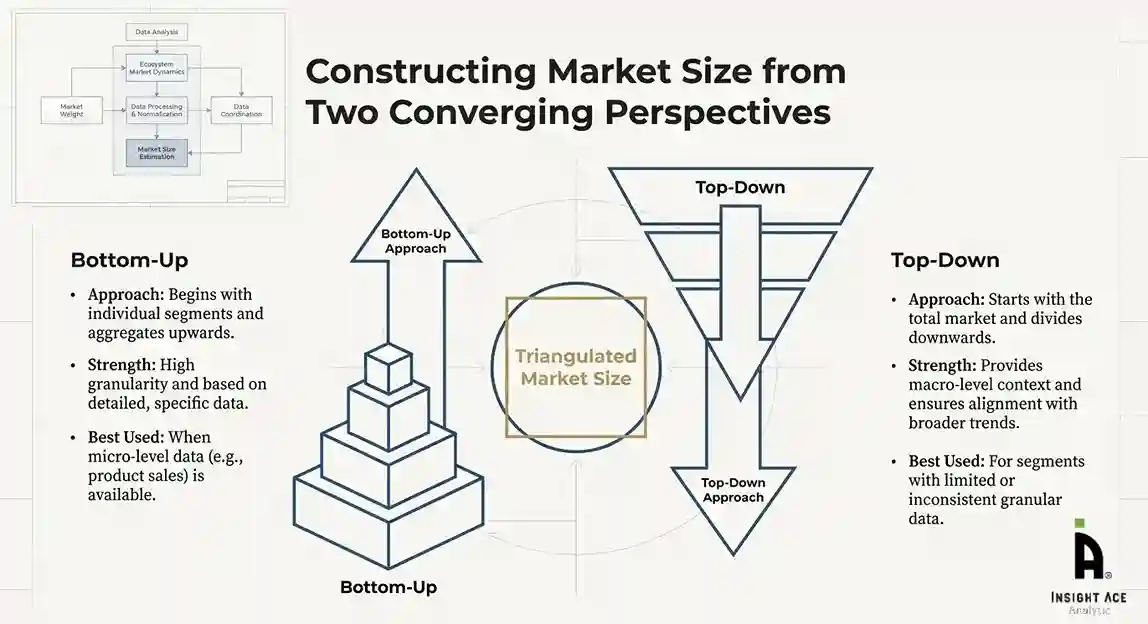
Top-Down Approach
The top-down approach used macro-level indicators:
- Parent market benchmarks
- Global/regional industry trends
- Economic indicators (GDP, demographics, spending patterns)
- Penetration and usage ratios
This approach was used for segments where granular data were limited or inconsistent.
Hybrid Triangulation Approach
To ensure accuracy, a triangulated hybrid model was used. This included:
- Reconciling top-down and bottom-up estimates
- Cross-checking revenues, volumes, and pricing assumptions
- Incorporating expert insights to validate segment splits and adoption rates
This multi-angle validation yielded the final market size.
Forecasting Framework and Scenario Modelling
Market forecasts were developed using a combination of time-series modelling, adoption curve analysis, and driver-based forecasting tools.
Forecasting Methods
- Time-series modelling
- S-curve and diffusion models (for emerging technologies)
- Driver-based forecasting (GDP, disposable income, adoption rates, regulatory changes)
- Price elasticity models
- Market maturity and lifecycle-based projections
Scenario Analysis
Given inherent uncertainties, three scenarios were constructed:
- Base-Case Scenario: Expected trajectory under current conditions
- Optimistic Scenario: High adoption, favourable regulation, strong economic tailwinds
- Conservative Scenario: Slow adoption, regulatory delays, economic constraints
Sensitivity testing was conducted on key variables, including pricing, demand elasticity, and regional adoption.
Request Customization
Add countries, segments, company profiles, or extend forecast — free 10% customization with purchase.
Customize This Report →Enquire Before Buying
Speak with our analyst team about scope, methodology, pricing, or deliverable formats.
Enquire Now →Frequently Asked Questions
Global Electric Pressure Infusor Market is likely to grow at a 5.0% CAGR during the forecast period for 2025-2034.
Armstrong Medical, SARSTEDT AG & Co. KG, Biegler GmbH, Shenzhen Prunus Medical, Nanchang Biotek Medical, Wuxi Biomedical Technology, Shandong Qiaopai Group, Hebei Pukang Medical, MedCaptain Medical Technology, and Lhasa Medical.
Type, Application, End-user, and Region are the key segments of the Electric Pressure Infusor Market.
North America region is leading the Electric Pressure Infusor Market.