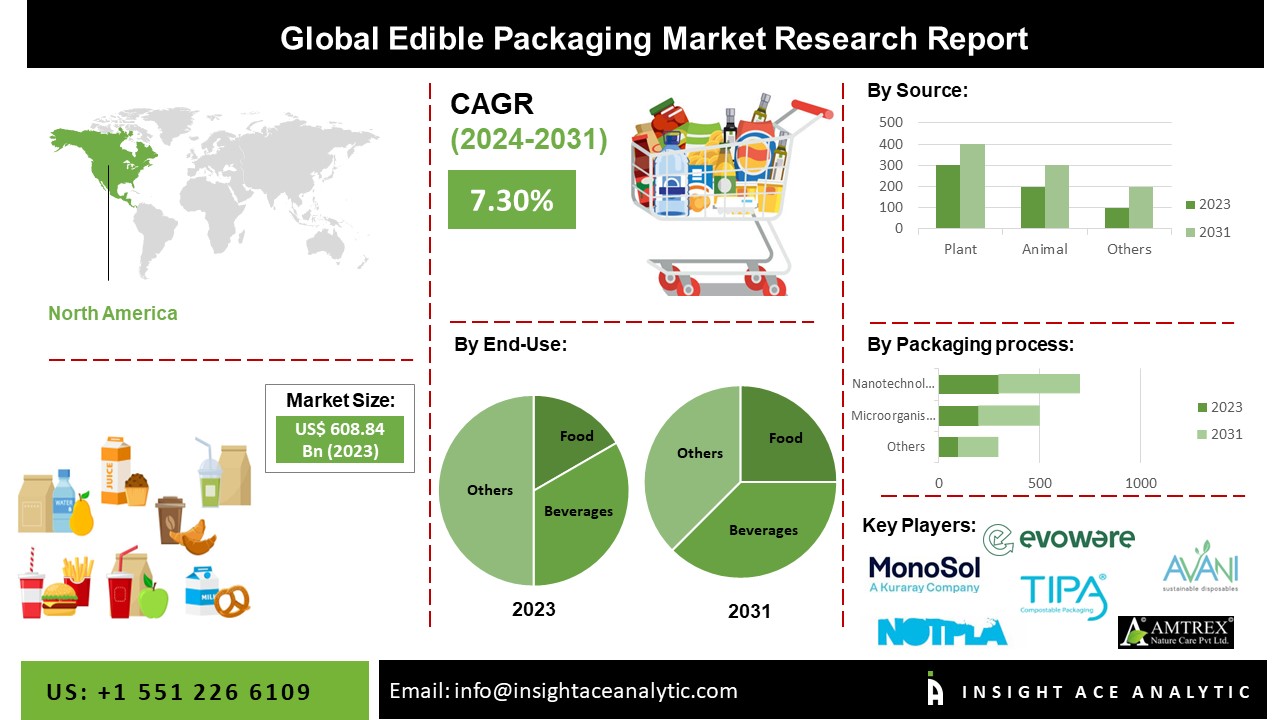
The Global Edible-Packaging Market Size is valued at 608.84 million in 2023 and is predicted to reach 1054.60 million by the year 2031 at an 7.30% CAGR during the forecast period in 2024-2031.
Key Industry Insights & Findings from the report:
- Natural and edible ingredients including cellulose, starch, and proteins are used to make edible packaging, which is intended to be consumed with the product.
- The regulatory support for eco-friendly alternatives is expected to drive industry growth.
- North America dominated the market and accounted for a revenue share of global revenue in 2023.
- One of the significant concerns restraining industry growth is the limited shelf life and durability.
An edible packaging container is used for food items or consumables like medicines. The main goal of edible packaging is to extend the shelf life of food goods. The market for edible packaging is expanding due to the increased desire to eliminate the wasteful use of food packaging.
Packaging makes up almost one-third of all trash produced worldwide. Therefore, recycling solid trash is required to decrease the garbage produced on land as more people become aware of environmental issues, including solid waste disposal and reducing waste generated in landfills. The use of edible packaging is crucial for lowering landfill waste. Because so many people consume processed foods, using edible coatings and films is anticipated to support industry expansion.
The market will experience strong growth for the projected period due to the increasing demand for biodegradable films in edible packaging. This reduced the need for fossil fuels while enabling new features and functions, such as biodegradability, to be offered by materials like cellulose/starch-based polymers, lipids, polysaccharides, and composite films.
Market restrictions could come from hygiene concerns with transportation and distribution and the high cost of edible packaging materials. For the projection period, market challenges could include the need for supplementary packaging while using edible packaging and the influence of COVID-19.
Recent Developments:
- In October 2020, a company in London called Notpla created edible seaweed packaging as an alternative to conventional plastic packaging.
- In January 2020-A New York-based company called Loliware started producing edible seaweed and algae straws.
Competitive Landscape:
Some of the major key players in the edible-packaging market are:
- MonoSol (US)
- JRF Technologies (US)
- Evoware (Indonesia),
- Nagase America LLC (US),
- Notpla Ltd. (UK)
Market Segmentation:
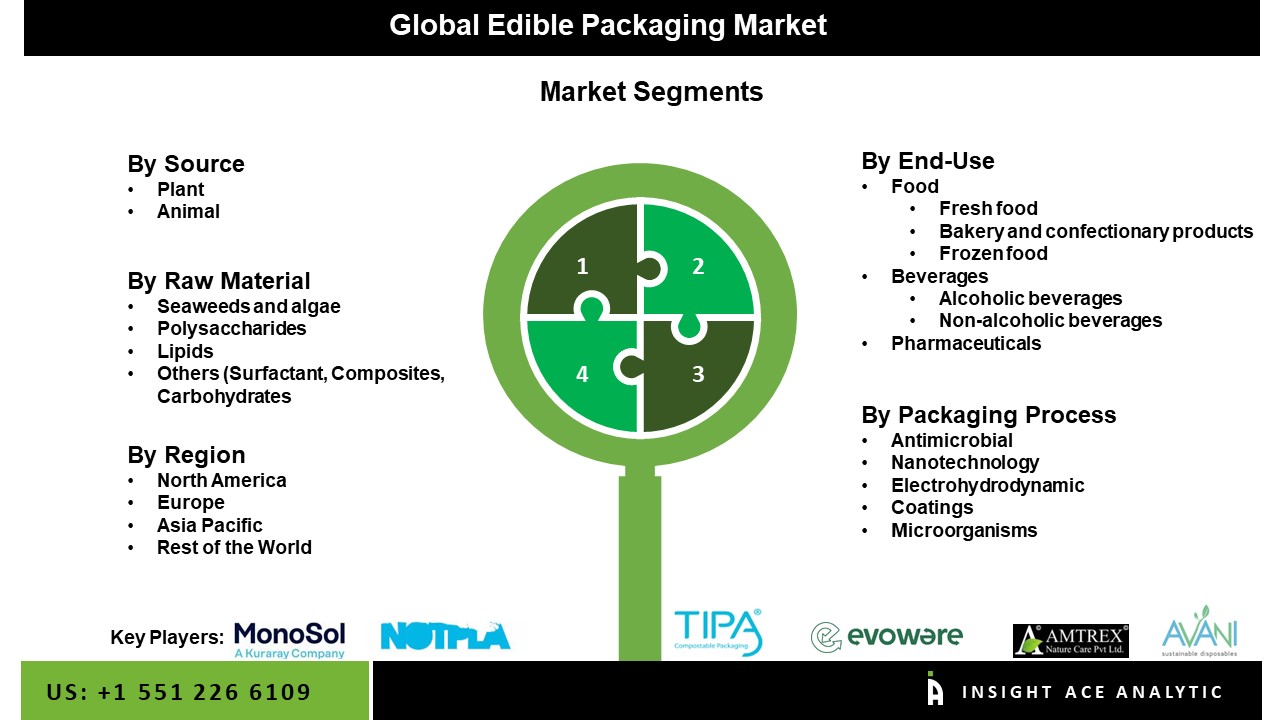
The edible-packaging market is segmented based on end users, packaging process, and raw materials. Based on end users, the edible-packaging market is segmented as food (fresh foods, bakery & confectionery products, frozen foods), beverages (non-alcoholic beverages, alcoholic beverages), and pharmaceuticals. Based on source, the market is segmented as plant and animal. Packaging processes segment the market into antimicrobial, nanotechnology, electrohydrodynamic, coatings and microorganisms. The market is segmented by material: seaweed and algae, polysaccharides, lipids, and others (surfactants, composites, carbohydrates).
Based on end users, the food & beverages segment is a major contributor to the edible-packaging market
The food & beverages category will hold a major share of the global edible-packaging market in 2024. In the food and beverage industry, the product segment is typically used for packaging a diverse range of items, including prepared foods, bakery and confectionery, maternity food, functional meals, and dairy products. The market is anticipated that edible packaging will expand as highly processed demand rises internationally due to changing lifestyles. In the food and beverage sector, edible packaging is frequently used to pack and safeguard various food products, including vitamins, proteins, food colors, dietary supplements, beverage mixes, and soup. The market for edible packaging is predicted to increase over the next several years as processed food demand increases globally due to changing lifestyles.
The polysaccharides segment witnessed growth at a rapid rate
The polysaccharides segment is projected to grow rapidly in the global edible-packaging market. Polysaccharides are often used to create edible packaging because they are a strong barrier to carbon dioxide and oxygen at low and moderate humidity levels. Biopolymers, wheat, cellulose, gum, and other substances are the main sources of polysaccharides. Over the coming years, consumption for polysaccharides is anticipated to rise in response to the expanding global market., especially in the US, Germany, the UK, China, and India.
In the region, the North America edible-packaging market holds a significant revenue share
The North America edible-packaging market is expected to register the highest market share in revenue soon. The large consumer base for edible packaging solutions, fundamental change away from single-use plastics to edible alternatives to cut packaging waste, Canada and the US holding the largest share, steadily increasing need for packaged foods due to lifestyle changes, companies allowing inventions and advances and abandoning the traditional ways of packaging, raising adoption of edible packaging by catering outlets and food & beverage carmakers in their product formats to reduce packaging waste Along with the fact that there are a ton of edible packaging manufacturers and growing advancements, particularly in the US. In addition, Asia Pacific region is projected to grow rapidly in the global edible-packaging market. Implementation and development in China for its industrial development and urbanization, growing consumer awareness of the benefits of edible packaging, rising disposable income among consumers, and an improvement in the region's standard of living are all factors contributing to the growth of the global edible packaging market. Additionally, the growing demand for packaged foods, the wide and simple accessibility of raw materials, the low cost of labor, the booming food, refreshments, and drug companies, and the growing awareness among consumers of the negative effects of excessive plastic clamshell usage for food are all contributing to market growth.
Edible-Packaging Market Report Scope:
|
Report Attribute
|
Specifications
|
|
Market size value in 2023
|
USD 608.84 million
|
|
Revenue forecast in 2031
|
USD 1054.60 million
|
|
Growth rate CAGR
|
CAGR of 7.30% from 2024 to 2031
|
|
Quantitative units
|
Representation of revenue in US$ Million, Volume in KT and CAGR from 2024 to 2031
|
|
Historic Year
|
2019 to 2023
|
|
Forecast Year
|
2024-2031
|
|
Report coverage
|
The forecast of revenue, the position of the company, the competitive market structure, growth prospects, and trends
|
|
Segments covered
|
Product Type, Material, End-use Industry
|
|
Regional scope
|
North America; Europe; Asia Pacific; Latin America; Middle East & Africa
|
|
Country scope
|
U.S.; Canada; U.K.; Germany; China; India; Japan; Brazil; Mexico; The UK; France; Italy; Spain; China; Japan; India; South Korea; South East Asia; South Korea; South East Asia
|
|
Competitive Landscape
|
MonoSol (US), JRF Technologies (US), Evoware (Indonesia), Nagase America LLC (US), and Notpla Ltd. (UK)
|
|
Customization scope
|
Free customization report with the procurement of the report, Modifications to the regional and segment scope. Particular Geographic competitive landscape.
|
|
Pricing and available payment methods
|
Explore pricing alternatives that are customized to your particular study requirements.
|
Segmentation of Edible-packaging Market :
Edible-packaging Market By End Use
- Food
- Fresh foods
- Bakery & confectionery products
- Frozen foods
- Beverages
- Non-alcoholic beverages
- Alcoholic beverages
- Pharmaceuticals
Edible-packaging Market By Source
Edible-packaging Market By Packaging Process
- Antimicrobial
- Nanotechnology
- Electrohydrodynamic
- Coatings
- Microorganisms
Edible-packaging Market By Raw Material
- Seaweeds and algae
- Polysaccharides
- Lipids
- Others (Surfactant, Composites, Carbohydrates)
Edible-packaging Market By Region-
North America-
Europe-
- Germany
- The UK
- France
- Italy
- Spain
- Rest of Europe
Asia-Pacific-
- China
- Japan
- India
- South Korea
- Southeast Asia
- Rest of Asia Pacific
Latin America-
- Brazil
- Argentina
- Rest of Latin America
Middle East & Africa-
- GCC Countries
- South Africa
- Rest of Middle East and Africa