



Global Digital Health Market Size is valued at USD 295.8 Billion in 2024 and is predicted to reach USD 1846.6 Billion by the year 2034 at a 20.2% CAGR during the forecast period for 2025-2034.

Key Industry Insights & Findings from the Report:
The fusion of information technology and electronic communications with various healthcare operations is known as digital health. Telehealth, medical wearables, electronic medical records and electronic health records (EMR and EHR) apps, healthcare analytics, and many other digital health services are among them. This approach aims to improve patient care, illness management, and the user's healthcare cost experience.
Furthermore, the rising number of mobile devices, enhanced internet connectivity brought about by the introduction of 4G/5G, improvements in the healthcare IT power grid, healthcare costs, the prevalence of chronic illnesses increasing, the implementation of remote patient monitoring services continuing to grow, and the connectivity of virtual care increasing are some of the key drivers of digital health industry growth.
In addition, major firms are concentrating on releasing cutting-edge applications that will allow users to keep track of their daily activities, find answers to medical questions, interact with doctors, and store their medical records.
The digital health market expansion may be constrained in the next years by escalating data security issues such as cyberattacks and unauthorized access to information technology systems. Security issues with patient data could hamper the market value. The development of the digital health business may need to be improved by a global shortage of qualified IT workers in the healthcare industry.
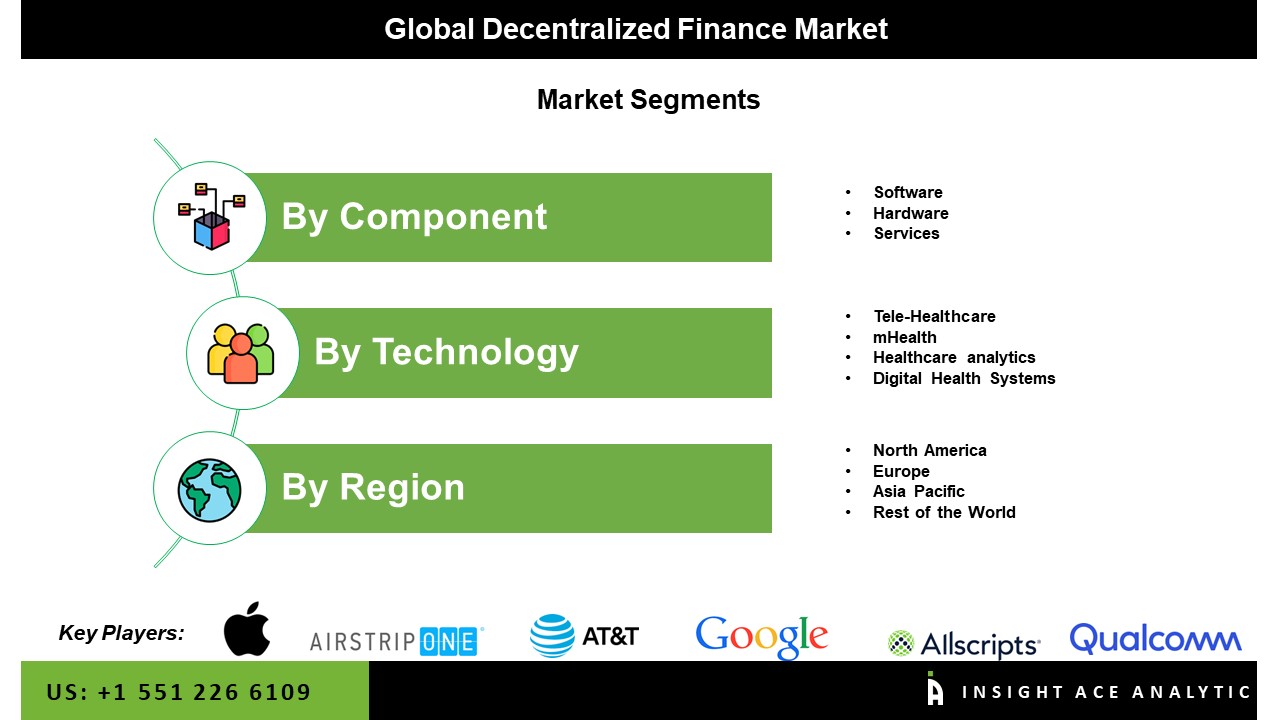
The digital health market is divided based on technology, services and component. Based on technology, the market is segmented as tele-healthcare, tele-care, telehealth, mHealth, wearables and mHealth apps. Based on services, the market is divided into healthcare analytics, digital health systems, HER and E-Prescribing Systems. The market is segmented by components into software, hardware, and services.
The services category will hold a significant share of the global digital health market in 2021. This is primarily due to the substantial increase in such updates and quick improvements in different equipment and software. These services include installation, upgrade, and coaching & integration. Also, many businesses are concentrating on service-based operations, including training & integration, installation, and up-gradation, which have accelerated market growth during the study. The need for services in the next years will be driven by rising investments in digital healthcare infrastructure, particularly in developing nations.
The mHealth segment is projected to grow rapidly in the global digital health market. mHealth, often known as mobile health, is the application of wireless and mobile technology to support the pursuit of health goals. The use of mobile devices to inform customers about preventative healthcare services is the most widespread application of mHealth. Additionally, mHealth is utilized for managing chronic diseases, tracking epidemic outbreaks, supporting treatment, and surveillance of diseases. For the projection period, factors such as the increased prevalence of chronic diseases, technological developments, rising public awareness of health issues, and government initiatives will continue to fuel the expansion of this market sector. The rising number of research studies is another fueling the digital health market development.
The North American digital health market is expected to register the highest market share in revenue soon. Due to the rising incidence of chronic diseases, the widespread use of cutting-edge healthcare technologies, support from the government and public authorities, and the introduction of new products and services, digital health is a fast-expanding area of healthcare in North America. The market is anticipated to increase during the projection period due to the increasing demand for wireless technology, patients' increasing adoption of home care, and a decline in hospital visits.
The development of telemedicine services, which enable the public to manage their health, notably during the COVID-19 epidemic actively, contributes to favourable developments in healthcare in North America. In addition, the Asia Pacific region is projected to proliferate in the global digital health market. As more people in the area use the web and similar devices, demand from the rural healthcare sector is growing. Telehealth services provide remote patient monitoring (RPM), the storage and forwarding of medical data, mobile health communication, and other services. The rise aids the expansion of the digital health market in this region by adopting functional networks and compatible devices.
| Report Attribute | Specifications |
| Market Size Value in 2024 | USD 295.8 Billion |
| Revenue Forecast in 2034 | USD 1846.6 Billion |
| Growth Rate CAGR | CAGR of 20.2% from 2025 to 2034 |
| Quantitative Units | Representation of revenue in US$ Mn, and CAGR from 2025 to 2034 |
| Historic Year | 2021 to 2024 |
| Forecast Year | 2025-2034 |
| Report coverage | The forecast of revenue, the position of the company, the competitive market statistics, growth prospects, and trends |
| Segments covered | Material, Product, Application, End-Use |
| Regional scope | North America; Europe; Asia Pacific; Latin America; Middle East & Africa |
| Country scope | U.S.; Canada; U.K.; Germany; China; India; Japan; Brazil; Mexico; The UK; France; Italy; Spain; China; Japan; India; South Korea; Southeast Asia; South Korea; Southeast Asia |
| Competitive Landscape | Cerner Corporation; Allscripts; Apple Inc; Telefonica S.A.; McKesson Corporation; Epic Systems Corporation; QSI Management, LLC; AT&T; Vodafone Group; Airstrip Technologies; Google, Inc; Samsung Electronics Co. Ltd; Himes; Orange; Qualcomm Technologies, Inc; Soft serve; Mura; Computer Programs and Systems, Inc; Voceru Communications; IBM Corporation; CISCO Systems, Inc. |
| Customization scope | Free customization report with the procurement of the report, Modifications to the regional and segment scope. Particular Geographic competitive landscape. |
| Pricing and available payment methods | Explore pricing alternatives that are customized to your particular study requirements. |
Digital Health Market By Technology
Digital Health Market By Component
By Region-
North America-
Europe-
Asia-Pacific-
Latin America-
Middle East & Africa-
This study employed a multi-step, mixed-method research approach that integrates:
This approach ensures a balanced and validated understanding of both macro- and micro-level market factors influencing the market.
Secondary research for this study involved the collection, review, and analysis of publicly available and paid data sources to build the initial fact base, understand historical market behaviour, identify data gaps, and refine the hypotheses for primary research.
Secondary data for the market study was gathered from multiple credible sources, including:
These sources were used to compile historical data, market volumes/prices, industry trends, technological developments, and competitive insights.

Primary research was conducted to validate secondary data, understand real-time market dynamics, capture price points and adoption trends, and verify the assumptions used in the market modelling.
Primary interviews for this study involved:
Interviews were conducted via:
Primary insights were incorporated into demand modelling, pricing analysis, technology evaluation, and market share estimation.
All collected data were processed and normalized to ensure consistency and comparability across regions and time frames.
The data validation process included:
This ensured that the dataset used for modelling was clean, robust, and reliable.
The bottom-up approach involved aggregating segment-level data, such as:
This method was primarily used when detailed micro-level market data were available.

The top-down approach used macro-level indicators:
This approach was used for segments where granular data were limited or inconsistent.
To ensure accuracy, a triangulated hybrid model was used. This included:
This multi-angle validation yielded the final market size.
Market forecasts were developed using a combination of time-series modelling, adoption curve analysis, and driver-based forecasting tools.
Given inherent uncertainties, three scenarios were constructed:
Sensitivity testing was conducted on key variables, including pricing, demand elasticity, and regional adoption.