Dental Orthodontic Archwires Market Size, Trend, Revenue Report 2026 to 2035
What is Dental Orthodontic Archwires Market Size?
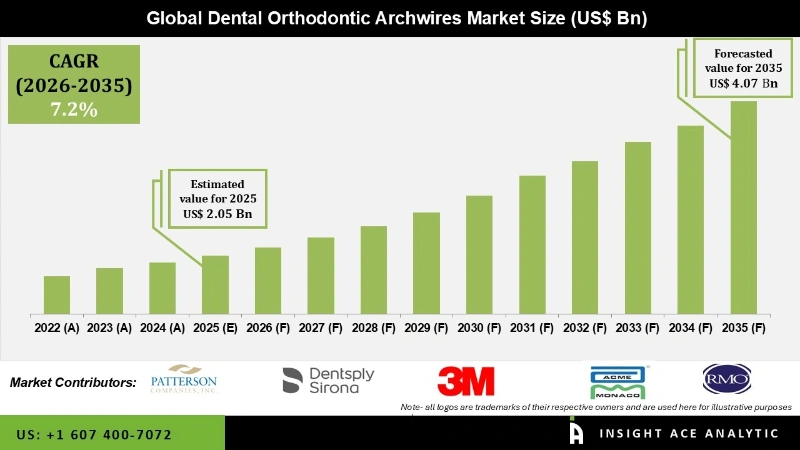
Global Dental Orthodontic Archwires Market Size is valued at US$ 2.05 Bn in 2025 and is predicted to reach US$ 4.07 Bn by the year 2035 at an 7.2% CAGR during the forecast period for 2026 to 2035.
Dental Orthodontic Archwires Market Size, Share & Trends Analysis Distribution By Product Type (NiTi, Stainless Steel, Beta-Titanium, Heat-Activated, Coated), Treatment Type (Interceptive, Comprehensive, Surgical, Corrective, Retentive), Material Type (Metal, Polymer, Composite, Advanced Thermoplastic, Multilayer), Application (Traditional Metal Braces, Ceramic Braces, Lingual Braces, Clear Aligners, Surgical Orthodontics), and End-User (Dental Clinics, Hospitals, Orthodontic Specialty Clinics, Research Institutions, Homecare Settings) and Segment Forecasts, 2026 to 2035.
Dental Orthodontic Archwires Market Key Takeaways:
|
Dental orthodontic archwires are the core working component of fixed braces. These thin, flexible wires connect the brackets on teeth and apply gentle, continuous force to move teeth into correct alignment over time. Available in materials like nickel-titanium (NiTi), stainless steel, and beta-titanium, they vary in shape, size, and properties (super-elastic, heat-activated, or shape-memory) to suit different treatment stages. Archwires are essential for correcting crowding, spacing, bite issues, and jaw misalignment, making them indispensable in both traditional and modern orthodontic practices worldwide.
Growing public awareness of oral health and aesthetics is the strongest driver of the orthodontic archwire market. People now better understand that straight teeth not only improve smiles but also prevent tooth decay, gum disease, and jaw problems. Social media, celebrity endorsements, dental health campaigns, and easy access to information have made orthodontic treatment desirable across all age groups. Adults, in particular, are seeking discreet and faster solutions, while parents are choosing early intervention for children. This shift in mindset is increasing patient footfall at orthodontic clinics globally and directly boosting demand for high-quality archwires.
Advancements in digital orthodontics are rapidly transforming the archwire market. Tools like 3D intraoral scanners, CBCT imaging, and CAD/CAM software enable precise treatment planning and fully customized archwire sequences. Heat-activated NiTi wires can now be robotically bent (e.g., SureSmile, Insignia) to match each patient’s exact dental anatomy, reducing treatment time by 20–30% and minimizing discomfort. AI-powered platforms predict tooth movement more accurately, allowing fewer adjustments and better outcomes. As orthodontists worldwide adopt these digital workflows, demand surges for premium, custom-manufactured archwires, driving both market revenue and continued innovation in the sector.
Competitive Landscape
Some of the Key Players in the Dental Orthodontic Archwires Market:
- GC Orthodontics
- Rocky Mountain Orthodontics
- ACME Monaco
- Patterson
- Ultimate Wireforms
- Ormco
- 3M Company
- Dentsply
- Henry Schien
- American Orthodontics
- G&H Orthodontics
- TP Orthodontics
- Forestadent
- Dentauru
Market Segmentation:
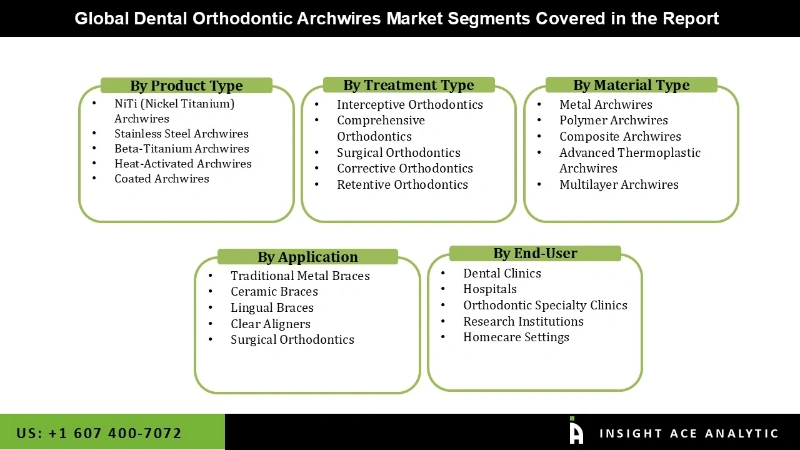
The dental orthodontic archwires market is segmented by product type, treatment type, material type, applications, end-user and by region. By product type (niti, stainless steel, beta-titanium, heat-activated, coated), treatment type (interceptive, comprehensive, surgical, corrective, retentive), material type (metal, polymer, composite, advanced thermoplastic, multilayer), application (traditional metal braces, ceramic braces, lingual braces, clear aligners, surgical orthodontics), and end-user (dental clinics, hospitals, orthodontic specialty clinics, research institutions, homecare settings).
By Material Type, the Nickel Titanium Segment is Expected to Drive the Dental Orthodontic Archwires Market
In 2024, the nickel titanium held the major market share over the projected period. NiTi archwires deliver continuous, gentle forces, improving patient comfort and decreasing chairside adjustments compared to stainless steel. Growing demand for aesthetic, efficient orthodontic treatments and increasing cases of malocclusion fuel their utilization. Advancements in NiTi technology, such as heat-activated and superelastic variants, further expand treatment outcomes, boosting their preference among orthodontists and driving overall market expansion.
Removable Orthodontics Segment by Type of Treatment is Growing at the Highest Rate in the Dental Orthodontic Archwires Market
The dental orthodontic archwires market is dominated by removable orthodontics due to rising demand for removable orthodontics. Patients increasingly need clear aligners and removable braces owing to their comfort, aesthetics, and ease of oral hygiene maintenance. This trend fuels the requirement for advanced archwires compatible with hybrid and combination treatments, where removable devices are paired with fixed appliances. Additionally, technological advancements in archwire materials, including nickel-titanium and coated wires, enhance efficiency and treatment outcomes, further helping market expansion globally.
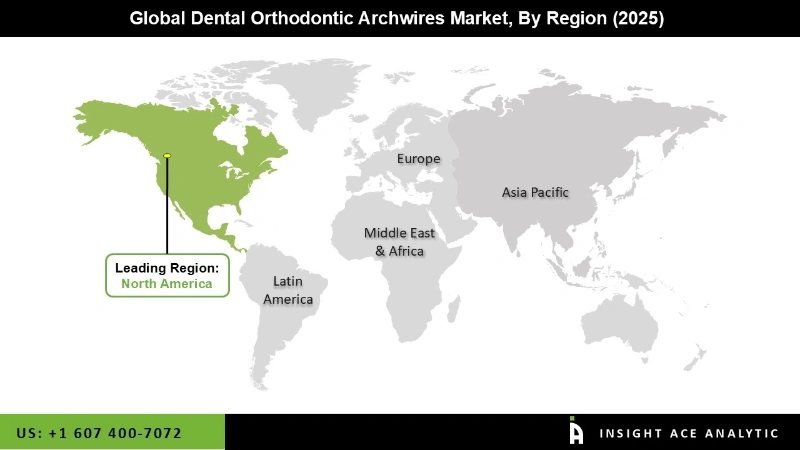
Regionally, North America Led the Dental Orthodontic Archwires Market
North America is the biggest market for orthodontic archwires. Many people here have crooked teeth, care a lot about their smile, and can afford treatment. Insurance often covers braces, there are plenty of orthodontists, and patients quickly get the newest wires (like super-elastic or heat-activated ones). All of this keeps North America in the top spot.
Europe is growing the fastest. More kids and adults want straighter teeth, and they are willing to pay for modern treatments. Countries like Germany, France, and the UK help cover costs, and people have more money to spend. Dentists here love the latest wires that work better and feel more comfortable. Because of these reasons, Europe’s market is expanding quickly.
Dental Orthodontic Archwires Market Report Scope :
Segmentation of Dental Orthodontic Archwires Market -
Dental Orthodontic Archwires Market by Product Type-
- NiTi (Nickel Titanium) Archwires
- Stainless Steel Archwires
- Beta-Titanium Archwires
- Heat-Activated Archwires
- Coated Archwires
Dental Orthodontic Archwires Market by Treatment Type-
- Interceptive Orthodontics
- Comprehensive Orthodontics
- Surgical Orthodontics
- Corrective Orthodontics
- Retentive Orthodontics
Dental Orthodontic Archwires Market by Material Type-
- Metal Archwires
- Polymer Archwires
- Composite Archwires
- Advanced Thermoplastic Archwires
- Multilayer Archwires
Dental Orthodontic Archwires Market by Application-
- Traditional Metal Braces
- Ceramic Braces
- Lingual Braces
- Clear Aligners
- Surgical Orthodontics
Dental Orthodontic Archwires Market by End-User-
- Dental Clinics
- Hospitals
- Orthodontic Specialty Clinics
- Research Institutions
- Homecare Settings
Dental Orthodontic Archwires Market by Region-
- North America-
- The US
- Canada
- Europe-
- Germany
- The UK
- France
- Italy
- Spain
- Rest of Europe
- Asia-Pacific-
- China
- Japan
- India
- South Korea
- Southeast Asia
- Rest of Asia Pacific
- Latin America-
- Brazil
- Argentina
- Mexico
- Rest of Latin America
- Middle East & Africa-
- GCC Countries
- South Africa
- Rest of the Middle East and Africa
Research Design and Approach
This study employed a multi-step, mixed-method research approach that integrates:
- Secondary research
- Primary research
- Data triangulation
- Hybrid top-down and bottom-up modelling
- Forecasting and scenario analysis
This approach ensures a balanced and validated understanding of both macro- and micro-level market factors influencing the market.
Secondary Research
Secondary research for this study involved the collection, review, and analysis of publicly available and paid data sources to build the initial fact base, understand historical market behaviour, identify data gaps, and refine the hypotheses for primary research.
Sources Consulted
Secondary data for the market study was gathered from multiple credible sources, including:
- Government databases, regulatory bodies, and public institutions
- International organizations (WHO, OECD, IMF, World Bank, etc.)
- Commercial and paid databases
- Industry associations, trade publications, and technical journals
- Company annual reports, investor presentations, press releases, and SEC filings
- Academic research papers, patents, and scientific literature
- Previous market research publications and syndicated reports
These sources were used to compile historical data, market volumes/prices, industry trends, technological developments, and competitive insights.

Primary Research
Primary research was conducted to validate secondary data, understand real-time market dynamics, capture price points and adoption trends, and verify the assumptions used in the market modelling.
Stakeholders Interviewed
Primary interviews for this study involved:
- Manufacturers and suppliers in the market value chain
- Distributors, channel partners, and integrators
- End-users / customers (e.g., hospitals, labs, enterprises, consumers, etc., depending on the market)
- Industry experts, technology specialists, consultants, and regulatory professionals
- Senior executives (CEOs, CTOs, VPs, Directors) and product managers
Interview Process
Interviews were conducted via:
- Structured and semi-structured questionnaires
- Telephonic and video interactions
- Email correspondences
- Expert consultation sessions
Primary insights were incorporated into demand modelling, pricing analysis, technology evaluation, and market share estimation.
Data Processing, Normalization, and Validation
All collected data were processed and normalized to ensure consistency and comparability across regions and time frames.
The data validation process included:
- Standardization of units (currency conversions, volume units, inflation adjustments)
- Cross-verification of data points across multiple secondary sources
- Normalization of inconsistent datasets
- Identification and resolution of data gaps
- Outlier detection and removal through algorithmic and manual checks
- Plausibility and coherence checks across segments and geographies
This ensured that the dataset used for modelling was clean, robust, and reliable.
Market Size Estimation and Data Triangulation
Bottom-Up Approach
The bottom-up approach involved aggregating segment-level data, such as:
- Company revenues
- Product-level sales
- Installed base/usage volumes
- Adoption and penetration rates
- Pricing analysis
This method was primarily used when detailed micro-level market data were available.

Top-Down Approach
The top-down approach used macro-level indicators:
- Parent market benchmarks
- Global/regional industry trends
- Economic indicators (GDP, demographics, spending patterns)
- Penetration and usage ratios
This approach was used for segments where granular data were limited or inconsistent.
Hybrid Triangulation Approach
To ensure accuracy, a triangulated hybrid model was used. This included:
- Reconciling top-down and bottom-up estimates
- Cross-checking revenues, volumes, and pricing assumptions
- Incorporating expert insights to validate segment splits and adoption rates
This multi-angle validation yielded the final market size.
Forecasting Framework and Scenario Modelling
Market forecasts were developed using a combination of time-series modelling, adoption curve analysis, and driver-based forecasting tools.
Forecasting Methods
- Time-series modelling
- S-curve and diffusion models (for emerging technologies)
- Driver-based forecasting (GDP, disposable income, adoption rates, regulatory changes)
- Price elasticity models
- Market maturity and lifecycle-based projections
Scenario Analysis
Given inherent uncertainties, three scenarios were constructed:
- Base-Case Scenario: Expected trajectory under current conditions
- Optimistic Scenario: High adoption, favourable regulation, strong economic tailwinds
- Conservative Scenario: Slow adoption, regulatory delays, economic constraints
Sensitivity testing was conducted on key variables, including pricing, demand elasticity, and regional adoption.
Request Customization
Add countries, segments, company profiles, or extend forecast — free 10% customization with purchase.
Customize This Report →Enquire Before Buying
Speak with our analyst team about scope, methodology, pricing, or deliverable formats.
Enquire Now →Frequently Asked Questions
The major players in the dental orthodontic archwires market are Align Technology, Inc, 3M Company, Danaher Corporation, Henry Schien, Inc, DENTSPLY SIRONA, Inc, American Orthodontics, Rocky Mountain Orthodontics, G&H Orthodontics, DENTAURUM GmbH & Co, TP Orthodontics, Inc, ClearCorrect, and Ultradent Products, Inc
The primary dental orthodontic archwires market segments are by material type, by type of treatment, by coating type, by applications, by diameter size and by region.
North America leads the market for dental orthodontic archwires due to is the growing popularity of clear aligners, and rising demand for alteative to traditional braces.
Dental Orthodontic Archwires Market Size is valued at US$ 2.05 Bn in 2025 and is predicted to reach US$ 4.07 Bn by the year 2035
Dental Orthodontic Archwires Market growth is predicted at a 7.2% CAGR during the forecast period for 2026-2035.