Cathode Active Materials Market Size, Share, Scope Report 2026 to 2035
What is Cathode Active Materials Market Size?
Global Cathode Active Materials Market Size is valued at USD 37.96 Billion in 2025 and is predicted to reach USD 116.58 Billion by the year 2035 at a 12.0% CAGR during the forecast period for 2026 to 2035.
Cathode Active Materials Market Size, Share & Trends Analysis Report By Material Type (Lithium-Ion Cathode Materials, Lead-Acid Materials, And Other Materials), Battery Type (Lithium-Ion Batteries, Lead-Acid Batteries And Others), End-Use By Region, And Segment Forecasts, 2026 to 2035.
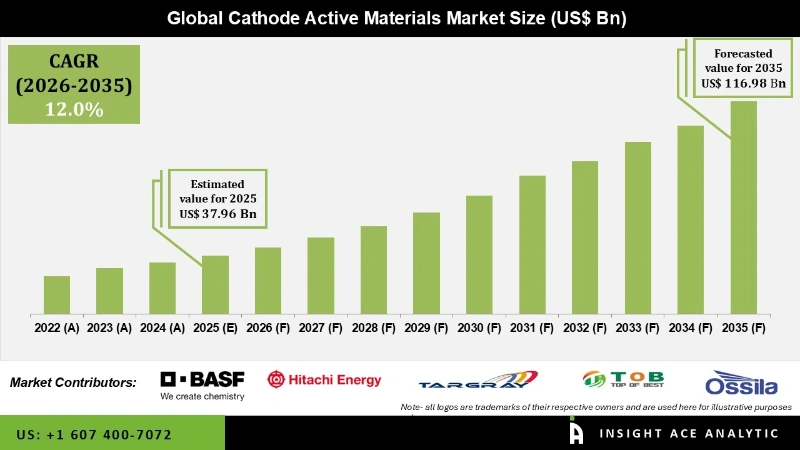
Cathode Active Materials Market Key Takeaways:
|
High-purity chemicals known as active cathode materials (CAM) determine the performance and use of several rechargeable lithium-ion battery types used in electric vehicles and renewable energy storage. The cathode active material's quality significantly influences the effectiveness of the cell or battery as a whole. It is projected that the need for electric car batteries will increase as the number of electric vehicles on the road expands globally. This is likely to give cathode active material significant growth potential.
Due to strict government regulations and additional incentives and subsidies for their widespread adoption, the electric car sector is predicted to experience tremendous growth shortly. The general use of active cathode material in electric vehicle batteries is one of the main factors promoting its expansion.
Additionally, the dynamic demand for these energy storage solutions, such as increased durability, quick charging, and long service lives, is likely to feed the need for innovative materials in these batteries. The possible technical advance will cause preferences to change in favour of adopting various cathode-active materials. Moreover, government regulations and fierce competition between the current players are also anticipated to impact the worldwide cathode active material market over the projected period.
Recent Developments:
- In August 2022, General Motors, a global leader in the automotive industry with headquarters in Michigan and operations across the globe, announced a strategic partnership for CAM with Posco Chemical. The joint venture will produce Cathode Active Material (CAM), a critical battery material that accounts for around 40% of the cost of a battery cell.
- In December 2022-The European Investment Bank (EIB) stated, that it would lend USD 39.04 million to Königswarter & Ebell, an entirely German division of Pure Battery Technologies in Australia.
Competitive Landscape:
Key players in the cathode active materials market:
- BASF SE
- Hitachi Chemical Energy
- Targray
- XIAMEN TOB NEW ENERGY TECHNOLOGY Co., LTD.
- Ossila
- Mitsui Mining & Smelting Co., Ltd.
- NEI Corporation
- POSCO
- Pulead Technology Industry Co
- Showa Denko
- Sumitomo
- Toda Kogyo Corp
- Umicore
- Tanaka Chemical
- LG Chem
Market Segmentation:
The cathode active materials market is segmented on material, battery types and end-use. Based on material type, the cathode active materials market is segmented into Li-Ion Cathode Materials (Lithium Iron Phosphate (LFP), Lithium Cobalt Oxide (LCO), Lithium Nickel Manganese Cobalt (NMC) (NCM 111 (1:1:1 Ratio), NCM 523 (5:2:3 Ratio), NCM 622 (6:2:2 Ratio), NCM 811 (8:1:1 Ratio), Others), Lead Dioxide Cathode Materials, Other Cathode Materials), By Battery Type, the segment comprises Lithium-ion-Batteries, Lead-Acid-Batteries, and Others. According to the End-Use, the market is categorized into Automotive, Consumer electronics, Industrial, Others.
Based on materials, the lithium-ion cathode materials segment is a major contributor to the cathode active materials market.
The lithium-ion cathode materials category is expected to hold a major share of the global cathode active materials market in 2021. The adoption of electric vehicles and rising energy storage requirements for the electric power grid are the main drivers of the segment's revenue growth. Lithium-ion battery parts are being replaced with more affordable, safe, and ecologically friendly alternatives. Integrating renewable energy sources for power generation while reducing reliance on fossil fuels may be aided by longer-term storage technologies like flow batteries. Companies in the sector are concentrating on developing partnerships and spending money on top-notch battery technologies.
The lithium-ion batteries segment witnessed growth at a rapid rate.
The lithium-ion batteries segment is projected to grow rapidly in the global cathode active materials market. Electronic products like smartphones, computers, clocks, smartwatches, and remote controls frequently employ lithium-ion batteries. The population and disposable income of the nation heavily influence consumer electronics sales. India's improved living standards and expanding disposable income over the past few years have increased demand for consumer electronics. Rapid product innovation and strategic alliances are key elements boosting market revenue development. Large expenditures in developing current production capabilities in several nations primarily drive the segment's revenue growth.
The North America cathode active materials market holds a significant regional revenue share.
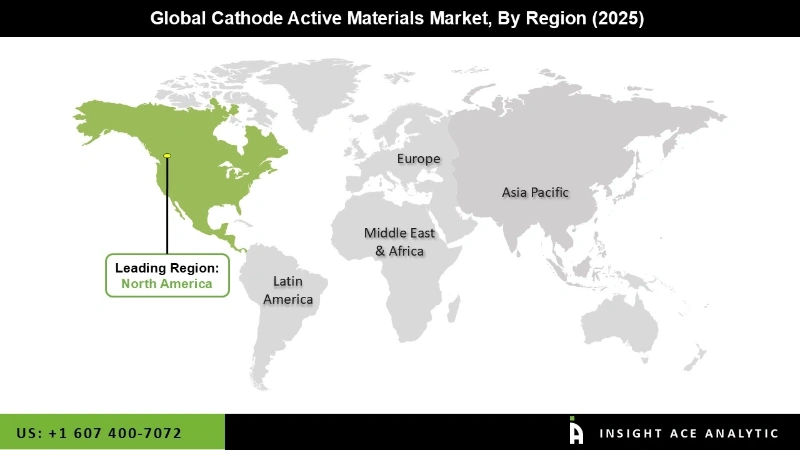
The North American cathode active materials market is expected to register the highest market share in revenue shortly. The main drivers of the market expansion are the growing middle-class population, shifting lifestyle choices, soaring demand for electric vehicles, quickening technological development, and rising propensity toward smart electronic devices. In addition, the falling cost of EVs results from more initiatives and subsidies. In addition, Asia Pacific is projected to grow rapidly in the global cathode active materials market. The market for cathode-active materials is expected to be dominated by Asia Pacific, particularly China. The availability of cheap labor in this area, coupled with increased investment by major EV manufacturers, is predicted to boost demand for active cathode material during the forecast period.
Cathode Active Materials Market Report Scope:
| Report Attribute | Specifications |
| Market size value in 2025 | USD 37.96 Billion |
| Revenue forecast in 2035 | USD 116.58 Billion |
| Growth rate CAGR | CAGR of 12.0% from 2026 to 2035 |
| Quantitative units | Representation of revenue in US$ Mn, Volume in Kiloton and CAGR from 2026 to 2035 |
| Historic Year | 2022 to 2025 |
| Forecast Year | 2026-2035 |
| Report coverage | The forecast of revenue, the position of the company, the competitive market structure, growth prospects, and trends |
| Segments covered | Material, Battery Type, End-Use |
| Regional scope | North America; Europe; Asia Pacific; Latin America; Middle East & Africa |
| Country scope | U.S.; Canada; U.K.; Germany; China; India; Japan; Brazil; Mexico; The UK; France; Italy; Spain; South Korea; South East Asia |
| Competitive Landscape | Umicore, Posco Chemical, BASF SE, Hitachi Metals, Ltd., Strategic Initiatives, Kureha Corporation, Sumitomo Metal Mining Co., Ltd., Mitsui & Co., Ltd. And NEI Corporation and others |
| Customization scope | Free customization report with the procurement of the report, Modifications to the regional and segment scope. Particular Geographic competitive landscape. |
| Pricing and available payment methods | Explore pricing alternatives that are customized to your particular study requirements. |
Segmentation of Cathode Active Materials Market-
Cathode Active Materials Market By Material Type
- Li-Ion Cathode Materials
- Lithium Iron Phosphate (LFP)
- Lithium Cobalt Oxide (LCO)
- Lithium Nickel Manganese Cobalt (NMC)
- NCM 111 (1:1:1 Ratio)
- NCM 523 (5:2:3 Ratio)
- NCM 622 (6:2:2 Ratio)
- NCM 811 (8:1:1 Ratio)
- Others
- Lead Dioxide Cathode Materials
- Other Cathode Materials
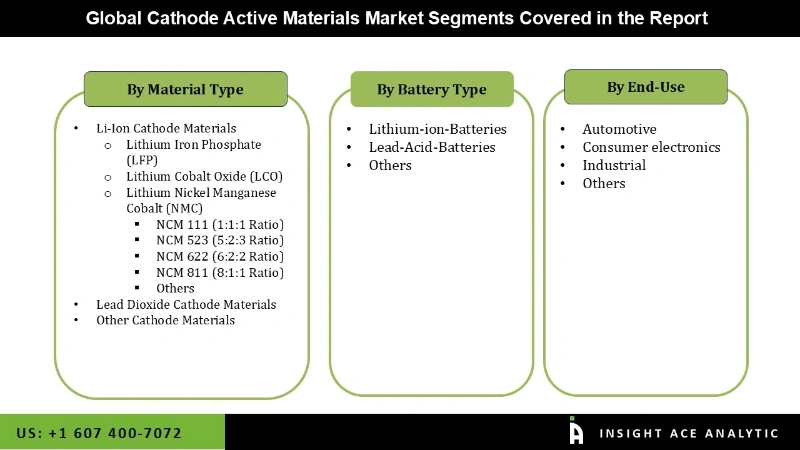
Cathode Active Materials Market By Battery Type
- Lithium-ion-Batteries
- Lead-Acid-Batteries
- Others
Cathode Active Materials Market By End-Use
- Automotive
- Consumer electronics
- Industrial
- Others
Cathode Active Materials Market By Region-
North America-
- The US
- Canada
- Mexico
Europe-
- Germany
- The UK
- France
- Italy
- Spain
- Rest of Europe
Asia-Pacific-
- China
- Japan
- India
- South Korea
- Southeast Asia
- Rest of Asia Pacific
Latin America-
- Brazil
- Argentina
- Rest of Latin America
Middle East & Africa-
- GCC Countries
- South Africa
- Rest of Middle East and Africa
Research Design and Approach
This study employed a multi-step, mixed-method research approach that integrates:
- Secondary research
- Primary research
- Data triangulation
- Hybrid top-down and bottom-up modelling
- Forecasting and scenario analysis
This approach ensures a balanced and validated understanding of both macro- and micro-level market factors influencing the market.
Secondary Research
Secondary research for this study involved the collection, review, and analysis of publicly available and paid data sources to build the initial fact base, understand historical market behaviour, identify data gaps, and refine the hypotheses for primary research.
Sources Consulted
Secondary data for the market study was gathered from multiple credible sources, including:
- Government databases, regulatory bodies, and public institutions
- International organizations (WHO, OECD, IMF, World Bank, etc.)
- Commercial and paid databases
- Industry associations, trade publications, and technical journals
- Company annual reports, investor presentations, press releases, and SEC filings
- Academic research papers, patents, and scientific literature
- Previous market research publications and syndicated reports
These sources were used to compile historical data, market volumes/prices, industry trends, technological developments, and competitive insights.

Primary Research
Primary research was conducted to validate secondary data, understand real-time market dynamics, capture price points and adoption trends, and verify the assumptions used in the market modelling.
Stakeholders Interviewed
Primary interviews for this study involved:
- Manufacturers and suppliers in the market value chain
- Distributors, channel partners, and integrators
- End-users / customers (e.g., hospitals, labs, enterprises, consumers, etc., depending on the market)
- Industry experts, technology specialists, consultants, and regulatory professionals
- Senior executives (CEOs, CTOs, VPs, Directors) and product managers
Interview Process
Interviews were conducted via:
- Structured and semi-structured questionnaires
- Telephonic and video interactions
- Email correspondences
- Expert consultation sessions
Primary insights were incorporated into demand modelling, pricing analysis, technology evaluation, and market share estimation.
Data Processing, Normalization, and Validation
All collected data were processed and normalized to ensure consistency and comparability across regions and time frames.
The data validation process included:
- Standardization of units (currency conversions, volume units, inflation adjustments)
- Cross-verification of data points across multiple secondary sources
- Normalization of inconsistent datasets
- Identification and resolution of data gaps
- Outlier detection and removal through algorithmic and manual checks
- Plausibility and coherence checks across segments and geographies
This ensured that the dataset used for modelling was clean, robust, and reliable.
Market Size Estimation and Data Triangulation
Bottom-Up Approach
The bottom-up approach involved aggregating segment-level data, such as:
- Company revenues
- Product-level sales
- Installed base/usage volumes
- Adoption and penetration rates
- Pricing analysis
This method was primarily used when detailed micro-level market data were available.

Top-Down Approach
The top-down approach used macro-level indicators:
- Parent market benchmarks
- Global/regional industry trends
- Economic indicators (GDP, demographics, spending patterns)
- Penetration and usage ratios
This approach was used for segments where granular data were limited or inconsistent.
Hybrid Triangulation Approach
To ensure accuracy, a triangulated hybrid model was used. This included:
- Reconciling top-down and bottom-up estimates
- Cross-checking revenues, volumes, and pricing assumptions
- Incorporating expert insights to validate segment splits and adoption rates
This multi-angle validation yielded the final market size.
Forecasting Framework and Scenario Modelling
Market forecasts were developed using a combination of time-series modelling, adoption curve analysis, and driver-based forecasting tools.
Forecasting Methods
- Time-series modelling
- S-curve and diffusion models (for emerging technologies)
- Driver-based forecasting (GDP, disposable income, adoption rates, regulatory changes)
- Price elasticity models
- Market maturity and lifecycle-based projections
Scenario Analysis
Given inherent uncertainties, three scenarios were constructed:
- Base-Case Scenario: Expected trajectory under current conditions
- Optimistic Scenario: High adoption, favourable regulation, strong economic tailwinds
- Conservative Scenario: Slow adoption, regulatory delays, economic constraints
Sensitivity testing was conducted on key variables, including pricing, demand elasticity, and regional adoption.
Request Customization
Add countries, segments, company profiles, or extend forecast — free 10% customization with purchase.
Customize This Report →Enquire Before Buying
Speak with our analyst team about scope, methodology, pricing, or deliverable formats.
Enquire Now →Frequently Asked Questions
Cathode Active Materials Market Size is valued at USD 37.96 Billion in 2025 and is predicted to reach USD 116.58 Billion by the year 2035.
Cathode Active Materials Market expected to grow at a 12.0% CAGR during the forecast period for 2026- 2035.
Umicore, Posco Chemical, BASF SE, Hitachi Metals, Ltd., Strategic Initiatives, Kureha Corporation, Sumitomo Metal Mining Co., Ltd., Mitsui & Co., Ltd.
cathode active materials market is segmented on material, battery types and end-use, Lithium-ion-Batteries, Lead-Acid-Batteries, and Others.
North America region is leading the Cathode Active Materials Market.