Carbon Neutral Mining Market Size, Share & Trends Analysis Distribution by Technology (Renewable Energy & Microgrids, Electrification of Mining Fleet & Equipment, Energy Storage & Charging Infrastructure, Low-Carbon Fuels, Carbon Capture, Utilization & Storage, Emission Monitoring & Digital Solutions, and Others), by Mine Type (Surface, Underground, and Others), and Segment Forecasts, 2025-2034
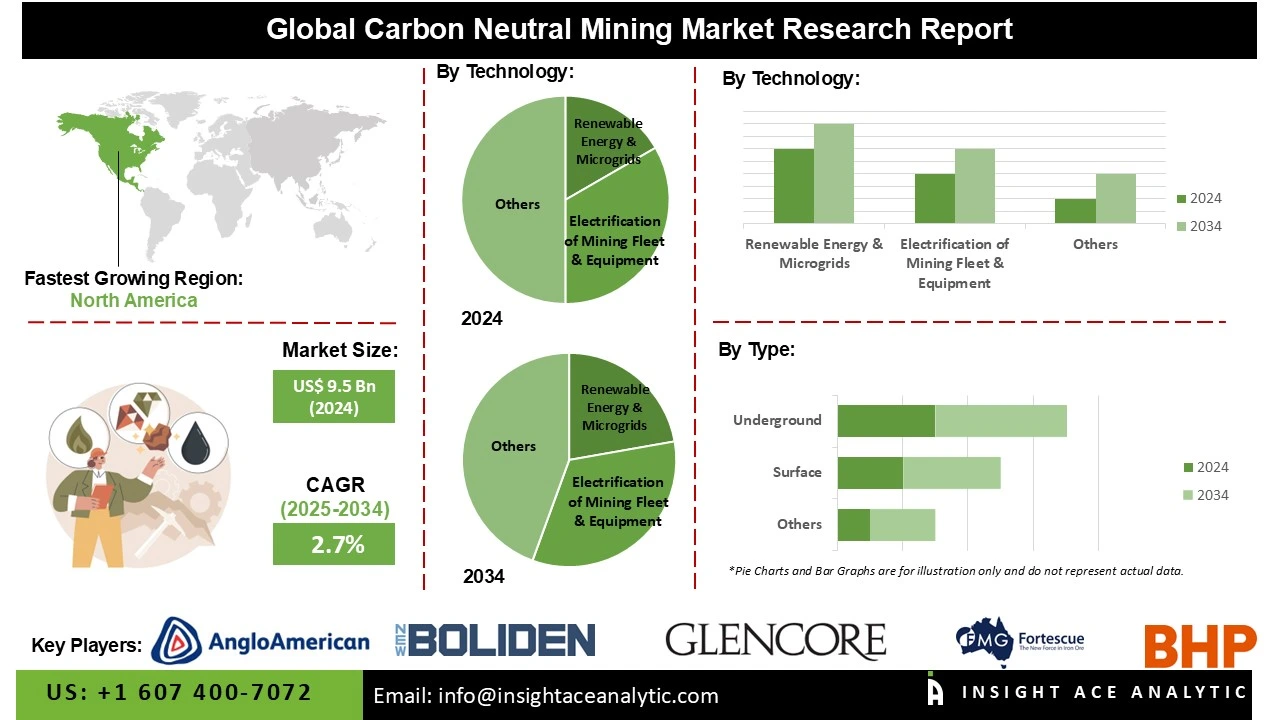
Global Carbon Neutral Mining Market Size is valued at US$ 9.5 Bn in 2024 and is predicted to reach US$ 12.1 Bn by the year 2034 at an 2.7% CAGR during the forecast period for 2025-2034.
Carbon-neutral mining has emerged as a critical response to the mining industry's environmental impact, representing a fundamental shift from traditional extraction methods to sustainable operations. This transformative approach integrates renewable energy microgrids, innovative carbon capture technologies, and verified emission offset mechanisms to dramatically reduce ecological impact while enhancing operational efficiency and energy security.
The sector is demonstrating tangible progress through equipment electrification, with companies progressively deploying battery-electric vehicles and piloting green hydrogen applications for heavy machinery and processing operations.
The global market for carbon-neutral mining solutions is experiencing accelerated growth, encompassing a comprehensive ecosystem of technologies and services specifically designed to help operations achieve net-zero emissions across their value chain. Major industry players including BHP Group and Barrick Gold have established measurable benchmarks, with BHP transitioning approximately 50% of its purchased electricity to renewable sources and Barrick achieving a 16% reduction in greenhouse gas emissions by 2023. This strategic shift is propelled by converging regulatory requirements, evolving investor expectations, and the compelling economic case for sustainable energy integration.
Beyond emissions reduction, leading operators are implementing comprehensive environmental strategies including carbon mineralization, advanced land restoration, and biodiversity enhancement programs. This emerging sector represents not merely an environmental imperative but a fundamental restructuring of mining economics and operational philosophy, creating new standards for responsible resource development. Despite challenges including substantial capital requirements and technical complexities in remote locations, the market presents substantial opportunities through continued technological innovation positioning carbon-neutral mining as an essential component in securing sustainable supplies of critical minerals for the global clean energy transition.
Competitive Landscape
Some of the Key Players in Carbon Neutral Mining Market:
- Anglo American plc.
- BHP Group Ltd.
- Boliden AB
- Fortescue Metals Group Ltd.
- Glencore plc.
- Newmont Corporation
- Rio Tinto Group
- Sibanye-Stillwater Limited
- Teck Resources Limited
- Vale S.A.
Market Segmentation:
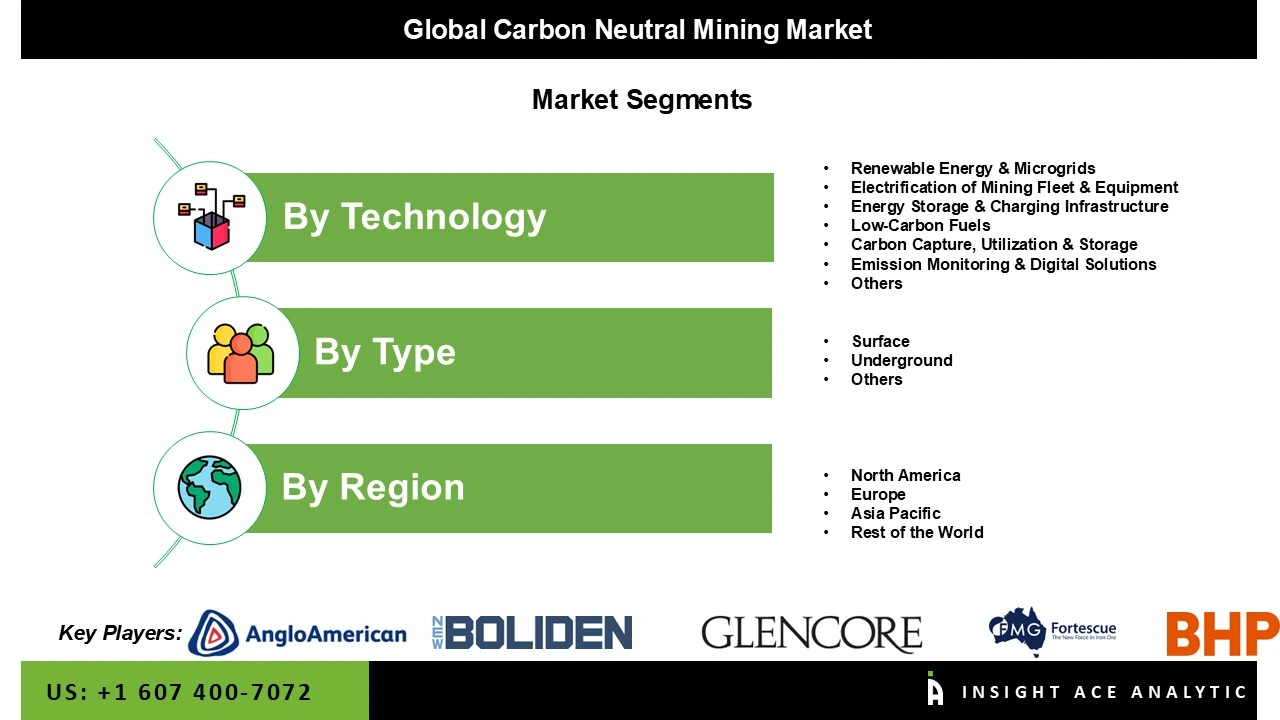
The carbon neutral mining market is segmented by technology and mine type. The technology segment includes renewable energy & microgrids, electrification of mining fleet & equipment, energy storage & charging infrastructure, low-carbon fuels, carbon capture, utilization & storage, emission monitoring & digital solutions, and others. By mine type, the market is segmented into surface, underground, and others.
By Technology , the Renewable Energy & Microgrids Segment is Expected to Drive the Carbon-Neutral Mining Market
The mobile applications category led the carbon neutral mining market in 2024. This convergence is fueled by the need to limit carbon emissions and lessen their reliance on diesel generators. Mining corporations are progressively using solar, wind, and hybrid microgrid systems. In remote mining zones with limited grid connectivity, these renewable-based systems maintain an uninterrupted power source while substantially lowering operating expenses. Leading nations in the integration of renewable microgrids in large-scale mining operations include Chile, Australia, and Canada. F.
Surface Segment by Mine Type is Growing at the Highest Rate in the Carbon Neutral Mining Market
The largest and fastest-growing Mine Type is Surface. This trend is Due to its large-scale operations, greater production output, and simpler integration of renewable energy sources; the surface mining segment dominates the worldwide carbon-neutral mining industry. Large mining companies in places like South Africa, Chile, and Australia have been increasingly transitioning to surface operations driven by renewable energy, which has significantly reduced Scope 1 emissions. Surface mining is the best choice for incorporating renewable energy into and carrying out large-scale electrification projects due to its space availability and excellent environmental circumstances..
Regionally, North America Led the Carbon-Neutral Mining Market
North America dominated the carbon neutral mining market in 2024. The United States is at the forefront of this expansion. This is due to robust legislative backing, cutting-edge technologies, and increasing ESG commitments throughout the mining industry; the North American carbon-neutral mining market continues to dominate the worldwide market. In addition, a larger clean energy and net-zero strategy is also supporting the carbon-neutral mining business in the region. Low-emission fleet technologies, carbon capture systems, and renewable microgrids have become more popular because of federal incentives such as the Inflation Reduction Act (IRA).
Europe has emerged as the fastest-growing region in the carbon neutral mining market, demonstrating exceptional growth driven by substantial investments and regulatory leadership. The region's expansion is particularly propelled by the European Union's stringent environmental mandates and comprehensive Green Deal framework, which have accelerated the adoption of sustainable mining practices across member states. With both governmental bodies and private enterprises heavily investing in renewable-based mining solutions and low-emission technologies, Europe has placed itself as a global leader in the transition toward green mining. The region's commitment is further evidenced by major mining companies operating in Europe rapidly implementing carbon reduction strategies, aligning with the continent's ambitious climate targets, and creating a robust ecosystem for carbon-neutral mining innovation and implementation.
Recent Developments:
- June 2025: Anglo American has deployed the world's largest hydrogen-powered haul truck at its Mogalakwena platinum mine. The 290-ton capacity vehicle represents a major advancement in zero-emission mining technology. This implementation is part of the company's nuGen™ zero-emission haulage solution. The project demonstrates the practical viability of hydrogen in heavy mining equipment.
Carbon Neutral Mining Market Report Scope :
Segmentation of Carbon Neutral Mining Market -
Carbon Neutral Mining Market by Technology-
· Renewable Energy & Microgrids
· Electrification of Mining Fleet & Equipment
· Energy Storage & Charging Infrastructure
· Low-Carbon Fuels
· Carbon Capture, Utilization & Storage
· Emission Monitoring & Digital Solutions
· Others
Carbon Neutral Mining Market by Mine Type-
· Surface
· Underground
· Others
Carbon Neutral Mining Market by Region-
North America-
· The US
· Canada
Europe-
· Germany
· The UK
· France
· Italy
· Spain
· Rest of Europe
Asia-Pacific-
· China
· Japan
· India
· South Korea
· Southeast Asia
· Rest of Asia Pacific
Latin America-
· Brazil
· Argentina
· Mexico
· Rest of Latin America
Middle East & Africa-
· GCC Countries
· South Africa
· Rest of the Middle East and Africa
Research Design and Approach
This study employed a multi-step, mixed-method research approach that integrates:
- Secondary research
- Primary research
- Data triangulation
- Hybrid top-down and bottom-up modelling
- Forecasting and scenario analysis
This approach ensures a balanced and validated understanding of both macro- and micro-level market factors influencing the market.
Secondary Research
Secondary research for this study involved the collection, review, and analysis of publicly available and paid data sources to build the initial fact base, understand historical market behaviour, identify data gaps, and refine the hypotheses for primary research.
Sources Consulted
Secondary data for the market study was gathered from multiple credible sources, including:
- Government databases, regulatory bodies, and public institutions
- International organizations (WHO, OECD, IMF, World Bank, etc.)
- Commercial and paid databases
- Industry associations, trade publications, and technical journals
- Company annual reports, investor presentations, press releases, and SEC filings
- Academic research papers, patents, and scientific literature
- Previous market research publications and syndicated reports
These sources were used to compile historical data, market volumes/prices, industry trends, technological developments, and competitive insights.

Primary Research
Primary research was conducted to validate secondary data, understand real-time market dynamics, capture price points and adoption trends, and verify the assumptions used in the market modelling.
Stakeholders Interviewed
Primary interviews for this study involved:
- Manufacturers and suppliers in the market value chain
- Distributors, channel partners, and integrators
- End-users / customers (e.g., hospitals, labs, enterprises, consumers, etc., depending on the market)
- Industry experts, technology specialists, consultants, and regulatory professionals
- Senior executives (CEOs, CTOs, VPs, Directors) and product managers
Interview Process
Interviews were conducted via:
- Structured and semi-structured questionnaires
- Telephonic and video interactions
- Email correspondences
- Expert consultation sessions
Primary insights were incorporated into demand modelling, pricing analysis, technology evaluation, and market share estimation.
Data Processing, Normalization, and Validation
All collected data were processed and normalized to ensure consistency and comparability across regions and time frames.
The data validation process included:
- Standardization of units (currency conversions, volume units, inflation adjustments)
- Cross-verification of data points across multiple secondary sources
- Normalization of inconsistent datasets
- Identification and resolution of data gaps
- Outlier detection and removal through algorithmic and manual checks
- Plausibility and coherence checks across segments and geographies
This ensured that the dataset used for modelling was clean, robust, and reliable.
Market Size Estimation and Data Triangulation
Bottom-Up Approach
The bottom-up approach involved aggregating segment-level data, such as:
- Company revenues
- Product-level sales
- Installed base/usage volumes
- Adoption and penetration rates
- Pricing analysis
This method was primarily used when detailed micro-level market data were available.

Top-Down Approach
The top-down approach used macro-level indicators:
- Parent market benchmarks
- Global/regional industry trends
- Economic indicators (GDP, demographics, spending patterns)
- Penetration and usage ratios
This approach was used for segments where granular data were limited or inconsistent.
Hybrid Triangulation Approach
To ensure accuracy, a triangulated hybrid model was used. This included:
- Reconciling top-down and bottom-up estimates
- Cross-checking revenues, volumes, and pricing assumptions
- Incorporating expert insights to validate segment splits and adoption rates
This multi-angle validation yielded the final market size.
Forecasting Framework and Scenario Modelling
Market forecasts were developed using a combination of time-series modelling, adoption curve analysis, and driver-based forecasting tools.
Forecasting Methods
- Time-series modelling
- S-curve and diffusion models (for emerging technologies)
- Driver-based forecasting (GDP, disposable income, adoption rates, regulatory changes)
- Price elasticity models
- Market maturity and lifecycle-based projections
Scenario Analysis
Given inherent uncertainties, three scenarios were constructed:
- Base-Case Scenario: Expected trajectory under current conditions
- Optimistic Scenario: High adoption, favourable regulation, strong economic tailwinds
- Conservative Scenario: Slow adoption, regulatory delays, economic constraints
Sensitivity testing was conducted on key variables, including pricing, demand elasticity, and regional adoption.
Request Customization
Add countries, segments, company profiles, or extend forecast — free 10% customization with purchase.
Customize This Report →Enquire Before Buying
Speak with our analyst team about scope, methodology, pricing, or deliverable formats.
Enquire Now →Frequently Asked Questions
The Carbon Neutral Mining Market Size is valued at US$ 9.5 Bn in 2024 and is predicted to reach US$ 12.1 Bn by the year 2034 at an 2.7% CAGR over the forecast period.
The major players in the Carbon Neutral Mining market are Anglo American plc., BHP Group Ltd., Boliden AB, Fortescue Metals Group Ltd., Glencore plc., Newmont Corporation, Rio Tinto Group, Sibanye-Stillwater Limited, Teck Resources Limited, and Vale S.A.
The primary Carbon Neutral Mining market segments are Technology and Mine Type.
North America leads the market for Carbon Neutral Mining due to by robust legislative backing, cutting-edge technologies, and increasing ESG commitments throughout the mining industry.