Calcium Ammonium Nitrate Market Size, Share, Trend, Revenue Report 2026 to 2035
What is Calcium Ammonium Nitrate Market Size?
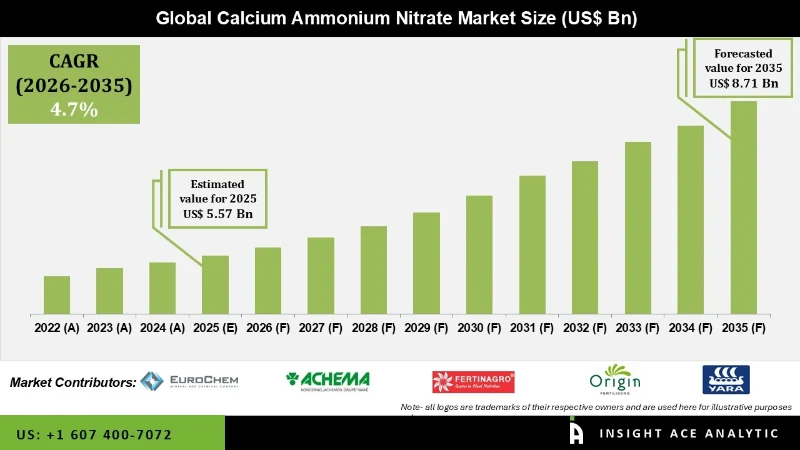
Calcium Ammonium Nitrate Market Size was valued at USD 5.57 Billion in 2025 and is predicted to reach USD 8.71 Billion by 2035 at a 4.7% CAGR during the forecast period for 2026 to 2035.
Calcium Ammonium Nitrate Market Size, Share & Trends Analysis Report, By Application (Fertilizer and Explosive), By Region, Forecasts, 2026 to 2035
Calcium Ammonium Nitrate Market Key Takeaways:
|
CAN, or calcium ammonium nitrate, is a commonly used pesticide. It is highly renowned for possessing a nutritional makeup that is well-balanced. The constitution of this substance contains both ammonium and sodium nitrate. CAN is used to supply crops with all the necessary ingredients needed for normal development and growth. These elements primarily consist of nitrogen and calcium. Because of its extremely special formulation, CAN offers both rapid and continuous nutritional absorption. The industry's proportions have altered due to significant improvements. Enhancing calcium ammonium nitrate's (CAN) durability and effectiveness in farming uses is a priority.
The goal of producers is to improve the kinetics of nitrogen expulsion, which aids in all crops' efficient utilization of nutrients. Minimizing the influence on the planet is also prioritized. Furthermore, the demand for calcium ammonium nitrate is driven by government policies that improve crop production, particularly in emerging economies, as well as encouragement and subsidies from the government. These programs motivate farmers to apply calcium ammonium nitrate fertilizer, increasing the market for goods like this, which is necessary for improving crop productivity in sustainable ways.
However, the barrier to the expansion of the calcium ammonium nitrate (CAN) market is the availability of substitute choices, along with rigorous government laws limiting product consumption. In order to reduce the possibility of ammonium nitrate being misused in terrorist acts, federal departments have put strict regulations in place regulating the manufacturing, preservation, shipment, and application of the substance. Given that the use of substitutes has grown in the explosions and fertilizer application sectors, it is therefore expected that this regulatory framework will limit market expansion.
Competitive Landscape
Some of the Major Key Players in the Calcium Ammonium Nitrate Market are
- Achema AB
- Aurepio
- Azomures
- EuroChem Group
- Fatima Group
- Fertinagro India Pvt. Ltd.
- Gemlik Gubre Fertilizer Industry Inc.
- HELM AG
- HIP Azotara Pan?evo
- J.R. Simplot Company
- MEA Ltd.
- Origin Fertilizers (UK) Limited
- Petrokemija, Plc
- PJSC Ostchem
- Ravensdown
- San Corporation
- SASOL
- Shandong Lvfeng Fertilizer Co.,Ltd
- Shanxi Leixin Chemical Co., Ltd
- Trammo, Inc.
- Yara International ASA
- Others
Market Segmentation:
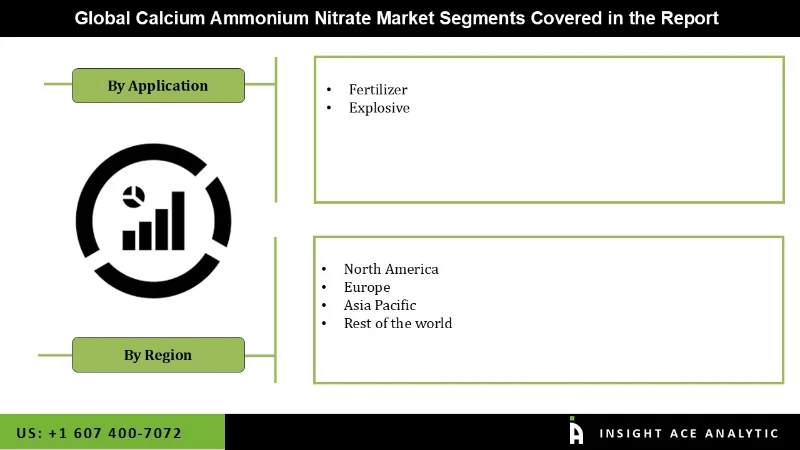
The global calcium ammonium nitrate market is segmented based on application. Based on application, the market is segmented into fertilizer and explosive.
Based on the Application, the Explosive Segment is Accounted as a Major Contributor to the Global Calcium Ammonium Nitrate Market
Explosive in the global calcium ammonium nitrate market is expected to hold a major global market share in 2023. Because of its intrinsic qualities and adaptability, calcium ammonium nitrate (CAN) is in great need in the explosives industry. It is an essential component of explosive preparations because it acts as an antioxidant, releasing oxygen upon explosion to facilitate the combustibility of additional aggressive ingredients.
Fertilizer Factor Segment to Witness Growth at a Rapid Rate
Fertilizer factors use acrylic acid esters mainly because they are easily soluble in water, guaranteeing quick plant absorption and encouraging effective digestion of nutrients. Furthermore, this sector will develop even more as a result of the agricultural industry's rapid expansion and technological advancements, especially in countries like the US, Germany, the UK, China, and India.
In the region, the North American Global Calcium Ammonium Nitrate Market Holds a Significant Revenue Share
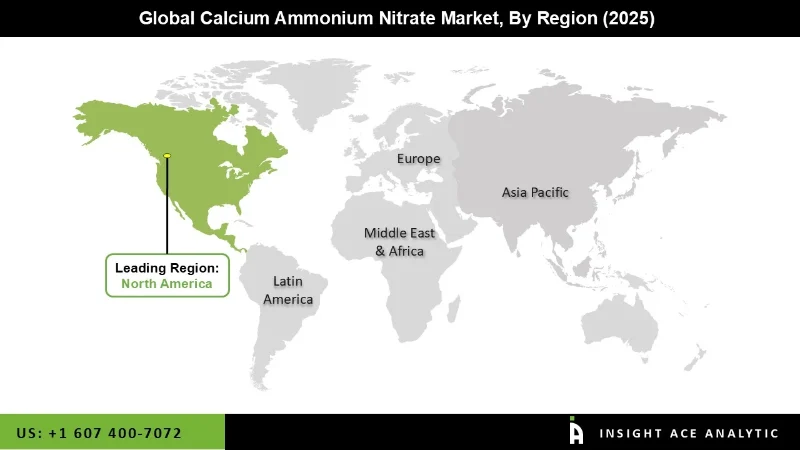
The North American global calcium ammonium nitrate market is expected to register the highest market share in revenue in the near future. This is explained by the rising need for ammonia nitrate energy and increasing curiosity about security explosives. The boom in agricultural operations spurred on by the region's greater usage of pesticides is another of the causes propelling this area's expansion.
In addition, Asia Pacific is projected to grow rapidly in the global calcium ammonium nitrate market because of increased consumption and growing end-use industries, which include water treatment, manufacturing, agricultural chemicals, drugs, and agribusiness. The economy is growing as a result of the rising demand, which is supported by a wide range of applications in different sectors.
Recent Developments:
- In July 2024, Yara International, a multinational nutrients business and one of the biggest suppliers of ammonium worldwide, and Kongsberg Electronic, an established supplier of manufacturing programs, executed a two-year contract under which Kongsberg Shipyard Electronic will establish artificial intelligence (AI) for Yara's production facilities in Sluiskil, the Netherlands, and Heroya, the Nordic nation.
- In January 2024, EuroChem Group AG declared it would begin the endeavor of shutting down its Lifosa business in Estonia because of the effect of penalties, which it claims has hindered regular and profitable activities.
Calcium Ammonium Nitrate Market Report Scope
| Report Attribute | Specifications |
| Market Size Value In 2025 | USD 5.57 Billion |
| Revenue Forecast In 2035 | USD 8.71 Billion |
| Growth Rate CAGR | CAGR of 4.7% from 2026 to 2035 |
| Quantitative Units | Representation of revenue in US$ Million and CAGR from 2026 to 2035 |
| Historic Year | 2022 to 2024 |
| Forecast Year | 2026 to 2035 |
| Report Coverage | The forecast of revenue, the position of the company, the competitive market structure, growth prospects, and trends |
| Segments Covered | By Application and By Region |
| Regional Scope | North America; Europe; Asia Pacific; Latin America; Middle East & Africa |
| Country Scope | U.S.; Canada; U.K.; Germany; China; India; Japan; Brazil; Mexico; France; Italy; Spain; South East Asia; South Korea |
| Competitive Landscape | Yara International ASA, EuroChem Group, Achema AB, Origin Fertilizers (UK) Limited, Fertinagro India Pvt. Ltd., and others. |
| Customization Scope | Free customization report with the procurement of the report and modifications to the regional and segment scope. Particular Geographic competitive landscape. |
| Pricing And Available Payment Methods | Explore pricing alternatives that are customized to your particular study requirements. |
Segmentation of Global Calcium Ammonium Nitrate Market -
Calcium Ammonium Nitrate Market - By Application
- Fertilizer
- Explosive
Calcium Ammonium Nitrate Market - By Region
North America-
- The US
- Canada
- Mexico
Europe-
- Germany
- The UK
- France
- Italy
- Spain
- Rest of Europe
Asia-Pacific-
- China
- Japan
- India
- South Korea
- South East Asia
- Rest of Asia Pacific
Latin America-
- Brazil
- Argentina
- Rest of Latin America
Middle East & Africa-
- GCC Countries
- South Africa
- Rest of the Middle East and Africa
Research Design and Approach
This study employed a multi-step, mixed-method research approach that integrates:
- Secondary research
- Primary research
- Data triangulation
- Hybrid top-down and bottom-up modelling
- Forecasting and scenario analysis
This approach ensures a balanced and validated understanding of both macro- and micro-level market factors influencing the market.
Secondary Research
Secondary research for this study involved the collection, review, and analysis of publicly available and paid data sources to build the initial fact base, understand historical market behaviour, identify data gaps, and refine the hypotheses for primary research.
Sources Consulted
Secondary data for the market study was gathered from multiple credible sources, including:
- Government databases, regulatory bodies, and public institutions
- International organizations (WHO, OECD, IMF, World Bank, etc.)
- Commercial and paid databases
- Industry associations, trade publications, and technical journals
- Company annual reports, investor presentations, press releases, and SEC filings
- Academic research papers, patents, and scientific literature
- Previous market research publications and syndicated reports
These sources were used to compile historical data, market volumes/prices, industry trends, technological developments, and competitive insights.

Primary Research
Primary research was conducted to validate secondary data, understand real-time market dynamics, capture price points and adoption trends, and verify the assumptions used in the market modelling.
Stakeholders Interviewed
Primary interviews for this study involved:
- Manufacturers and suppliers in the market value chain
- Distributors, channel partners, and integrators
- End-users / customers (e.g., hospitals, labs, enterprises, consumers, etc., depending on the market)
- Industry experts, technology specialists, consultants, and regulatory professionals
- Senior executives (CEOs, CTOs, VPs, Directors) and product managers
Interview Process
Interviews were conducted via:
- Structured and semi-structured questionnaires
- Telephonic and video interactions
- Email correspondences
- Expert consultation sessions
Primary insights were incorporated into demand modelling, pricing analysis, technology evaluation, and market share estimation.
Data Processing, Normalization, and Validation
All collected data were processed and normalized to ensure consistency and comparability across regions and time frames.
The data validation process included:
- Standardization of units (currency conversions, volume units, inflation adjustments)
- Cross-verification of data points across multiple secondary sources
- Normalization of inconsistent datasets
- Identification and resolution of data gaps
- Outlier detection and removal through algorithmic and manual checks
- Plausibility and coherence checks across segments and geographies
This ensured that the dataset used for modelling was clean, robust, and reliable.
Market Size Estimation and Data Triangulation
Bottom-Up Approach
The bottom-up approach involved aggregating segment-level data, such as:
- Company revenues
- Product-level sales
- Installed base/usage volumes
- Adoption and penetration rates
- Pricing analysis
This method was primarily used when detailed micro-level market data were available.

Top-Down Approach
The top-down approach used macro-level indicators:
- Parent market benchmarks
- Global/regional industry trends
- Economic indicators (GDP, demographics, spending patterns)
- Penetration and usage ratios
This approach was used for segments where granular data were limited or inconsistent.
Hybrid Triangulation Approach
To ensure accuracy, a triangulated hybrid model was used. This included:
- Reconciling top-down and bottom-up estimates
- Cross-checking revenues, volumes, and pricing assumptions
- Incorporating expert insights to validate segment splits and adoption rates
This multi-angle validation yielded the final market size.
Forecasting Framework and Scenario Modelling
Market forecasts were developed using a combination of time-series modelling, adoption curve analysis, and driver-based forecasting tools.
Forecasting Methods
- Time-series modelling
- S-curve and diffusion models (for emerging technologies)
- Driver-based forecasting (GDP, disposable income, adoption rates, regulatory changes)
- Price elasticity models
- Market maturity and lifecycle-based projections
Scenario Analysis
Given inherent uncertainties, three scenarios were constructed:
- Base-Case Scenario: Expected trajectory under current conditions
- Optimistic Scenario: High adoption, favourable regulation, strong economic tailwinds
- Conservative Scenario: Slow adoption, regulatory delays, economic constraints
Sensitivity testing was conducted on key variables, including pricing, demand elasticity, and regional adoption.
Request Customization
Add countries, segments, company profiles, or extend forecast — free 10% customization with purchase.
Customize This Report →Enquire Before Buying
Speak with our analyst team about scope, methodology, pricing, or deliverable formats.
Enquire Now →Frequently Asked Questions
Calcium Ammonium Nitrate Market Size was valued at USD 5.57 Billion in 2025 and is predicted to reach USD 8.71 Billion by 2035
Calcium Ammonium Nitrate Market is expected to grow at a 4.7% CAGR during the forecast period for 2026 to 2035
Yara International ASA, EuroChem Group, Achema AB, Origin Fertilizers (UK) Limited, Fertinagro India Pvt. Ltd., and others.
Application and Region are the key segments of the Calcium Ammonium Nitrate Market.
North American region is leading the Calcium Ammonium Nitrate Market.