Biopsy Devices Market Size, Share & Trends Analysis Report By Product Type (Needle Biopsy Devices (Guidance Systems, Biopsy Consoles, Site Markers, Biopsy Guns (Automated Systems, Semi-Automated Systems), Needles), Skin Biopsy Devices (Punch Biopsy Instruments, Shave Biopsy Instruments), Consumables (Forceps, Trocars, Trays, Other Consumables), By Biopsy Type, By Anatomy, By Disease Type, By Guidance Technique, By Region, And By Segment Forecasts, 2024-2031
Biopsy Devices Market Size is valued at USD 6.84 Bn in 2023 and is predicted to reach USD 20.04 Bn by the year 2031 at a 14.51% CAGR during the forecast period for 2024-2031.
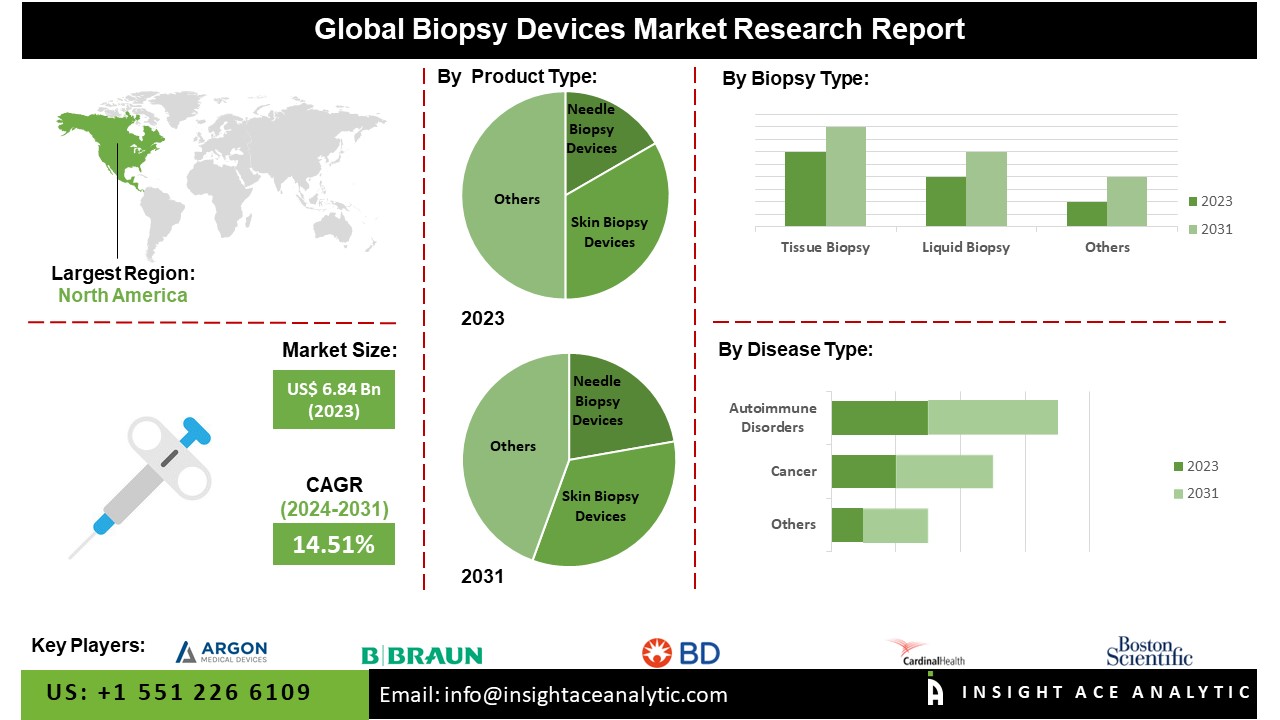
A biopsy is a surgical procedure that takes tissue from an organ to detect the presence or extent of disease, most commonly malignant and inflammatory conditions. The most common people who carry it out are radiologists, surgeons, and interventional cardiologists. Biopsies are used to perform on any organ using specific biopsy instruments as a confirming test for cancer and celiac disease. The application of each biopsy equipment differs depending on the type of organ under consideration. The rising global cancer prevalence, untapped potential in emerging nations, particularly in Asia Pacific, and the improvement of healthcare infrastructure in these regions are among the important themes driving market growth.
However, the COVID-19 pandemic had a moderate impact on the market. Prioritizing cancer patients was difficult because healthcare personnel were mostly focused on COVID-19 patients. With a greater emphasis on avoiding viral infection, most people preferred fewer trips to healthcare settings. To some extent, this had a negative impact on the biopsy market. However, once the globe returned to normalcy and cancer cases increased, the market swiftly rebounded.
Competitive Landscape
Some Major Key Players In The Biopsy Devices Market:
- Argon Medical Devices, Inc.
- Braun SE
- Becton
- Dickinson and Company
- Boston Scientific Corporation
- Cardinal Health, Inc.
- Cook Group Incorporated
- Conmed Corporation
- FUJIFILM Holdings Corporation
- GE Healthcare
- Inrad, Inc.
- Medtronic plc
- Olympus Corporation
- Siemens Healthineers AG
- Stryker Corporation
- Zamar Care
- Changzhou Jiuhong Medical Instrument Co., Ltd.
- Kindly (KDL) Meditech
- Ningbo Xinwell Medical Technology Co., LTD.
- Shenzhen Manners Technology Co., Ltd.
- Zhejiang Soudon Medical Technology Co., Ltd
- Agilent Technologies, Inc.
- BGI Group
- Biocept, Inc.
- Bio-Rad Laboratories, Inc.
- Dxcover Limited
- Elypta Limited
- Hoffmann-La Roche Ltd
- Illumina, Inc.
- Micronoma
- QIAGEN
- Revvity, Inc.
- Sysmex Corporation
- Thermo Fisher Scientific Inc
- Others
Market Segmentation:
The Biopsy Devices Market is segmented based on Product Type, Biopsy Type, Disease Type, Anatomy, and Guidance Technique. By Product Type segment comprises Needle Biopsy Devices (Guidance Systems, Biopsy Consoles, Site Markers, Biopsy Guns (Automated Systems, Semi-Automated Systems), Needles), Skin Biopsy Devices (Punch Biopsy Instruments, Shave Biopsy Instruments), and Consumables (Forceps, Trocars, Trays, Other Consumables). Whereas the Biopsy Type segment consists of Tissue Biopsy, which is again divided into Needle Biopsy, Surgical Biopsy and Skin Biopsy, and Liquid Biopsy. The Anatomy segment includes Breast, Lung, Bone, Liver, Uterus/Cervix/Ovary, Abdomen, Prostate, Cardiac, Skin, and Others. By Disease Type, the market is segmented into Cancer, Infections, Autoimmune Disorders, Non-Cancerous Indications, and Others. According to the Guidance Technique segment, the market is divided into Growth-Share Analysis, Ultrasound-Guided Biopsy, X-Ray-Guided Biopsy, MRI-Guided Biopsy, and CT-Guided Biopsy.
Based On The Product Type, The Needle Biopsy Devices Segment Is Accounted As A Major Contributor In The Biopsy Devices Market.
The needle biopsy devices sector held the most significant portion of the market. Needle biopsies are characterized by their minimally invasive nature, allowing for prompt execution while minimizing patient distress. As a result, they are favored by healthcare providers and patients alike. Furthermore, the escalating prevalence of cancer and the imperative for timely detection have heightened the need for tissue sampling, specifically for lesions that are conventionally challenging to access.
The Breast Anatomy Segment Witnessed Growth At A Rapid Rate.
The Breast anatomy segment is projected to grow rapidly in the global Biopsy Devices Market. The current domination of this category is mostly because of the availability of many cancer therapies monitoring liquid biopsies that key players now offer.
In The Region, The North American Biopsy Devices Market Holds A Significant Revenue Share.
The North America Biopsy Devices Market is expected to record the maximum market share in revenue in the near future. Owing to the existence of established market players in the region, it is expected to continue to account for a sizable part of the market throughout the projection period. The regional market will likely benefit from high market penetration rates of technologically advanced equipment such as vacuum-assisted biopsy systems and rapidly expanding demand for disposable devices. Asia Pacific offers numerous prospects for market expansion. The rapid improvement of healthcare infrastructure in growing Asia Pacific countries, the prevalence of significant unmet patient demands, and the rising incidence of cancer are expected to drive regional market expansion.
Recent Developments:
- In Sept 2023, A revolutionary collaboration has been declared between Roche France, Foundation Medicine, and the Institute Gustave Roussy to provide cancer patients in France with in-house liquid biopsy genomic testing. By transferring FoundationOne®Liquid CDx technology to the Institute Gustave Roussy, Roche France and Foundation Medicine have the potential to provide liquid biopsy testing for comprehensive genomic profiling (CGP) in all patients in France diagnosed with advanced cancer.
- In August 2022, Mammotome announced the release of the Mammotome DualCoreTM biopsy system, the company's first twin-stage core biopsy tool. This novel core biopsy device adds to the Mammotome ultrasound-guided breast biopsy portfolio, which already includes the Mammotome® Elite Tetherless Vacuum-Assisted Biopsy Device (tetherless VABB) and the Mammotome RevolveTM Dual Vacuum-Assisted Breast Biopsy System (tethered VABB).
Biopsy Devices Market Report Scope
| Report Attribute | Specifications |
| Market Size Value In 2023 | USD 6.84 Bn |
| Revenue Forecast In 2031 | USD 20.04 Bn |
| Growth Rate CAGR | CAGR of 14.51% from 2024 to 2031 |
| Quantitative Units | Representation of revenue in US$ Million and CAGR from 2024 to 2031 |
| Historic Year | 2019 to 2023 |
| Forecast Year | 2024-2031 |
| Report Coverage | The forecast of revenue, the position of the company, the competitive market structure, growth prospects, and trends |
| Segments Covered | By Product Type, By Biopsy Type, By Anatomy, By Disease Type, By Guidance Technique |
| Regional Scope | North America; Europe; Asia Pacific; Latin America; Middle East & Africa |
| Country Scope | U.S.; Canada; U.K.; Germany; China; India; Japan; Brazil; Mexico ;The UK; France; Italy; Spain; China; Japan; India; South Korea; South East Asia; South Korea; South East Asia |
| Competitive Landscape | Argon Medical Devices, Inc., B. Braun SE, Becton, Dickinson and Company, Boston Scientific Corporation, Cardinal Health, Inc., Cook Group Incorporated, Conmed Corporation, FUJIFILM Holdings Corporation, GE Healthcare, Inrad, Inc., Medtronic plc, Olympus Corporation, Siemens Healthineers AG, Stryker Corporation, Zamar Care, Changzhou Jiuhong Medical Instrument Co., Ltd., Kindly (KDL) Meditech, Ningbo Xinwell Medical Technology Co., LTD., Shenzhen Manners Technology Co., Ltd., Zhejiang Soudon Medical Technology Co., Ltd, Agilent Technologies, Inc., BGI Group, Biocept, Inc., Bio-Rad Laboratories, Inc., Dxcover Limited, Elypta Limited, F. Hoffmann-La Roche Ltd, Illumina, Inc., Micronoma, QIAGEN, Revvity, Inc., Sysmex Corporation, and Thermo Fisher Scientific Inc. |
| Customization Scope | Free customization report with the procurement of the report and modifications to the regional and segment scope. Particular Geographic competitive landscape. |
| Pricing And Available Payment Methods | Explore pricing alternatives that are customized to your particular study requirements. |
Segmentation of Biopsy Devices Market-
Biopsy Devices Market By Product Type-
- Needle Biopsy Devices
- Guidance Systems
- Biopsy Consoles
- Site Markers
- Biopsy Guns
- Automated Systems
- Semi-Automated Systems
- Needles
- Skin Biopsy Devices
- Punch Biopsy Instruments
- Shave Biopsy Instruments
- Consumables
- Forceps
- Trocars
- Trays
- Other Consumables
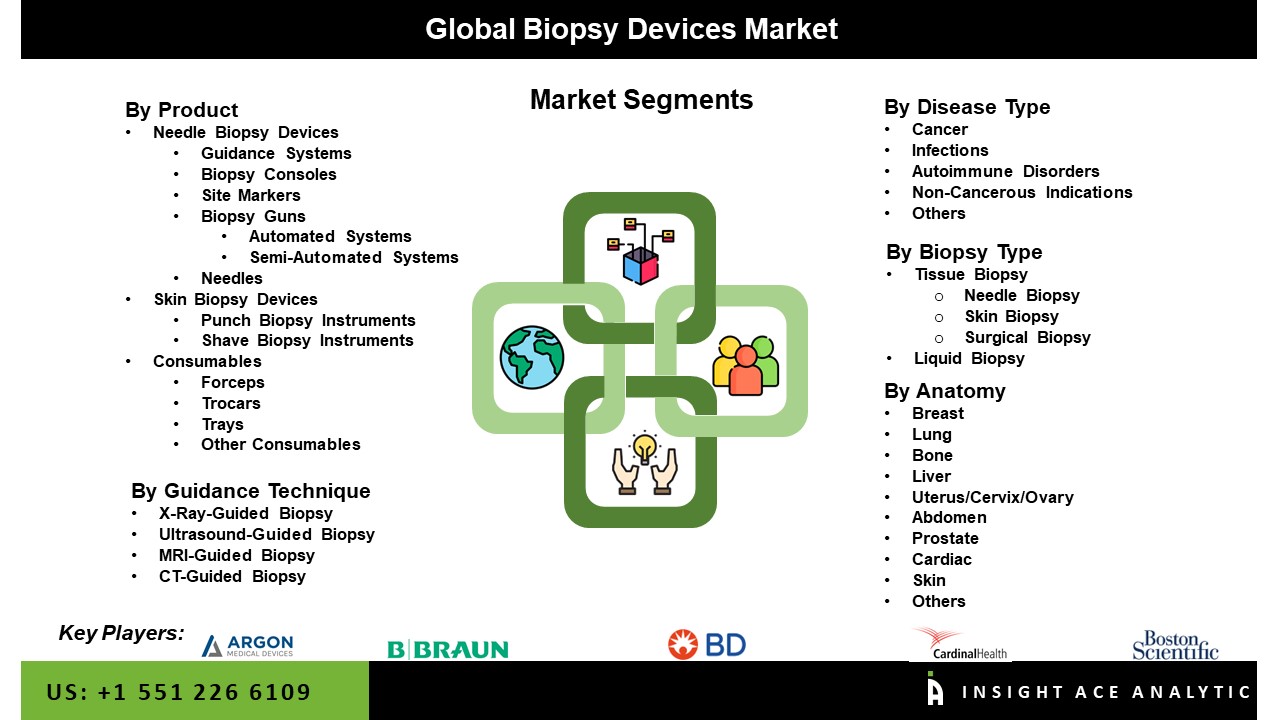
Biopsy Devices Market By Biopsy Type
- Tissue Biopsy
- Needle Biopsy
- Surgical Biopsy
- Skin Biopsy
- Liquid Biopsy
Biopsy Devices Market By Anatomy-
- Breast
- Lung
- Bone
- Liver
- Uterus/Cervix/Ovary
- Abdomen
- Prostate
- Cardiac
- Skin
- Others
Biopsy Devices Market By Disease Type-
- Cancer
- Infections
- Autoimmune Disorders
- Non-Cancerous Indications
- Others
Biopsy Devices Market By Guidance Technique -
- Ultrasound-Guided Biopsy
- X-Ray-Guided Biopsy
- MRI-Guided Biopsy
- CT-Guided Biopsy
Biopsy Devices Market By Region-
North America-
- The US
- Canada
- Mexico
Europe-
- Germany
- The UK
- France
- Italy
- Spain
- Rest of Europe
Asia-Pacific-
- China
- Japan
- India
- South Korea
- South East Asia
- Rest of Asia Pacific
Latin America-
- Brazil
- Argentina
- Rest of Latin America
Middle East & Africa-
- GCC Countries
- South Africa
Rest of Middle East and Africa
Research Design and Approach
This study employed a multi-step, mixed-method research approach that integrates:
- Secondary research
- Primary research
- Data triangulation
- Hybrid top-down and bottom-up modelling
- Forecasting and scenario analysis
This approach ensures a balanced and validated understanding of both macro- and micro-level market factors influencing the market.
Secondary Research
Secondary research for this study involved the collection, review, and analysis of publicly available and paid data sources to build the initial fact base, understand historical market behaviour, identify data gaps, and refine the hypotheses for primary research.
Sources Consulted
Secondary data for the market study was gathered from multiple credible sources, including:
- Government databases, regulatory bodies, and public institutions
- International organizations (WHO, OECD, IMF, World Bank, etc.)
- Commercial and paid databases
- Industry associations, trade publications, and technical journals
- Company annual reports, investor presentations, press releases, and SEC filings
- Academic research papers, patents, and scientific literature
- Previous market research publications and syndicated reports
These sources were used to compile historical data, market volumes/prices, industry trends, technological developments, and competitive insights.

Primary Research
Primary research was conducted to validate secondary data, understand real-time market dynamics, capture price points and adoption trends, and verify the assumptions used in the market modelling.
Stakeholders Interviewed
Primary interviews for this study involved:
- Manufacturers and suppliers in the market value chain
- Distributors, channel partners, and integrators
- End-users / customers (e.g., hospitals, labs, enterprises, consumers, etc., depending on the market)
- Industry experts, technology specialists, consultants, and regulatory professionals
- Senior executives (CEOs, CTOs, VPs, Directors) and product managers
Interview Process
Interviews were conducted via:
- Structured and semi-structured questionnaires
- Telephonic and video interactions
- Email correspondences
- Expert consultation sessions
Primary insights were incorporated into demand modelling, pricing analysis, technology evaluation, and market share estimation.
Data Processing, Normalization, and Validation
All collected data were processed and normalized to ensure consistency and comparability across regions and time frames.
The data validation process included:
- Standardization of units (currency conversions, volume units, inflation adjustments)
- Cross-verification of data points across multiple secondary sources
- Normalization of inconsistent datasets
- Identification and resolution of data gaps
- Outlier detection and removal through algorithmic and manual checks
- Plausibility and coherence checks across segments and geographies
This ensured that the dataset used for modelling was clean, robust, and reliable.
Market Size Estimation and Data Triangulation
Bottom-Up Approach
The bottom-up approach involved aggregating segment-level data, such as:
- Company revenues
- Product-level sales
- Installed base/usage volumes
- Adoption and penetration rates
- Pricing analysis
This method was primarily used when detailed micro-level market data were available.

Top-Down Approach
The top-down approach used macro-level indicators:
- Parent market benchmarks
- Global/regional industry trends
- Economic indicators (GDP, demographics, spending patterns)
- Penetration and usage ratios
This approach was used for segments where granular data were limited or inconsistent.
Hybrid Triangulation Approach
To ensure accuracy, a triangulated hybrid model was used. This included:
- Reconciling top-down and bottom-up estimates
- Cross-checking revenues, volumes, and pricing assumptions
- Incorporating expert insights to validate segment splits and adoption rates
This multi-angle validation yielded the final market size.
Forecasting Framework and Scenario Modelling
Market forecasts were developed using a combination of time-series modelling, adoption curve analysis, and driver-based forecasting tools.
Forecasting Methods
- Time-series modelling
- S-curve and diffusion models (for emerging technologies)
- Driver-based forecasting (GDP, disposable income, adoption rates, regulatory changes)
- Price elasticity models
- Market maturity and lifecycle-based projections
Scenario Analysis
Given inherent uncertainties, three scenarios were constructed:
- Base-Case Scenario: Expected trajectory under current conditions
- Optimistic Scenario: High adoption, favourable regulation, strong economic tailwinds
- Conservative Scenario: Slow adoption, regulatory delays, economic constraints
Sensitivity testing was conducted on key variables, including pricing, demand elasticity, and regional adoption.
Request Customization
Add countries, segments, company profiles, or extend forecast — free 10% customization with purchase.
Customize This Report →Enquire Before Buying
Speak with our analyst team about scope, methodology, pricing, or deliverable formats.
Enquire Now →Frequently Asked Questions
Biopsy Devices Market Size is valued at USD 6.84 Bn in 2023 and is predicted to reach USD 20.04 Bn by the year 2031
Biopsy Devices Market expected to grow at a 14.51% CAGR during the forecast period for 2024-2031.
F. Hoffmann-La Roche Ltd, Illumina, Inc., Micronoma, QIAGEN, Revvity, Inc., Sysmex Corporation, and Thermo Fisher Scientific Inc.