Battery Manufacturing Scrap Recycling Market Size, Share & Trends Analysis Report By Application (Automotive, Electronics, Energy and Power, Aerospace and Defense, Construction, Others), By Scrap Source (Automotive Batteries, Industrial Batteries, Consumer Electronics Batteries, Others), By Technology (Hydrometallurgy, Pyrometallurgy, Others), By Region, And By Segment Forecasts, 2025-2034

Report Id: 2309 Pages: 180 Last Updated: 17 April 2025 Format: PDF / PPT / Excel / Power BI
Share With : linkedin twitter facebook

Global Battery Manufacturing Scrap Recycling Market Size is valued at USD 2.3 Billion in 2024 and is predicted to reach USD 11.0 Billion by the year 2034 at a 16.7% CAGR during the forecast period for 2025-2034.

Key Industry Insights & Findings from the Report:

  • The increasing awareness about scrap recycling as well as demand and consumption of batteries such as lithium-ion in the end-use industries drive the market growth.
  • Rising advancements, investments in recycling technologies as well as electronic industry and government support are expected to drive industry growth.
  • North America dominated the market and accounted for a global revenue share in 2024.
  • The battery recycling industry may encounter significant obstacles as a result of the exorbitant expense of recycling and a dearth of viable options.

Battery Manufacturing Scrap Recycling Market

Battery manufacturing scrap recycling is a rapidly growing business that deals with producing scrap materials created during the battery cell manufacturing process. As electric vehicles become more popular, the market for these batteries is likely to expand dramatically, aiding in the growth of battery manufacturing trash recycling technology. Regardless, many new competitors will enter the market in the next years, increasing competition and driving additional growth and innovation. In the medium term, factors such as falling lithium-ion battery prices and rising concerns about battery waste disposal are expected to boost the battery recycling market throughout the projected period.

However, the COVID-19 epidemic has harmed the global battery recycling sector. This is due to a temporary ban on import, export, and transportation, which has affected the supply chain and battery demand from automotive and consumer electronics manufacturers. Although physical interactions and laboratory operations were restricted, there was an increased demand for digital solutions and virtual research platforms in materials science. MI systems that allow for remote collaboration, data analysis, and virtual experimentation have grown in popularity.

Competitive Landscape

Some Major Key Players In the Battery Manufacturing Scrap Recycling Market:

  • Fortum
  • Brunp Recycling
  • Hydrovolt AS
  • Umicore
  • BASF SE
  • Tenova S.p.A.
  • Duesenfeld
  • Aqua Metals Inc.
  • Green Li-ion Pte Ltd.
  • ACCUREC Recycling GmbH
  • American Battery Technology Company
  • Call2Recycle, Inc.
  • Cirba Solutions
  • Contemporary Amperex Technology Co., Limited
  • East Penn Manufacturing Company
  • Ecobat
  • Element Resources
  • EnerSys
  • Exide Industries Ltd.
  • GEM Co., Ltd.
  • Glencore
  • Gopher Resource
  • Gravita India Limited
  • Li-Cycle Corp.
  • Neometals Ltd.
  • Raw Materials Company
  • RecycLiCo Battery Materials Inc.
  • Redwood Materials Inc.
  • Shenzhen Highpower Technology Co., Ltd.
  • Other prominent players

Market Segmentation:

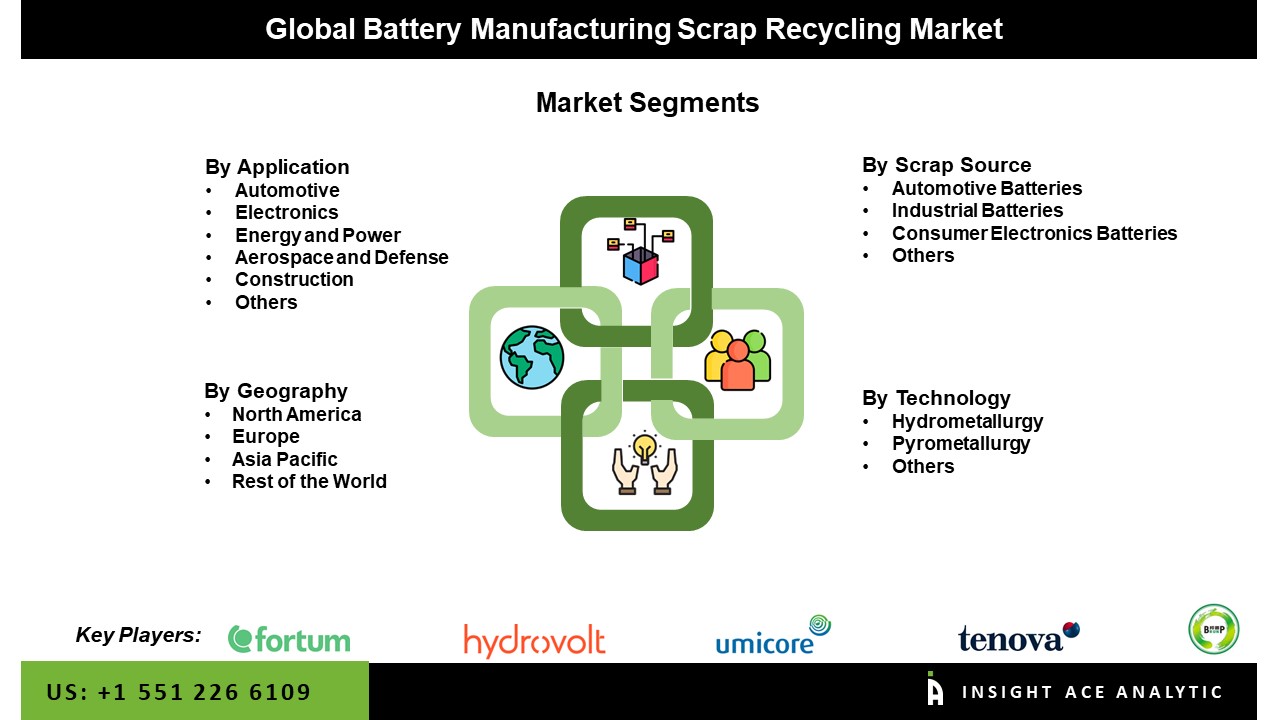
The Battery Manufacturing Scrap Recycling Market is segmented based on scrap source, recycling technology, and application. Based on scrap sources, the market is segmented as Automotive Batteries, Industrial Batteries, Consumer Electronics Batteries, and Others. The recycling technology segment includes Hydrometallurgy, Pyrometallurgy, and Others. By application, the market is segmented into Hydrometallurgy, Pyrometallurgy, and Others.

Based On Scrap Sources, The Automotive Batteries Segment Is A Major Contributor In The Battery Manufacturing Scrap Recycling Market. 

The Automotive Batteries category is expected to hold a major share of the global Battery Manufacturing Scrap Recycling Market in 2023. Battery Manufacturing Waste Several factors influence the recycling market, particularly in the context of automotive batteries, shaping demand, growth, and innovation in recycling technologies and solutions. Environmental restrictions, government incentives, customer preferences, and sustainability aspirations are pushing the increased number of end-of-life car batteries accessible for recycling. The life cycles of automotive batteries, as well as the requirement for replacement or repurposing, generate a constant supply of wasted batteries, creating the need for recycling to recover valuable materials and reduce environmental effects.

The Automotive Segment Witnessed Rapid Growth.

The automotive segment is more likely to grow at a rapid rate in the global Battery Manufacturing Scrap Recycling Market. Various forces shape the demand, growth, and innovation of recycling technologies and processes in the automotive sector. The growing global use and manufacturing of electric vehicles (EVs), driven by legislative mandates, environmental concerns, technological improvements, and customer preferences, is generating a considerable volume of end-of-life batteries and driving the demand for recycling solutions.

In The Region, The North America Battery Manufacturing Scrap Recycling Market Holds A Significant Revenue Share.

The North America Battery Manufacturing Scrap Recycling Market is expected to record the maximum market revenue share in the near future. This can be attributed to the United States playing a significant role in industry growth. The increased use of lithium-ion batteries in smartphones to extend their shelf life and improve their efficiency is projected to fuel market growth in North America in the coming years. Asia Pacific is likely to generate a sizable portion of income. Asia Pacific is also predicted to have the highest CAGR during the forecast period. Countries like China, India, Australia, and Japan are likely to experience rapid expansion as a result of rising demand from expanding end-use industries, including automotive, consumer electronics, and industrial.

Recent Developments:

  • In May 2023, Li-cycle Holdings Group and Glencore International signed a Letter of Intent to jointly investigate the possibility of, and subsequently build, a Hub facility in Portovesme, Italy, to create crucial battery components such as nickel, cobalt, and lithium from recovered battery content.
  • In Feb 2023, BASF and Tenova Advanced Technologies formed a collaborative partnership to create an effective method for recycling lithium-ion batteries. Both firms have reached an agreement to collaborate on enhancing the hydrometallurgical recycling process, leveraging TAT's cutting-edge method for extracting and manufacturing lithium. This procedure encompasses lithium solvent extraction (LiSX™) and lithium electrolysis (LiEL™).

Battery Manufacturing Scrap Recycling Market Report Scope

Report Attribute Specifications
Market Size Value In 2024 USD 2.3 Billion
Revenue Forecast In 2034 USD 11.0 Billion
Growth Rate CAGR CAGR of 16.7% from 2025 to 2034
Quantitative Units Representation of revenue in US$ Mn, Volume (KT) and CAGR from 2025 to 2034
Historic Year 2021 to 2024
Forecast Year 2025-2034
Report Coverage The forecast of revenue, the position of the company, the competitive market structure, growth prospects, and trends
Segments Covered By Application, Scrap Source, Technology
Regional Scope North America; Europe; Asia Pacific; Latin America; Middle East & Africa
Country Scope U.S.; Canada; U.K.; Germany; China; India; Japan; Brazil; Mexico; France; Italy; Spain; Southeast Asia; South Korea
Competitive Landscape Fortum, Brunp Recycling, Hydrovolt AS, Umicore, BASF SE, Tenova S.p.A., Duesenfeld, Aqua Metals Inc., Green Li-ion Pte Ltd., ACCUREC Recycling GmbH, American Battery, Technology Company, Call2Recycle, Inc., Cirba Solutions, Contemporary Amperex Technology Co., Limited, East Penn Manufacturing Company, Ecobat, Element Resources, EnerSys, Exide Industries Ltd., GEM Co., Ltd., Glencore, Gopher Resource, Gravita India Limited, Li-Cycle Corp., Neometals Ltd., Raw Materials Company, RecycLiCo Battery Materials Inc., Redwood Materials Inc., Shenzhen Highpower Technology Co., Ltd., Others
Customization Scope Free customization report with the procurement of the report and modifications to the regional and segment scope. Particular Geographic competitive landscape.
Pricing And Available Payment Methods Explore pricing alternatives that are customized to your particular study requirements.

Segmentation of Battery Manufacturing Scrap Recycling Market-

Battery Manufacturing Scrap Recycling Market By Application-

  • Automotive
  • Electronics
  • Energy and Power
  • Aerospace and Defense
  • Construction
  • Others

Battery Manufacturing Scrap Recycling Market Seg

Battery Manufacturing Scrap Recycling Market By Scrap Source-

  • Automotive Batteries
  • Industrial Batteries
  • Consumer Electronics Batteries
  • Others

Battery Manufacturing Scrap Recycling Market By Technology-

  • Hydrometallurgy
  • Pyrometallurgy
  • Others

Battery Manufacturing Scrap Recycling Market By Region-

North America-

  • The US
  • Canada

Europe-

  • Germany
  • The UK
  • France
  • Italy
  • Spain
  • Rest of Europe

Asia-Pacific-

  • China
  • Japan
  • India
  • South Korea
  • South East Asia
  • Rest of Asia Pacific

Latin America-

  • Brazil
  • Mexico
  • Argentina
  • Rest of Latin America

 Middle East & Africa-

  • GCC Countries
  • South Africa
  • Rest of Middle East and Africa

Need specific information/chapter from the report of the custom data table, graph or complete report? Tell us more.

Research Design and Approach

This study employed a multi-step, mixed-method research approach that integrates:

  • Secondary research
  • Primary research
  • Data triangulation
  • Hybrid top-down and bottom-up modelling
  • Forecasting and scenario analysis

This approach ensures a balanced and validated understanding of both macro- and micro-level market factors influencing the market.

Secondary Research

Secondary research for this study involved the collection, review, and analysis of publicly available and paid data sources to build the initial fact base, understand historical market behaviour, identify data gaps, and refine the hypotheses for primary research.

Sources Consulted

Secondary data for the market study was gathered from multiple credible sources, including:

  • Government databases, regulatory bodies, and public institutions
  • International organizations (WHO, OECD, IMF, World Bank, etc.)
  • Commercial and paid databases
  • Industry associations, trade publications, and technical journals
  • Company annual reports, investor presentations, press releases, and SEC filings
  • Academic research papers, patents, and scientific literature
  • Previous market research publications and syndicated reports

These sources were used to compile historical data, market volumes/prices, industry trends, technological developments, and competitive insights.

Secondary Research

Primary Research

Primary research was conducted to validate secondary data, understand real-time market dynamics, capture price points and adoption trends, and verify the assumptions used in the market modelling.

Stakeholders Interviewed

Primary interviews for this study involved:

  • Manufacturers and suppliers in the market value chain
  • Distributors, channel partners, and integrators
  • End-users / customers (e.g., hospitals, labs, enterprises, consumers, etc., depending on the market)
  • Industry experts, technology specialists, consultants, and regulatory professionals
  • Senior executives (CEOs, CTOs, VPs, Directors) and product managers

Interview Process

Interviews were conducted via:

  • Structured and semi-structured questionnaires
  • Telephonic and video interactions
  • Email correspondences
  • Expert consultation sessions

Primary insights were incorporated into demand modelling, pricing analysis, technology evaluation, and market share estimation.

Data Processing, Normalization, and Validation

All collected data were processed and normalized to ensure consistency and comparability across regions and time frames.

The data validation process included:

  • Standardization of units (currency conversions, volume units, inflation adjustments)
  • Cross-verification of data points across multiple secondary sources
  • Normalization of inconsistent datasets
  • Identification and resolution of data gaps
  • Outlier detection and removal through algorithmic and manual checks
  • Plausibility and coherence checks across segments and geographies

This ensured that the dataset used for modelling was clean, robust, and reliable.

Market Size Estimation and Data Triangulation

Bottom-Up Approach

The bottom-up approach involved aggregating segment-level data, such as:

  • Company revenues
  • Product-level sales
  • Installed base/usage volumes
  • Adoption and penetration rates
  • Pricing analysis

This method was primarily used when detailed micro-level market data were available.

Bottom Up Approach

Top-Down Approach

The top-down approach used macro-level indicators:

  • Parent market benchmarks
  • Global/regional industry trends
  • Economic indicators (GDP, demographics, spending patterns)
  • Penetration and usage ratios

This approach was used for segments where granular data were limited or inconsistent.

Hybrid Triangulation Approach

To ensure accuracy, a triangulated hybrid model was used. This included:

  • Reconciling top-down and bottom-up estimates
  • Cross-checking revenues, volumes, and pricing assumptions
  • Incorporating expert insights to validate segment splits and adoption rates

This multi-angle validation yielded the final market size.

Forecasting Framework and Scenario Modelling

Market forecasts were developed using a combination of time-series modelling, adoption curve analysis, and driver-based forecasting tools.

Forecasting Methods

  • Time-series modelling
  • S-curve and diffusion models (for emerging technologies)
  • Driver-based forecasting (GDP, disposable income, adoption rates, regulatory changes)
  • Price elasticity models
  • Market maturity and lifecycle-based projections

Scenario Analysis

Given inherent uncertainties, three scenarios were constructed:

  • Base-Case Scenario: Expected trajectory under current conditions
  • Optimistic Scenario: High adoption, favourable regulation, strong economic tailwinds
  • Conservative Scenario: Slow adoption, regulatory delays, economic constraints

Sensitivity testing was conducted on key variables, including pricing, demand elasticity, and regional adoption.


Name field cannot be blank!
Email field cannot be blank!(Use email format)
Designation field cannot be blank!
Company field cannot be blank!
Contact No field cannot be blank!
Message field cannot be blank!
8287
Security Code field cannot be blank!

Frequently Asked Questions

Global Battery Manufacturing Scrap Recycling Market Size is valued at USD 2.3 Bn in 2024 and is predicted to reach USD 11.0 Bn by the year 2034

Global Battery Manufacturing Scrap Recycling Market is expected to grow at a 16.7% CAGR during the forecast period for 2025-2034

Neometals Ltd., Raw Materials Company, RecycLiCo Battery Materials Inc., Redwood Materials Inc., Shenzhen Highpower Technology Co., Ltd., Others

Application, Scrap Source and Technology are the key segments of the Battery Manufacturing Scrap Recycling Market

North America region is leading the Battery Manufacturing Scrap Recycling Market.
Get Sample Report Enquiry Before Buying