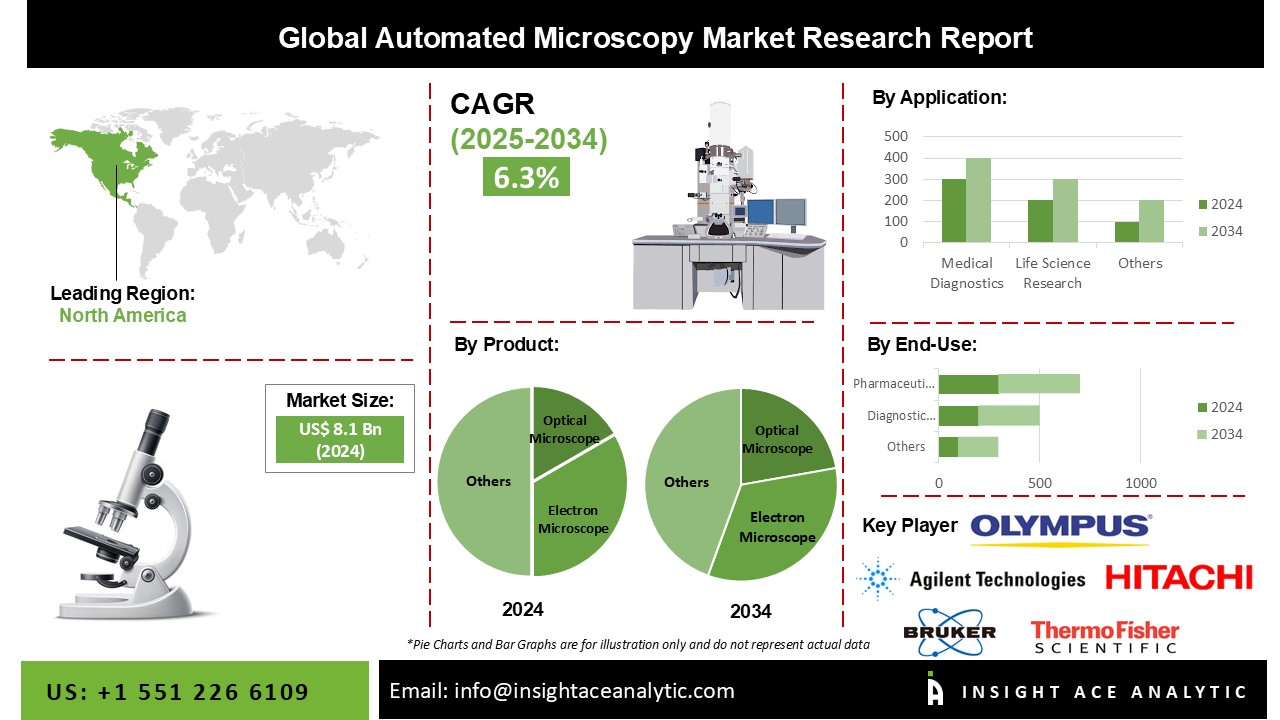
Global Automated Microscopy Market Size is valued at USD 8.1 Bn in 2024 and is predicted to reach USD 14.8 Bn by the year 2034 at a 6.3% CAGR during the forecast period for 2025-2034.
The demand for technologically superior, high-resolution microscopic devices has increased due to growing investments in the nanotechnology sector. The study of materials at the macromolecular, molecular, or atomic level is achievable by applying modern microscopic technologies, such as automated microscopy, which can result in multiple breakthroughs in various end uses.
Additionally, the usage of automated microscopy has been stimulated by the expanding range of applications for biological science, semiconductors, and material science, portending well for its market in the years to come. In the years to come, it is anticipated that the demand for automated microscopy will grow due to the increasing importance of research and development and the widespread usage of advanced microscopes in numerous applications, such as precision manufacturing. Nevertheless, it is anticipated that demand for automated microscopy across a range of end uses will increase quickly, which will support market expansion.
Additionally, automated digital microscopy is a relatively new technology that integrates data science, robotics, and artificial intelligence. Automated microscopy with digital intervention makes it possible to deal with the shortage of pathologists. The AI-based digital platform simplifies screening for pathologists, enabling remote sample examination and providing prompt consultations. Future automated microscopy market prospects are projected to be created by such advancements.
Competitive Landscape:
Some of the Automated Microscopy market players are:
- Agilent Technologies, Inc.
- Bruker Corporation
- Carl Zeiss AG
- Fei Company (Thermo Fisher Scientific)
- Hitachi High-Technologies
- Nikon Corporation
- Olympus Corporation
- Leica Microsystems (Danaher Corporation)
- Sutter Instruments, Inc.
- HORIBA Scientific
- Hirox Co. Ltd
- ACCU-SCOPE Inc.
- Oxford Instruments plc
- Scientifica
Market Segmentation:
The Automated Microscopy market is segmented based on product, application, and end-use. Based on the product, the market is segmented as an optical, electron, and scanning probe microscope. By application, the market is segmented into medical diagnostics and life science research. The end-user segment includes diagnostics laboratories, pharmaceutical, biotechnology companies, and others.
Based On Product, The Optical Microscope Segment Is Accounted As A Major Contributor In The Automated Microscopy Market
The majority of my income came from the optical microscope area. The main reasons for the increase include factors like high resolution, non-destructive imaging, imaging speed, efficiency, and fluorescence imaging compatibility, among others. Optical microscopy techniques make High-resolution imaging possible, enabling researchers to examine and analyze samples at the cellular and subcellular levels. Comparatively more accessible and less expensive than other cutting-edge microscopy methods like scanning probes or electron microscopy are optical microscopes. The segment will therefore experience noticeable expansion as a result of the factors mentioned above.
The Life Science Research Segment Witnessed Growth At A Rapid Rate
The main share belonged to the life science research industry. The study of cellular structures, interactions, and processes heavily relies on microscopy in the life sciences, including cell biology, neuroscience, and molecular biology. As researchers look to automate repetitive processes, capture dynamic cellular events, and evaluate massive amounts of information, automated microscopy is becoming more and more necessary. It makes it possible to get data more quickly and accurately, which aids in the study of disease mechanisms and the creation of new drugs. Therefore, the growth of the automated microscopy market will be further accelerated by the increase in research activities in biotech companies.
In The Region, The Asia Pacific Automated Microscopy Market Holds A Significant Revenue Share
Asia Pacific's developing nations are anticipated to continue to be significant sources of revenue for the automated microscopy industry. The expansion of healthcare-specific infrastructure, increased investments in this industry, and the low cost of labor and land availability all contribute to the region's continued leadership in the automated microscopy market.
Additionally, several significant firms engaged in automated microscopy are tapping Asian soil due to the advantageous business climate and accessibility of a sizable consumer base, which is likely to boost market growth further. Although automated microscopy use has grown slowly, the region is anticipated to offer promising chances in the years to come due to the rapid development of technology like artificial intelligence.
Automated Microscopy Market Report Scope:
|
Report Attribute
|
Specifications
|
|
Market Size Value In 2024
|
USD 8.1 Bn
|
|
Revenue Forecast In 2034
|
USD 14.8 Bn
|
|
Growth Rate CAGR
|
CAGR of 6.3% from 2025 to 2034
|
|
Quantitative Units
|
Representation of revenue in US$ Bn and CAGR from 2025 to 2034
|
|
Historic Year
|
2021 to 2024
|
|
Forecast Year
|
2025-2034
|
|
Report Coverage
|
The forecast of revenue, the position of the company, the competitive market structure, growth prospects, and trends
|
|
Segments Covered
|
Product, Application, And End-Use
|
|
Regional Scope
|
North America; Europe; Asia Pacific; Latin America; Middle East & Africa
|
|
Country Scope
|
U.S.; Canada; U.K.; Germany; China; India; Japan; Brazil; Mexico; The UK; France; Italy; Spain; China; Japan; India; South Korea; Southeast Asia; South Korea; South East Asia
|
|
Competitive Landscape
|
Agilent Technologies, Inc., Bruker Corporation, Carl Zeiss AG, Fei Company (Thermo Fisher Scientific), Hitachi High-Technologies, Nikon Corporation, Olympus Corporation, Leica Microsystems (Danaher Corporation), Sutter Instruments, Inc., HORIBA Scientific, Hirox Co. Ltd, ACCU-SCOPE Inc., and Oxford Instruments plc.
|
|
Customization Scope
|
Free customization report with the procurement of the report, Modifications to the regional and segment scope. Particular Geographic competitive landscape.
|
|
Pricing and Available Payment Methods
|
Explore pricing alternatives that are customized to your particular study requirements.
|
Segmentation of Automated Microscopy Market-
Automated Microscopy Market By Product-
- Optical Microscope
- Electron Microscope
- Transmission Electron Microscope (TEM)
- Scanning Electron Microscope (SEM)
- Tabletop/Benchtop
- Conventional
- Scanning Probe Microscope
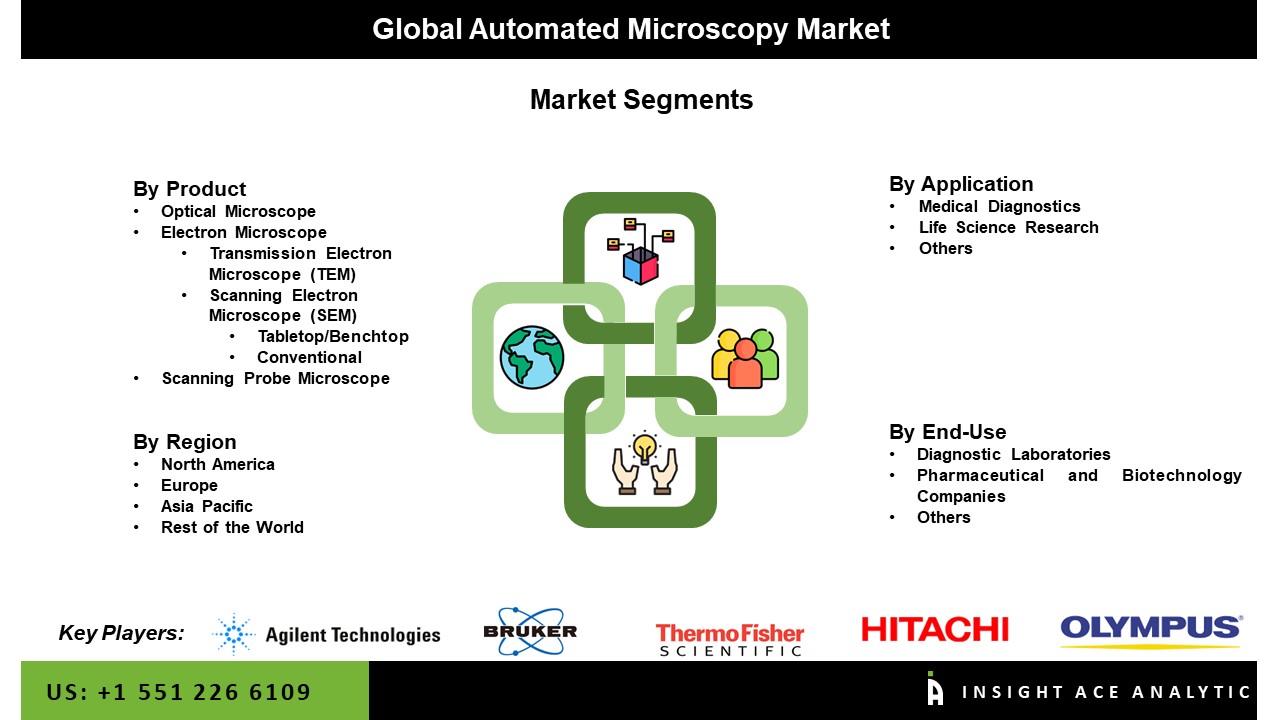
Automated Microscopy Market By Application-
- Medical Diagnostics
- Life Science Research
- Others
Automated Microscopy Market By End-Use-
- Diagnostics Laboratories
- Pharmaceutical and Biotechnology Companies
- Others
Automated Microscopy Market By Region-
North America-
Europe-
- Germany
- The UK
- France
- Italy
- Spain
- Rest of Europe
Asia-Pacific-
- China
- Japan
- India
- South Korea
- Southeast Asia
- Rest of Asia Pacific
Latin America-
- Brazil
- Mexico
- Argentina
- Rest of Latin America
Middle East & Africa-
- GCC Countries
- South Africa
- Rest of the Middle East and Africa