



Global Antioxidants Market Size is valued at USD 2.31 billion in 2024 and is predicted to reach USD 5.08 billion by the year 2034 at a 8.4% CAGR during the forecast period for 2025-2034.
Antioxidants are substances that help protect the body against oxidative damage caused by free radicals. They are commonly found in various foods, supplements, and personal care products. The market for antioxidants is driven by the growing awareness of their health benefits, the aging population, and increasing interest in functional and healthy foods. Growing numbers of consumers are actively searching for products that provide health advantages, with antioxidants being seen as advantageous in preventing chronic diseases, which is driving the expansion.
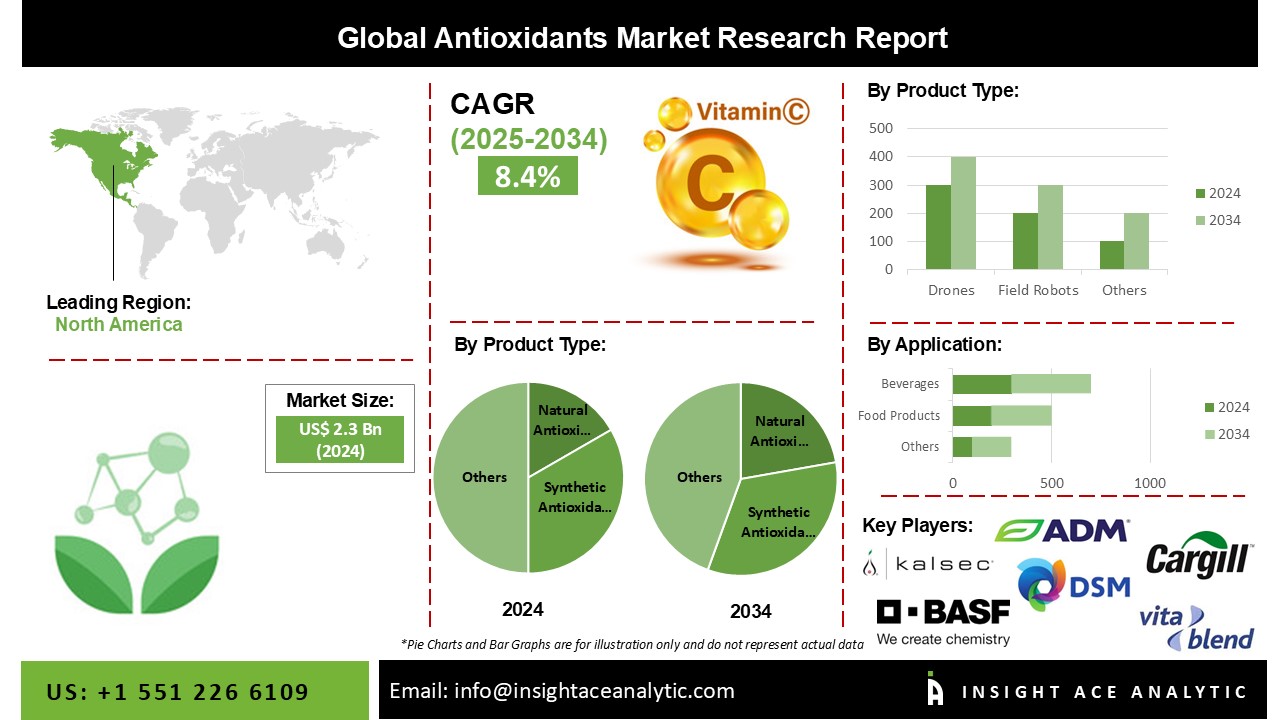
Moreover, there is a rising consumer interest in functional foods and beverages fortified with antioxidants. These items are promoted for their health benefits that extend beyond essential nutrition, contributing to accelerated growth. The cost of incorporating antioxidants into products could restrain manufacturers, especially in price-sensitive markets. Additionally, the market offers several notable opportunities, including increased interest in natural antioxidants, growth in emerging markets, the creation of innovative antioxidant products, collaborative partnerships, and expansion within the pharmaceutical industry.
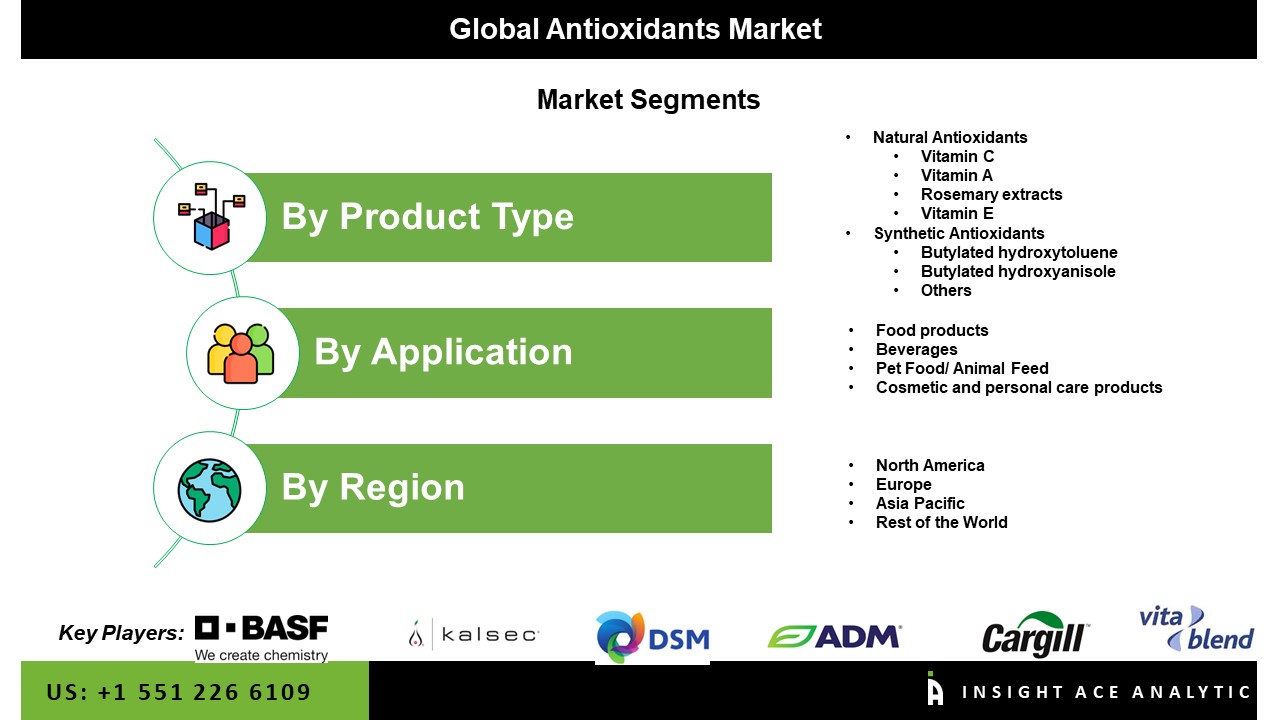
The antioxidants market is segmented based on product and application. The product segment includes natural and synthetic antioxidants. Application product segment food products, beverages, pet food/animal food and cosmetic & personal care products.
The synthetic antioxidant category will hold a major share of the global antioxidants market in 2022. To produce a variety of food products, butylated hydroxytoluene (BHT), butylated hydroxyanisole (BHA), tert-butylhydroquinone (TBHQ), and propyl gallate (PG) are widely used. Synthetic antioxidants are made by a traditional industrial process using various ingredients. As a result, its use as an addition is subject to some rigorous regulations from the governments of several nations. Synthetic antioxidants are often used to prolong the shelf life of food goods and improve their texture, color, and scent.
The food segment is projected to proliferate in the global antioxidants market. The antioxidants in fruits, vegetables, and other plants help treat various health conditions, including cardiovascular disorders. The industry is also expanding due to the increasing use of antioxidants in animal feed. Due to changing consumer preferences and behaviours, the bakery and confectionery industry is undergoing fast innovation. In addition, the custom of giving candy, baked goods, and other confectionery items, particularly at festivals, contributes to expanding the bakery and confectionery business.
The Asia Pacific antioxidants market is expected to record the most elevated market share in revenue shortly. The antioxidant market is expanding in emerging economies, particularly in Asia, where rising incomes and urbanization are leading to changing consumer preferences and a growing interest in health and wellness products. Growing health consciousness among consumers in Asia Pacific was driving demand for products with health-enhancing properties. Antioxidants gained popularity owing to their ability to resist oxidative stress and lower the risk of chronic illnesses.
In addition, North American is projected to grow rapidly in the global antioxidants market. North American consumers were strongly interested in functional foods and beverages fortified with antioxidants. This trend extended to a wide range of products, including energy drinks, fortified water, and snacks. The aging demographic in North America was a significant driver. With an enormous proportion of the population entering older age groups, there was an increased focus on products that promote longevity and address age-related health concerns.
| Report Attribute | Specifications |
| Market Size Value In 2024 | USD 2.31 Bn |
| Revenue Forecast In 2034 | USD 5.08 Bn |
| Growth Rate CAGR | CAGR of 8.4% from 2025 to 2034 |
| Quantitative Units | Representation of revenue in US$ Bn and CAGR from 2025 to 2034 |
| Historic Year | 2021 to 2024 |
| Forecast Year | 2025-2034 |
| Report Coverage | The forecast of revenue, the position of the company, the competitive market structure, growth prospects, and trends |
| Segments Covered | By Product, Application |
| Regional Scope | North America; Europe; Asia Pacific; Latin America; Middle East & Africa |
| Country Scope | U.S.; Canada; U.K.; Germany; China; India; Japan; Brazil; Mexico ; France; Italy; Spain; South Korea; South East |
| Competitive Landscape | BASF SE, Cargill Incorporated, Kalsec Inc., Koninklijke DSM N.V., Nutreo N.V., Vitablend Nederland B.V., Archer-Daniels-Midland Company, Archer-Daniels-Midland Company |
| Customization Scope | Free customization report with the procurement of the report and modifications to the regional and segment scope. Particular Geographic competitive landscape. |
| Pricing And Available Payment Methods | Explore pricing alternatives that are customized to your particular study requirements. |
Antioxidants Market By Product-
Antioxidants Market By Application-
By Region-
North America-
Europe-
Asia-Pacific-
Latin America-
Middle East & Africa-
This study employed a multi-step, mixed-method research approach that integrates:
This approach ensures a balanced and validated understanding of both macro- and micro-level market factors influencing the market.
Secondary research for this study involved the collection, review, and analysis of publicly available and paid data sources to build the initial fact base, understand historical market behaviour, identify data gaps, and refine the hypotheses for primary research.
Secondary data for the market study was gathered from multiple credible sources, including:
These sources were used to compile historical data, market volumes/prices, industry trends, technological developments, and competitive insights.

Primary research was conducted to validate secondary data, understand real-time market dynamics, capture price points and adoption trends, and verify the assumptions used in the market modelling.
Primary interviews for this study involved:
Interviews were conducted via:
Primary insights were incorporated into demand modelling, pricing analysis, technology evaluation, and market share estimation.
All collected data were processed and normalized to ensure consistency and comparability across regions and time frames.
The data validation process included:
This ensured that the dataset used for modelling was clean, robust, and reliable.
The bottom-up approach involved aggregating segment-level data, such as:
This method was primarily used when detailed micro-level market data were available.

The top-down approach used macro-level indicators:
This approach was used for segments where granular data were limited or inconsistent.
To ensure accuracy, a triangulated hybrid model was used. This included:
This multi-angle validation yielded the final market size.
Market forecasts were developed using a combination of time-series modelling, adoption curve analysis, and driver-based forecasting tools.
Given inherent uncertainties, three scenarios were constructed:
Sensitivity testing was conducted on key variables, including pricing, demand elasticity, and regional adoption.