Air Freight Market Size, Scope, Forecast Report 2026 to 2035
What is Air Freight Market Size?
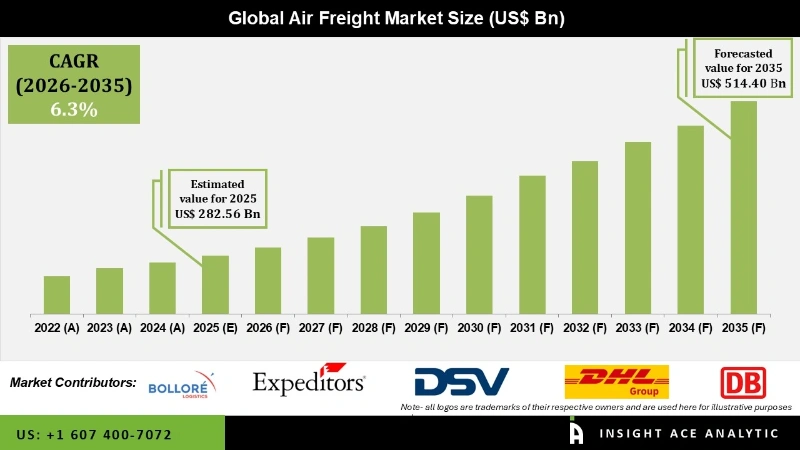
Air Freight Market Size is valued at USD 282.56 billion in 2025 and is predicted to reach USD 514.40 billion by the year 2035 at a 6.3% CAGR during the forecast period for 2026 to 2035.
Air Freight Market Size, Share & Trends Analysis Report By Service (Freight, Express, Mail, and Other Services), Destination (Domestic and International), and End-Use (Private and Commercial), By Region, And Segment Forecasts, 2026 to 2035.
Air Freight Market Key Takeaways:
|
Air Freight solutions are designed to meet the demands of businesses that engage in air and ground transportation. Industrial and passenger cargo can be transported securely and safely from one point to another using these technologies. Air Freight technologies, which provide more affordable and practical options for speedier and easier transportation, are used to trace the item.
The demand for enhanced Air Freight systems is rising as a result of population increase and the outsourcing of manufacturing operations. One of the main elements promoting the development of Air Freight solutions is the demand for the safety and security of shipments. For normal trading and shipping firms, on-time delivery and cost-effectiveness are top priorities. Tools are available through Air Freight solutions to meet and address these issues. This has further improved the market for freight management systems growth prospects.
Additionally, faster and better transportation and growth in air cargo volume has led to a greater need for Air Freight solutions.
Furthermore, technological developments are influencing advancements in the market for Air Freight, including the integration of software for finance, personnel management, and customer relationship management to support the organization's end-to-end operation. Strong infrastructure, rising maintenance costs, and hefty setup prices are some of the sector's biggest obstacles.
Recent Development:
- In 2022, Turkish Cargo said that it has been investing in technology and infrastructure in order to offer privileged shipment solutions that are flexible, cost-effective, and convenient through the use of three new air cargo service models, namely TK SMART, TK PREMIUM, and TK URGENT.
- In 2022, as part of a range of priority options for its clients, Cathay Pacific Airways Limited developed specific booking tiers for cargo shipments. Due to shipping priority, which includes quicker shipping, increased capacity, and shipment assurance, customers will have more options and more clearly defined service options.
Competitive Landscape:
Some of the Air Freight Market Player are:
- Bolloré Logistics
- DB SCHENKER (Deutsche Bahn Group (DB GROUP))
- Deutsche Post AG (DHL GROUP)
- DSV Panalpina
- Expeditors International of Washington, Inc.
- FedEx
- Hellmann Worldwide Logistics
- Kuehne+Nagel International AG
- Nippon Express
- United Parcel Service, Inc. (UPS)
Market Segmentation:
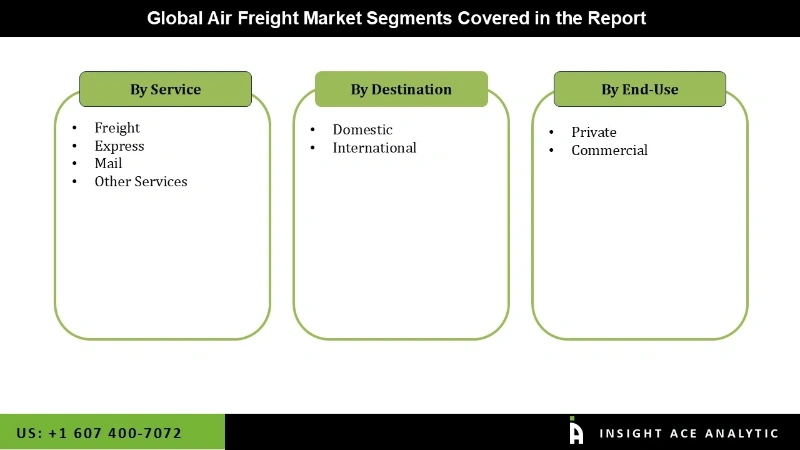
The Air Freight market is segmented on service, destination and end-use. Based on service, the market is categorized into freight, express, mail and other services. Based on the destination, the market is segmented into domestic and international. Based on end-use, the Air Freight market is segmented into private and commercial.
Based On Service, The Freight Segment Is Accounted As A Major Contributor To The Air Freight Market
The freight category grabbed the highest revenue share, and it is projected that it will continue to maintain that position during the anticipated time. The expansion of air freight fleets across various locations is one of the factors propelling the growth of the regular services segment. The majority of operators of cargo aircraft have been pressing for expenditures to expand their own fleets of air cargo aircraft. To do this, the operators are concentrating on developing teamwork and aircraft leasing techniques, in which the businesses rent out cargo aircraft models to various customers, allowing them to expand into new areas.
The International Segment Witnessed Growth At A Rapid Rate
The construction & infrastructure category is anticipated to grow significantly over the forecast period. The quickest delivery method for goods across international borders is via cargo jets. Additionally, air cargo is the safest way of shipping orders internationally because it requires the least handling and airport safety measures are closely enforced. This reduces the possibility of theft and shipment damage. Additionally, because air cargo shipments are typically short, insurance costs are frequently modest. These elements make Air Freight systems superior and necessary for moving products. Importing high-value commodities like electronics, jewelry, medications, perishables, and other items through air cargo is advantageous.
North America Air Freight Market Hold A Significant Revenue Share In The Region
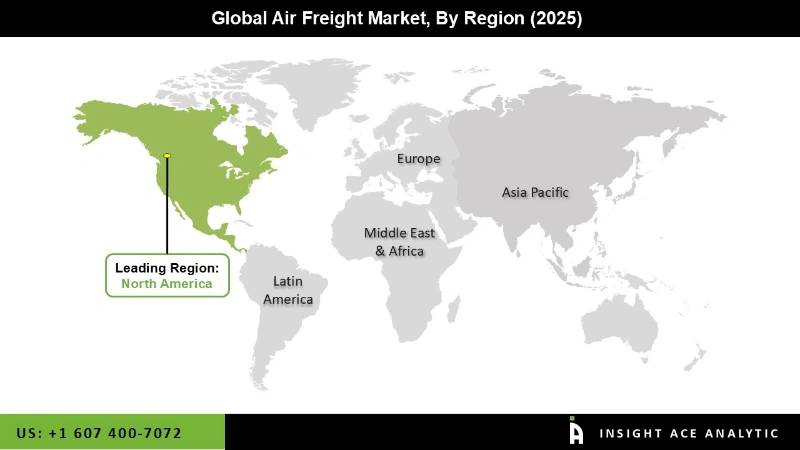
North America Air Freight market is expected to record the highest market share in revenue shortly. This is made feasible by regional users' widespread adoption of Air Freight products and services. High levels of technological adoption and the presence of important solution providers will affect how quickly the North American Air Freight system market will expand. Air Freight software is widely used in the US and Canada, two nations in North America. In addition, the European is projected to grow at a rapid rate in the global Air Freight market. This can be attributed to the increasing cargo freight handled by the area's logistics sector. Additionally, it is anticipated that the industry in the area will grow due to the major market players' rising investments in developing improved Air Freight software. The expansion is also credited to the presence of numerous important players in this area.
Air Freight Market Report Scope:
| Report Attribute | Specifications |
| Market size value in 2025 | USD 282.56 Bn |
| Revenue forecast in 2035 | USD 514.40 Bn |
| Growth rate CAGR | CAGR of 6.3% from 2026 to 2035 |
| Quantitative units | Representation of revenue in US$ Billion, and CAGR from 2026 to 2035 |
| Historic Year | 2022 to 2025 |
| Forecast Year | 2026-2035 |
| Report coverage | The forecast of revenue, the position of the company, the competitive market statistics, growth prospects, and trends |
| Segments covered | Service, Destination And End-Use |
| Regional scope | North America; Europe; Asia Pacific; Latin America; Middle East & Africa |
| Country scope | U.S.; Canada; U.K.; Germany; China; India; Japan; Brazil; Mexico; The UK; France; Italy; Spain; South Korea; Southeast Asia |
| Competitive Landscape | Bolloré Logistics, DB SCHENKER (Deutsche Bahn Group (DB GROUP)), Deutsche Post AG (DHL GROUP), DSV Panalpina , Expeditors International of Washington, Inc., FedEx, Hellmann Worldwide Logistics, Kuehne+Nagel International AG, Nippon Express and United Parcel Service, Inc. (UPS). |
| Customization scope | Free customization report with the procurement of the report, Modifications to the regional and segment scope. Particular Geographic competitive landscape. |
| Pricing and available payment methods | Explore pricing alternatives that are customized to your particular study requirements. |
Segmentation of Air Freight Market-
Air Freight Market By Service
- Freight
- Express
- Other Services
Air Freight Market By Destination
- Domestic
- International
Air Freight Market By End-Use
- Private
- Commercial
Air Freight Market By Region-
North America-
- The US
- Canada
- Mexico
Europe-
- Germany
- The UK
- France
- Italy
- Spain
- Rest of Europe
Asia-Pacific-
- China
- Japan
- India
- South Korea
- South East Asia
- Rest of Asia Pacific
Latin America-
- Brazil
- Argentina
- Rest of Latin America
Middle East & Africa-
- GCC Countries
- South Africa
- Rest of Middle East and Africa
Research Design and Approach
This study employed a multi-step, mixed-method research approach that integrates:
- Secondary research
- Primary research
- Data triangulation
- Hybrid top-down and bottom-up modelling
- Forecasting and scenario analysis
This approach ensures a balanced and validated understanding of both macro- and micro-level market factors influencing the market.
Secondary Research
Secondary research for this study involved the collection, review, and analysis of publicly available and paid data sources to build the initial fact base, understand historical market behaviour, identify data gaps, and refine the hypotheses for primary research.
Sources Consulted
Secondary data for the market study was gathered from multiple credible sources, including:
- Government databases, regulatory bodies, and public institutions
- International organizations (WHO, OECD, IMF, World Bank, etc.)
- Commercial and paid databases
- Industry associations, trade publications, and technical journals
- Company annual reports, investor presentations, press releases, and SEC filings
- Academic research papers, patents, and scientific literature
- Previous market research publications and syndicated reports
These sources were used to compile historical data, market volumes/prices, industry trends, technological developments, and competitive insights.

Primary Research
Primary research was conducted to validate secondary data, understand real-time market dynamics, capture price points and adoption trends, and verify the assumptions used in the market modelling.
Stakeholders Interviewed
Primary interviews for this study involved:
- Manufacturers and suppliers in the market value chain
- Distributors, channel partners, and integrators
- End-users / customers (e.g., hospitals, labs, enterprises, consumers, etc., depending on the market)
- Industry experts, technology specialists, consultants, and regulatory professionals
- Senior executives (CEOs, CTOs, VPs, Directors) and product managers
Interview Process
Interviews were conducted via:
- Structured and semi-structured questionnaires
- Telephonic and video interactions
- Email correspondences
- Expert consultation sessions
Primary insights were incorporated into demand modelling, pricing analysis, technology evaluation, and market share estimation.
Data Processing, Normalization, and Validation
All collected data were processed and normalized to ensure consistency and comparability across regions and time frames.
The data validation process included:
- Standardization of units (currency conversions, volume units, inflation adjustments)
- Cross-verification of data points across multiple secondary sources
- Normalization of inconsistent datasets
- Identification and resolution of data gaps
- Outlier detection and removal through algorithmic and manual checks
- Plausibility and coherence checks across segments and geographies
This ensured that the dataset used for modelling was clean, robust, and reliable.
Market Size Estimation and Data Triangulation
Bottom-Up Approach
The bottom-up approach involved aggregating segment-level data, such as:
- Company revenues
- Product-level sales
- Installed base/usage volumes
- Adoption and penetration rates
- Pricing analysis
This method was primarily used when detailed micro-level market data were available.

Top-Down Approach
The top-down approach used macro-level indicators:
- Parent market benchmarks
- Global/regional industry trends
- Economic indicators (GDP, demographics, spending patterns)
- Penetration and usage ratios
This approach was used for segments where granular data were limited or inconsistent.
Hybrid Triangulation Approach
To ensure accuracy, a triangulated hybrid model was used. This included:
- Reconciling top-down and bottom-up estimates
- Cross-checking revenues, volumes, and pricing assumptions
- Incorporating expert insights to validate segment splits and adoption rates
This multi-angle validation yielded the final market size.
Forecasting Framework and Scenario Modelling
Market forecasts were developed using a combination of time-series modelling, adoption curve analysis, and driver-based forecasting tools.
Forecasting Methods
- Time-series modelling
- S-curve and diffusion models (for emerging technologies)
- Driver-based forecasting (GDP, disposable income, adoption rates, regulatory changes)
- Price elasticity models
- Market maturity and lifecycle-based projections
Scenario Analysis
Given inherent uncertainties, three scenarios were constructed:
- Base-Case Scenario: Expected trajectory under current conditions
- Optimistic Scenario: High adoption, favourable regulation, strong economic tailwinds
- Conservative Scenario: Slow adoption, regulatory delays, economic constraints
Sensitivity testing was conducted on key variables, including pricing, demand elasticity, and regional adoption.
Request Customization
Add countries, segments, company profiles, or extend forecast — free 10% customization with purchase.
Customize This Report →Enquire Before Buying
Speak with our analyst team about scope, methodology, pricing, or deliverable formats.
Enquire Now →Frequently Asked Questions
Air Freight Market Size is valued at USD 282.56 billion in 2025 and is predicted to reach USD 514.40 billion by the year 2035 .
Air Freight Market expected to grow at a 6.3% CAGR during the forecast period for 2026-2035
Bolloré Logistics, DB SCHENKER (Deutsche Bahn Group (DB GROUP)), Deutsche Post AG (DHL GROUP), DSV Panalpina , Expeditors International of Washington,
Air Freight market is segmented on service, destination and end-use, Based on service, the market is categorized into freight, express, mail and other services.
North America region is leading the Air Freight market.