AI in Mining and Natural Resources Market Research Report with Forecast 2026 to 2035
What is AI in Mining and Natural Resources Market Size?
Global AI in Mining and Natural Resources Market Size is valued at USD 6.39 Bn in 2025 and is predicted to reach USD 41.13 Bn by the year 2035 at a 20.6% CAGR during the forecast period for 2026 to 2035.
AI in Mining and Natural Resources Market Size, Share & Trends Analysis Report By Type (Machine Learning, Computer Vision, Natural Language Processing, Robotics), By Application, By End-User, By Region, And By Segment Forecasts, 2026 to 2035.
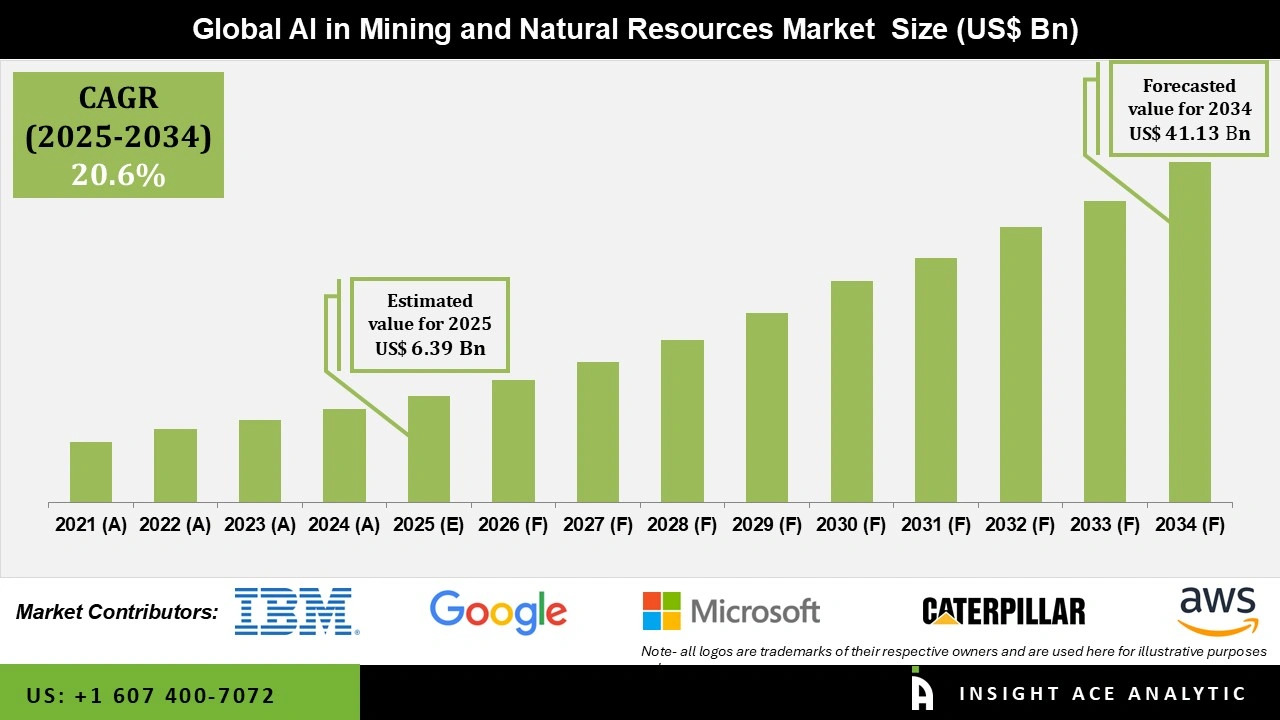
AI in Mining and Natural Resources Market Key Takeaways:
|
Artificial intelligence has become a disruptive factor in the natural resources and mining sector. This field aims to transform resource extraction and management by utilizing AI technologies like computer vision and machine learning. AI's capacity to interpret mining businesses may improve worker safety protocols, make data-driven decisions, and maximize exploration efforts by analyzing large databases. Additionally, in dangerous mining locations, AI-powered autonomous trucks and equipment can lower operating hazards and boost production.
Artificial intelligence in mining and natural resources has a lot of potential to advance sustainable practices, boost operational effectiveness, and satisfy the growing demand for essential natural resources worldwide.The growing necessity for effective and sustainable resource management is a key impetus in the mining sector. Extensive data processing and analytical insights from AI enhance decision-making, thereby reducing environmental impact, decreasing operational expenses, and streamlining exploration and extraction processes.
Competitive Landscape
Some Major Key Players In The AI in Mining and Natural Resources Market:
- IBM Corporation
- Google LLC
- Microsoft Corporation
- Amazon Web Services, Inc.
- Caterpillar Inc.
- Komatsu Ltd.
- Sandvik AB
- Hexagon AB
- ABB Ltd.
- Rockwell Automation, Inc.
- Hitachi Construction Machinery Co., Ltd.
- NVIDIA Corporation
- SAP SE
- Cisco Systems, Inc.
- Wenco International Mining Systems Ltd.
- BHP Group
- Rio Tinto Group
- Vale S.A.
- Anglo American plc
- Freeport-McMoRan Inc.
- Newmont Corporation
- Teck Resources Limited
- Glencore plc
- Gold Fields Limited
- Barrick Gold Corporation
- Other Market Players
Market Segmentation:
AI in the mining and natural resources market is segmented by type, application, and end user. Based on type, the market is segmented into machine learning, computer vision, natural language processing, and robotics. By application, the market is segmented as exploration and geological analysis, mine planning and design, autonomous vehicles and equipment, predictive maintenance, safety and risk assessment, environmental monitoring and management, supply chain optimization, resource extraction and processing, and mine closure and rehabilitation. By end-user, the market is segmented into mining companies, mining equipment manufacturers, consulting and service providers, and research and academia.
Based On Application, The Exploration And Geological Analysis Segment Is Accounted As A Major Contributor To The AI In The Mining And Natural Resources Market.
The market is expanding due in large part to its critical role in exploration and geological analysis, where AI makes target identification, geological modelling, and efficient data processing possible. AI improves scheduling, resource allocation, and layouts in mine planning and design, resulting in more economical and sustainable mining operations. While predictive maintenance solutions reduce downtime and boost equipment reliability, autonomous vehicles and equipment that integrate artificial intelligence (AI) improve automation and safety in demanding mining conditions—AI-powered data analytics help Safety and Risk Assessment by offering real-time insights to avert potential dangers and mishaps.
The Predictive Maintenance Segment Witnessed Growth At A Rapid Rate.
Predictive maintenance is another current use of AI in mining. Mining companies have reduced downtime and increased the lifespan of both fixed and mobile assets by employing machine learning (ML) algorithms to evaluate equipment data and detect breakdowns before they happen. In addition to saving money, this strategy increases safety by reducing the likelihood of incidents involving equipment.
In The Region, North American AI In The Mining And Natural Resources Market Holds A Significant Revenue Share.
Due to significant R&D investments, technological developments, and partnerships between mining businesses and AI technology providers, North America is at the forefront of the implementation of AI in mining. The market is thriving in Europe as a result of the region's emphasis on environmentally friendly mining methods, legislative backing, and the presence of top suppliers of AI solutions.
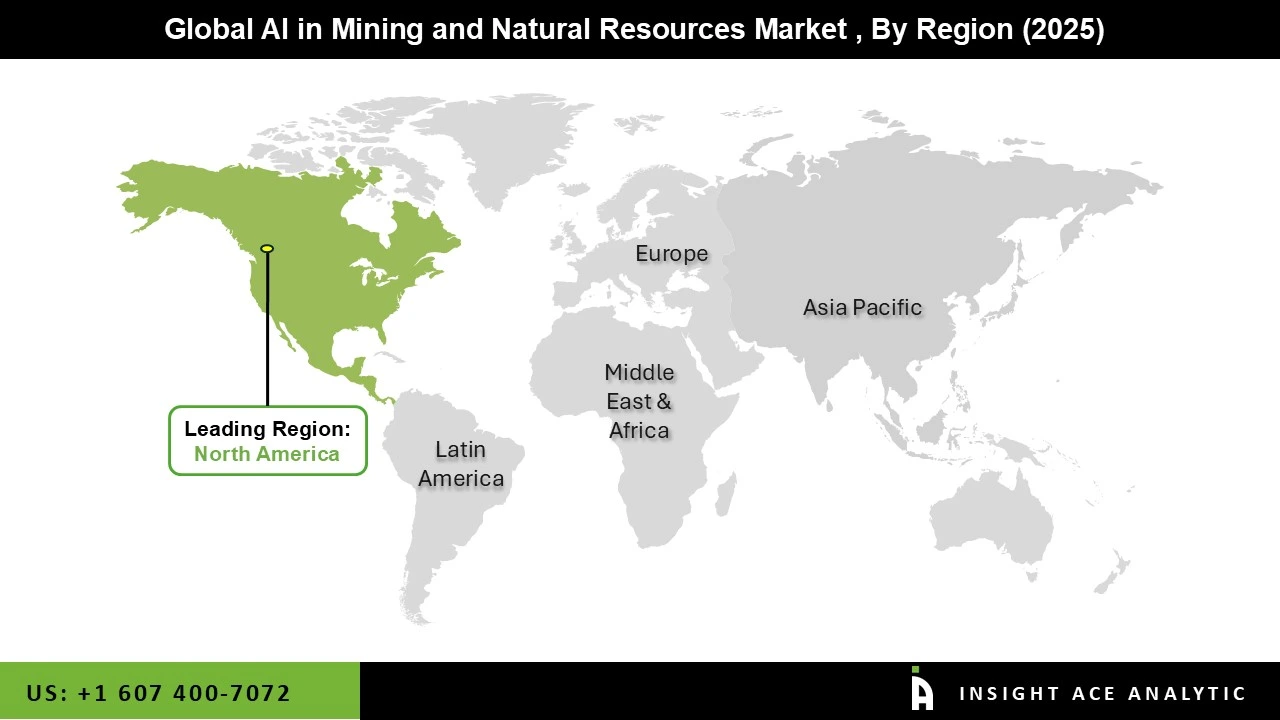
With nations like Australia and China making significant investments in AI technology to improve safety, optimize mining operations, and satisfy resource demands, Asia Pacific offers potential for rapid growth. While the Middle East and Africa see growing AI integration for resource exploration and extraction, supporting the region's economic development, Latin America embraces AI-driven technologies to increase efficiency and productivity in the mining sector.
Recent Developments:
- In Aug 2024, ABB and Komatsu established a partnership to create electrification and decarbonization solutions for the mining sector. The collaboration amalgamates the experience of both firms to provide comprehensive solutions, encompassing renewable energy production and entirely powered mining trucks. ABB and Komatsu's collaboration seeks to reduce diesel usage and ultimately eradicate it through the electrification of mining operations. The companies will offer a suite of interoperable solutions tailored to match customer requirements.
AI in Mining and Natural Resources Market Report Scope:
| Report Attribute | Specifications |
| Market Size Value In 2025 | USD 6.39 Bn |
| Revenue Forecast In 2035 | USD 41.13 Bn |
| Growth Rate CAGR | CAGR of 20.6% from 2026 to 2035 |
| Quantitative Units | Representation of revenue in US$ Bn and CAGR from 2026 to 2035 |
| Historic Year | 2022 to 2025 |
| Forecast Year | 2026-2035 |
| Report Coverage | The forecast of revenue, the position of the company, the competitive market structure, growth prospects, and trends |
| Segments Covered | By Type, Application, End-User |
| Regional Scope | North America; Europe; Asia Pacific; Latin America; Middle East & Africa |
| Country Scope | U.S.; Canada; U.K.; Germany; China; India; Japan; Brazil; Mexico; France; Italy; Spain; South East Asia; South Korea |
| Competitive Landscape | IBM Corporation, Google LLC, Microsoft Corporation, Amazon Web Services, Inc., Caterpillar Inc., Komatsu Ltd., Sandvik AB, Hexagon AB, ABB Ltd., Rockwell Automation, Inc., Hitachi Construction Machinery Co., Ltd., NVIDIA Corporation, SAP SE, Cisco Systems, Inc., Wenco International Mining Systems Ltd., BHP Group, Rio Tinto Group, Vale S.A., Anglo American plc, Freeport-McMoRan Inc., Newmont Corporation, Teck Resources Limited, Glencore plc, Gold Fields Limited, Barrick Gold Corporation. |
| Customization Scope | Free customization report with the procurement of the report and modifications to the regional and segment scope. Particular Geographic competitive landscape. |
| Pricing And Available Payment Methods | Explore pricing alternatives that are customized to your particular study requirements. |
Segmentation Of AI In Mining And Natural Resources Market :
AI In Mining And Natural Resources Market By Product-
- Machine Learning
- Computer Vision
- Natural Language Processing
- Robotics
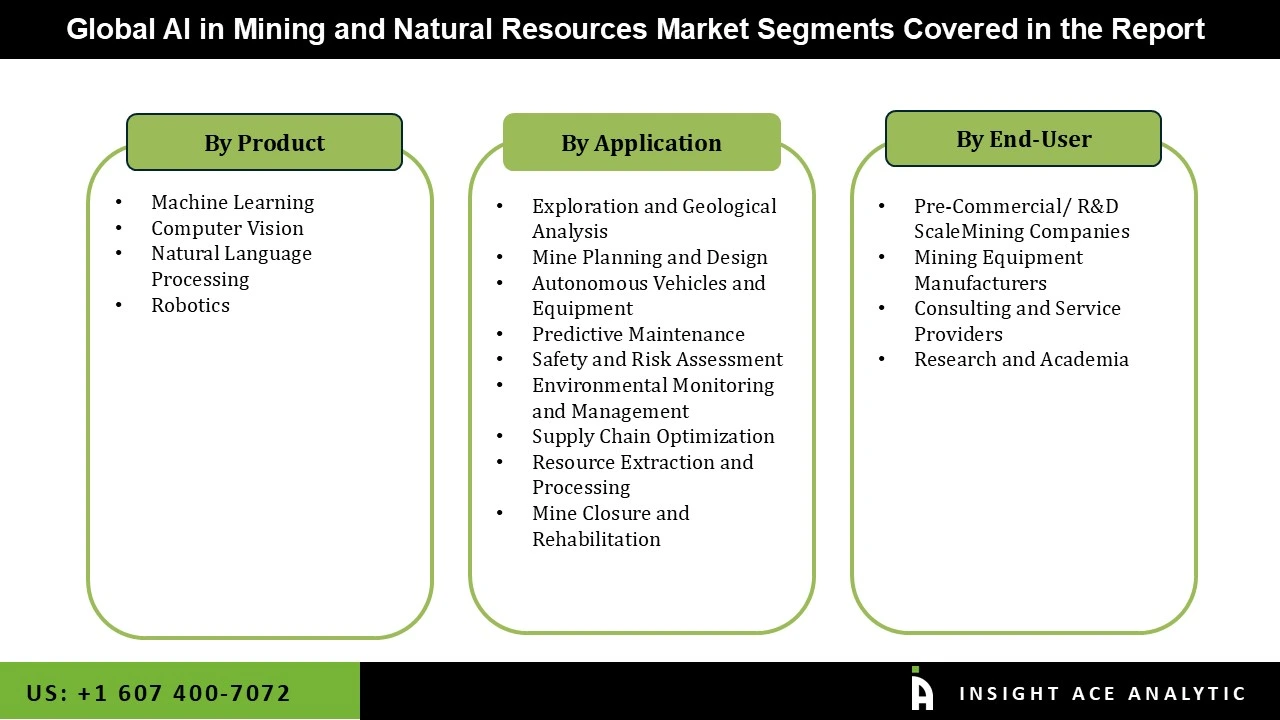
AI In Mining And Natural Resources Market By Application-
- Exploration and Geological Analysis
- Mine Planning and Design
- Autonomous Vehicles and Equipment
- Predictive Maintenance
- Safety and Risk Assessment
- Environmental Monitoring and Management
- Supply Chain Optimization
- Resource Extraction and Processing
- Mine Closure and Rehabilitation
AI In Mining And Natural Resources Market By End-User-
- Mining Companies
- Mining Equipment Manufacturers
- Consulting and Service Providers
- Research and Academia
AI In Mining And Natural Resources Market By Region-
North America-
- North America-
- The US
- Canada
- Europe-
- Germany
- The UK
- France
- Italy
- Spain
- Rest of Europe
- Asia-Pacific-
- China
- Japan
- India
- South Korea
- South East Asia
- Rest of Asia Pacific
- Latin America-
- Brazil
- Argentina
- Mexico
- Rest of Latin America
- Middle East & Africa-
- GCC Countries
- South Africa
- Rest of Middle East and Africa
Research Design and Approach
This study employed a multi-step, mixed-method research approach that integrates:
- Secondary research
- Primary research
- Data triangulation
- Hybrid top-down and bottom-up modelling
- Forecasting and scenario analysis
This approach ensures a balanced and validated understanding of both macro- and micro-level market factors influencing the market.
Secondary Research
Secondary research for this study involved the collection, review, and analysis of publicly available and paid data sources to build the initial fact base, understand historical market behaviour, identify data gaps, and refine the hypotheses for primary research.
Sources Consulted
Secondary data for the market study was gathered from multiple credible sources, including:
- Government databases, regulatory bodies, and public institutions
- International organizations (WHO, OECD, IMF, World Bank, etc.)
- Commercial and paid databases
- Industry associations, trade publications, and technical journals
- Company annual reports, investor presentations, press releases, and SEC filings
- Academic research papers, patents, and scientific literature
- Previous market research publications and syndicated reports
These sources were used to compile historical data, market volumes/prices, industry trends, technological developments, and competitive insights.
Primary Research
Primary research was conducted to validate secondary data, understand real-time market dynamics, capture price points and adoption trends, and verify the assumptions used in the market modelling.
Stakeholders Interviewed
Primary interviews for this study involved:
- Manufacturers and suppliers in the market value chain
- Distributors, channel partners, and integrators
- End-users / customers (e.g., hospitals, labs, enterprises, consumers, etc., depending on the market)
- Industry experts, technology specialists, consultants, and regulatory professionals
- Senior executives (CEOs, CTOs, VPs, Directors) and product managers
Interview Process
Interviews were conducted via:
- Structured and semi-structured questionnaires
- Telephonic and video interactions
- Email correspondences
- Expert consultation sessions
Primary insights were incorporated into demand modelling, pricing analysis, technology evaluation, and market share estimation.
Data Processing, Normalization, and Validation
All collected data were processed and normalized to ensure consistency and comparability across regions and time frames.
The data validation process included:
- Standardization of units (currency conversions, volume units, inflation adjustments)
- Cross-verification of data points across multiple secondary sources
- Normalization of inconsistent datasets
- Identification and resolution of data gaps
- Outlier detection and removal through algorithmic and manual checks
- Plausibility and coherence checks across segments and geographies
This ensured that the dataset used for modelling was clean, robust, and reliable.
Market Size Estimation and Data Triangulation
Bottom-Up Approach
The bottom-up approach involved aggregating segment-level data, such as:
- Company revenues
- Product-level sales
- Installed base/usage volumes
- Adoption and penetration rates
- Pricing analysis
This method was primarily used when detailed micro-level market data were available.
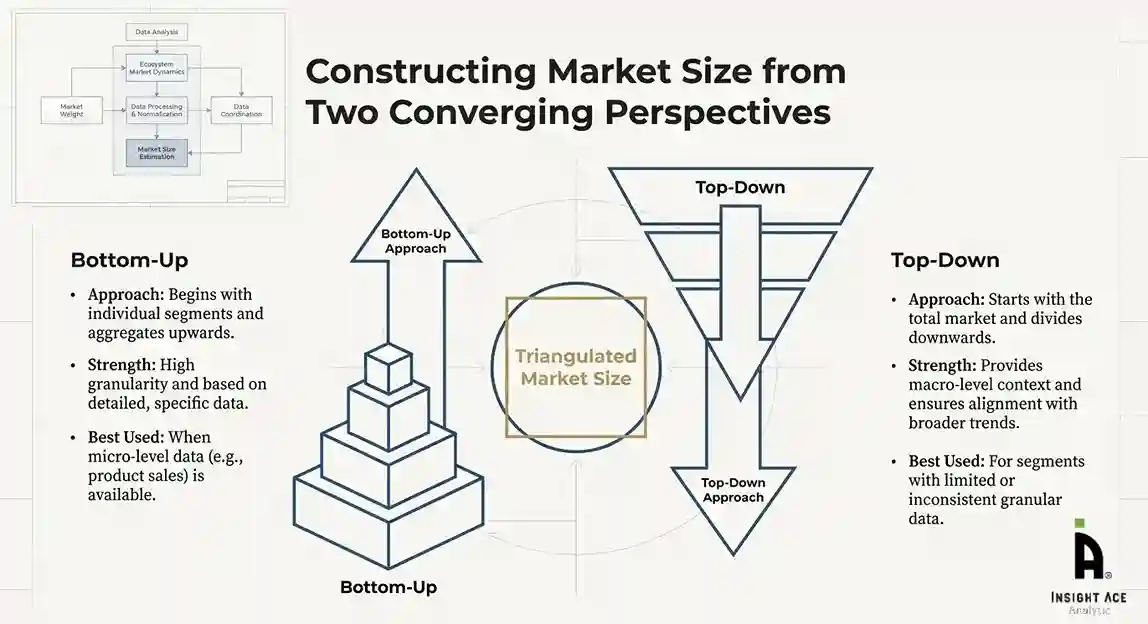
Top-Down Approach
The top-down approach used macro-level indicators:
- Parent market benchmarks
- Global/regional industry trends
- Economic indicators (GDP, demographics, spending patterns)
- Penetration and usage ratios
This approach was used for segments where granular data were limited or inconsistent.
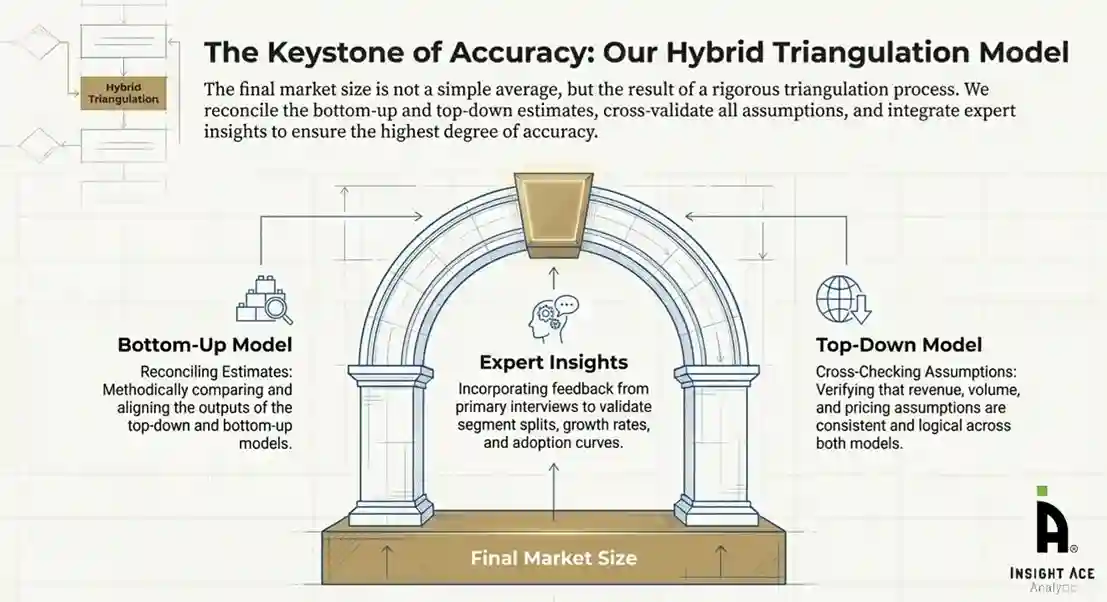
Hybrid Triangulation Approach
To ensure accuracy, a triangulated hybrid model was used. This included:
- Reconciling top-down and bottom-up estimates
- Cross-checking revenues, volumes, and pricing assumptions
- Incorporating expert insights to validate segment splits and adoption rates
This multi-angle validation yielded the final market size.
Forecasting Framework and Scenario Modelling
Market forecasts were developed using a combination of time-series modelling, adoption curve analysis, and driver-based forecasting tools.
Forecasting Methods
- Time-series modelling
- S-curve and diffusion models (for emerging technologies)
- Driver-based forecasting (GDP, disposable income, adoption rates, regulatory changes)
- Price elasticity models
- Market maturity and lifecycle-based projections
Scenario Analysis
Given inherent uncertainties, three scenarios were constructed:
- Base-Case Scenario: Expected trajectory under current conditions
- Optimistic Scenario: High adoption, favourable regulation, strong economic tailwinds
- Conservative Scenario: Slow adoption, regulatory delays, economic constraints
Sensitivity testing was conducted on key variables, including pricing, demand elasticity, and regional adoption.
Request Customization
Add countries, segments, company profiles, or extend forecast — free 10% customization with purchase.
Customize This Report →Enquire Before Buying
Speak with our analyst team about scope, methodology, pricing, or deliverable formats.
Enquire Now →Frequently Asked Questions
AI in Mining and Natural Resources Market Size is valued at USD 6.39 Bn in 2025 and is predicted to reach USD 41.13 Bn by the year 2035
AI in Mining and Natural Resources Market is expected to grow at a 20.6% CAGR during the forecast period for 2026 to 2035.
IBM Corporation, Google LLC, Microsoft Corporation, Amazon Web Services, Inc., Caterpillar Inc., Komatsu Ltd., Sandvik AB, Hexagon AB, ABB Ltd., Rockwell Automation, Inc., Hitachi Construction Machinery Co., Ltd., NVIDIA Corporation, SAP SE, Cisco Systems, Inc., Wenco International Mining Systems Ltd., BHP Group, Rio Tinto Group, Vale S.A., Anglo American plc, Freeport-McMoRan Inc., Newmont Corporation, Teck Resources Limited, Glencore plc, Gold Fields Limited, Barrick Gold Corporation. and Others.
AI in Mining and Natural Resources Market is segmented in By Type (Machine Learning, Computer Vision, Natural Language Processing, Robotics), By Application, By End-User and other.
North America region is leading the AI in Mining and Natural Resources Market.