



Global AI In Life Science Analytics Market Size is valued at USD 1.7 Bn in 2024 and is predicted to reach USD 4.6 Bn by the year 2034 at a 10.4% CAGR during the forecast period for 2025-2034.
Artificial Intelligence (AI) in life science analytics harnesses machine learning (ML), deep learning, as well as data analytics to revolutionize research and development in biotechnology, pharmaceuticals, and healthcare. Artificial intelligence (AI) applied to life science analytics has enormous potential to revolutionize research, improve healthcare outcomes, and streamline operations in the healthcare and life sciences industries. The use of AI is anticipated to transform data analysis and utilization in these crucial fields further as technology keeps progressing.
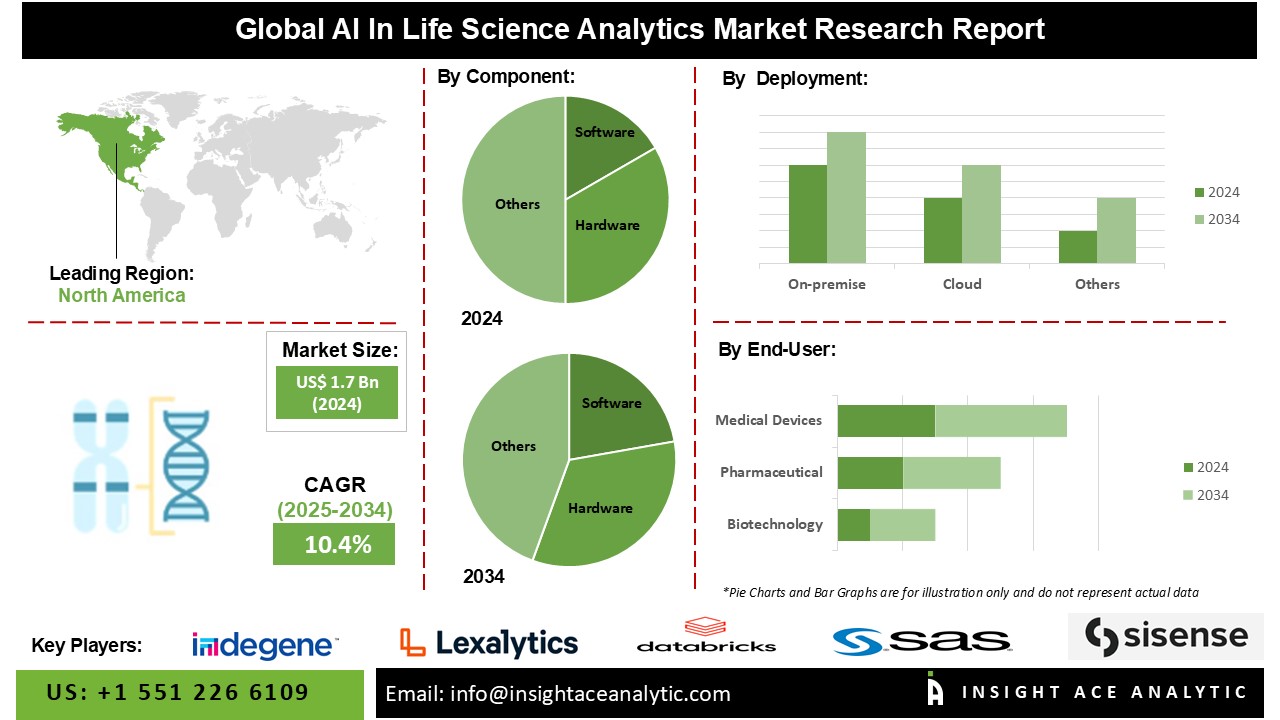
Healthcare results and operational efficiency are both improved with the use of artificial intelligence (AI) in life science analytics. Furthermore, the field of drug research and development is ripe with potential for the growing market for artificial intelligence in life science analytics.
However, the market growth is hampered by the high investment criteria for the safety and health of this market and the product's inability to prevent fog in environments with dramatic temperature fluctuations or high AI in life science analytics because launching effective AI products requires massive investments of capital. The industry is neither easily nor immediately monetizable. Research and development teams and engineers specializing in machine learning are often necessary for these goods, and they can be rather costly.
In addition to the upfront software and cloud support expenses, life science businesses must also cover the continuing costs of training the AI system in response to changes in business processes. The difficulty in estimating return on investment (ROI), particularly at the outset of a project, is another major hurdle. However, The COVID-19 pandemic had a beneficial impact on businesses in the health and life sciences sector. The industry was forced to accelerate innovation in response to the pandemic, manage the interruption to clinical trials and supply chains, and deal with the crisis by using artificial intelligence (AI) for life science analytics at a significant upswing.
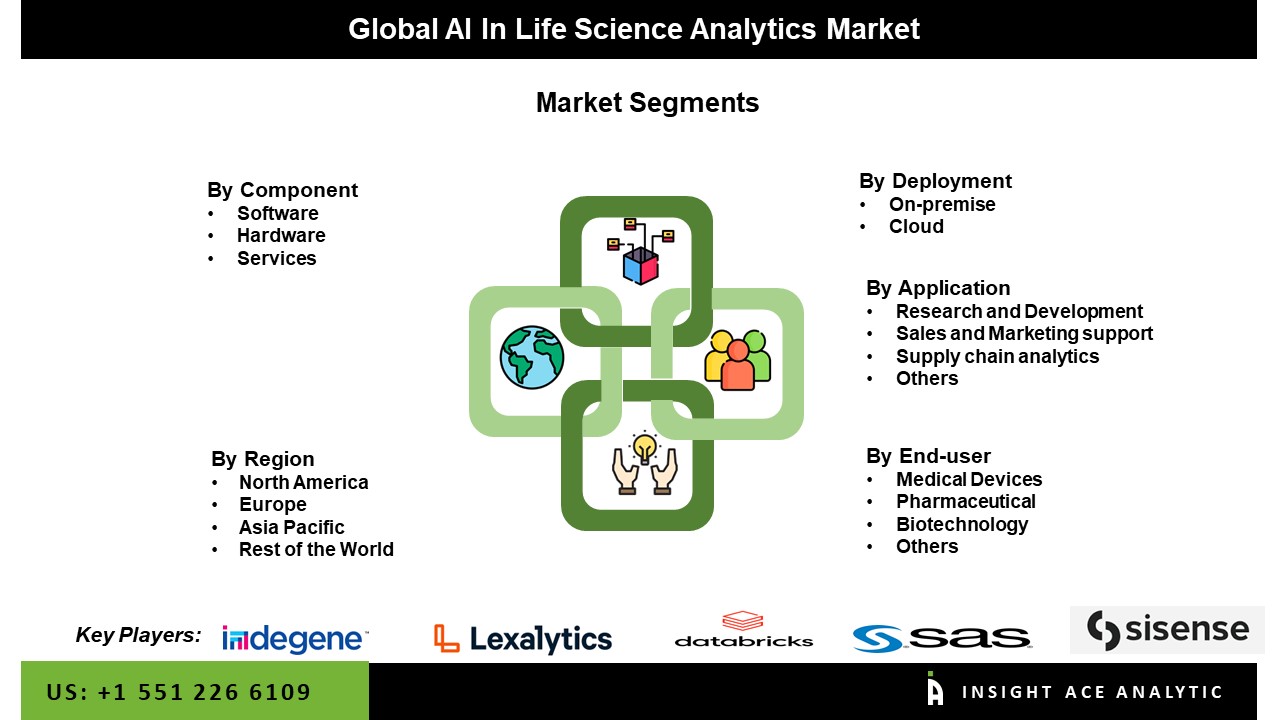
The Global AI in life science analytics market is segmented based on component, application, deployment, and end-use. As per the components, the market is categorized into hardware, software, and services. According to deployment, the market comprises on-premise and cloud. By application, the market is segmented into research and development, sales and marketing support, supply chain analytics, and others. By end use, the market is segmented into medical devices, pharmaceuticals, and biotechnology.
The research and development of AI in the life science analytics market is expected to hold a major global market share in 2023. Research and development rely on AI to help accelerate the discovery of potential new medications, analyze genomic data, and support different steps in the drug development pipeline. It makes research decision-making, data analysis, and experimentation more efficient.
The hardware dominates because specialist hardware components like AI memory and processors are in high demand. AI algorithms are used for more complicated operations,
The North American AI in life science analytics market is estimated to register the maximum market revenue share in the near future. This can be attributed to the fact that sophisticated network of roads, hospitals, and other medical facilities, as well as a booming biotech industry. The area is known for its innovative spirit, high concentration on research and development, and partnerships between IT firms and healthcare organizations. In addition, Asia Pacific is predicted to grow rapidly in the AI in life science analytics market because of the growing funding for cutting-edge research and development in this area. The expansion of healthcare facilities in the area is another factor that will boost the market's growth.
The key players in the AI in life science analytics market have shifted their focus toward technological advancement and higher demand for them. They are initiating significant strategies such as mergers and joint ventures of major and domestic players to expand their selection of products and raise their global market footprint. Some of the major key players in the AI in life science analytics market are Indegene, Lexalytics, Databricks, SAS Institute Inc., Sisense, IQVIA, IBM, Sorcero, Atomwise, NuMedii, AiCure LLC, Nuance Communications, APIXIO, Inc, Insilico Medicine, and Other Market Players.
| Report Attribute | Specifications |
| Market Size Value In 2024 | USD 1.7 Bn |
| Revenue Forecast In 2034 | USD 4.6 Bn |
| Growth Rate CAGR | CAGR of 10.4% from 2025 to 2034 |
| Quantitative Units | Representation of revenue in US$ Bn,and CAGR from 2025 to 2034 |
| Historic Year | 2021 to 2024 |
| Forecast Year | 2025-2034 |
| Report Coverage | The forecast of revenue, the position of the company, the competitive market structure, growth prospects, and trends |
| Segments Covered | By Component, Application, Deployment, And End-Use |
| Regional Scope | North America; Europe; Asia Pacific; Latin America; Middle East & Africa |
| Country Scope | U.S.; Canada; U.K.; Germany; China; India; Japan; Brazil; Mexico; France; Italy; Spain; South East Asia; South Korea |
| Competitive Landscape | Indegene, Lexalytics, Databricks, SAS Institute Inc., Sisense, IQVIA, IBM, Sorcero, Atomwise, NuMedii, AiCure LLC, Nuance Communications, APIXIO, Inc, Insilico Medicine, and Other Market Players |
| Customization Scope | Free customization report with the procurement of the report and modifications to the regional and segment scope. Particular Geographic competitive landscape. |
| Pricing And Available Payment Methods | Explore pricing alternatives that are customized to your particular study requirements. |
AI In Life Science Analytics Market By Component-
AI In Life Science Analytics Market By Deployment-
AI In Life Science Analytics Market By Application-
AI In Life Science Analytics Market By End-user-
AI In Life Science Analytics Market By Region-
North America-
Europe-
Asia-Pacific-
Latin America-
Middle East & Africa-
This study employed a multi-step, mixed-method research approach that integrates:
This approach ensures a balanced and validated understanding of both macro- and micro-level market factors influencing the market.
Secondary research for this study involved the collection, review, and analysis of publicly available and paid data sources to build the initial fact base, understand historical market behaviour, identify data gaps, and refine the hypotheses for primary research.
Secondary data for the market study was gathered from multiple credible sources, including:
These sources were used to compile historical data, market volumes/prices, industry trends, technological developments, and competitive insights.

Primary research was conducted to validate secondary data, understand real-time market dynamics, capture price points and adoption trends, and verify the assumptions used in the market modelling.
Primary interviews for this study involved:
Interviews were conducted via:
Primary insights were incorporated into demand modelling, pricing analysis, technology evaluation, and market share estimation.
All collected data were processed and normalized to ensure consistency and comparability across regions and time frames.
The data validation process included:
This ensured that the dataset used for modelling was clean, robust, and reliable.
The bottom-up approach involved aggregating segment-level data, such as:
This method was primarily used when detailed micro-level market data were available.

The top-down approach used macro-level indicators:
This approach was used for segments where granular data were limited or inconsistent.
To ensure accuracy, a triangulated hybrid model was used. This included:
This multi-angle validation yielded the final market size.
Market forecasts were developed using a combination of time-series modelling, adoption curve analysis, and driver-based forecasting tools.
Given inherent uncertainties, three scenarios were constructed:
Sensitivity testing was conducted on key variables, including pricing, demand elasticity, and regional adoption.