AI First Surgical Robotics Market Size, Share & Trends Analysis Distribution by Type (Instruments & Accessories, Robotic Systems (Hardware), and Services & Software), Technology (AI-Assisted, Autonomous, and Semi-Autonomous), Application (General Surgery, Neurosurgery, Orthopedic Surgery, Gynecology Surgery, and Urology Surgery), End-use (Hospitals, Ambulatory Surgical Centers (ASCs), and Others), and Segment Forecasts, 2025-2034
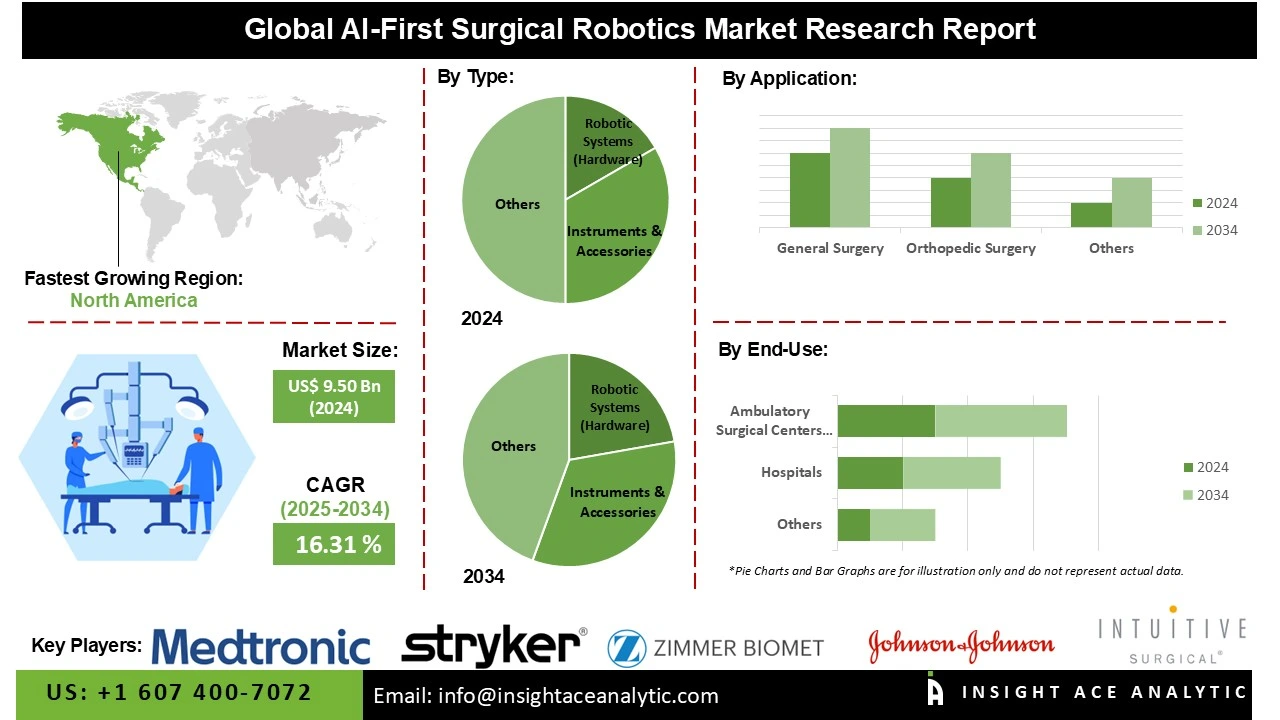
Global AI-First Surgical Robotics Market is valued at US$ 9.50 Bn in 2024 and it is expected to reach US$ 42.25 Bn by 2034, with a CAGR of 16.31% during the forecast period of 2025-2034.
The field of surgery is undergoing a paradigm shift with the advent of AI-first surgical robotics. This new class of medical technology moves beyond traditional robotic assistance, where instruments are merely extensions of a surgeon's hands. Instead, AI is embedded as the central nervous system of these platforms, creating an intelligent partner that provides cognitive support, enhances decision-making, and enables new levels of precision and safety. This evolution from a tool to a collaborator is poised to redefine standards of surgical care worldwide.
AI-first surgical robotics systems leverage continuous, multi-source data—from pre-operative scans and real-time imaging to intra-operative sensors and historical surgical outcomes. This data is processed by sophisticated algorithms to empower surgeons with dynamic guidance, predictive insights, and the ability to execute autonomous or semi-autonomous actions for specific, repetitive tasks. Core capabilities include predicting subsequent surgical steps, recommending optimal instrument trajectories, and issuing real-time alerts for potential hazards such as unexpected anatomical variations or bleeding. The result is a significant elevation in procedural accuracy, consistency, and ultimately, patient outcomes.
The convergence of several powerful drivers is fueling the rapid expansion of the global AI-first surgical robotics market. The increasing prevalence of chronic diseases demands more precise and efficient surgical interventions, while a strong clinical and patient-driven preference for minimally invasive procedures creates a natural synergy with robotic platforms. Furthermore, the proven value of AI in enhancing clinical decision-making is accelerating its integration into surgical workflows. This growth is actively amplified by strategic initiatives from leading medical technology companies, including targeted partnerships, mergers, and acquisitions, which are consolidating expertise and accelerating the development of next-generation intelligent systems, ensuring their continued adoption across the global healthcare landscape.
Competitive Landscape
Some of the Key Players in the AI-First Surgical Robotics Market:
- Medtronic plc
- Zimmer Biomet Holdings Inc.
- Intuitive Surgical Inc.
- Stryker Corporation
- Johnson & Johnson
- Siemens Healthineers AG
- Asensus Surgical Inc.
- Smith & Nephew plc
- Accuray Incorporated
- Renishaw plc
- Meerecompany Inc.
- Beijing Baihui Weikang Technology Co. Ltd.
- CMR Surgical Ltd.
- Moon Surgical SAS
- PROCEPT BioRobotics Corporation
- Robocath Inc.
- Globus Medical Inc.
- Venus Concept Inc.
- Curexo Inc.
- Surgical Automations Inc.
Market Segmentation:
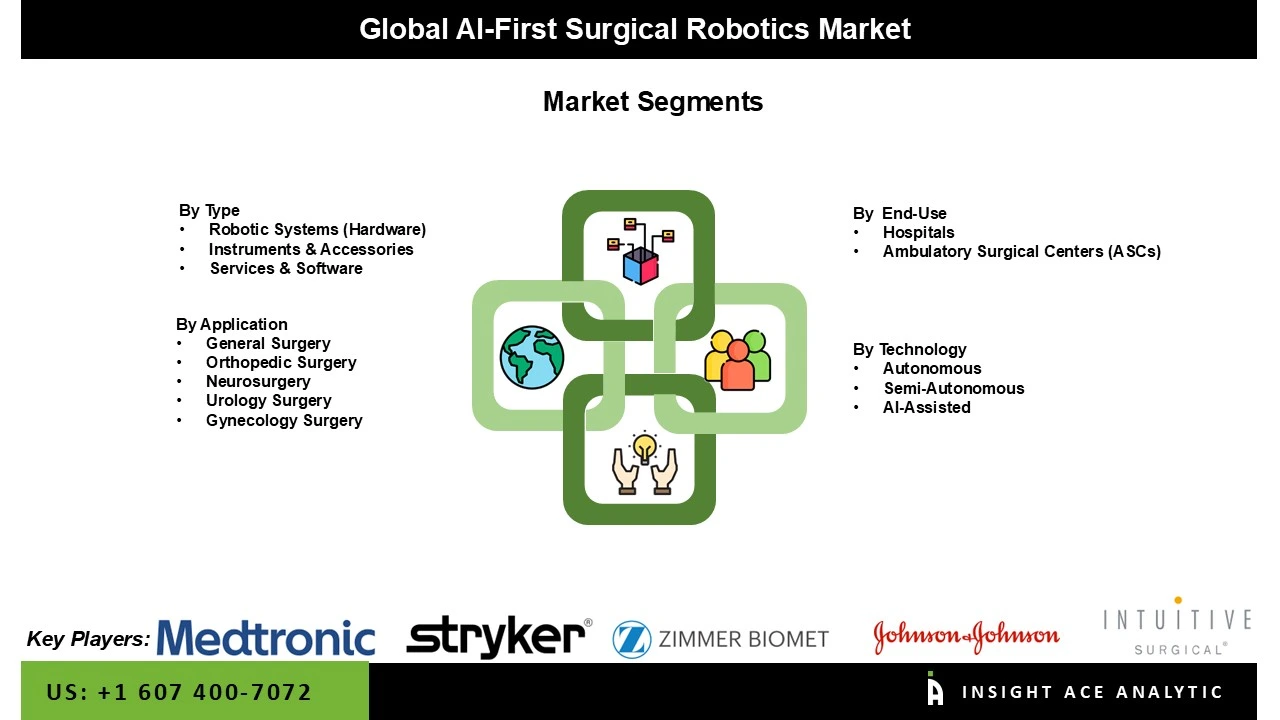
The AI-First Surgical Robotics market is segmented by Type, Technology, Application, and End-use. By Type, the market is segmented into Instruments & Accessories, Robotic Systems (Hardware), and Services & Software. By Technology, the market is segmented into AI-assisted, Autonomous, and Semi-Autonomous. By Application, the market is segmented into General Surgery, Neurosurgery, Orthopedic Surgery, Gynecology Surgery, and Urology Surgery. The End-use segment includes Hospitals, Ambulatory Surgical Centers (ASCs), and Others.
By Application, The General Surgery Segment Is Expected To Drive The AI-First Surgical Robotics Market
In 2024, the general surgery category held the highest share in the AI-first surgical robotics market. Globally, a significant number of surgical procedures are performed in the general surgery category. The need for effective, dependable surgical solutions, such as AI-first surgical robotics, is driven by the growing demand for these procedures, especially as the population ages and lifestyle-related conditions become more common. Additionally, general surgeons often need to focus for extended periods and exert significant physical effort. By helping with high-precision tasks, AI-first surgical robotics can lessen this strain and improve overall surgical results by lowering surgeon fatigue.
Hospitals Segment By End-Use Is Growing At The Highest Rate In The AI-First Surgical Robotics Market
The hospitals category has the largest share in the AI-first surgical robotics market in 2024 due to increasing demand for intricate surgical procedures. Hospitals that offer specialized surgical treatments, including cardiology, neurology, and cancer care, will particularly benefit from AI-first surgical robotics. These robots help with challenging surgeries that require high levels of accuracy and fast decision-making. Hospitals are seeking scalable, diverse surgical solutions that can be applied across many types of surgeries.
Regionally, North America Led The AI-First Surgical Robotics Market.
The AI-first surgical robotics market in North America had the largest revenue share in 2024. The market is rapidly growing due to the increasing utilization of advanced medical technologies and a well-established, cutting-edge healthcare infrastructure. Additionally, the increasing adoption of AI-first surgical robotics and minimally invasive surgical techniques will boost the region's market growth. The US regulatory framework supports the use of AI-first surgical technologies. Regulatory agencies like the FDA offer expedited procedures for approving medical devices, such as AI-first surgical robotics, to hasten their market release.
Over the forecast years, the Asia Pacific region is expected to grow at the fastest rate in the AI-first surgical robotics market. The rise in patients with chronic illnesses and the growing awareness of the need for minimally invasive, automated robotic medical devices are the main drivers of this expansion. Furthermore, with rising private sector investment and government-backed healthcare reforms, China, Japan, South Korea, and India are the top adopters in this region. The need for better surgical options is fueled by an expanding middle-class population and an increase in medical tourism. In general surgery, gynecology, and cancer care, hospitals are increasingly using robotic platforms.
Recent Developments:
- In Sept 2023: The Zimmer Biomet received FDA clearance for its Omni Suite, a digital platform that integrates with the ROSA® Robotics ecosystem. It uses AI to analyze intra-operative data from joint replacement surgeries to provide surgeons with real-time insights on soft tissue balance and procedural efficiency, aiming to standardize and improve outcomes.
AI-First Surgical Robotics Market Report Scope
| Report Attribute | Specifications |
| Market Size Value In 2024 | USD 9.50 Bn |
| Revenue Forecast In 2034 | USD 42.25 Bn |
| Growth Rate CAGR | CAGR of 16.31% from 2025 to 2034 |
| Quantitative Units | Representation of revenue in US$ Bn and CAGR from 2025 to 2034 |
| Historic Year | 2021 to 2024 |
| Forecast Year | 2025-2034 |
| Report Coverage | The forecast of revenue, the position of the company, the competitive market structure, growth prospects, and trends |
| Segments Covered | By Type, By Technology, By Application, By End-use, and By Region |
| Regional Scope | North America; Europe; Asia Pacific; Latin America; Middle East & Africa |
| Country Scope | U.S.; Canada; Germany; The UK; France; Italy; Spain; Rest of Europe; China; Japan; India; South Korea; Southeast Asia; Rest of Asia Pacific; Brazil; Argentina; Mexico; Rest of Latin America; GCC Countries; South Africa; Rest of the Middle East and Africa |
| Competitive Landscape | Medtronic plc, Zimmer Biomet Holdings Inc., Intuitive Surgical Inc., Stryker Corporation, Johnson & Johnson, Siemens Healthineers AG, Asensus Surgical Inc., Smith & Nephew plc, Accuray Incorporated, Renishaw plc, Meerecompany Inc., Beijing Baihui Weikang Technology Co. Ltd., CMR Surgical Ltd., Moon Surgical SAS, PROCEPT BioRobotics Corporation, Robocath Inc., Globus Medical Inc., Venus Concept Inc., Curexo Inc., and Surgical Automations Inc. |
| Customization Scope | Free customization report with the procurement of the report, Modifications to the regional and segment scope. Geographic competitive landscape. |
| Pricing and Available Payment Methods | Explore pricing alternatives that are customized to your particular study requirements. |
Segmentation of AI-First Surgical Robotics Market -
AI-First Surgical Robotics Market by Type-
· Instruments & Accessories
· Robotic Systems (Hardware)
· Services & Software
AI-First Surgical Robotics Market by Technology -
· AI-Assisted
· Autonomous
· Semi-Autonomous
AI-First Surgical Robotics Market by Application-
· General Surgery
· Neurosurgery
· Orthopedic Surgery
· Gynecology Surgery
· Urology Surgery
AI-First Surgical Robotics Market by End-use-
· Hospitals
· Ambulatory Surgical Centers (ASCs)
· Others
AI-First Surgical Robotics Market by Region-
North America-
· The US
· Canada
Europe-
· Germany
· The UK
· France
· Italy
· Spain
· Rest of Europe
Asia-Pacific-
· China
· Japan
· India
· South Korea
· Southeast Asia
· Rest of Asia Pacific
Latin America-
· Brazil
· Argentina
· Mexico
· Rest of Latin America
Middle East & Africa-
· GCC Countries
· South Africa
· Rest of the Middle East and Africa
Research Design and Approach
This study employed a multi-step, mixed-method research approach that integrates:
- Secondary research
- Primary research
- Data triangulation
- Hybrid top-down and bottom-up modelling
- Forecasting and scenario analysis
This approach ensures a balanced and validated understanding of both macro- and micro-level market factors influencing the market.
Secondary Research
Secondary research for this study involved the collection, review, and analysis of publicly available and paid data sources to build the initial fact base, understand historical market behaviour, identify data gaps, and refine the hypotheses for primary research.
Sources Consulted
Secondary data for the market study was gathered from multiple credible sources, including:
- Government databases, regulatory bodies, and public institutions
- International organizations (WHO, OECD, IMF, World Bank, etc.)
- Commercial and paid databases
- Industry associations, trade publications, and technical journals
- Company annual reports, investor presentations, press releases, and SEC filings
- Academic research papers, patents, and scientific literature
- Previous market research publications and syndicated reports
These sources were used to compile historical data, market volumes/prices, industry trends, technological developments, and competitive insights.

Primary Research
Primary research was conducted to validate secondary data, understand real-time market dynamics, capture price points and adoption trends, and verify the assumptions used in the market modelling.
Stakeholders Interviewed
Primary interviews for this study involved:
- Manufacturers and suppliers in the market value chain
- Distributors, channel partners, and integrators
- End-users / customers (e.g., hospitals, labs, enterprises, consumers, etc., depending on the market)
- Industry experts, technology specialists, consultants, and regulatory professionals
- Senior executives (CEOs, CTOs, VPs, Directors) and product managers
Interview Process
Interviews were conducted via:
- Structured and semi-structured questionnaires
- Telephonic and video interactions
- Email correspondences
- Expert consultation sessions
Primary insights were incorporated into demand modelling, pricing analysis, technology evaluation, and market share estimation.
Data Processing, Normalization, and Validation
All collected data were processed and normalized to ensure consistency and comparability across regions and time frames.
The data validation process included:
- Standardization of units (currency conversions, volume units, inflation adjustments)
- Cross-verification of data points across multiple secondary sources
- Normalization of inconsistent datasets
- Identification and resolution of data gaps
- Outlier detection and removal through algorithmic and manual checks
- Plausibility and coherence checks across segments and geographies
This ensured that the dataset used for modelling was clean, robust, and reliable.
Market Size Estimation and Data Triangulation
Bottom-Up Approach
The bottom-up approach involved aggregating segment-level data, such as:
- Company revenues
- Product-level sales
- Installed base/usage volumes
- Adoption and penetration rates
- Pricing analysis
This method was primarily used when detailed micro-level market data were available.

Top-Down Approach
The top-down approach used macro-level indicators:
- Parent market benchmarks
- Global/regional industry trends
- Economic indicators (GDP, demographics, spending patterns)
- Penetration and usage ratios
This approach was used for segments where granular data were limited or inconsistent.
Hybrid Triangulation Approach
To ensure accuracy, a triangulated hybrid model was used. This included:
- Reconciling top-down and bottom-up estimates
- Cross-checking revenues, volumes, and pricing assumptions
- Incorporating expert insights to validate segment splits and adoption rates
This multi-angle validation yielded the final market size.
Forecasting Framework and Scenario Modelling
Market forecasts were developed using a combination of time-series modelling, adoption curve analysis, and driver-based forecasting tools.
Forecasting Methods
- Time-series modelling
- S-curve and diffusion models (for emerging technologies)
- Driver-based forecasting (GDP, disposable income, adoption rates, regulatory changes)
- Price elasticity models
- Market maturity and lifecycle-based projections
Scenario Analysis
Given inherent uncertainties, three scenarios were constructed:
- Base-Case Scenario: Expected trajectory under current conditions
- Optimistic Scenario: High adoption, favourable regulation, strong economic tailwinds
- Conservative Scenario: Slow adoption, regulatory delays, economic constraints
Sensitivity testing was conducted on key variables, including pricing, demand elasticity, and regional adoption.
Request Customization
Add countries, segments, company profiles, or extend forecast — free 10% customization with purchase.
Customize This Report →Enquire Before Buying
Speak with our analyst team about scope, methodology, pricing, or deliverable formats.
Enquire Now →Frequently Asked Questions
Global AI-First Surgical Robotics Market is valued at US$ 9.50 Bn in 2024 and it is expected to reach US$ 42.25 Bn by 2034, with a CAGR of 16.31% during the forecast period of 2025-2034.
The major players in the AI-First Surgical Robotics market are Medtronic plc, Zimmer Biomet Holdings Inc., Intuitive Surgical Inc., Stryker Corporation, Johnson & Johnson, Siemens Healthineers AG, Asensus Surgical Inc., Smith & Nephew plc, Accuray Incorporated, Renishaw plc, Meerecompany Inc., Beijing Baihui Weikang Technology Co. Ltd., CMR Surgical Ltd., Moon Surgical SAS, PROCEPT BioRobotics Corporation, Robocath Inc., Globus Medical Inc., Venus Concept Inc., Curexo Inc., and Surgical Automations Inc.
The primary AI-First Surgical Robotics market segments are Type, Technology, Application, and End-use.
North America leads the market for AI-First Surgical Robotics due to the increasing utilization of advanced medical technologies and a well-established, cutting-edge healthcare infrastructure.