Ablative Skin Resurfacing Market Size, Share & Trends Analysis Distribution By Technology (CO₂ Laser and Er:YAG Laser), By Application (Acne Scar Removal, Wrinkle Removal, Surgical Scar Removal, and Skin Pigmentation Correction), By End-user (Hospitals, Dermatology Clinics, and Medical Spas), and Segment Forecasts, 2025-2034
Global Ablative Skin Resurfacing Market Size is predicted to grow at a 7.5% CAGR during the forecast period for 2025-2034.
In order to encourage the body's natural healing process and foster the development of new, smoother skin, ablative skin resurfacing is a cosmetic dermatological technique that removes the outer layers of damaged skin. Laser technologies like CO₂ (carbon dioxide) or Er:YAG (erbium) lasers, which accurately vaporize the skin's outer layers while simultaneously tightening the underlying tissue, are frequently used for this procedure. Deep wrinkles, scars (including acne scars), UV damage, uneven skin tone, and other cosmetic flaws can all be lessened with this treatment.
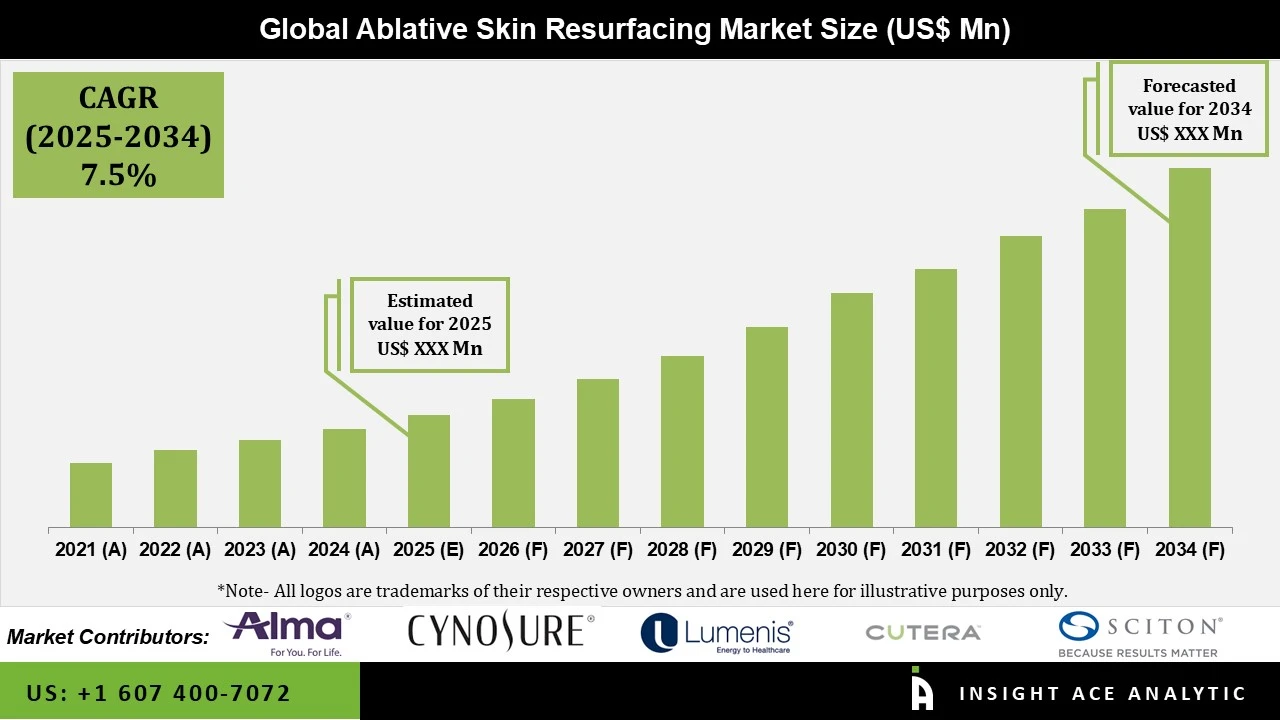
Ablative resurfacing produces more striking effects than non-ablative techniques because it targets deeper skin layers. The growing incidence of skin aging and dermatological problems that require efficient treatment choices is the main factor driving the growth dynamics of the ablative skin resurfacing market.
In addition, the ablative skin resurfacing market expansion is further supported by customers' increased aesthetic sensibility and rising disposable incomes. The growing demand for cutting-edge dermatological procedures targeted at wrinkle reduction, scar removal, and skin rejuvenation is propelling the global market for ablative skin resurfacing. Further driving market expansion are technical developments and growing public awareness of minimally invasive cosmetic procedures. The ablative skin resurfacing market's strong trajectory is supported by the convergence of cutting-edge laser technology and rising aesthetic sensitivity among consumers globally. Moreover, innovative product introductions that support the ablative skin resurfacing market's growth potential are also being fostered by strategic expenditures in research and development.
However, the high cost of the operations, dangers and side effects, limited reimbursement coverage for the procedures, and lack of knowledge about skin resurfacing are some of the primary challenges holding back the ablative skin resurfacing market. Additionally, since strict safety and efficacy requirements must be fulfilled, regulatory obstacles may affect the adoption of innovative technology and practices. For startups and small firms looking to innovate in this field, navigating the regulatory framework can be especially difficult. On the other hand, during the course of the projection period, the ablative skin resurfacing market is expected to develop due to the widespread availability of accurate, energy-efficient ablative laser systems, which will offer safer and quicker recovery choices.
Competitive Landscape
Which are the Leading Players in Ablative Skin Resurfacing Market?
- Lumenis
- Cutera
- Alma Lasers
- Cynosure
- Sciton
- Fotona
- Solta Medical
- Lutronic Corporation
- Candela Corporation
- DEKA M.E.L.A.
- Others
Market Dynamics
Driver
Growing Awareness for Skin Care
There has been a noticeable movement toward proactive skincare and cosmetic treatments as people become more aware of the significance of maintaining good skin. Increased awareness of skin protection and rejuvenation has resulted from awareness campaigns, social media influence, and instructional content about the detrimental effects of environmental variables like UV radiation, pollution, and lifestyle choices. As more people become aware of the long-term consequences of ignoring skin health, more people are looking for ways to prevent skin damage and deal with pre-existing issues like wrinkles, pigmentation, and acne scars. Additionally, people are more likely to spend money on professional skin treatments, such as resurfacing procedures, to enhance the health and appearance of their skin due to the increased emphasis on self-care. As a result, there is a greater need for ablative skin resurfacing procedures, especially among those who are increasingly aware of the dangers of neglecting their skin's demands and are searching for practical solutions.
Restrain/Challenge
High Cost Associated with the Treatment
A major obstacle for both patients and clinicians is the high initial cost of sophisticated ablative skin resurfacing tools and techniques. Modern laser systems and energy-based equipment can be difficult for smaller clinics and practitioners to get because of their high capital costs. The operational costs are further raised by the cost of maintenance, consumables, and operator training. Many patients consider ablative skin resurfacing to be a cosmetic or elective procedure, which results in restricted insurance coverage and the need for out-of-pocket expenses. In price-conscious markets, this cost sensitivity limits procedure volumes. For the ablative skin resurfacing market to continue expanding widely, affordability issues must be resolved.
CO₂ Laser Segment is Expected to Drive the Ablative Skin Resurfacing Market
The CO₂ laser segment held the largest share in the ablative skin resurfacing market in 2024 because of its significant clinical efficacy in treating photoaging, wrinkles, acne scars, and dyschromia, which is why dermatologists and patients are in high demand. While maintaining the superior collagen-remodeling benefits of classic ablative systems, innovations like fractional CO₂ technologies have drastically decreased downtime and side effects, increasing therapy acceptability for a larger patient group. Additionally, the dermatology clinics and medical spas are seeing an increase in procedure volumes due to rising aesthetic consciousness, rising disposable incomes, and the popularity of less invasive cosmetic operations.
Wrinkle Removal Segment is Growing at the Highest Rate in the Ablative Skin Resurfacing Market
In 2024, the wrinkle removal segment dominated the ablative skin resurfacing market, since wrinkles are among the most prevalent and obvious indications of aging and are a major concern for many patients seeking ablative skin resurfacing treatments. The normal aging process, which involves a decrease in the production of collagen and elastin, is usually the cause of these skin flaws. While elastin enables the skin to regain its previous shape after stretching, collagen gives the skin strength and structure. Over time, the breakdown of these proteins causes the skin to become less firm and more prone to wrinkles and sagging. Due to the large number of people looking for remedies for these obvious indications of aging, the demand for ablative skin resurfacing procedures that target wrinkles and fine lines has increased dramatically.
Why North America Led the Ablative Skin Resurfacing Market?
The ablative skin resurfacing market was dominated by the North America region in 2024, driven by an aging population looking for efficient anti-aging therapies, greater awareness of cosmetic dermatology, and an increasing demand for sophisticated aesthetic procedures. Strong adoption of laser-based technology, high disposable income, and the existence of reputable dermatology clinics and medical spas all contribute to market growth.
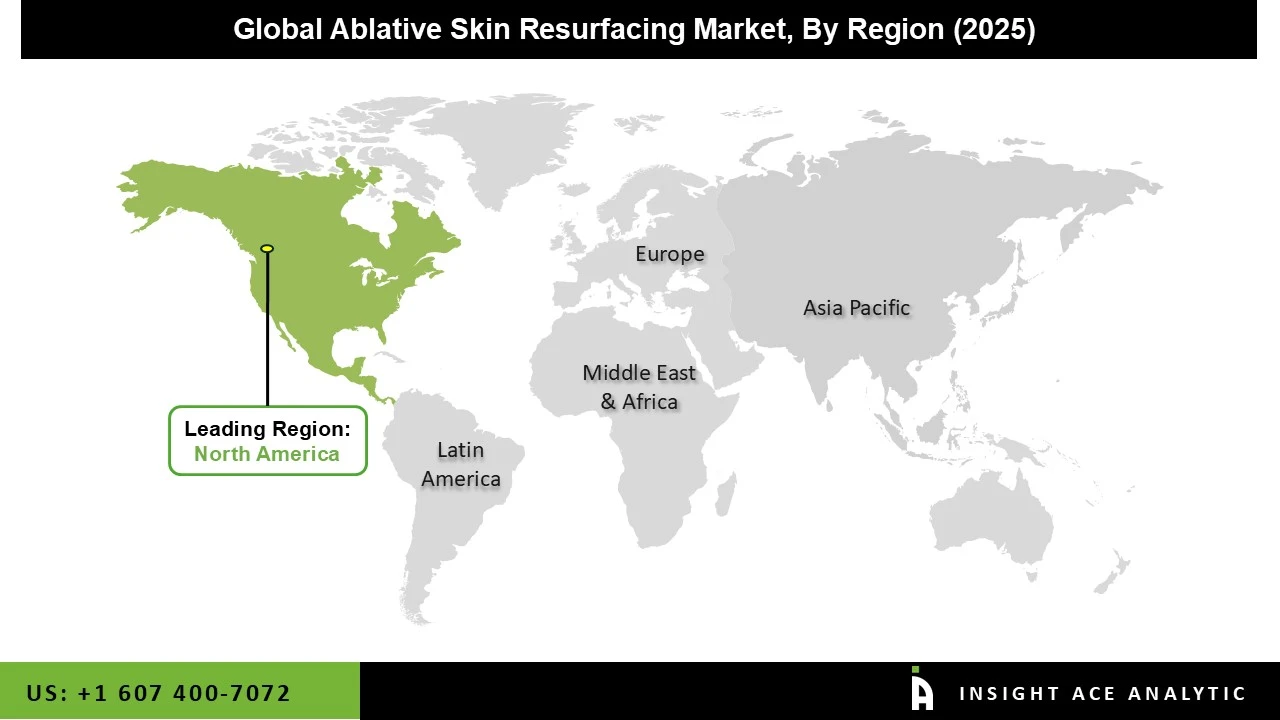
Furthermore, ongoing technological developments in CO2 and Er:YAG laser systems, which provide enhanced safety, accuracy, and quicker recovery periods, are increasing procedural volumes in the United States and Canada. The sustained market growth is also greatly aided by the impact of social media, local medical tourism, and growing indications for pigmentation treatment and scar revision.
Key Development
November 2023: Venus Versa Pro was introduced in the United States by Venus Concept Inc., a leader in medical aesthetic technology worldwide. Ten applicators can be used with this unique multi-application platform to address wrinkles, pigmentation, acne, and skin texture. It improves coagulation and ablation for better skin resurfacing, building on the Venus VivaMD system. Additionally, the gadget offers the renowned TriBella therapy, which combines NanoFractional RF and (MP)² IPL technologies for complete skin rejuvenation.
February 2023: In the United States, Biolase Inc. launched the Waterlase Fractional Handpiece. Physicians can modify penetration depth using various settings and approaches using this device, which offers both ablative and non-ablative fractional therapies. It increases the effectiveness of treatment by creating a uniform, one-dimensional micro-perforation pattern on tissue surfaces.
Segmentation of Ablative Skin Resurfacing Market :
Ablative Skin Resurfacing Market by Technology-
- CO₂ Laser
- Er:YAG Laser
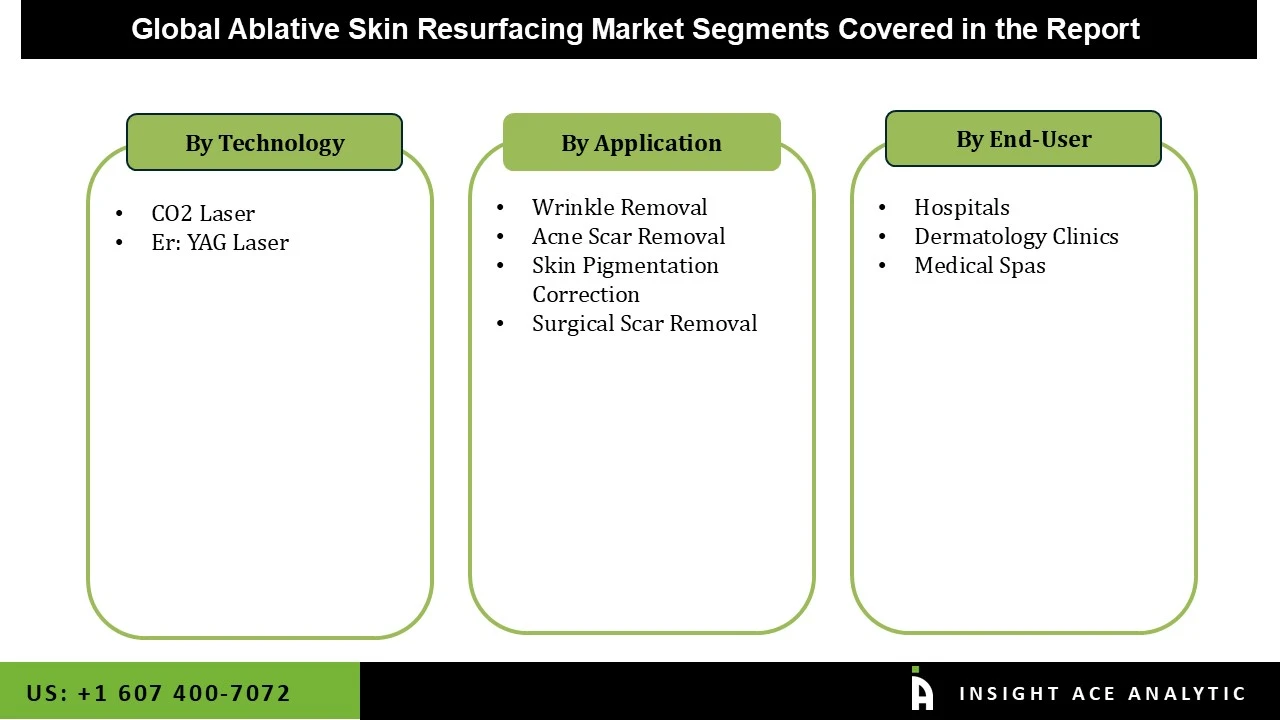
Ablative Skin Resurfacing Market by Application
- Acne Scar Removal
- Wrinkle Removal
- Surgical Scar Removal
- Skin Pigmentation Correction
Ablative Skin Resurfacing Market by End-user
- Hospitals
- Dermatology Clinics
- Medical Spas
Ablative Skin Resurfacing Market- By Region
- North America-
- The US
- Canada
- Europe-
- Germany
- The UK
- France
- Italy
- Spain
- Rest of Europe
- Asia-Pacific-
- China
- Japan
- India
- South Korea
- South East Asia
- Rest of Asia Pacific
- Latin America-
- Brazil
- Argentina
- Mexico
- Rest of Latin America
- Middle East & Africa-
- GCC Countries
- South Africa
- Rest of Middle East and Africa
Research Design and Approach
This study employed a multi-step, mixed-method research approach that integrates:
- Secondary research
- Primary research
- Data triangulation
- Hybrid top-down and bottom-up modelling
- Forecasting and scenario analysis
This approach ensures a balanced and validated understanding of both macro- and micro-level market factors influencing the market.
Secondary Research
Secondary research for this study involved the collection, review, and analysis of publicly available and paid data sources to build the initial fact base, understand historical market behaviour, identify data gaps, and refine the hypotheses for primary research.
Sources Consulted
Secondary data for the market study was gathered from multiple credible sources, including:
- Government databases, regulatory bodies, and public institutions
- International organizations (WHO, OECD, IMF, World Bank, etc.)
- Commercial and paid databases
- Industry associations, trade publications, and technical journals
- Company annual reports, investor presentations, press releases, and SEC filings
- Academic research papers, patents, and scientific literature
- Previous market research publications and syndicated reports
These sources were used to compile historical data, market volumes/prices, industry trends, technological developments, and competitive insights.

Primary Research
Primary research was conducted to validate secondary data, understand real-time market dynamics, capture price points and adoption trends, and verify the assumptions used in the market modelling.
Stakeholders Interviewed
Primary interviews for this study involved:
- Manufacturers and suppliers in the market value chain
- Distributors, channel partners, and integrators
- End-users / customers (e.g., hospitals, labs, enterprises, consumers, etc., depending on the market)
- Industry experts, technology specialists, consultants, and regulatory professionals
- Senior executives (CEOs, CTOs, VPs, Directors) and product managers
Interview Process
Interviews were conducted via:
- Structured and semi-structured questionnaires
- Telephonic and video interactions
- Email correspondences
- Expert consultation sessions
Primary insights were incorporated into demand modelling, pricing analysis, technology evaluation, and market share estimation.
Data Processing, Normalization, and Validation
All collected data were processed and normalized to ensure consistency and comparability across regions and time frames.
The data validation process included:
- Standardization of units (currency conversions, volume units, inflation adjustments)
- Cross-verification of data points across multiple secondary sources
- Normalization of inconsistent datasets
- Identification and resolution of data gaps
- Outlier detection and removal through algorithmic and manual checks
- Plausibility and coherence checks across segments and geographies
This ensured that the dataset used for modelling was clean, robust, and reliable.
Market Size Estimation and Data Triangulation
Bottom-Up Approach
The bottom-up approach involved aggregating segment-level data, such as:
- Company revenues
- Product-level sales
- Installed base/usage volumes
- Adoption and penetration rates
- Pricing analysis
This method was primarily used when detailed micro-level market data were available.

Top-Down Approach
The top-down approach used macro-level indicators:
- Parent market benchmarks
- Global/regional industry trends
- Economic indicators (GDP, demographics, spending patterns)
- Penetration and usage ratios
This approach was used for segments where granular data were limited or inconsistent.
Hybrid Triangulation Approach
To ensure accuracy, a triangulated hybrid model was used. This included:
- Reconciling top-down and bottom-up estimates
- Cross-checking revenues, volumes, and pricing assumptions
- Incorporating expert insights to validate segment splits and adoption rates
This multi-angle validation yielded the final market size.
Forecasting Framework and Scenario Modelling
Market forecasts were developed using a combination of time-series modelling, adoption curve analysis, and driver-based forecasting tools.
Forecasting Methods
- Time-series modelling
- S-curve and diffusion models (for emerging technologies)
- Driver-based forecasting (GDP, disposable income, adoption rates, regulatory changes)
- Price elasticity models
- Market maturity and lifecycle-based projections
Scenario Analysis
Given inherent uncertainties, three scenarios were constructed:
- Base-Case Scenario: Expected trajectory under current conditions
- Optimistic Scenario: High adoption, favourable regulation, strong economic tailwinds
- Conservative Scenario: Slow adoption, regulatory delays, economic constraints
Sensitivity testing was conducted on key variables, including pricing, demand elasticity, and regional adoption.
Request Customization
Add countries, segments, company profiles, or extend forecast — free 10% customization with purchase.
Customize This Report →Enquire Before Buying
Speak with our analyst team about scope, methodology, pricing, or deliverable formats.
Enquire Now →Frequently Asked Questions
Ablative Skin Resurfacing Market Size is predicted to grow at a 7.5% CAGR during the forecast period for 2025-2034.
Lumenis, Cutera, Alma Lasers, Cynosure, Sciton, Fotona, Solta Medical, Lutronic Corporation, Candela Corporation, and DEKA M.E.L.A.
Technology, Application, End-user, and Region are the key segments of the Ablative Skin Resurfacing Market.
North America region is leading the Ablative Skin Resurfacing Market.