Whiskey Tourism Market Size and Revenue Impact Study 2026 to 2035
What is Whiskey Tourism Market Size?
Whiskey Tourism Market Size is valued at USD 21.5 billion in 2025 and is predicted to reach USD 62.57 billion by the year 2035 at a 11.8% CAGR during the forecast period for 2026 to 2035.
Whiskey Tourism Market Size, Share & Trends Analysis Report By Experience Type (Distillery Tours/ Tasting Experiences, Whiskey Festival, Others), By Whiskey Type (Single Malt Whiskey, Blended Whiskey, Bourbon, Craft Whiskey, Others), By Region, And By Segment Forecasts, 2026 to 2035
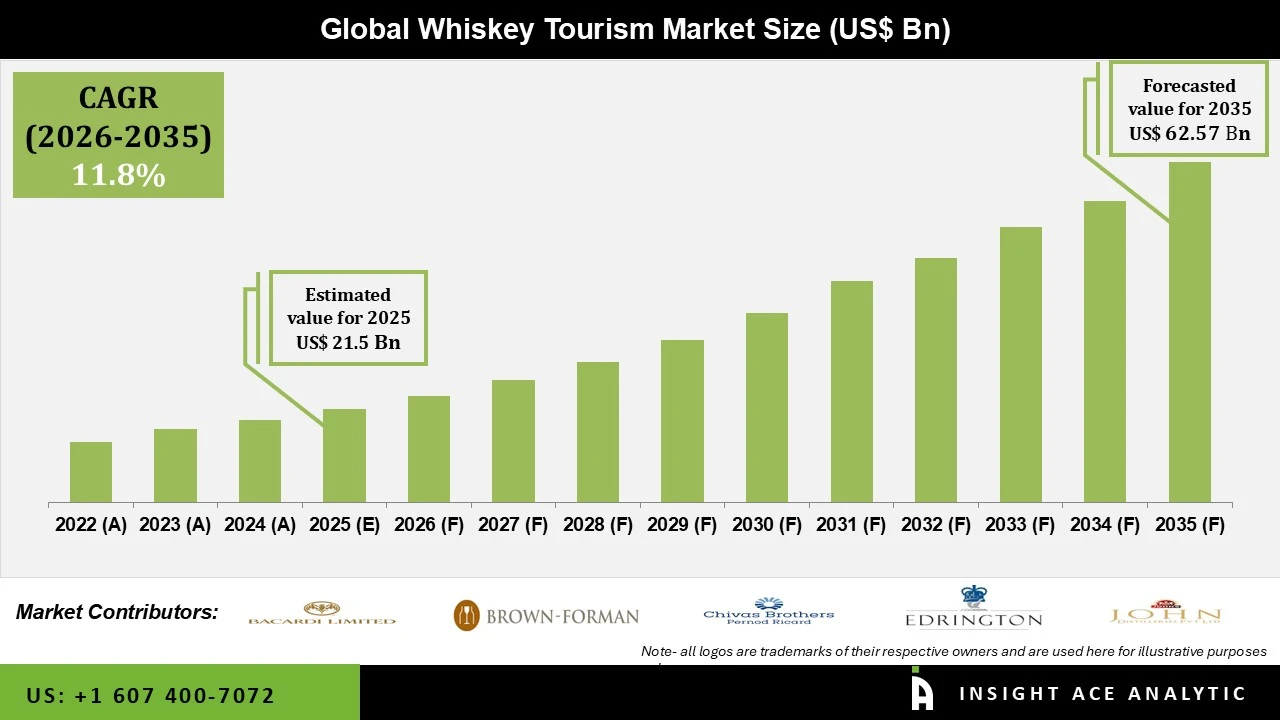
Whiskey Tourism Market Key Takeaways:
|
Whiskey tourism entails visiting whiskey-producing areas to tour distilleries, get knowledge about the production process, and partake in tastings. Notable destinations encompass Scotland, Ireland, the United States, and Japan, where travelers engage with whiskey trails and delve into local culture and history.
The rising number of consumers viewing whiskey as a measure of wealth and their preference for high-end liquor are the main factors driving the whiskey industry. Greater financial freedom due to industrialization and the development of the upper social class has led to greater expenditure on expensive beings, which in turn is driving up the need for whiskey. In addition, the whiskey sector is significantly influenced by the booming travel and tourism sector. Travellers and frequent travellers alike seek out genuine and high-quality ethnic drinks to imbibe, which boosts sales. Drinking events, occasions, and social gatherings piqued customer interest, which is fueling the market's expansion. Expenditures also aid the expansion of the whiskey market in distinctive containers and advertising strategies.
However, the biggest element limiting the whiskey industry's growth is the prolonged maturation process. Whiskey containers require lengthy storage and upkeep, which requires breweries to commit funds and resources with no guarantee of recovery. Alcohol distilleries may also find it difficult to precisely project market demands due to shifts in consumer choices and variations in supply. Alcohol distilleries manage the risk of either excessive or underproduction of old whiskey as a consequence, which could result in diminished profits or insufficient stock. Furthermore, external elements like temperature and moisture might have an impact on the standard of the end item during ageing.
Competitive Landscape
Some Major Key Players In The Whiskey Tourism Market:
- Bacardi Limited
- Brown-Forman Corporation
- Chivas Brothers Limited
- Diageo Plc
- Edrington Group
- Heaven Hill Distilleries, Inc.
- John Distilleries Pvt Ltd
- LVMH
- Pernod Ricard S.A.
- Speyside Distillers Ltd,
- Suntory Global Spirits, Inc.
- The Bunnahabhain distillery
- The Edrington Group Limited
- William Grant & Sons Ltd
- Other Market Players
Market Segmentation:
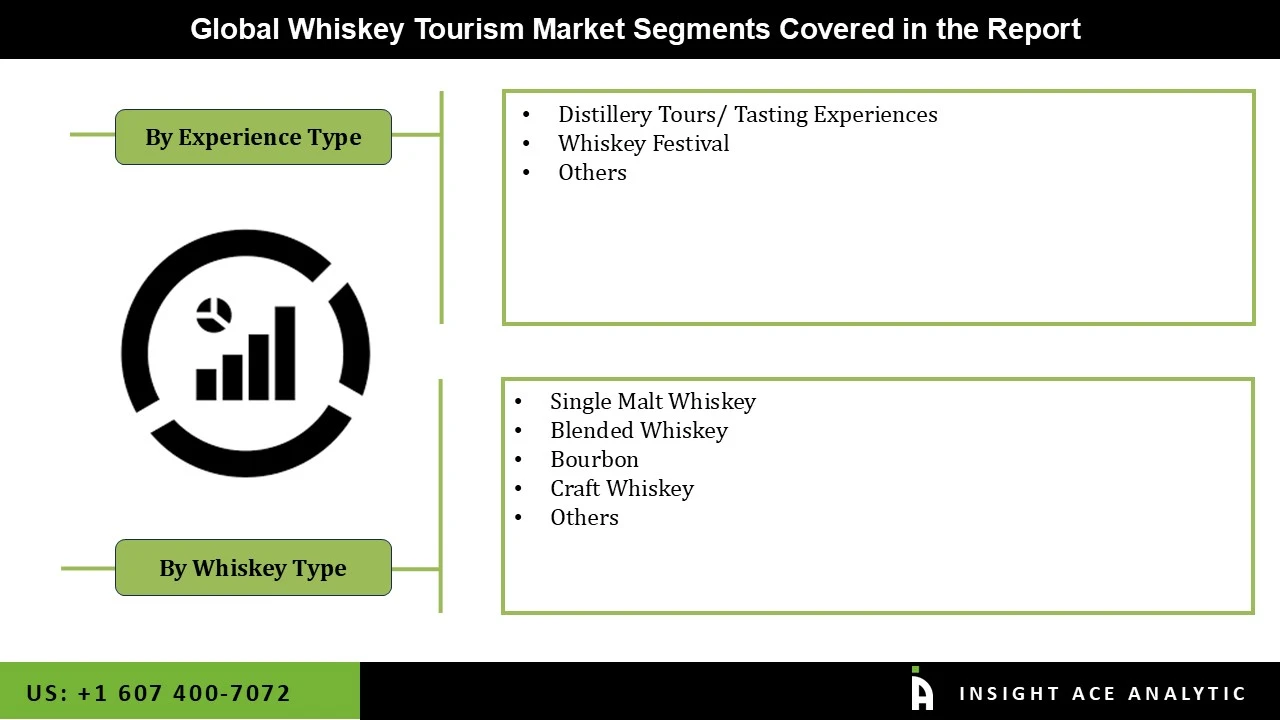
The whiskey tourism market is segmented based on experience type and whiskey type. Based on experience type, the market is segmented into distillery tours/ tasting experiences, whiskey festivals, and others. By whiskey type, the market is segmented into single malt whiskey, blended whiskey, bourbon, craft whiskey, and others.
Based On The Experience Type, The Whisky Festivals Whiskey Tourism Market Segment Is Accounted As A Major Contributor To The Whiskey Tourism Market
The whisky festivals' whiskey tourism market will hold a major global market share. Whisky festivals are becoming increasingly popular, progressing from small-scale communal events to significant global audiences. Whisky festivals are expected to develop further because they provide distinctive, deep experiences that reflect the extensive culture and tradition of the liquor. This rise is indicative of the sector's ability to engage with enthusiasts throughout nations.
Single Malt Whisky Segment To Witness Growth At A Rapid Rate
The single malt whisky industry is the dominating category. A fully immersive event that showcases the tradition and creativity in single malt whisky manufacturing, the tour offers travellers the chance to discover Glenfiddich's historic storage facility, understand the history of barrel development, and taste the whisky's extraordinary level of sweetness.
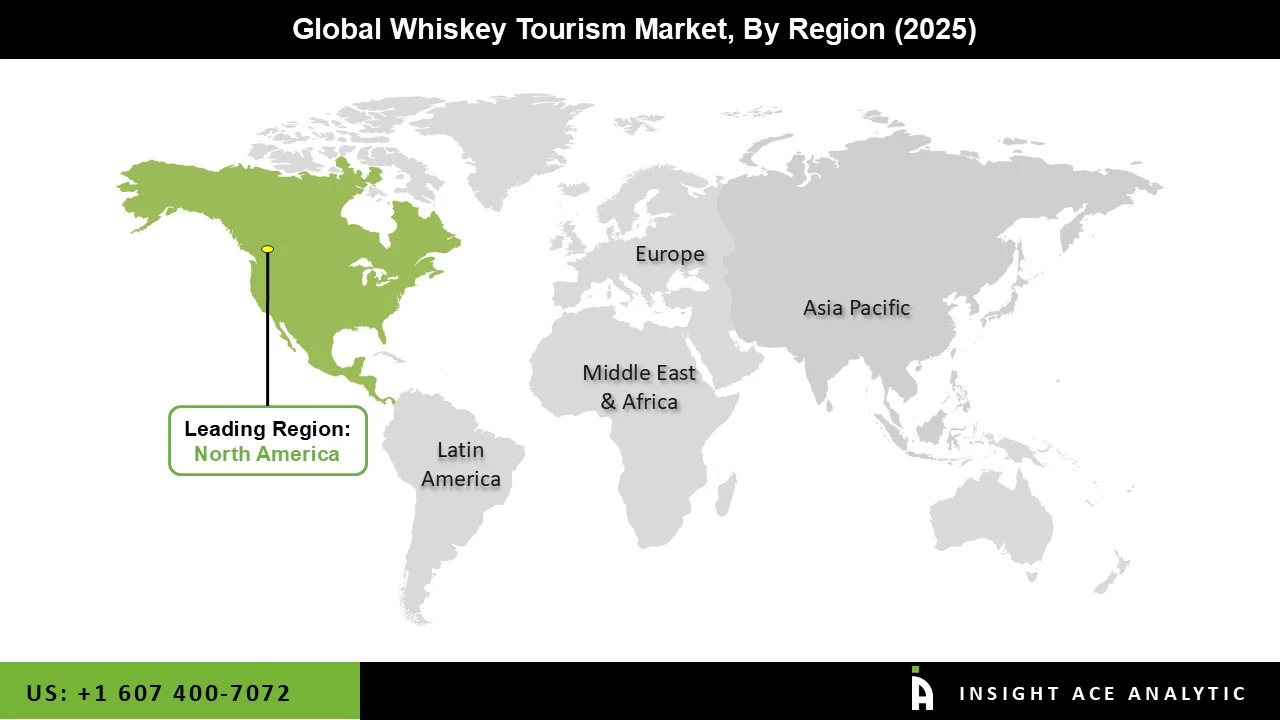
In The Region, The North American Whiskey Tourism Market Holds A Significant Revenue Share.
The North American whiskey tourism market is expected to note the highest market share in revenue in the near future. This can be attributed to the area's food and beverage sector's sharply growing need for whiskey and the increasingly evolving living in this area. Furthermore, the distillery began producing whiskey because of a deadline for permission from government regulators. Big distilleries will thus become much more prevalent in the area. In addition, Europe is likely to grow rapidly in the global whiskey tourism industry because of the area's growing nightclub and eating establishment scene as well as the population's sharply expanding average disposable income. Furthermore, it is anticipated that the expanding impact of occidental societies on this region's youth will expand the global market.
Recent Developments:
- In Aug 2024, Chivas Brothers, the Pernod Ricard division focused on Scotch whisky and producers of Chivas Regal and Ballantine’s, in collaboration with its wheat supplier, Simpsons Malt Ltd., has invested in low-carbon fertilizer developed by OCI Global, a major fertilizer enterprise. The trial represented a significant advancement in Chivas Brothers' objective to establish a sustainable future for whisky and mitigate its indirect carbon footprint.
- In March 2024, Bacardi announced Move the Future in five Italian regions. Despite Venice, Rome, Florence, and Naples, the event will be hosted in Genoa as its inaugural perpetually, offering forty youngsters a unique chance to begin a profession in cocktails.
Whiskey Tourism Market Report Scope
| Report Attribute | Specifications |
| Market Size Value In 2025 | USD 21.5 Bn |
| Revenue Forecast In 2035 | USD 62.57 Bn |
| Growth Rate CAGR | CAGR of 11.8% from 2026 to 2035 |
| Quantitative Units | Representation of revenue in US$ Bn and CAGR from 2026 to 2035 |
| Historic Year | 2022 to 2025 |
| Forecast Year | 2026-2035 |
| Report Coverage | The forecast of revenue, the position of the company, the competitive market structure, growth prospects, and trends |
| Segments Covered | By Experience Type, Whiskey Type |
| Regional Scope | North America; Europe; Asia Pacific; Latin America; Middle East & Africa |
| Country Scope | U.S.; Canada; U.K.; Germany; China; India; Japan; Brazil; Mexico; France; Italy; Spain; South East Asia; South Korea |
| Competitive Landscape | Diageo, Pernod Ricard, William Grant & Sons Ltd, Brown-Forman Corporation, Suntory Global Spirits, Inc, Bacardi Limited, Edrington Group, Heaven Hill Brands, Chivas Brothers Ltd, and LVMH. |
| Customization Scope | Free customization report with the procurement of the report and modifications to the regional and segment scope. Particular Geographic competitive landscape. |
| Pricing And Available Payment Methods | Explore pricing alternatives that are customized to your particular study requirements. |
Segmentation of Whiskey Tourism Market-
Whiskey Tourism Market By Experience Type-
- Distillery Tours/ Tasting Experiences
- Whiskey Festival
- Others
Whiskey Tourism Market By Whiskey Type-
- Single Malt Whiskey
- Blended Whiskey
- Bourbon
- Craft Whiskey
- Others
Whiskey Tourism Market By Region-
North America-
- The US
- Canada
- Mexico
Europe-
- Germany
- The UK
- France
- Italy
- Spain
- Rest of Europe
Asia-Pacific-
- China
- Japan
- India
- South Korea
- South East Asia
- Rest of Asia Pacific
Latin America-
- Brazil
- Argentina
- Rest of Latin America
Middle East & Africa-
- GCC Countries
- South Africa
- Rest of the Middle East and Africa
Research Design and Approach
This study employed a multi-step, mixed-method research approach that integrates:
- Secondary research
- Primary research
- Data triangulation
- Hybrid top-down and bottom-up modelling
- Forecasting and scenario analysis
This approach ensures a balanced and validated understanding of both macro- and micro-level market factors influencing the market.
Secondary Research
Secondary research for this study involved the collection, review, and analysis of publicly available and paid data sources to build the initial fact base, understand historical market behaviour, identify data gaps, and refine the hypotheses for primary research.
Sources Consulted
Secondary data for the market study was gathered from multiple credible sources, including:
- Government databases, regulatory bodies, and public institutions
- International organizations (WHO, OECD, IMF, World Bank, etc.)
- Commercial and paid databases
- Industry associations, trade publications, and technical journals
- Company annual reports, investor presentations, press releases, and SEC filings
- Academic research papers, patents, and scientific literature
- Previous market research publications and syndicated reports
These sources were used to compile historical data, market volumes/prices, industry trends, technological developments, and competitive insights.

Primary Research
Primary research was conducted to validate secondary data, understand real-time market dynamics, capture price points and adoption trends, and verify the assumptions used in the market modelling.
Stakeholders Interviewed
Primary interviews for this study involved:
- Manufacturers and suppliers in the market value chain
- Distributors, channel partners, and integrators
- End-users / customers (e.g., hospitals, labs, enterprises, consumers, etc., depending on the market)
- Industry experts, technology specialists, consultants, and regulatory professionals
- Senior executives (CEOs, CTOs, VPs, Directors) and product managers
Interview Process
Interviews were conducted via:
- Structured and semi-structured questionnaires
- Telephonic and video interactions
- Email correspondences
- Expert consultation sessions
Primary insights were incorporated into demand modelling, pricing analysis, technology evaluation, and market share estimation.
Data Processing, Normalization, and Validation
All collected data were processed and normalized to ensure consistency and comparability across regions and time frames.
The data validation process included:
- Standardization of units (currency conversions, volume units, inflation adjustments)
- Cross-verification of data points across multiple secondary sources
- Normalization of inconsistent datasets
- Identification and resolution of data gaps
- Outlier detection and removal through algorithmic and manual checks
- Plausibility and coherence checks across segments and geographies
This ensured that the dataset used for modelling was clean, robust, and reliable.
Market Size Estimation and Data Triangulation
Bottom-Up Approach
The bottom-up approach involved aggregating segment-level data, such as:
- Company revenues
- Product-level sales
- Installed base/usage volumes
- Adoption and penetration rates
- Pricing analysis
This method was primarily used when detailed micro-level market data were available.

Top-Down Approach
The top-down approach used macro-level indicators:
- Parent market benchmarks
- Global/regional industry trends
- Economic indicators (GDP, demographics, spending patterns)
- Penetration and usage ratios
This approach was used for segments where granular data were limited or inconsistent.
Hybrid Triangulation Approach
To ensure accuracy, a triangulated hybrid model was used. This included:
- Reconciling top-down and bottom-up estimates
- Cross-checking revenues, volumes, and pricing assumptions
- Incorporating expert insights to validate segment splits and adoption rates
This multi-angle validation yielded the final market size.
Forecasting Framework and Scenario Modelling
Market forecasts were developed using a combination of time-series modelling, adoption curve analysis, and driver-based forecasting tools.
Forecasting Methods
- Time-series modelling
- S-curve and diffusion models (for emerging technologies)
- Driver-based forecasting (GDP, disposable income, adoption rates, regulatory changes)
- Price elasticity models
- Market maturity and lifecycle-based projections
Scenario Analysis
Given inherent uncertainties, three scenarios were constructed:
- Base-Case Scenario: Expected trajectory under current conditions
- Optimistic Scenario: High adoption, favourable regulation, strong economic tailwinds
- Conservative Scenario: Slow adoption, regulatory delays, economic constraints
Sensitivity testing was conducted on key variables, including pricing, demand elasticity, and regional adoption.
Request Customization
Add countries, segments, company profiles, or extend forecast — free 10% customization with purchase.
Customize This Report →Enquire Before Buying
Speak with our analyst team about scope, methodology, pricing, or deliverable formats.
Enquire Now →Frequently Asked Questions
Whiskey Tourism Market Size is valued at USD 21.5 billion in 2025 and is predicted to reach USD 62.57 billion by the year 2035
Whiskey Tourism Market is expected to grow at a 11.8% CAGR during the forecast period for 2026 to 2035.
Diageo, Pernod Ricard, William Grant & Sons Ltd, Brown-Forman Corporation, Suntory Global Spirits, Inc, Bacardi Limited, Edrington Group, Heaven Hill