



Global Sustainable Data Center Market Size is valued at USD 85.1 Bn in 2024 and is predicted to reach USD 440.7 Bn by the year 2034 at a 18.0% CAGR during the forecast period for 2025-2034.
Sustainable data centers aim to reduce environmental impact through energy efficiency, renewable energy use, and innovative cooling technologies. They utilize green building practices, deploy energy-efficient equipment, and often rely on solar, wind, or hydro power to minimize carbon emissions. Advanced technologies like AI optimize energy consumption, enhancing their sustainability.

With the growing volume of data being generated, businesses are looking for energy-efficient and carbon-conscious solutions. To lessen their environmental impact, sustainable data centers use renewable energy, optimize cooling systems, and install energy-efficient equipment. Government policies and activities promote the adoption of sustainable practices. Sustainable data centers are now more efficient and cost-effective because to technological developments in cooling systems, power management, and renewable energy integration. However, problems include high initial prices, complications in integrating renewable energy, and a scarcity of experienced specialists. Despite these limitations, the market continues to expand as businesses aim for sustainability.
The Sustainable Data Center Market is segmented on the basis of Component, data centre size, and vertical. The component segment is divided into Solutions (Power, IT, Cooling) and Services (Design and Consulting, Maintenance and Support, Installation and Deployment)). According to data centre size, the market is segmented into small, mid-sized, and large. As per the Vertical segment, the market is categorised into BFSI, IT and Telecom, Media and Entertainment, Healthcare, Government and Defense, Retail, Manufacturing and Others (energy, research and academia, and transportation and logistics))
Media and entertainment companies produce massive amounts of high-resolution content. These massive amounts of unstructured data must be managed in a way that can be scaled up and accessed across the media chain. Thus, they consume a lot of computation storage and power-intensive services. Due to the unexpected growth of OTT platforms like, energy-efficient data centers are essential to providing their clients. The performance of content delivery solutions' infrastructure is crucial. Media firms are using green data centre solutions to make their content internationally available via PCs, tablets, and laptops.
Large data centers have high-density server racks and are over 25,000 square feet. They install ceiling services better and streamline factory floor operations. This sort of large data center uses more electricity than mid-size and corporate data centers. Due to growing data center infrastructure and complex networking, server, storage, and other equipment, green data center solutions and services are needed. massive companies with many cloud computing systems utilize massive data centers. The worldwide green data center market is likely to grow as large organizations use massive data centers.
North America had the highest market share in 2023. Regional expansion can be ascribed to the emergence of energy efficiency standards, regulatory requirements, and a desire to support sustainability efforts. Rising green approaches across a variety of firms in the region, as a result of increased environmental consciousness, also contribute to growth. Asia Pacific is estimated to experience the quickest CAGR of 22.2% throughout the forecast period. Rapid economic development, increased data traffic, environmental concerns, and growing support for international sustainability programs all contribute to the Asia Pacific regional market's expansion.
| Report Attribute | Specifications |
| Market Size Value In 2024 | USD 85.1 Bn |
| Revenue Forecast In 2034 | USD 440.7 Bn |
| Growth Rate CAGR | CAGR of 18.0% from 2025 to 2034 |
| Quantitative Units | Representation of revenue in US$ Bn and CAGR from 2025 to 2034 |
| Historic Year | 2021 to 2024 |
| Forecast Year | 2025-2034 |
| Report Coverage | The forecast of revenue, the position of the company, the competitive market structure, growth prospects, and trends |
| Segments Covered | By Component, data center size, and vertical. |
| Regional Scope | North America; Europe; Asia Pacific; Latin America; Middle East & Africa |
| Country Scope | U.S.; Canada; U.K.; Germany; China; India; Japan; Brazil; Mexico; France; Italy; Spain; South East Asia; South Korea |
| Competitive Landscape | Equinix, Delta Electronics, Rittal, Eaton, Cisco, Nortek Air Solutions, Dell Technologies, AsetekSchneider Electric, Vertiv, Hewlett Packard Enterprise, Green Revolution Cooling, Midas Green Technologies, Airedale,Lenovo, Fujitsu, Cyber Power Systems, Super Micro, Tripp Lite, Inspur, Microsoft, AWS, Google, Apple, Meta, and others |
| Customization Scope | Free customization report with the procurement of the report and modifications to the regional and segment scope. Particular Geographic competitive landscape. |
| Pricing And Available Payment Methods | Explore pricing alternatives that are customized to your particular study requirements. |
Sustainable Data Center Market By Components-
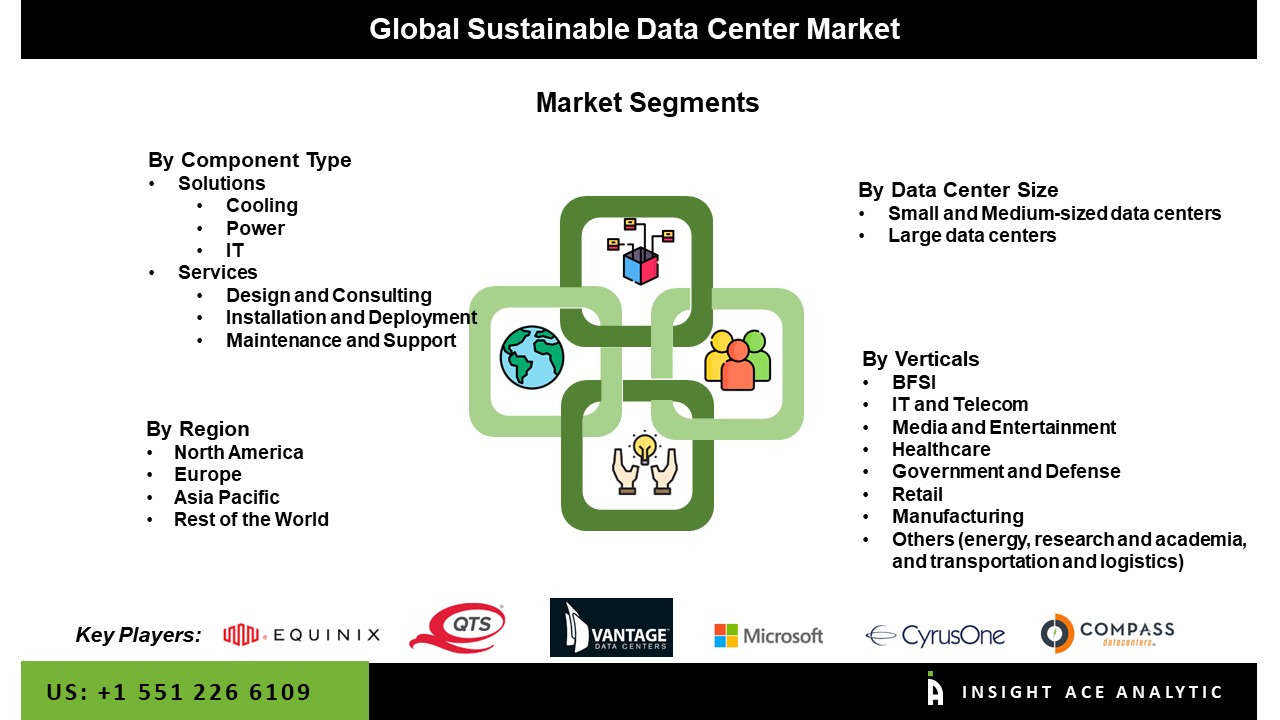
Sustainable Data Center Market By Data Center Size -
Sustainable Data Center Market By Verticals -
Sustainable Data Center Market By Region-
North America-
Europe-
Asia-Pacific-
Latin America-
Middle East & Africa-
This study employed a multi-step, mixed-method research approach that integrates:
This approach ensures a balanced and validated understanding of both macro- and micro-level market factors influencing the market.
Secondary research for this study involved the collection, review, and analysis of publicly available and paid data sources to build the initial fact base, understand historical market behaviour, identify data gaps, and refine the hypotheses for primary research.
Secondary data for the market study was gathered from multiple credible sources, including:
These sources were used to compile historical data, market volumes/prices, industry trends, technological developments, and competitive insights.

Primary research was conducted to validate secondary data, understand real-time market dynamics, capture price points and adoption trends, and verify the assumptions used in the market modelling.
Primary interviews for this study involved:
Interviews were conducted via:
Primary insights were incorporated into demand modelling, pricing analysis, technology evaluation, and market share estimation.
All collected data were processed and normalized to ensure consistency and comparability across regions and time frames.
The data validation process included:
This ensured that the dataset used for modelling was clean, robust, and reliable.
The bottom-up approach involved aggregating segment-level data, such as:
This method was primarily used when detailed micro-level market data were available.

The top-down approach used macro-level indicators:
This approach was used for segments where granular data were limited or inconsistent.
To ensure accuracy, a triangulated hybrid model was used. This included:
This multi-angle validation yielded the final market size.
Market forecasts were developed using a combination of time-series modelling, adoption curve analysis, and driver-based forecasting tools.
Given inherent uncertainties, three scenarios were constructed:
Sensitivity testing was conducted on key variables, including pricing, demand elasticity, and regional adoption.