Returnable Plastic Crate Market Size, Share & Trends Analysis Report By Capacity (Less than 10 kg, 10 kg to 20 kg, 21 to 35 kg, 36 to 50 kg, Above 50 kg), By Product Type (Stackable, Nestable, Collapsible), By Material (High-Density Polyethylene (HDPE), Polypropylene (P.P.), Others), By Application, By Region, And By Segment Forecasts, 2025-2034
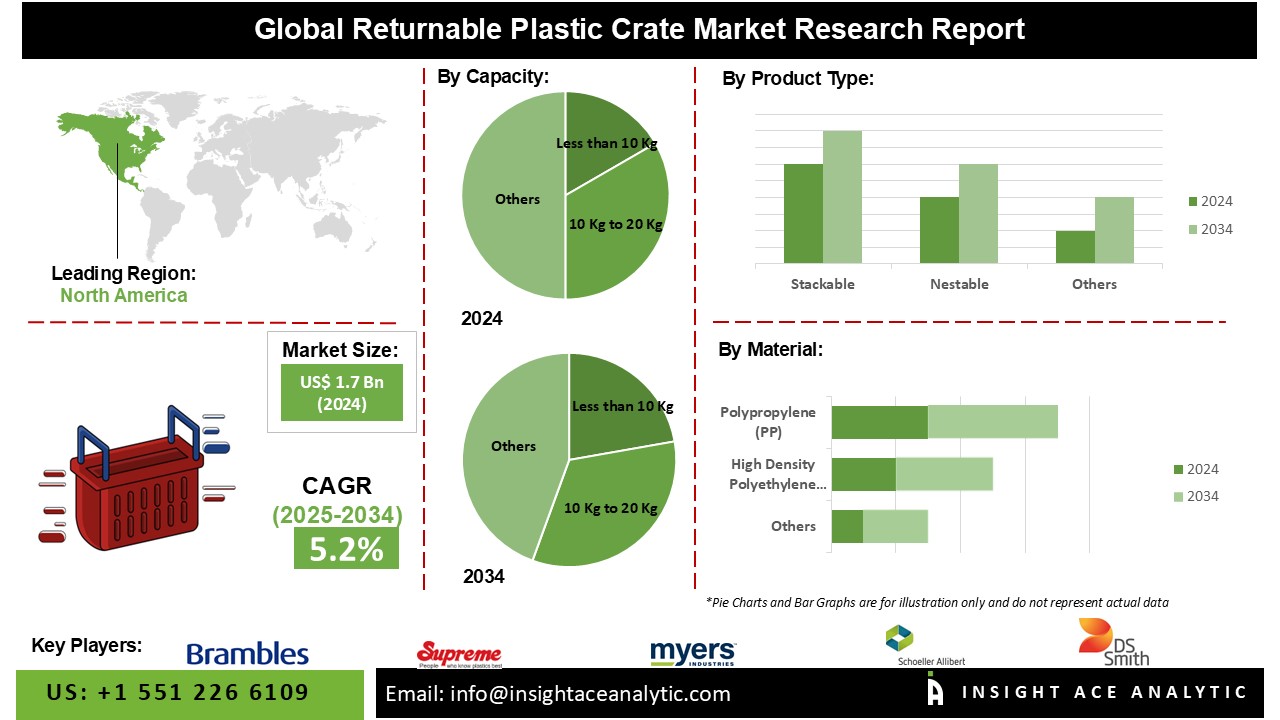
Global Returnable Plastic Crate Market Size is valued at USD 1.7 Bn in 2024 and is predicted to reach USD 2.9 Bn by the year 2034 at a 5.2% CAGR during the forecast period for 2025-2034.
Returnable containers have emerged as a solution that effectively meets transportation requirements and significantly reduces losses in complex supply chain networks. Consequently, the returnable plastic crates are expected to become more popular during the projection period due to urbanization. Storage plastic crates, which are available in a variety of sizes and patterns, are an alternative to traditional wooden boxes. Reusable packaging as a service is one of the primary causes driving the rise of the returnable plastic crate market.
Some organizations provide reusable packaging as a service, managing the whole lifetime of returnable plastic crates for enterprises and easing the load of maintenance and management for end users. However, lockdowns and restrictions disrupted supply systems all around the world. This could have had an impact on RPC return and reuse logistics, causing disruptions in their intended cycle. Economic insecurity and downturns in numerous industries may have prompted some organizations to decrease expenditures, thus hurting investments in reusable packaging solutions such as RPCs.
Some Major Key Players In The Returnable Plastic Crate Market:
- Brambles Limited
- Myers Industries Inc.
- Supreme Industries Limited
- Schoeller Allibert Services BV.
- DS Smith PLC
- Rehrig Pacific Company Inc.
- TranPak Inc.
- IPL Plastics Inc.
- RPP Containers
- Craemer UK Limited
- Dynawest Limited
- Dolav UK Limited
- Ravensbourn Limited
- Zhejiang Zhengji Plastic Industry Co. Ltd.
- Stamford Products Limited
- Others
Market Segmentation:
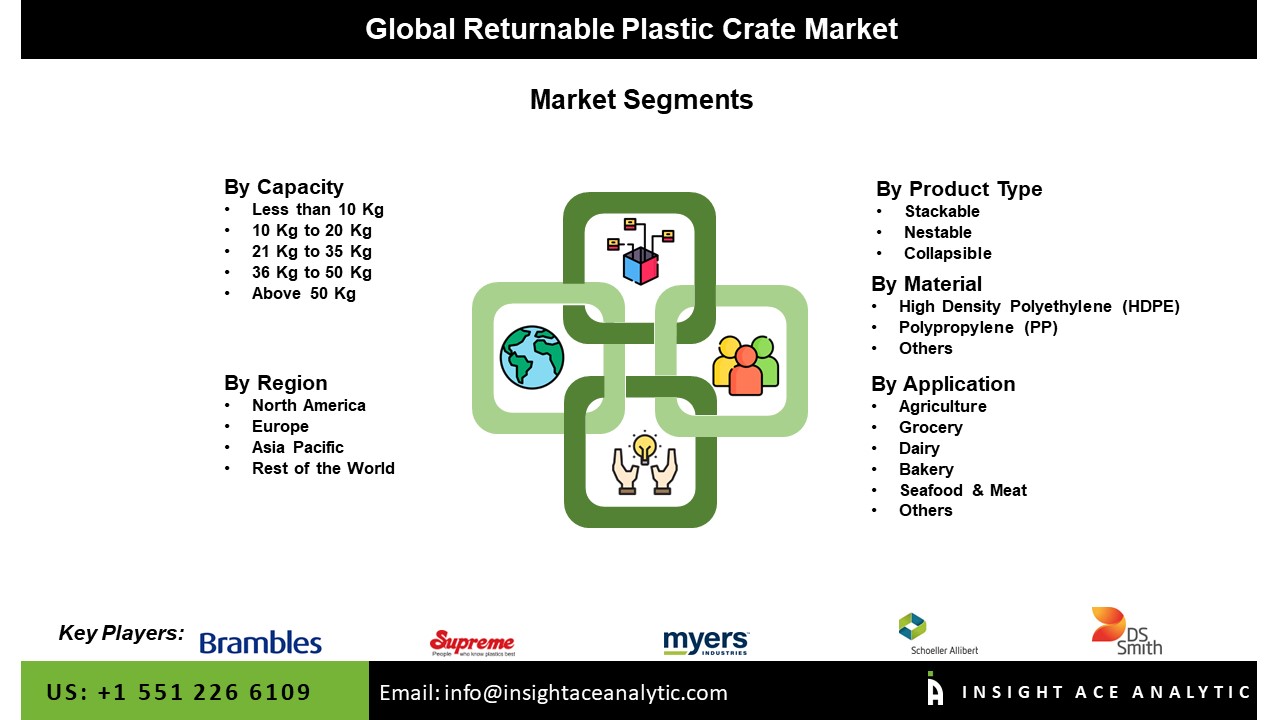
The Returnable Plastic Crate Market is segmented as capacity, product type, material, and application. As per the capacity, the market is segmented as less than 10 kg, 10 kg to 20 kg, 21 to 35 kg, 36 to 50 kg, and above 50 kg. The product type segment includes stackable, nestable, and collapsible. By material, the market is segmented into high-density polyethene (HDPE), polypropylene (P.P.), and others. The applications segment includes agriculture, grocery, dairy, bakery, seafood & meat, and others.
Based On Capacity, The Nestable Segment Is A Major Contributor In The Returnable Plastic Crate Market.
The nestable category is expected to hold a major share of the global Returnable Plastic Crate Market in 2024. Nestable boxes save a lot of space. They can be nested or stacked inside one another while not in use, minimizing the amount of storage space necessary, which is especially useful in warehouses, distribution centres, and during return transit. Nestable crates' space efficiency results in cost savings in storage and transportation. Lower warehouse expenses result from reduced storage space requirements, and the capacity to stack more crates on a single pallet results in lower shipping costs. Nestable containers make supply chain and logistical operations more efficient.
High-Density Polyethylene (HDPE) Segment Witnessed Growth At A Rapid Rate.
The High-density polyethene segment is projected to grow at a rapid rate in the global Returnable Plastic Crate Market. Because of its great durability, HDPE is ideal for applications requiring long-lasting and durable packaging solutions. HDPE boxes can withstand hard handling and safeguard the products being transported. Because HDPE is extremely recyclable, it is an environmentally friendly alternative. Businesses and industries are increasingly choosing packaging solutions produced from recycled HDPE or recyclable after use. HDPE crates with insulating qualities can be created, making them useful for temperature-regulated logistics, such as the delivery of medications and perishable items. HDPE crates can be customized with company logos and product information as a marketing tool during transit and in-store displays. The use of HDPE in returnable plastic crates is consistent with environmental objectives and efforts to reduce waste.
In The Region, Europe's Returnable Plastic Crate Market Holds A Significant Revenue Share.
Europe's Returnable Plastic Crate Market is expected to record the maximum market share in revenue in the near future. Europe has been a leader in environmental sustainability efforts, and there is a significant push to reduce single-use plastics. RPCs are compatible with the region's environmental goals because they are reusable and recyclable. The emphasis in Europe on efficient and sustainable supply chains pushes the deployment of RPCs. With their stackable and robust construction, these boxes help to streamline logistics and reduce environmental impact. Asia-Pacific, on the other hand, is expected to demonstrate profitable growth during the forecast period due to the region's higher concentration of prominence, expanding investment for research and development capabilities, and rising standard of living.
Recent Developments:
- In July 2023, DS Smith allocated €34 million into a strategic initiative aimed at substituting plastic and promoting environmentally-friendly packaging. DS Smith's Greek division has announced a total investment of €33.9m, which will be distributed across three facilities. These sites are focused on developing sustainable packaging solutions and will receive the investment over the course of the next two years.
Returnable Plastic Crate Market Report Scope
| Report Attribute | Specifications |
| Market Size Value In 2024 | USD 1.7 Bn |
| Revenue Forecast In 2034 | USD 2.9 Bn |
| Growth Rate CAGR | CAGR of 5.2% from 2025 to 2034 |
| Quantitative Units | Representation of revenue in US$ Bn, Volume (Unit) and CAGR from 2025 to 2034 |
| Historic Year | 2021 to 2024 |
| Forecast Year | 2025-2034 |
| Report Coverage | The forecast of revenue, the position of the company, the competitive market structure, growth prospects, and trends |
| Segments Covered | By Capacity, By Product Type, By Material, By Application |
| Regional Scope | North America; Europe; Asia Pacific; Latin America; Middle East & Africa |
| Country Scope | U.S.; Canada; U.K.; Germany; China; India; Japan; Brazil; Mexico; France; Italy; Spain; South East Asia; South Korea |
| Competitive Landscape | Brambles Limited, Myers Industries Inc., Supreme Industries Limited, DS Smith PLC, Schoeller Allibert Services B.V., Rehrig Pacific Company Inc., TranPak Inc., IPL Plastics Inc., RPP Containers, Craemer UK Limited, Dynawest Limited, Dolav UK Limited, Ravensbourn Limited, Zhejiang Zhengji Plastic Industry Co. Ltd., Stamford Products Limited., Others |
| Customization Scope | Free customization report with the procurement of the report and modifications to the regional and segment scope. Particular Geographic competitive landscape. |
| Pricing And Available Payment Methods | Explore pricing alternatives that are customized to your particular study requirements. |
Segmentation of Returnable Plastic Crate Market-
By Capacity-
- Less than 10 kg
- 10 kg to 20 kg
- 21 to 35 kg
- 36 to 50 kg
- Above 50 kg
By Product Type-
- Stackable
- Nestable
- Collapsible
By Material-
- High-Density Polyethylene (HDPE)
- Polypropylene (P.P.)
- Others
By Application-
- Agriculture
- Grocery
- Dairy
- Bakery
- Seafood & Meat
- Others
By Region-
North America-
- The US
- Canada
Europe-
- Germany
- The UK
- France
- Italy
- Spain
- Rest of Europe
Asia-Pacific-
- China
- Japan
- India
- South Korea
- South East Asia
- Rest of Asia Pacific
Latin America-
- Brazil
- Mexico
- Argentina
- Rest of Latin America
Middle East & Africa-
- GCC Countries
- South Africa
- Rest of Middle East and Africa
Research Design and Approach
This study employed a multi-step, mixed-method research approach that integrates:
- Secondary research
- Primary research
- Data triangulation
- Hybrid top-down and bottom-up modelling
- Forecasting and scenario analysis
This approach ensures a balanced and validated understanding of both macro- and micro-level market factors influencing the market.
Secondary Research
Secondary research for this study involved the collection, review, and analysis of publicly available and paid data sources to build the initial fact base, understand historical market behaviour, identify data gaps, and refine the hypotheses for primary research.
Sources Consulted
Secondary data for the market study was gathered from multiple credible sources, including:
- Government databases, regulatory bodies, and public institutions
- International organizations (WHO, OECD, IMF, World Bank, etc.)
- Commercial and paid databases
- Industry associations, trade publications, and technical journals
- Company annual reports, investor presentations, press releases, and SEC filings
- Academic research papers, patents, and scientific literature
- Previous market research publications and syndicated reports
These sources were used to compile historical data, market volumes/prices, industry trends, technological developments, and competitive insights.

Primary Research
Primary research was conducted to validate secondary data, understand real-time market dynamics, capture price points and adoption trends, and verify the assumptions used in the market modelling.
Stakeholders Interviewed
Primary interviews for this study involved:
- Manufacturers and suppliers in the market value chain
- Distributors, channel partners, and integrators
- End-users / customers (e.g., hospitals, labs, enterprises, consumers, etc., depending on the market)
- Industry experts, technology specialists, consultants, and regulatory professionals
- Senior executives (CEOs, CTOs, VPs, Directors) and product managers
Interview Process
Interviews were conducted via:
- Structured and semi-structured questionnaires
- Telephonic and video interactions
- Email correspondences
- Expert consultation sessions
Primary insights were incorporated into demand modelling, pricing analysis, technology evaluation, and market share estimation.
Data Processing, Normalization, and Validation
All collected data were processed and normalized to ensure consistency and comparability across regions and time frames.
The data validation process included:
- Standardization of units (currency conversions, volume units, inflation adjustments)
- Cross-verification of data points across multiple secondary sources
- Normalization of inconsistent datasets
- Identification and resolution of data gaps
- Outlier detection and removal through algorithmic and manual checks
- Plausibility and coherence checks across segments and geographies
This ensured that the dataset used for modelling was clean, robust, and reliable.
Market Size Estimation and Data Triangulation
Bottom-Up Approach
The bottom-up approach involved aggregating segment-level data, such as:
- Company revenues
- Product-level sales
- Installed base/usage volumes
- Adoption and penetration rates
- Pricing analysis
This method was primarily used when detailed micro-level market data were available.

Top-Down Approach
The top-down approach used macro-level indicators:
- Parent market benchmarks
- Global/regional industry trends
- Economic indicators (GDP, demographics, spending patterns)
- Penetration and usage ratios
This approach was used for segments where granular data were limited or inconsistent.
Hybrid Triangulation Approach
To ensure accuracy, a triangulated hybrid model was used. This included:
- Reconciling top-down and bottom-up estimates
- Cross-checking revenues, volumes, and pricing assumptions
- Incorporating expert insights to validate segment splits and adoption rates
This multi-angle validation yielded the final market size.
Forecasting Framework and Scenario Modelling
Market forecasts were developed using a combination of time-series modelling, adoption curve analysis, and driver-based forecasting tools.
Forecasting Methods
- Time-series modelling
- S-curve and diffusion models (for emerging technologies)
- Driver-based forecasting (GDP, disposable income, adoption rates, regulatory changes)
- Price elasticity models
- Market maturity and lifecycle-based projections
Scenario Analysis
Given inherent uncertainties, three scenarios were constructed:
- Base-Case Scenario: Expected trajectory under current conditions
- Optimistic Scenario: High adoption, favourable regulation, strong economic tailwinds
- Conservative Scenario: Slow adoption, regulatory delays, economic constraints
Sensitivity testing was conducted on key variables, including pricing, demand elasticity, and regional adoption.
Request Customization
Add countries, segments, company profiles, or extend forecast — free 10% customization with purchase.
Customize This Report →Enquire Before Buying
Speak with our analyst team about scope, methodology, pricing, or deliverable formats.
Enquire Now →Frequently Asked Questions
Returnable Plastic Crate Market Size is valued at USD 1.7 Bn in 2024 and is predicted to reach USD 2.9 Bn by the year 2034
Returnable Plastic Crate Market expected to grow at a 5.2% CAGR during the forecast period for 2025-2034
Dynawest Limited, Dolav UK Limited, Ravensbourn Limited, Zhejiang Zhengji Plastic Industry Co. Ltd., Stamford Products Limited., Others
Capacity, Product Type, material, and Application are the key segments of the Returnable Plastic Crate Market.
North America region is leading the Returnable Plastic Crate Market.