



Quantum Computing Market Size is valued at USD 1.60 Bn in 2024 and is predicted to reach USD 31.26 Bn by the year 2031 at a 34.8% CAGR during the forecast period for 2025-2034.

A cutting-edge form of computing known as quantum computing is based on quantum mechanics and quantum theory. Although it uses 0 and 1 bits, it uses every condition between 0 and 1, which results in exceptional performance. Quantum computing has the potential to transform fields such as encryption, optimisation, material science, drug development, and artificial intelligence. It may be able to solve issues that are almost difficult for traditional computers to solve owing to their enormous computing capacity.
Additionally, integrating AI and ML technologies is anticipated to increase demand. These elements could fuel market expansion in the ensuing years. As qubits must be kept at extremely low, subzero temperatures, the quantum computing industry needs help to maintain their stability. Organizations are motivated to overcome this difficulty and the challenging process of commercializing quantum computers. Moreover, sales of quantum computing components are projected to increase as governments invest more money in solutions for a wide range of applications.
However, these systems' real-time applications come with several technological challenges. These computers are weak because interacting with the environment can turn off the state function. These variables have divided the company environment, research institutions, and acquisition firms, which is expected to restrict global market expansion.
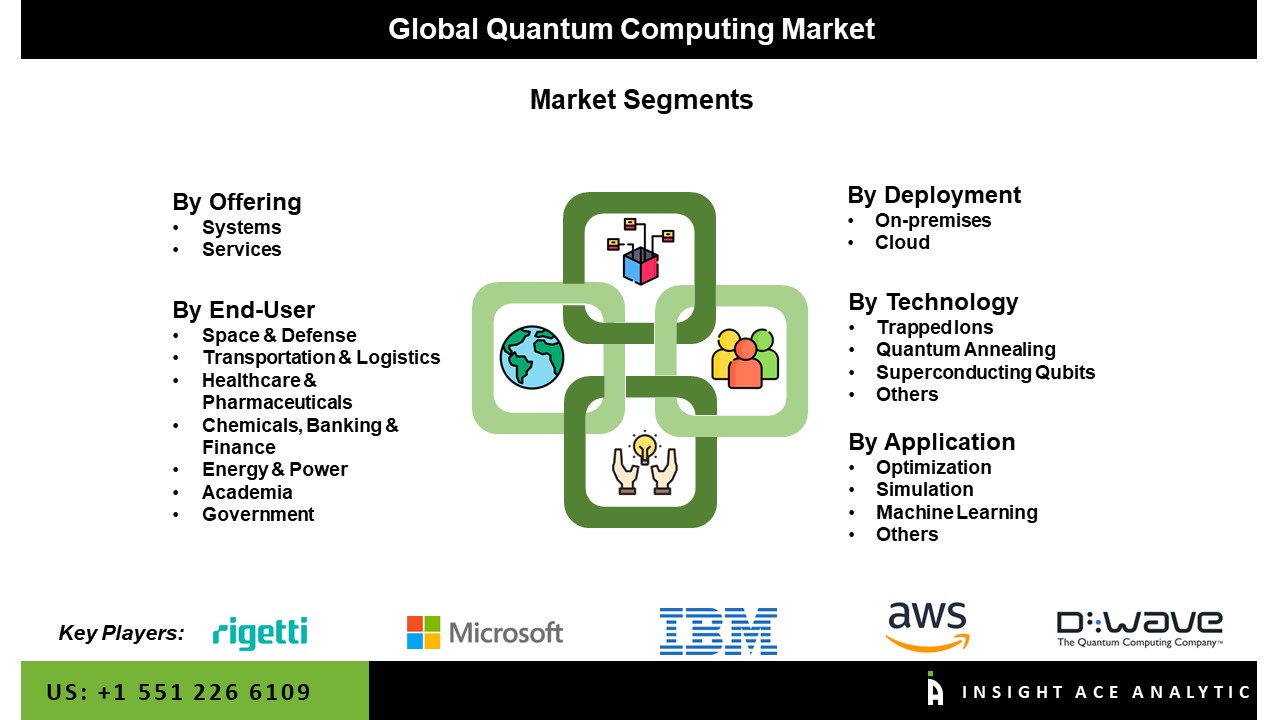
The quantum computing market is segmented based on Offering, deployment, technology, end-user and application. Based on offerings, the quantum computing market is segmented into systems and services. As per the deployment, the quantum computing market is classified into on-premises and cloud-based. The market is segmented by application into machine learning, optimization, simulations and others. The technology segment comprises trapped ions, quantum annealing & superconducting qubits. Based on end users, the quantum computing market is divided into space & defense, BFSI, healthcare & pharmaceuticals, chemical, banking & services, academia, government, transportation & logistics, and energy & power.
The services category will hold a major share of the global quantum computing market 2022. The increasing expansion of the services industry can be attributed to the rising trend of companies making global investments in research and development (R&D) focused on quantum computing technologies. Numerous sectors have decreased operating costs and operational efficiencies because of the technology's use in optimization, simulation, and machine learning approaches. The development of NQIT (network quantum information technologies) will probably improve the incorporation of optimization solutions for resolving issues that occur during the practical applications of quantum computing.
The Healthcare & pharmaceuticals segment is projected to develop rapidly in the global Quantum computing market. The advantages of the healthcare solution are what are fueling industry expansion. This program enables researchers to design more precise and customized diagnostic and therapeutic devices. Magnetic resonance imaging (MRI) equipment can also use these sensors to make incredibly accurate measurements. The quality of healthcare services may rise as a result of these developments.
The Asia Pacific quantum computing market is projected to register the highest market share. The US has a high adoption rate for quantum computing technology because of numerous users and important players based here. The government is investing significantly in the research and development of quantum computing systems, which will likely accelerate market growth. Key players have chosen partnerships with other quantum computing providers and geographical expansion as some of their strategies to drive their sales growth.
In addition, Europe is estimated to grow at a rapid rate in the global quantum computing market. This region's sales of quantum computing devices are primarily driven by expanding research activities, increasing government interest in nanoscience and nanotechnology, and rising investments by significant enterprises in developing novel quantum computing devices.
| Report Attribute | Specifications |
| Market Size Value In 2024 | USD 1.60 Bn |
| Revenue Forecast In 2034 | USD 31.26 Bn |
| Growth Rate CAGR | CAGR of 34.8% from 2025 to 2034 |
| Quantitative Units | Representation of revenue in US$ Mn and CAGR from 2025 to 2034 |
| Historic Year | 2021 to 2024 |
| Forecast Year | 2025-2034 |
| Report Coverage | The forecast of revenue, the position of the company, the competitive market structure, growth prospects, and trends |
| Segments Covered | By Offerings, By Deployment, By Technology, By Applications, By End Users |
| Regional Scope | North America; Europe; Asia Pacific; Latin America; Middle East & Africa |
| Country Scope | U.S.; Canada; U.K.; Germany; China; Japan; Brazil; Mexico; The UK; France; Italy; Spain; Japan; India; South Korea; Southeast Asia |
| Competitive Landscape | IBM (US), D-Wave Quantum Inc. (Canada), Microsoft (US), Amazon Web Services (US), Rigetti Computing (US), Fujitsu (Japan), Hitachi (Japan), Toshiba (Japan), Google (US), Intel (US), Quantinuum (US), Huawei (China), NEC (Japan), Accenture (Ireland), Nippon Telegraph and Telephone (Japan), Bosch (Germany), Quantum Circuits (US), IonQ (US), QC Ware (US), PsiQuantum (US), Alpine Quantum Technologies GmbH (Tyrol), Xanadu (Canada), ABDProf (Spain), Zapata Computing (US), and Northrop Grumman (US) |
| Customization Scope | Free customization report with the procurement of the report and modifications to the regional and segment scope. Particular Geographic competitive landscape. |
| Pricing And Available Payment Methods | Explore pricing alternatives that are customized to your particular study requirements. |
Quantum Computing Market By Offerings
Quantum Computing Market By Deployment
Quantum Computing Market By Technology
Quantum Computing Market By Applications
Quantum Computing Market By End Users
Quantum Computing Market By Region-
North America-
Europe-
Asia-Pacific-
Latin America-
Middle East & Africa-
This study employed a multi-step, mixed-method research approach that integrates:
This approach ensures a balanced and validated understanding of both macro- and micro-level market factors influencing the market.
Secondary research for this study involved the collection, review, and analysis of publicly available and paid data sources to build the initial fact base, understand historical market behaviour, identify data gaps, and refine the hypotheses for primary research.
Secondary data for the market study was gathered from multiple credible sources, including:
These sources were used to compile historical data, market volumes/prices, industry trends, technological developments, and competitive insights.

Primary research was conducted to validate secondary data, understand real-time market dynamics, capture price points and adoption trends, and verify the assumptions used in the market modelling.
Primary interviews for this study involved:
Interviews were conducted via:
Primary insights were incorporated into demand modelling, pricing analysis, technology evaluation, and market share estimation.
All collected data were processed and normalized to ensure consistency and comparability across regions and time frames.
The data validation process included:
This ensured that the dataset used for modelling was clean, robust, and reliable.
The bottom-up approach involved aggregating segment-level data, such as:
This method was primarily used when detailed micro-level market data were available.

The top-down approach used macro-level indicators:
This approach was used for segments where granular data were limited or inconsistent.
To ensure accuracy, a triangulated hybrid model was used. This included:
This multi-angle validation yielded the final market size.
Market forecasts were developed using a combination of time-series modelling, adoption curve analysis, and driver-based forecasting tools.
Given inherent uncertainties, three scenarios were constructed:
Sensitivity testing was conducted on key variables, including pricing, demand elasticity, and regional adoption.