Protein Bagel Market Size, Share & Trends Analysis Report By Ingredient (Gluten-Free Protein Bagels, Whole Grain Protein Bagels, Low-Carb/Keto Protein Bagels), By Flavor (Chocolate, Blueberry, Cinnamon, Plain), By Distribution Channel (Hypermarkets & Supermarkets, Convenience stores, Online,), By Region, And By Segment Forecasts, 2024-2031

Report Id: 2803 Pages: 170 Last Updated: 25 September 2024 Format: PDF / PPT / Excel / Power BI
Share With : linkedin twitter facebook

The Protein Bagel Market Size is valued at USD 242.6 million in 2023 and is predicted to reach USD 417.1 million by the year 2031 at a 7.13% CAGR during the forecast period for 2024-2031.

protein bagel

Protein bagels are a protein-enriched variant of conventional bagels, developed to provide a more nutritional alternative through the inclusion of protein-dense components. Protein bagels are frequently utilized as a post-exercise snack or a nutritious breakfast alternative to facilitate muscle recovery and deliver sustained energy. Protein bagels are an effective means to enhance protein intake. With physical wellness, tissue regeneration, and satisfaction, protein is essential. The increased popularity of healthy lifestyles and fitness across individuals is driving the need for protein bagels. More consumers are looking for quick food choices that fit their nutritional objectives as they place a higher priority on getting sufficient amounts of nutrients, particularly protein.  Food with protein bagels is satisfying and well-balanced, facilitating simple fitment into a hectic routine.

Furthermore, the growing recognition of lifestyle choices, including organic, vegan, and gluten-free diets, has resulted in the development of protein bagels that meet certain specific desires, expanding their popularity substantially. However, the industry's ability to develop is restricted by the sector's expensive requirements for the health and security of protein bagels as well as the item's incapacity of avoiding fog in settings with significant temperature swings or protein-packed bagels due to high costs of production that affect every step of the production procedure.

Producers are unable to boost prices for consumers due to the fierce competition in the industry. This puts stress on earnings margins and restricts possibilities for growth for companies that are already facing elevated manufacturing expenses. The COVID-19 epidemic hurt nearly every industry in several nations. Several industries, including food and beverage, medicines and nutraceuticals, personal care, and animal nutrition, saw their growth stunted due to lockdowns, travel restrictions, and company shutdowns in numerous nations.

Competitive Landscape

Some Major Key Players In The Protein Bagel Market:

  • McDonald's
  • Hostess Brands
  • BetterBrand
  • Einstein Bros. Bagels
  • Dave's Killer Bread
  • Thomas' Bagels
  • Panera Bread Company
  • Bruegger's Bagel Bakery
  • Dunkin Donuts
  • Flowers Foods
  • Other Market Players

Market Segmentation:

The protein bagel market is segmented based on ingredients, flavour, and end-users. According to the ingredients, the market is segmented into gluten-free protein bagels, whole grain protein bagels, low-carb/keto protein bagels, and other protein bagels. By flavour, the market is segmented into chocolate, blueberry, cinnamon, plain, and others. The distribution channel segment includes hypermarkets & supermarkets, convenience stores, online, and others.

Based On The Ingredients, The Gluten-Free Protein Bagels Protein Bagel Market Segment Is Accounted As A Major Contributor To The Protein Bagel Market

The gluten-free protein bagels protein bagel market will hold a major global market share. Gluten-free protein bagels are a perfect match for a variety of organic, prehistoric, and vegan diets, which frequently limit or avoid gluten. Customers who adhere to these dietary routines favour them because of their adaptability. In response to consumer interest, the industry has also expanded its selection of gluten-free protein bagel alternatives, incorporating a variety of combinations of flavours to suit a broad spectrum of palates and improving their popularity.

Supermarkets And Hypermarkets Immunoglobulin (IVIG) Segment To Witness Growth At A Rapid Rate

The supermarkets and hypermarkets industry uses protein bagels because they provide a large assortment of protein bagel brands, tastes, and formulas. Thanks to this selection, customers may readily evaluate goods and make decisions based on their tastes, nutritional needs, or nutritional goals. Offering a variety of alternatives boosts client satisfaction and promotes recurring business.

In The Region, The Asia Pacific Protein Bagel Market Holds A Significant Revenue Share.

The Asia Pacific protein bagel market is predicted to record the very large market revenue share in the comming future. This can be attributed to people having much extra money to spend. The region's robust research and development efforts will benefit the Asia Pacific market. In addition, Europe is likely to grow rapidly in the global protein bagel industry because local health concerns are becoming more pressing. The market is being overrun by new products from numerous companies as a result of the increased awareness of the need for protein-based products.

Recent Developments:

  • In May 2023, Thomas'® has announced the extension of its breakfast range with the launch of Thomas' Everything Mini Bagels and its inaugural keto product, Thomas' Keto Bagel Thins Bagels. The new bagel products enhance the brand's expanding array of creative breakfast options accessible nationwide.

Protein Bagel Market Report Scope

Report Attribute Specifications
Market Size Value In 2023 USD 242.6 Mn
Revenue Forecast In 2031 USD 417.1 Mn
Growth Rate CAGR CAGR of 7.13% from 2024 to 2031
Quantitative Units Representation of revenue in US$ Mn and CAGR from 2024 to 2031
Historic Year 2019 to 2023
Forecast Year 2024-2031
Report Coverage The forecast of revenue, the position of the company, the competitive market structure, growth prospects, and trends
Segments Covered By Ingredient, Flavor and Distribution Channel.
Regional Scope North America; Europe; Asia Pacific; Latin America; Middle East & Africa
Country Scope U.S.; Canada; U.K.; Germany; China; India; Japan; Brazil; Mexico; France; Italy; Spain; South East Asia; South Korea
Competitive Landscape McDonald’s, Hostess Brands, BetterBrand, Einstein Bros. Bagels, Dave's Killer Bread, Thomas' Bagels, Panera Bread Company, Bruegger's Bagel Bakery, Dunkin Donuts, Flowers Foods.
Customization Scope Free customization report with the procurement of the report and modifications to the regional and segment scope. Particular Geographic competitive landscape.
Pricing And Available Payment Methods Explore pricing alternatives that are customized to your particular study requirements.

Segmentation of Protein Bagel Market-

Protein Bagel Market By Ingredient-

  • Gluten-Free Protein Bagels
  • Whole Grain Protein Bagels
  • Low-Carb/Keto Protein Bagels
  • Other Protein Bagels

protein bagel

Protein Bagel Market By Flavor-

  • Chocolate
  • Blueberry
  • Cinnamon
  • Plain
  • Others

Protein Bagel Market By Distribution Channel-

  • Hypermarkets & Supermarkets
  • Convenience stores
  • Online
  • Others

Protein Bagel Market By Region-

North America-

  • The US
  • Canada
  • Mexico

Europe-

  • Germany
  • The UK
  • France
  • Italy
  • Spain
  • Rest of Europe

Asia-Pacific-

  • China
  • Japan
  • India
  • South Korea
  • South East Asia
  • Rest of Asia Pacific

Latin America-

  • Brazil
  • Argentina
  • Rest of Latin America

 Middle East & Africa-

  • GCC Countries
  • South Africa
  • Rest of the Middle East and Africa

Need specific information/chapter from the report of the custom data table, graph or complete report? Tell us more.

Research Design and Approach

This study employed a multi-step, mixed-method research approach that integrates:

  • Secondary research
  • Primary research
  • Data triangulation
  • Hybrid top-down and bottom-up modelling
  • Forecasting and scenario analysis

This approach ensures a balanced and validated understanding of both macro- and micro-level market factors influencing the market.

Secondary Research

Secondary research for this study involved the collection, review, and analysis of publicly available and paid data sources to build the initial fact base, understand historical market behaviour, identify data gaps, and refine the hypotheses for primary research.

Sources Consulted

Secondary data for the market study was gathered from multiple credible sources, including:

  • Government databases, regulatory bodies, and public institutions
  • International organizations (WHO, OECD, IMF, World Bank, etc.)
  • Commercial and paid databases
  • Industry associations, trade publications, and technical journals
  • Company annual reports, investor presentations, press releases, and SEC filings
  • Academic research papers, patents, and scientific literature
  • Previous market research publications and syndicated reports

These sources were used to compile historical data, market volumes/prices, industry trends, technological developments, and competitive insights.

Secondary Research

Primary Research

Primary research was conducted to validate secondary data, understand real-time market dynamics, capture price points and adoption trends, and verify the assumptions used in the market modelling.

Stakeholders Interviewed

Primary interviews for this study involved:

  • Manufacturers and suppliers in the market value chain
  • Distributors, channel partners, and integrators
  • End-users / customers (e.g., hospitals, labs, enterprises, consumers, etc., depending on the market)
  • Industry experts, technology specialists, consultants, and regulatory professionals
  • Senior executives (CEOs, CTOs, VPs, Directors) and product managers

Interview Process

Interviews were conducted via:

  • Structured and semi-structured questionnaires
  • Telephonic and video interactions
  • Email correspondences
  • Expert consultation sessions

Primary insights were incorporated into demand modelling, pricing analysis, technology evaluation, and market share estimation.

Data Processing, Normalization, and Validation

All collected data were processed and normalized to ensure consistency and comparability across regions and time frames.

The data validation process included:

  • Standardization of units (currency conversions, volume units, inflation adjustments)
  • Cross-verification of data points across multiple secondary sources
  • Normalization of inconsistent datasets
  • Identification and resolution of data gaps
  • Outlier detection and removal through algorithmic and manual checks
  • Plausibility and coherence checks across segments and geographies

This ensured that the dataset used for modelling was clean, robust, and reliable.

Market Size Estimation and Data Triangulation

Bottom-Up Approach

The bottom-up approach involved aggregating segment-level data, such as:

  • Company revenues
  • Product-level sales
  • Installed base/usage volumes
  • Adoption and penetration rates
  • Pricing analysis

This method was primarily used when detailed micro-level market data were available.
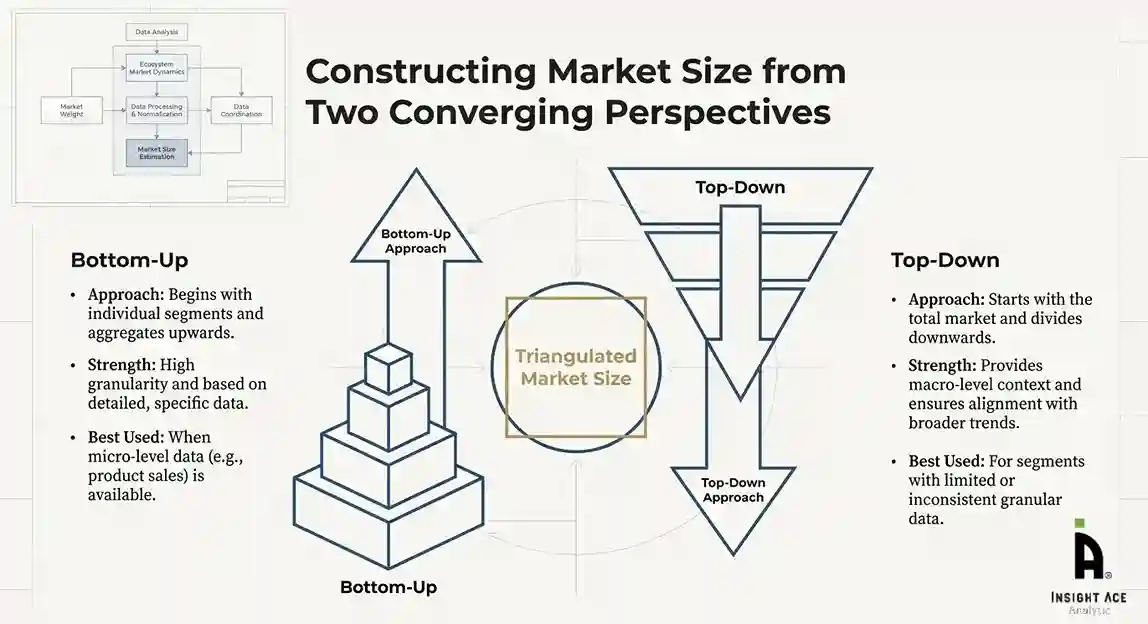
Bottom Up Approach

Top-Down Approach

The top-down approach used macro-level indicators:

  • Parent market benchmarks
  • Global/regional industry trends
  • Economic indicators (GDP, demographics, spending patterns)
  • Penetration and usage ratios

This approach was used for segments where granular data were limited or inconsistent.

Hybrid Triangulation Approach

To ensure accuracy, a triangulated hybrid model was used. This included:

  • Reconciling top-down and bottom-up estimates
  • Cross-checking revenues, volumes, and pricing assumptions
  • Incorporating expert insights to validate segment splits and adoption rates

This multi-angle validation yielded the final market size.

Forecasting Framework and Scenario Modelling

Market forecasts were developed using a combination of time-series modelling, adoption curve analysis, and driver-based forecasting tools.

Forecasting Methods

  • Time-series modelling
  • S-curve and diffusion models (for emerging technologies)
  • Driver-based forecasting (GDP, disposable income, adoption rates, regulatory changes)
  • Price elasticity models
  • Market maturity and lifecycle-based projections

Scenario Analysis

Given inherent uncertainties, three scenarios were constructed:

  • Base-Case Scenario: Expected trajectory under current conditions
  • Optimistic Scenario: High adoption, favourable regulation, strong economic tailwinds
  • Conservative Scenario: Slow adoption, regulatory delays, economic constraints

Sensitivity testing was conducted on key variables, including pricing, demand elasticity, and regional adoption.


Name field cannot be blank!
Email field cannot be blank!(Use email format)
Designation field cannot be blank!
Company field cannot be blank!
Contact No field cannot be blank!
Message field cannot be blank!
2068
Security Code field cannot be blank!

Frequently Asked Questions

The Protein Bagel Market Size is valued at USD 242.6 million in 2023 and is predicted to reach USD 417.1 million by the year 2031

The Protein Bagel Market is expected to grow at a 7.13% CAGR during the forecast period for 2024-2031.

McDonald’s, Hostess Brands, BetterBrand, Einstein Bros. Bagels, Dave's Killer Bread, Thomas' Bagels, Panera Bread Company, Bruegger's Bagel Bakery, Du
Get Sample Report Enquiry Before Buying