Precooked Corn Flour Market Size, Share & Trends Analysis Report By Type (White, Yellow, And Blue), Application (Household And Commercial), Nature (Organic And Conventional), And Distribution Channel (B2C And B2B), By Region, And Segment Forecasts, 2025-2034
Global Precooked Corn Flour Market Size is valued at USD 2.5 Bn in 2024 and is predicted to reach USD 4.0 Bn by the year 2034 at 4.8% CAGR during the forecast period for 2025-2034.
Precooked corn flour can be made by adding steam and water to the ground form of maize at a high temperature. This maize flour that has already been cooked is well-liked in many North American, African, and Latin American countries. Around the world, functional foods, confections, and bakery goods are produced using precooked corn flour. Gluten is not present at all in precooked corn flour.
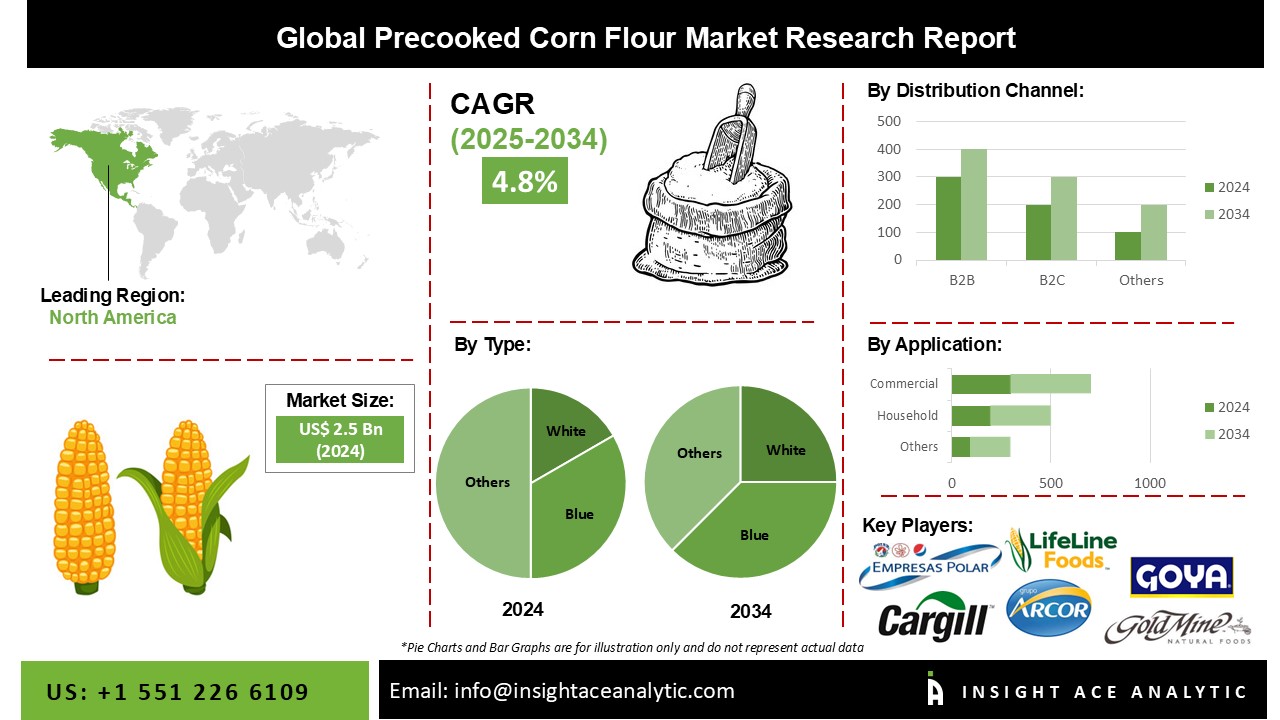
The demand for gluten-free foods and beverages has skyrocketed due to an increase in the prevalence of gluten-related illnesses among consumers. The most important factors anticipated to increase the demand for convenience food among consumers are rising consumer disposable income, rising participation of women in the workforce, changing consumption patterns, shifting towards a busy and hectic lifestyle, and increasing consumer expenditure on functional food. These factors will subsequently have a positive and significant impact on the growth of the global precooked corn flour market during the forecast period.
The market for precooked corn flour still needs to be constrained by the high cost of raw materials. The price of corn, the primary raw material needed to make precooked corn flour, has been rising substantially in recent years. As a result, buyers now find precooked corn flour more expensive, slowing the market's expansion.
Recent Developments:
- In December 2020, Empresas Polar updated and unveiled a new logo. The redesign kept the distinctive components of the brand while adding a fresh appearance to complement the company's international expansion. The brand's social media profiles and the All In One PAN digital platform will also run campaigns to advertise the new logo.
- By 2020, Goya Foods, Inc. will expand its manufacturing and distribution plant. Through this expansion, the business installed cutting-edge equipment to boost output and satisfy the rising demand for pre-cooked flour.
Competitive Landscape:
Some of the major key players in the Precooked Corn Flour Market are:
- Archer Daniels Midland Company
- Arcor Group
- Bob's Red Mill
- Bunge Limited, cargill, inc.
- Empresas Polar, Inc.
- Goldmine Natural Foods
- Goya Foods, Inc.,
- Harinera Del Valle
- LifeLine Foods LLC
- Molino Peila SpA, Gruma
- Cool Chile Company
- Garnec LLC
- The Quacker Oats Company
Market Segmentation:
The precooked corn flour market is segmented into type, application, nature, and distribution channel. The market is segmented based on type: white, yellow, and blue. Based on application, the market is segmented into household and commercial. Based on nature, the market is segmented into organic and conventional. Based on the distribution channel, the market is further segmented into B2C and B2B.
Based on application, the commercial segment is a major contributor to the precooked corn flour market.
prediction, the commercial is anticipated to rule the global market during the forecast period. Precooked corn flour is used extensively in the food processing industry to make various packaged foods, including RTE food, packaged and processed food, infant formula, bakery products, extruded food, and confectioneries. Furthermore, precooked maize flour is in high demand in the food service sector due to its expanding use in preparing pasta, soups, noodles, and flatbreads, among other foods and meals. Furthermore, it is predicted that demand for precooked corn flour will increase shortly due to the growing number of HoReCa (hotels, restaurants, and cafés) units in both established and emerging economies.
The B2B segment witnessed growth at a rapid rate
Based on the distribution channel, the B2B category is anticipated to maintain its dominance during the projection period. This is because the food service and processing industries have a high demand for commercial precooked corn flour. The market's B2B segment has grown significantly as a result of the abundance of producers of precooked corn flour and the soaring demand for it in the food and beverage sector. Further, the expansion of the precooked corn flour market is anticipated to benefit greatly from the growing popularity of online B2B marketplaces like India Mart, Alibaba, eWorld Trade, Global Sources, Amazon Business, and Just Dial shortly.
The Asia Pacific precooked corn flour market holds a significant revenue share in the region
Asia-Pacific is anticipated to experience the fastest growth during the forecast period. The most populous continent in the world and one that has some of the fastest-growing economies in the Asia-Pacific region. The increase in demand for processed and convenience foods and the shift in consumer lifestyle are the main drivers of market expansion. Most working people are concentrated in this area, and the improvement in disposable incomes has brought about a shift in purchasing habits. In addition, due to the use of precooked corn flour in traditional food products and the prevalence of gastrointestinal disorders brought on by the consumption of gluten or products containing gluten, which tends to steer consumers toward precooked flours that are healthy and gluten-free, North America dominates the precooked corn flour market.
Precooked Corn Flour Market Report Scope:
| Report Attribute | Specifications |
| Market size value in 2024 | USD 2.5 Bn |
| Revenue forecast in 2034 | USD 4.0 Bn |
| Growth rate CAGR | CAGR of 4.8% from 2025 to 2034 |
| Quantitative units | Representation of revenue in US$ Bn, and CAGR from 2025 to 2034 |
| Historic Year | 2021 to 2024 |
| Forecast Year | 2025-2034 |
| Report coverage | The forecast of revenue, the position of the company, the competitive market structure, growth prospects, and trends |
| Segments covered | Type, Application, Nature, and Distribution Channel |
| Regional scope | North America; Europe; Asia Pacific; Latin America; Middle East & Africa |
| Country scope | U.S.; Canada; U.K.; Germany; China; India; Japan; Brazil; Mexico; The UK; France; Italy; Spain; China; Japan; India; South Korea; Southeast Asia; South Korea; Southeast Asia |
| Competitive Landscape | Archer Daniels Midland Company, Arcor Group, Bob's Red Mill, Bunge Limited, cargill, inc., Empresas Polar, Inc., Goldmine Natural Foods, Goya Foods, Inc., Harinera Del Valle, LifeLine Foods LLC, Molino Peila SpA, Gruma, Cool Chile Company, Garnec, LLC and The Quacker Oats Company |
| Customization scope | Free customization report with the procurement of the report, Modifications to the regional and segment scope. Particular Geographic competitive landscape. |
| Pricing and available payment methods | Explore pricing alternatives that are customized to your particular study requirements. |
Segmentation of Precooked Corn Flour Market-
Precooked Corn Flour Market By Type-
- White
- Yellow
- Blue
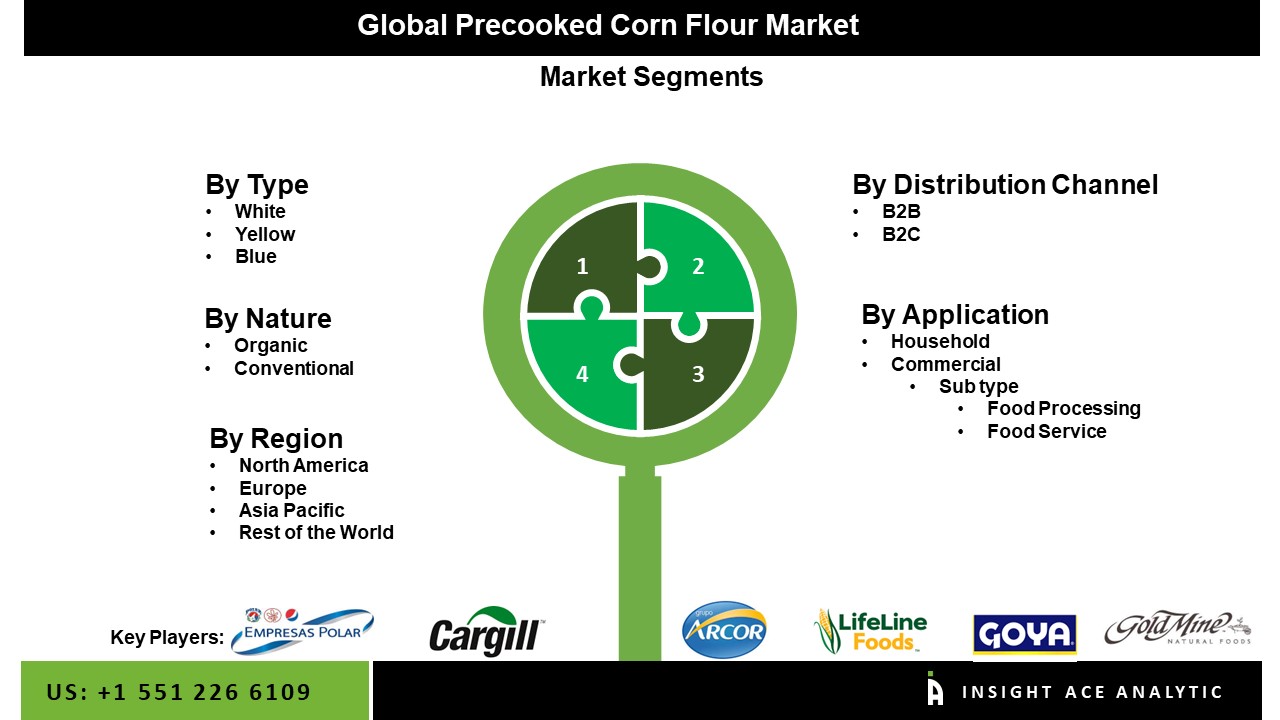
Precooked Corn Flour Market By Application-
- Household
- Commercial
Precooked Corn Flour Market By Subtype-
- Nature
- Organic
- Conventional
Precooked Corn Flour Market By Distribution channel-
- B2C
- B2B
Precooked Corn Flour Market By Region-
North America-
- The US
- Canada
- Mexico
Europe-
- Germany
- The UK
- France
- Italy
- Spain
- Rest of Europe
Asia-Pacific-
- China
- Japan
- India
- South Korea
- South East Asia
- Rest of Asia Pacific
Latin America-
- Brazil
- Argentina
- Rest of Latin America
Middle East & Africa-
- GCC Countries
- South Africa
- Rest of the Middle East and Africa
Research Design and Approach
This study employed a multi-step, mixed-method research approach that integrates:
- Secondary research
- Primary research
- Data triangulation
- Hybrid top-down and bottom-up modelling
- Forecasting and scenario analysis
This approach ensures a balanced and validated understanding of both macro- and micro-level market factors influencing the market.
Secondary Research
Secondary research for this study involved the collection, review, and analysis of publicly available and paid data sources to build the initial fact base, understand historical market behaviour, identify data gaps, and refine the hypotheses for primary research.
Sources Consulted
Secondary data for the market study was gathered from multiple credible sources, including:
- Government databases, regulatory bodies, and public institutions
- International organizations (WHO, OECD, IMF, World Bank, etc.)
- Commercial and paid databases
- Industry associations, trade publications, and technical journals
- Company annual reports, investor presentations, press releases, and SEC filings
- Academic research papers, patents, and scientific literature
- Previous market research publications and syndicated reports
These sources were used to compile historical data, market volumes/prices, industry trends, technological developments, and competitive insights.

Primary Research
Primary research was conducted to validate secondary data, understand real-time market dynamics, capture price points and adoption trends, and verify the assumptions used in the market modelling.
Stakeholders Interviewed
Primary interviews for this study involved:
- Manufacturers and suppliers in the market value chain
- Distributors, channel partners, and integrators
- End-users / customers (e.g., hospitals, labs, enterprises, consumers, etc., depending on the market)
- Industry experts, technology specialists, consultants, and regulatory professionals
- Senior executives (CEOs, CTOs, VPs, Directors) and product managers
Interview Process
Interviews were conducted via:
- Structured and semi-structured questionnaires
- Telephonic and video interactions
- Email correspondences
- Expert consultation sessions
Primary insights were incorporated into demand modelling, pricing analysis, technology evaluation, and market share estimation.
Data Processing, Normalization, and Validation
All collected data were processed and normalized to ensure consistency and comparability across regions and time frames.
The data validation process included:
- Standardization of units (currency conversions, volume units, inflation adjustments)
- Cross-verification of data points across multiple secondary sources
- Normalization of inconsistent datasets
- Identification and resolution of data gaps
- Outlier detection and removal through algorithmic and manual checks
- Plausibility and coherence checks across segments and geographies
This ensured that the dataset used for modelling was clean, robust, and reliable.
Market Size Estimation and Data Triangulation
Bottom-Up Approach
The bottom-up approach involved aggregating segment-level data, such as:
- Company revenues
- Product-level sales
- Installed base/usage volumes
- Adoption and penetration rates
- Pricing analysis
This method was primarily used when detailed micro-level market data were available.

Top-Down Approach
The top-down approach used macro-level indicators:
- Parent market benchmarks
- Global/regional industry trends
- Economic indicators (GDP, demographics, spending patterns)
- Penetration and usage ratios
This approach was used for segments where granular data were limited or inconsistent.
Hybrid Triangulation Approach
To ensure accuracy, a triangulated hybrid model was used. This included:
- Reconciling top-down and bottom-up estimates
- Cross-checking revenues, volumes, and pricing assumptions
- Incorporating expert insights to validate segment splits and adoption rates
This multi-angle validation yielded the final market size.
Forecasting Framework and Scenario Modelling
Market forecasts were developed using a combination of time-series modelling, adoption curve analysis, and driver-based forecasting tools.
Forecasting Methods
- Time-series modelling
- S-curve and diffusion models (for emerging technologies)
- Driver-based forecasting (GDP, disposable income, adoption rates, regulatory changes)
- Price elasticity models
- Market maturity and lifecycle-based projections
Scenario Analysis
Given inherent uncertainties, three scenarios were constructed:
- Base-Case Scenario: Expected trajectory under current conditions
- Optimistic Scenario: High adoption, favourable regulation, strong economic tailwinds
- Conservative Scenario: Slow adoption, regulatory delays, economic constraints
Sensitivity testing was conducted on key variables, including pricing, demand elasticity, and regional adoption.
Request Customization
Add countries, segments, company profiles, or extend forecast — free 10% customization with purchase.
Customize This Report →Enquire Before Buying
Speak with our analyst team about scope, methodology, pricing, or deliverable formats.
Enquire Now →Frequently Asked Questions
Precooked Corn Flour Market Size is valued at USD 2.5 Bn in 2024 and is predicted to reach USD 4.0 Bn by the year 2034
Precooked Corn Flour Market expected to grow at a 4.8% CAGR during the forecast period for 2025-2034
Archer Daniels Midland Company, Arcor Group, Bob's Red Mill, Bunge Limited, cargill, inc., Empresas Polar, Inc., Goldmine Natural Foods, Goya Foods, I
Type, Application, Nature, and Distribution Channel are the key segments of the Precooked Corn Flour Market
North America region is leading the Precooked Corn Flour Market.