Prebiotic Soda Market Size, Share & Trends Analysis Report By Type (Dairy-Based Prebiotic Soda, Plant-Based Prebiotic Soda), By Packaging (Bottles, Tetra Packs, Cans, Others), By Flavor (Fruit, Cola Flavors, Others), By Distribution Channel (Hypermarkets/Supermarkets, Convenience Stores, Independent Departmental Stores, Online Retailers, Wholesalers & Distributors), By Region, And By Segment Forecasts, 2025-2034
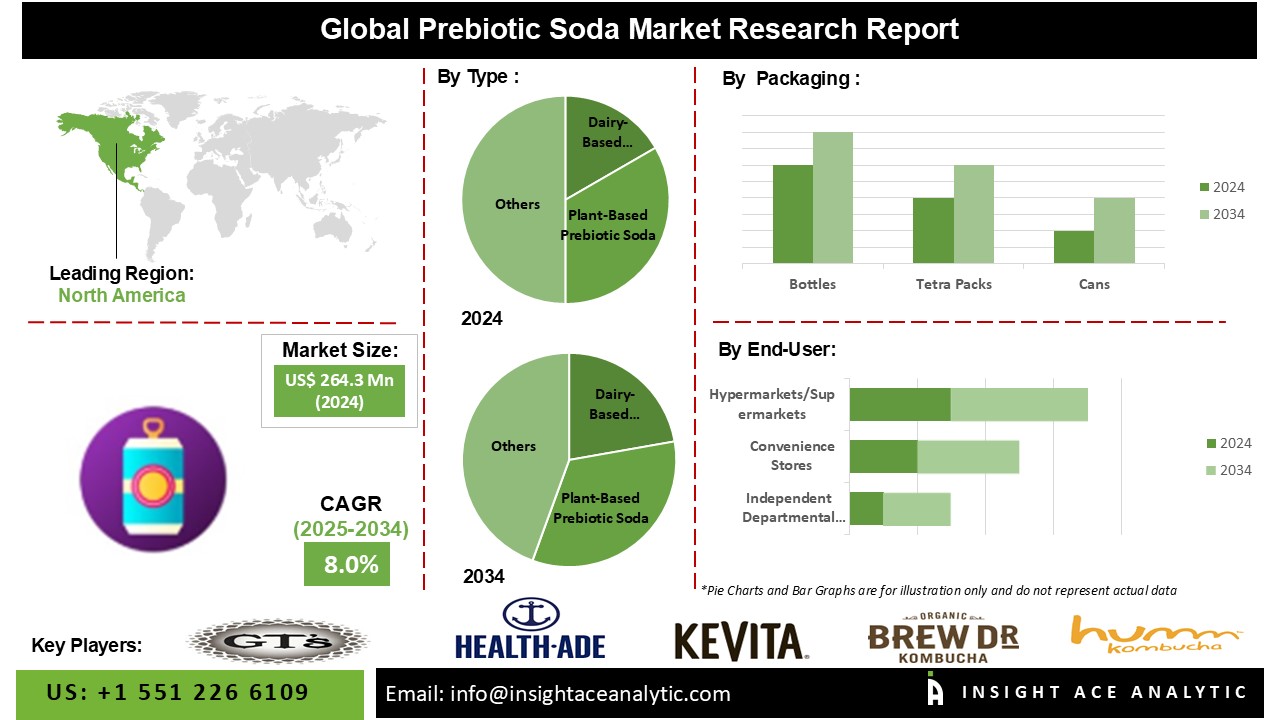
Global Prebiotic Soda Market Size is valued at USD 264.3 Mn in 2024 and is predicted to reach USD 563.9 Mn by the year 2034 at a 8.0% CAGR during the forecast period for 2025-2034
Prebiotic soda signifies a transformation in the beverage sector towards goods that not only quench thirst but also have a positive impact on health, specifically by promoting gut health through beneficial prebiotics. Prebiotic soda contains prebiotics as an active component. Prebiotics encourage the expansion of good bacteria in the digestive tract to maintain a balanced gut microbiota.
There was a surge in the market for functional drinks and beverages as people became more health conscious. During the forecast period, probiotic soda consumption is predicted to rise due to the growing awareness of the benefits of probiotic drinks, which include improved digestive health and maintained immunological function. The rising number of people suffering from chronic illness and lifestyle issues is likely to boost sales of probiotic soda drinks. More and more people are realizing that a healthy gut affects their immune, general well-being, and even their mental health, which is driving the growth of the prebiotic sodas market in the coming years.
However, the prebiotic soda industry is slowing down its growth due to the high price of prebiotic sodas and the absence of consumer knowledge regarding the advantages of these probiotic drinks. In addition, prebiotic sodas are benefiting from the current trend away from sugary drinks due to health concerns about diabetes and obesity. This is because prebiotic sodas are often promoted as having less sugar and more natural ingredients. As people become more health conscious and pick healthier diets, the prebiotic soda market is booming.
Competitive Landscape
Some Major Key Players In The Prebiotic Soda Market:
- GT’s Living Foods
- Health-Ade Kombucha
- Kevita
- Brew Dr. Kombucha
- Humm Kombucha
- Revive Kombucha
- Remedy Kombucha
- Better Booch
- Clearly Kombucha
- Suja Juice
- Farmhouse Culture
- Wild Tonic Jun Kombucha
- GoodBelly
- Lifeway Kefir
- The Bu Kombucha
- Nestle SA,
- Yakult Honsha Co. Ltd.,
- Danone S.A.,
- Chobani LLC,
- Harmless Harvest,
- Bio-K Plus International Inc.,
- GCMMF (Amul),
- Fonterra Co-operative Group
- Other Market Players
Market Segmentation:
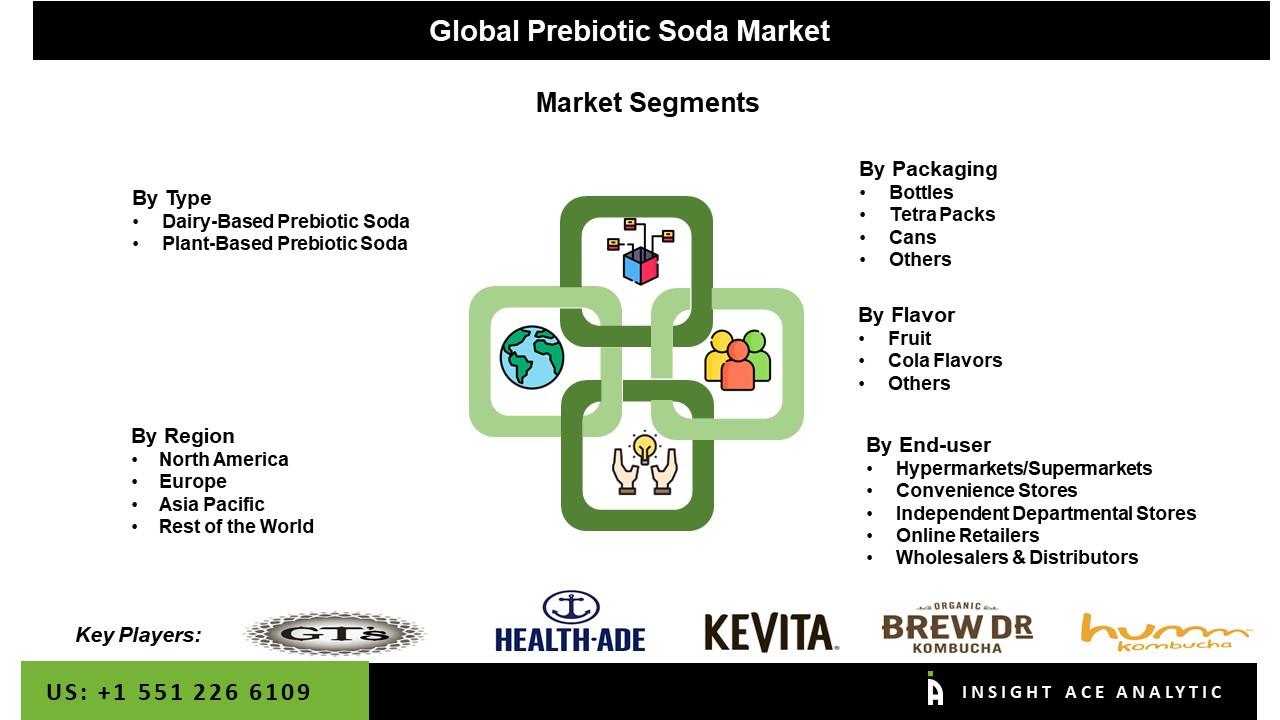
The prebiotic soda market is segmented based on type, packaging, flavor, and distribution channel. Based on the type, the market is segmented into dairy-based prebiotic soda and plant-based prebiotic soda. By packaging, the market is categorized into bottles, tetra packs, cans, and others. By flavor, the market is segmented into fruit, cola flavors, and others. The distribution channel segment comprises hypermarkets/supermarkets, convenience stores, independent departmental stores, online retailers, and wholesalers & distributors.
Based On The Type, The Dairy-Based Prebiotic Soda Segment Is Accounted As A Major Contributor To The Prebiotic Soda Market
The dairy-based prebiotic soda market is expected to hold a major global market share because a rising number of people are opting for functional beverages, which provide additional health advantages. This is especially true for dairy-based prebiotic sodas that aid with digestion and general well-being. Health-conscious customers are drawn to dairy-based prebiotic drinks because they combine the nutritional benefits of dairy, like calcium and protein, with the gut health benefits of prebiotics. Prebiotic drinks made with dairy are becoming more popular as people learn more about the mutually beneficial interaction between prebiotics and probiotics. The health advantages of dairy products can be enhanced by drinking these sodas, which promote the growth of good bacteria in the stomach.
Cans Segment To Witness Growth At A Rapid Rate
Cans are growing because cans of soda are a great fit for today’s consumers because of how easy they are to transport and enjoy when on the move. In terms of packaging, cans are perfect for customers who prioritize convenience because of their minimal weight, portability, and ease of storage. The fact that aluminum cans are more eco-friendly than plastic bottles and can be recycled makes them popular with younger generations that value sustainability, growing this segment.
In The Region, The North American Prebiotic Soda Market Holds A Significant Revenue Share
The North American prebiotic soda market is expected to record the maximum market revenue share in the near future. It can be attributed to the continuously rising trend of people consuming health-focused beverages with reduced sugar content in reaction to the increasing prevalence of obesity and diabetes. In addition, Asia Pacific is estimated to show rapid growth in the global prebiotic soda market because of rising consumer interest in these sodas, rising consumer consciousness in the Asia-Pacific region regarding the significance of gut health, as well as fast urbanization and hectic lifestyles, have boosted the demand for prebiotic soda in the expanding markets of the Asia Pacific region.
Recent Developments:
- In April 2023, NextFoods, the producer of GoodBelly, purchased Cheribundi, a beverage made from sour cherries. Previously, each brand was sold at over 20,000 retail locations. However, Cheribundi has recently seen a significant increase in online sales. Cheribundi's e-commerce sales had a significant increase of 120% compared to the previous year, as revealed by the company.
- In July 2021, KeVita, a fermented beverage brand owned by PepsiCo, introduced a new line of convenient prebiotic injections designed to promote digestive health. The new 2oz shots by KeVita contain 3g of prebiotic fiber and are fermented using water kefir culture.
Prebiotic Soda Market Report Scope:
| Report Attribute | Specifications |
| Market Size Value In 2024 | USD 264.3 Mn |
| Revenue Forecast In 2034 | USD 563.9 Mn |
| Growth Rate CAGR | CAGR of 8.0% from 2025 to 2034 |
| Quantitative Units | Representation of revenue in US$ Million and CAGR from 2025 to 2034 |
| Historic Year | 2021 to 2024 |
| Forecast Year | 2025-2034 |
| Report Coverage | The forecast of revenue, the position of the company, the competitive market structure, growth prospects, and trends |
| Segments Covered | By Type, Packaging, Flavor, And Distribution Channel |
| Regional Scope | North America; Europe; Asia Pacific; Latin America; Middle East & Africa |
| Country Scope | U.S.; Canada; U.K.; Germany; China; India; Japan; Brazil; Mexico; France; Italy; Spain; South East Asia; South Korea |
| Competitive Landscape | GT’s Living Foods, Health-Ade Kombucha, Kevita, Brew Dr. Kombucha, Humm Kombucha, Revive Kombucha, Remedy Kombucha, Better Booch, Clearly Kombucha, Suja Juice, Farmhouse Culture, Wild Tonic Jun Kombucha, GoodBelly, Lifeway Kefir, and The Bu Kombucha, Suja Juice, Farmhouse Culture, Wild Tonic Jun Kombucha, GoodBelly, Lifeway Kefir, The Bu Kombucha, Nestle SA, Yakult Honsha Co. Ltd., Danone S.A., Chobani LLC, Harmless Harvest, Bio-K Plus International Inc., GCMMF (Amul), Fonterra Co-operative Group. and Other Market Players |
| Customization Scope | Free customization report with the procurement of the report and modifications to the regional and segment scope. Particular Geographic competitive landscape. |
| Pricing And Available Payment Methods | Explore pricing alternatives that are customized to your particular study requirements. |
Segmentation of Prebiotic Soda Market-
Prebiotic Soda Market By Type-
- Dairy-Based Prebiotic Soda
- Plant-Based Prebiotic Soda
Prebiotic Soda Market By Packaging-
- Bottles
- Tetra Packs
- Cans
- Others
Prebiotic Soda Market By Flavor-
- Fruit
- Cola Flavors
- Others
Prebiotic Soda Market By Distribution Channel-
- Hypermarkets/Supermarkets
- Convenience Stores
- Independent Departmental Stores
- Online Retailers
- Wholesalers & Distributors
Prebiotic Soda Market By Region-
North America-
- The US
- Canada
Europe-
- Germany
- The UK
- France
- Italy
- Spain
- Rest of Europe
Asia-Pacific-
- China
- Japan
- India
- South Korea
- South East Asia
- Rest of Asia Pacific
Latin America-
- Brazil
- Mexico
- Argentina
- Rest of Latin America
Middle East & Africa-
- GCC Countries
- South Africa
- Rest of the Middle East and Africa
Research Design and Approach
This study employed a multi-step, mixed-method research approach that integrates:
- Secondary research
- Primary research
- Data triangulation
- Hybrid top-down and bottom-up modelling
- Forecasting and scenario analysis
This approach ensures a balanced and validated understanding of both macro- and micro-level market factors influencing the market.
Secondary Research
Secondary research for this study involved the collection, review, and analysis of publicly available and paid data sources to build the initial fact base, understand historical market behaviour, identify data gaps, and refine the hypotheses for primary research.
Sources Consulted
Secondary data for the market study was gathered from multiple credible sources, including:
- Government databases, regulatory bodies, and public institutions
- International organizations (WHO, OECD, IMF, World Bank, etc.)
- Commercial and paid databases
- Industry associations, trade publications, and technical journals
- Company annual reports, investor presentations, press releases, and SEC filings
- Academic research papers, patents, and scientific literature
- Previous market research publications and syndicated reports
These sources were used to compile historical data, market volumes/prices, industry trends, technological developments, and competitive insights.

Primary Research
Primary research was conducted to validate secondary data, understand real-time market dynamics, capture price points and adoption trends, and verify the assumptions used in the market modelling.
Stakeholders Interviewed
Primary interviews for this study involved:
- Manufacturers and suppliers in the market value chain
- Distributors, channel partners, and integrators
- End-users / customers (e.g., hospitals, labs, enterprises, consumers, etc., depending on the market)
- Industry experts, technology specialists, consultants, and regulatory professionals
- Senior executives (CEOs, CTOs, VPs, Directors) and product managers
Interview Process
Interviews were conducted via:
- Structured and semi-structured questionnaires
- Telephonic and video interactions
- Email correspondences
- Expert consultation sessions
Primary insights were incorporated into demand modelling, pricing analysis, technology evaluation, and market share estimation.
Data Processing, Normalization, and Validation
All collected data were processed and normalized to ensure consistency and comparability across regions and time frames.
The data validation process included:
- Standardization of units (currency conversions, volume units, inflation adjustments)
- Cross-verification of data points across multiple secondary sources
- Normalization of inconsistent datasets
- Identification and resolution of data gaps
- Outlier detection and removal through algorithmic and manual checks
- Plausibility and coherence checks across segments and geographies
This ensured that the dataset used for modelling was clean, robust, and reliable.
Market Size Estimation and Data Triangulation
Bottom-Up Approach
The bottom-up approach involved aggregating segment-level data, such as:
- Company revenues
- Product-level sales
- Installed base/usage volumes
- Adoption and penetration rates
- Pricing analysis
This method was primarily used when detailed micro-level market data were available.

Top-Down Approach
The top-down approach used macro-level indicators:
- Parent market benchmarks
- Global/regional industry trends
- Economic indicators (GDP, demographics, spending patterns)
- Penetration and usage ratios
This approach was used for segments where granular data were limited or inconsistent.
Hybrid Triangulation Approach
To ensure accuracy, a triangulated hybrid model was used. This included:
- Reconciling top-down and bottom-up estimates
- Cross-checking revenues, volumes, and pricing assumptions
- Incorporating expert insights to validate segment splits and adoption rates
This multi-angle validation yielded the final market size.
Forecasting Framework and Scenario Modelling
Market forecasts were developed using a combination of time-series modelling, adoption curve analysis, and driver-based forecasting tools.
Forecasting Methods
- Time-series modelling
- S-curve and diffusion models (for emerging technologies)
- Driver-based forecasting (GDP, disposable income, adoption rates, regulatory changes)
- Price elasticity models
- Market maturity and lifecycle-based projections
Scenario Analysis
Given inherent uncertainties, three scenarios were constructed:
- Base-Case Scenario: Expected trajectory under current conditions
- Optimistic Scenario: High adoption, favourable regulation, strong economic tailwinds
- Conservative Scenario: Slow adoption, regulatory delays, economic constraints
Sensitivity testing was conducted on key variables, including pricing, demand elasticity, and regional adoption.
Request Customization
Add countries, segments, company profiles, or extend forecast — free 10% customization with purchase.
Customize This Report →Enquire Before Buying
Speak with our analyst team about scope, methodology, pricing, or deliverable formats.
Enquire Now →Frequently Asked Questions
Global Prebiotic Soda Market Size is valued at USD 264.3 Mn in 2024 and is predicted to reach USD 563.9 Mn by the year 2034
Global Prebiotic Soda Market is expected to grow at a 8.0% CAGR during the forecast period for 2025-2034
Nestle SA, Yakult Honsha Co. Ltd., Danone S.A., Chobani LLC, Harmless Harvest, Bio-K Plus International Inc., GCMMF (Amul), Fonterra Co-operative Grou
Type, Packaging, Flavor, and Distribution Channel are the key segments of the Prebiotic Soda Market.
North America region is leading the Prebiotic Soda Market.