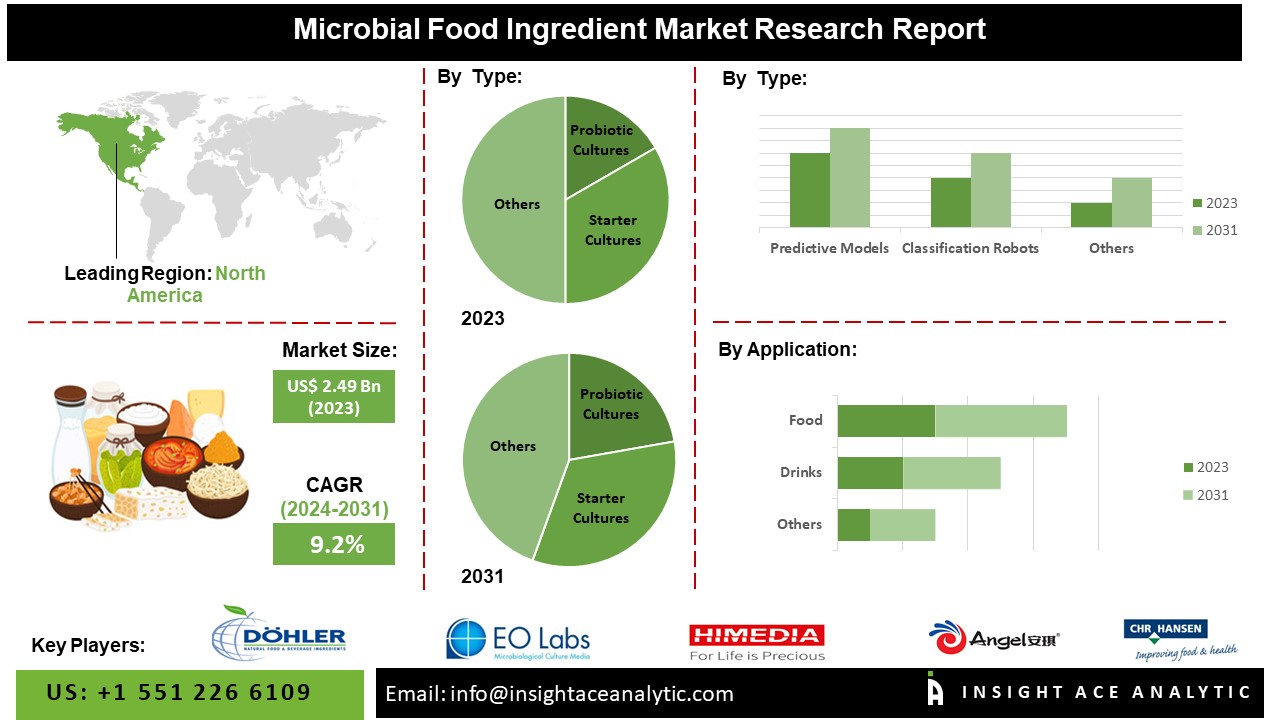
Microbial Food Ingredient Market Size is valued at USD 2.49 Bn in 2023 and is predicted to reach USD 4.97 Bn by the year 2031 at an 9.2% CAGR during the forecast period for 2024-2031.
Microorganisms are generating interest as an alternative food source because of their good nutritional profile, low carbon impact, and limited need for land and water. They are also resistant to seasonal fluctuations. The advent of new tools, particularly in synthetic biology, has significantly expanded the applications of microorganisms. These advancements demonstrate great potential in fulfilling many of our dietary needs. Microbes can now be utilized to produce whole foods directly from their biomass and serve as cell factories to create highly functional and nutritional ingredients. Microorganisms such as bacteria, yeast, or fungi, which is used as an ingredient in food products. These ingredients can serve various purposes, including enhancing flavor, improving texture, extending shelf life, or providing nutritional benefits.
Microorganisms are used to ferment food, resulting in products like yogurt, kefir, sauerkraut, kimchi, and soy sauce. Fermentation can enhance flavor, increase nutritional value, and improve food preservation. Certain microbes produce compounds that enhance the flavor of foods, such as monosodium glutamate (MSG) produced by fermentation. Microorganisms can be used to produce essential vitamins (e.g., B12) and amino acids (e.g., lysine) that are added to food products to enhance their nutritional profile. Some microorganisms produce natural preservatives that inhibit the growth of spoilage organisms and pathogens. Microbial polysaccharides like xanthan gum and gellan gum are used to thicken and stabilize foods. Microbial food ingredients are widely used in the food industry due to their efficiency, sustainability, and ability to improve food quality and safety.
Advances in genetic engineering, fermentation technology, and synthetic biology have made it possible to produce microbial ingredients more efficiently and at a lower cost. Enhanced fermentation techniques allow for higher yields and more consistent quality of microbial products. Increasing consumer awareness about health and nutrition drives demand for functional foods containing probiotics, vitamins, and other beneficial microbial ingredients.
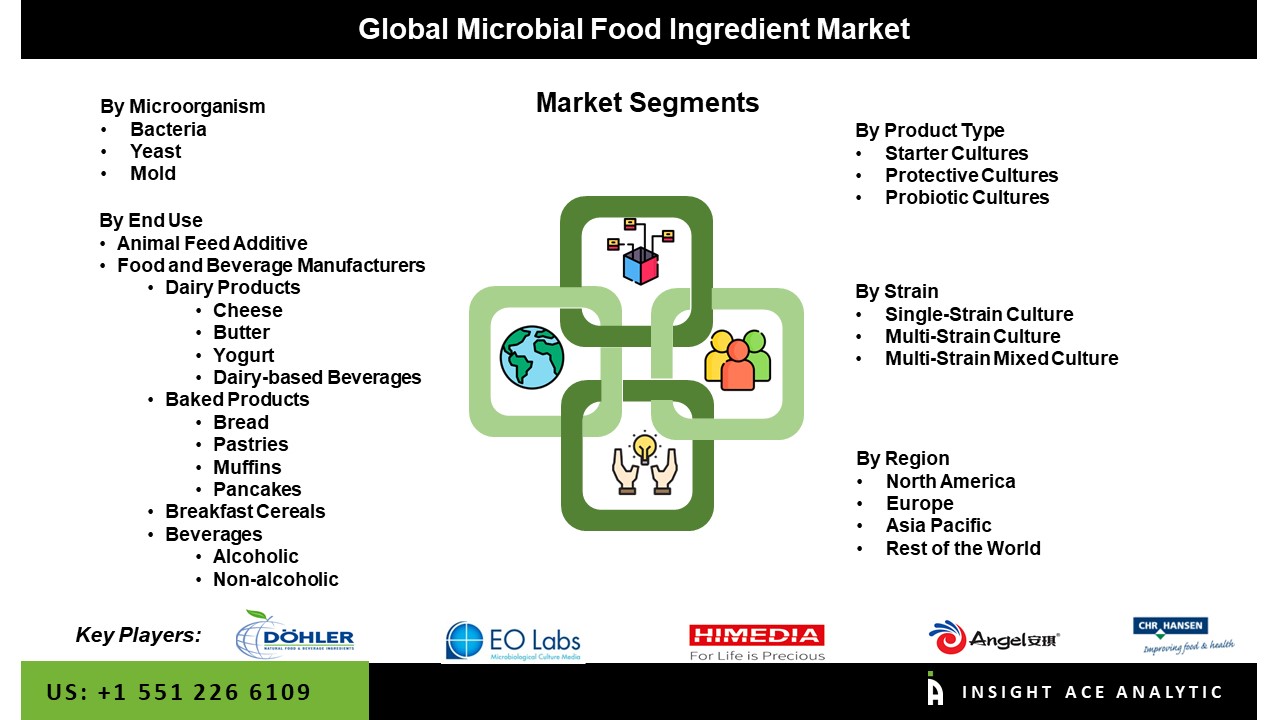
The is segmented based on microorganism, product type, strain, and end-user. By Microorganism segmented into bacteria, yeast, mold. Product Type segmented into starter cultures, protective cultures, probiotic cultures. Based on the strain, the market is segmented into single-strain culture, multi-strain culture, and multi-strain mixed culture. The End-user segment includes food and beverage manufacturers, animal feed additives.
| Report Attribute | Specifications |
| Market Size Value In 2023 | USD 2.49 Bn |
| Revenue Forecast In 2031 | USD 4.97 Bn |
| Growth Rate CAGR | CAGR of 9.2% from 2024 to 2031 |
| Quantitative Units | Representation of revenue in US$ Bn and CAGR from 2024 to 2031 |
| Historic Year | 2019 to 2023 |
| Forecast Year | 2024-2031 |
| Report Coverage | The forecast of revenue, the position of the company, the competitive market structure, growth prospects, and trends |
| Segments Covered | By Microorganism, Product Type, Strain, End-Use |
| Regional Scope | North America; Europe; Asia Pacific; Latin America; Middle East & Africa |
| Country Scope | U.S.; Canada; U.K.; Germany; China; India; Japan; Brazil; Mexico; The UK; France; Italy; Spain; China; Japan; India; South Korea; Southeast Asia; South Korea; South East Asia |
| Competitive Landscape | Hansen A/S, Dohler Group, E&O Laboratories Ltd., Angel Yeast Co. Ltd., HiMedia Company, Danisco A/S, Koninklijke DSM N.V. (Csk Food Enrichment B.V.), Lactina Ltd., Wyeast Laboratories Inc., Lb Bulgaricum Plc., Lesaffre Group, Lallemand Inc., Mediterranea Biotecnologie SRL, Dalton Biotecnologie, Kerry Group, NCIMB Ltd |
| Customization Scope | Free customization report with the procurement of the report, Modifications to the regional and segment scope. Particular Geographic competitive landscape. |
| Pricing and Available Payment Methods | Explore pricing alternatives that are customized to your particular study requirements. |
Global Microbial Food Ingredient Market, By Microorganism
Global Microbial Food Ingredient Market – By Product Type
Global Microbial Food Ingredient Market – By Strain
Global Microbial Food Ingredient Market – By End Use
Global Microbial Food Ingredient Market – By Region
North America-
Europe-
Asia-Pacific-
Latin America-
Middle East & Africa-
Chapter 1. Methodology and Scope
1.1. Research Methodology
1.2. Research Scope & Assumptions
Chapter 2. Executive Summary
Chapter 3. Global Microbial Food Ingredient Market Snapshot
Chapter 4. Global Microbial Food Ingredient Market Variables, Trends & Scope
4.1. Market Segmentation & Scope
4.2. Drivers
4.3. Challenges
4.4. Trends
4.5. Investment and Funding Analysis
4.6. Industry Analysis – Porter’s Five Forces Analysis
4.7. Competitive Landscape & Market Share Analysis
4.8. Impact of Covid-19 Analysis
Chapter 5. Market Segmentation 1: by Microorganism Estimates & Trend Analysis
5.1. by Microorganism & Market Share, 2019 & 2031
5.2. Market Size (Value (US$ Mn)) & Forecasts and Trend Analyses, 2019 to 2031 for the following by Microorganism:
5.2.1. Bacteria
5.2.2. Yeast
5.2.3. Mold
Chapter 6. Market Segmentation 2: by Product Type Estimates & Trend Analysis
6.1. by Product Type & Market Share, 2019 & 2031
6.2. Market Size (Value (US$ Mn)) & Forecasts and Trend Analyses, 2019 to 2031 for the following by Product Type:
6.2.1. Starter Cultures
6.2.2. Protective Cultures
6.2.3. Probiotic Cultures
Chapter 7. Market Segmentation 3: by Strain Estimates & Trend Analysis
7.1. by Strain & Market Share, 2019 & 2031
7.2. Market Size (Value (US$ Mn)) & Forecasts and Trend Analyses, 2019 to 2031 for the following by Strain:
7.2.1. Single-Strain Culture
7.2.2. Multi-Strain Culture
7.2.3. Multi-Strain Mixed Culture
Chapter 8. Market Segmentation 4: by End Use Estimates & Trend Analysis
8.1. by End Use & Market Share, 2019 & 2031
8.2. Market Size (Value (US$ Mn)) & Forecasts and Trend Analyses, 2019 to 2031 for the following: by End Use:
8.2.1. Animal Feed Additives
8.2.2. Food and Beverage Manufacturers
8.2.2.1. Dairy Products
8.2.2.1.1. Cheese
8.2.2.1.2. Butter
8.2.2.1.3. Yogurt
8.2.2.1.4. Dairy-based Beverages
8.2.2.2. Baked Products
8.2.2.2.1. Bread
8.2.2.2.2. Pastries
8.2.2.2.3. Muffins
8.2.2.2.4. Pancakes
8.2.2.3. Breakfast Cereals
8.2.2.4. Beverages
8.2.2.4.1. Alcoholic
8.2.2.4.2. Non-alcoholic
Chapter 9. Microbial Food Ingredient Market Segmentation 5: Regional Estimates & Trend Analysis
9.1. North America
9.1.1. North America Microbial Food Ingredient Market Revenue (US$ Million) Estimates and Forecasts by Microorganism, 2024-2031
9.1.2. North America Microbial Food Ingredient Market Revenue (US$ Million) Estimates and Forecasts by Product Type, 2024-2031
9.1.3. North America Microbial Food Ingredient Market Revenue (US$ Million) Estimates and Forecasts by Strain, 2024-2031
9.1.4. North America Microbial Food Ingredient Market Revenue (US$ Million) Estimates and Forecasts by End Use y Product Type, 2024-2031
9.1.5. North America Microbial Food Ingredient Market Revenue (US$ Million) Estimates and Forecasts by country, 2024-2031
9.2. Europe
9.2.1. Europe Microbial Food Ingredient Market Revenue (US$ Million) Estimates and Forecasts by Microorganism, 2024-2031
9.2.2. Europe Microbial Food Ingredient Market Revenue (US$ Million) Estimates and Forecasts by Product Type, 2024-2031
9.2.3. Europe Microbial Food Ingredient Market Revenue (US$ Million) Estimates and Forecasts by Strain, 2024-2031
9.2.4. Europe Microbial Food Ingredient Market Revenue (US$ Million) Estimates and Forecasts by End Use, 2024-2031
9.2.5. Europe Microbial Food Ingredient Market Revenue (US$ Million) Estimates and Forecasts by country, 2024-2031
9.3. Asia Pacific
9.3.1. Asia Pacific Microbial Food Ingredient Market Revenue (US$ Million) Estimates and Forecasts by Microorganism, 2024-2031
9.3.2. Asia Pacific Microbial Food Ingredient Market Revenue (US$ Million) Estimates and Forecasts by Product Type, 2024-2031
9.3.3. Asia-Pacific Microbial Food Ingredient Asia-Pacific Microbial Food Ingredient Market Revenue (US$ Million) Estimates and Forecasts by Strain, 2024-2031
9.3.4. Asia-Pacific Microbial Food Ingredient Market Revenue (US$ Million) Estimates and Forecasts by End Use, 2024-2031
9.3.5. Asia Pacific Microbial Food Ingredient Market Revenue (US$ Million) Estimates and Forecasts by country, 2024-2031
9.4. Latin America
9.4.1. Latin America Microbial Food Ingredient Market Revenue (US$ Million) Estimates and Forecasts by Microorganism, 2024-2031
9.4.2. Latin America Microbial Food Ingredient Market Revenue (US$ Million) Estimates and Forecasts by Product Type, 2024-2031
9.4.3. Latin America Microbial Food Ingredient Market Revenue (US$ Million) Estimates and Forecasts by Strain, 2024-2031
9.4.4. Latin America Microbial Food Ingredient Market Revenue (US$ Million) Estimates and Forecasts by End Use, 2024-2031
9.4.5. Latin America Microbial Food Ingredient Market Revenue (US$ Million) Estimates and Forecasts by country, 2024-2031
9.5. Middle East & Africa
9.5.1. Middle East & Africa Microbial Food Ingredient Market Revenue (US$ Million) Estimates and Forecasts by Microorganism, 2024-2031
9.5.2. Middle East & Africa Microbial Food Ingredient Market Revenue (US$ Million) Estimates and Forecasts by Product Type, 2024-2031
9.5.3. Middle East & Africa Microbial Food Ingredient Market Revenue (US$ Million) Estimates and Forecasts by Strain, 2024-2031
9.5.4. Middle East & Africa Microbial Food Ingredient Market Revenue (US$ Million) Estimates and Forecasts by End Use, 2024-2031
9.5.5. Middle East & Africa Microbial Food Ingredient Market Revenue (US$ Million) Estimates and Forecasts by country, 2024-2031
Chapter 10. Competitive Landscape
10.1. Major Mergers and Acquisitions/Strategic Alliances
10.2. Company Profiles
10.2.1. Angel Yeast Co. Ltd.
10.2.2. Chr. Hansen A/S,
10.2.3. Danisco A/S
10.2.4. Dohler Group
10.2.5. E&O Laboratories Ltd.
10.2.6. HiMedia Company
10.2.7. Koninklijke DSM N.V. (Csk Food Enrichment B.V.)
10.2.8. Lactina Ltd.
10.2.9. Wyeast Laboratories Inc.
10.2.10. Lb Bulgaricum Plc.
10.2.11. Lesaffre Group
10.2.12. Lallemand Inc.
10.2.13. Mediterranea Biotecnologie SRL
10.2.14. Dalton Biotecnologie
10.2.15. Kerry Group
10.2.16. NCIMB Ltd
10.2.17. Other Prominent Players