Industrial Valves Market Size, Trend, Forecast Report 2026 to 2035
What is Industrial Valves Market Size?
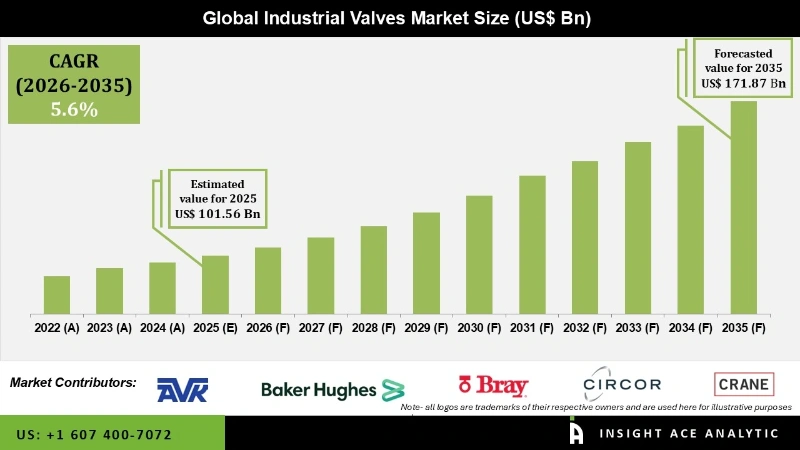
Industrial Valves Market Size is valued at USD 101.56 billion in 2025 and is predicted to reach USD 171.87 billion by the year 2035 at a 5.6% CAGR during the forecast period for 2026 to 2035.
Industrial Valves Market Size, Share & Trends Analysis Report By Type (Ball, Butterfly, Globe, Gate, Diaphragm, Safety, Check, Plug), Material (Steel, Cast Iron, Alloy Based, Cryogenic, Plastic, Bronze, Brass), Component (Actuator, Positioner), Function, By Region, And Segment Forecasts, 2026 to 2035.
Industrial Valves Market Key Takeaways:
|
Over the forecast period, rising automation brought on by growing industrialization and facility development is anticipated to drive the market. Increasing consumer demand for flow control equipment will positively affect market expansion. Intelligent control systems for smart valves are expected to become very important, which is anticipated to speed up their development. During the next seven years, demand will be driven by increased diagnostics and intelligent technologies in industrial valves for monitoring process variables such as upstream and downstream pressure stem position, temperature, and flow rate.
The use of coal is being demonized, and traditional coal-fired plants are being shut down, among other things, which could impede growth. Price changes for raw materials could slow down the use and uptake of the technology. Moreover, the expansion of the conventional power industry may need to be improved by compliance with onerous government restrictions.
Recent Developments:
- In November 2022, In keeping with the Saudi Arabian government's intentions to localise critical products, IMI Saudi Industry, a division of IMI Critical Engineering, launched a new 5,000 m2 facility in Dammam. This facility will provide cutting-edge valve solutions and boost national manufacturing capabilities.
Competitive Landscape:
Some of the Industrial Valves market players are:
- ALFA LAVAL
- AVK Holding AS
- Baker Hughes
- Bray International,
- CIRCOR International Inc.
- Crane Co.,
- Curtiss-Wright Corporation
- Danfoss AS
- Emerson Electric Co.
- Flowserve Corporation
- Georg Fischer Ltd
- Hitachi Ltd
- Honeywell International Inc.
- IMI PLC,
- ITT Inc.
- KITZ Corporation
- KLINGER Group
- KSB SE & Co, & KGaA,
- Mueller Water Products Inc.
- Neles,
- NIBCO Inc.
- Okano Valve Mfg. Co. Ltd
- Saint-Gobain
- Schlumberger Limited
- Spirax-Sarco Engineering PLC.
- TechnipFMC PLC
- The Weir Group PLC
- Valvitalia SpA
- Xylem
- Zhejiang Dunan Valve Co. Ltd
Market Segmentation:
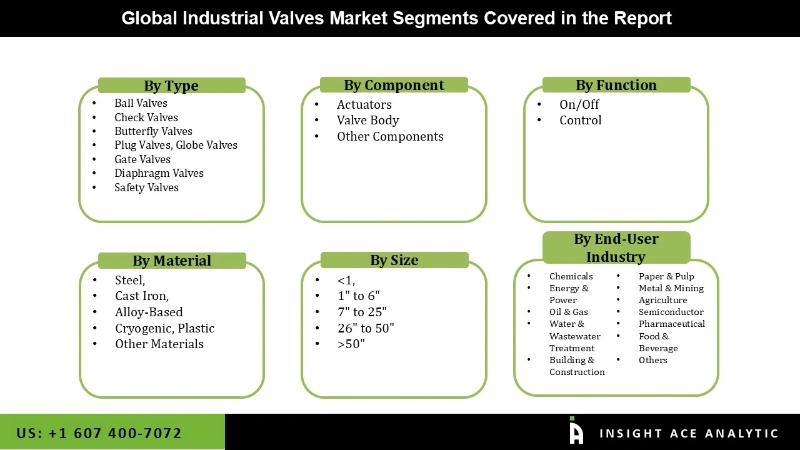
The Industrial Valves market is segmented based on type, material, component, function , size and end-user. Based on type, the market is segmented as ball valves, check valves, butterfly valves, plug valves, globe valves, gate valves, diaphragm valves, and safety valves. The component segment includes actuators, valve bodies, and other components. By function, the market is segmented into on/off, and control. The material segment includes steel, cast iron, alloy-based, cryogenic, plastic, and other materials. The size segment includes <1, 1" to 6", 7" to 25", 26" to 50", and>50".
The End-user industry includes chemicals, energy & power, oil & gas, water & wastewater treatment, building & construction, paper & pulp, metal & mining, agriculture, semiconductor, pharmaceutical, food & beverage, and others.
Based On Type, The Check Valves Segment Is Accounted As A Major Contributor In The Industrial Valves Market
The market for check valves is expected to continue expanding steadily. These valves are unidirectional, preventing the process flow from damaging the equipment or interrupting the flow, by preventing it from returning to the system. The demand across sectors has been positively impacted by rising automation and the need for refineries to control fluid flow.
Oil & Gas Segment Witness Growth At A Rapid Rate
The majority of total income was accounted for by the oil and gas segment. The market for industrial valves has grown as a result of rising demand for deeper wells, longer pipelines, and lower production costs as well as technological advancements in processing, production, and transportation. Furthermore, the requirement for monitoring and regulating from a centralized location and growing pipeline installations have boosted the industry's output and demand for smart valves.
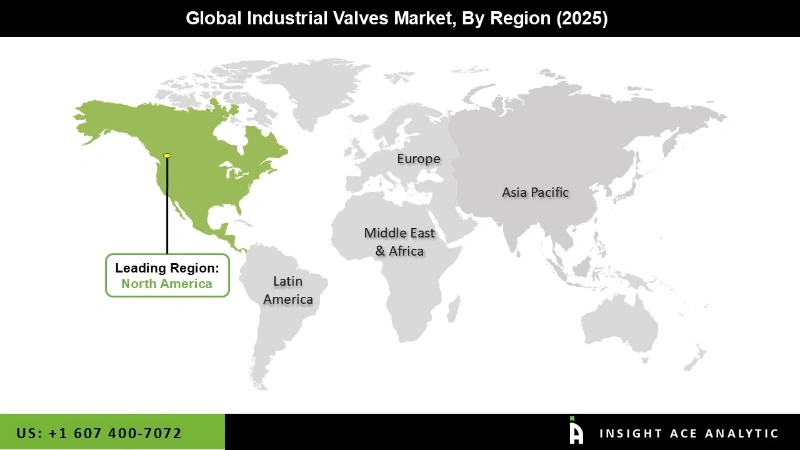
In The Region, The North America Industrial Valves Market Holds Significant Revenue Share
The market's largest region was Asia Pacific. Production across the region is predicted to benefit from the expanding construction activity and increasing chemical consumption. The demand is also anticipated to be fueled by increasing capacity additions at petroleum refineries and the development of new nuclear power plants. For example, China is planning to invest in the development of brand-new coal-fired and scrubber power plants.
Industrial Valves Market Report Scope:
| Report Attribute | Specifications |
| Market size value in 2025 | USD 101.56 Bn |
| Revenue forecast in 2035 | USD 171.87 Bn |
| Growth rate CAGR | CAGR of 5.6% from 2026 to 2035 |
| Quantitative units | Representation of revenue in US$ Million, and CAGR from 2026 to 2035 |
| Historic Year | 2022 to 2025 |
| Forecast Year | 2026-2035 |
| Report coverage | The forecast of revenue, the position of the company, the competitive market statistics, growth prospects, and trends |
| Segments covered | Type, Material, Component, Function, Size And End-user |
| Regional scope | North America; Europe; Asia Pacific; Latin America; Middle East & Africa |
| Country scope | U.S.; Canada; U.K.; Germany; China; India; Japan; Brazil; Mexico; The UK; France; Italy; Spain; South Korea; Southeast Asia |
| Competitive Landscape | Emerson, Flowserve Corporation, Sclumberger Limited, Crane Co., Neles, KITZ Corporatin, IMI PLC, KSB SE & Co, & KGaA, Bray International, and Spirax-Sarco Engineering PLC. |
| Customization scope | Free customization report with the procurement of the report, Modifications to the regional and segment scope. Particular Geographic competitive landscape. |
| Pricing and available payment methods | Explore pricing alternatives that are customized to your particular study requirements. |
Segmentation of Industrial Valves Market-
Industrial Valves Market By Type-
- Ball Valves
- Check Valves
- Butterfly Valves
- Plug Valves, Globe Valves
- Gate Valves
- Diaphragm Valves
- Safety Valves
Industrial Valves Market By Component-
- Actuators
- Valve Body
- Other Components
Industrial Valves Market By Function-
- On/Off
- Control
Industrial Valves Market By Material-
- Steel,
- Cast Iron,
- Alloy-Based
- Cryogenic, Plastic
- Other Materials
Industrial Valves Market By Size-
- <1,
- 1" to 6"
- 7" to 25"
- 26" to 50"
- >50"
Industrial Valves Market By End-User Industry-
- Chemicals
- Energy & Power
- Oil & Gas
- Water & Wastewater Treatment
- Building & Construction
- Paper & Pulp
- Metal & Mining
- Agriculture
- Semiconductor
- Pharmaceutical
- Food & Beverage
- Others
Industrial Valves Market By Region-
North America-
- The US
- Canada
- Mexico
Europe-
- Germany
- The UK
- France
- Italy
- Spain
- Rest of Europe
Asia-Pacific-
- China
- Japan
- India
- South Korea
- Southeast Asia
- Rest of Asia Pacific
Latin America-
- Brazil
- Argentina
- Rest of Latin America
Middle East & Africa-
- GCC Countries
- South Africa
- Rest of Middle East and Africa
Research Design and Approach
This study employed a multi-step, mixed-method research approach that integrates:
- Secondary research
- Primary research
- Data triangulation
- Hybrid top-down and bottom-up modelling
- Forecasting and scenario analysis
This approach ensures a balanced and validated understanding of both macro- and micro-level market factors influencing the market.
Secondary Research
Secondary research for this study involved the collection, review, and analysis of publicly available and paid data sources to build the initial fact base, understand historical market behaviour, identify data gaps, and refine the hypotheses for primary research.
Sources Consulted
Secondary data for the market study was gathered from multiple credible sources, including:
- Government databases, regulatory bodies, and public institutions
- International organizations (WHO, OECD, IMF, World Bank, etc.)
- Commercial and paid databases
- Industry associations, trade publications, and technical journals
- Company annual reports, investor presentations, press releases, and SEC filings
- Academic research papers, patents, and scientific literature
- Previous market research publications and syndicated reports
These sources were used to compile historical data, market volumes/prices, industry trends, technological developments, and competitive insights.

Primary Research
Primary research was conducted to validate secondary data, understand real-time market dynamics, capture price points and adoption trends, and verify the assumptions used in the market modelling.
Stakeholders Interviewed
Primary interviews for this study involved:
- Manufacturers and suppliers in the market value chain
- Distributors, channel partners, and integrators
- End-users / customers (e.g., hospitals, labs, enterprises, consumers, etc., depending on the market)
- Industry experts, technology specialists, consultants, and regulatory professionals
- Senior executives (CEOs, CTOs, VPs, Directors) and product managers
Interview Process
Interviews were conducted via:
- Structured and semi-structured questionnaires
- Telephonic and video interactions
- Email correspondences
- Expert consultation sessions
Primary insights were incorporated into demand modelling, pricing analysis, technology evaluation, and market share estimation.
Data Processing, Normalization, and Validation
All collected data were processed and normalized to ensure consistency and comparability across regions and time frames.
The data validation process included:
- Standardization of units (currency conversions, volume units, inflation adjustments)
- Cross-verification of data points across multiple secondary sources
- Normalization of inconsistent datasets
- Identification and resolution of data gaps
- Outlier detection and removal through algorithmic and manual checks
- Plausibility and coherence checks across segments and geographies
This ensured that the dataset used for modelling was clean, robust, and reliable.
Market Size Estimation and Data Triangulation
Bottom-Up Approach
The bottom-up approach involved aggregating segment-level data, such as:
- Company revenues
- Product-level sales
- Installed base/usage volumes
- Adoption and penetration rates
- Pricing analysis
This method was primarily used when detailed micro-level market data were available.

Top-Down Approach
The top-down approach used macro-level indicators:
- Parent market benchmarks
- Global/regional industry trends
- Economic indicators (GDP, demographics, spending patterns)
- Penetration and usage ratios
This approach was used for segments where granular data were limited or inconsistent.
Hybrid Triangulation Approach
To ensure accuracy, a triangulated hybrid model was used. This included:
- Reconciling top-down and bottom-up estimates
- Cross-checking revenues, volumes, and pricing assumptions
- Incorporating expert insights to validate segment splits and adoption rates
This multi-angle validation yielded the final market size.
Forecasting Framework and Scenario Modelling
Market forecasts were developed using a combination of time-series modelling, adoption curve analysis, and driver-based forecasting tools.
Forecasting Methods
- Time-series modelling
- S-curve and diffusion models (for emerging technologies)
- Driver-based forecasting (GDP, disposable income, adoption rates, regulatory changes)
- Price elasticity models
- Market maturity and lifecycle-based projections
Scenario Analysis
Given inherent uncertainties, three scenarios were constructed:
- Base-Case Scenario: Expected trajectory under current conditions
- Optimistic Scenario: High adoption, favourable regulation, strong economic tailwinds
- Conservative Scenario: Slow adoption, regulatory delays, economic constraints
Sensitivity testing was conducted on key variables, including pricing, demand elasticity, and regional adoption.
Request Customization
Add countries, segments, company profiles, or extend forecast — free 10% customization with purchase.
Customize This Report →Enquire Before Buying
Speak with our analyst team about scope, methodology, pricing, or deliverable formats.
Enquire Now →Frequently Asked Questions
Industrial Valves Market Size is valued at USD 101.56 billion in 2025 and is predicted to reach USD 171.87 billion by the year 2035.
Industrial Valves Market expected to grow at a 5.6% CAGR during the forecast period for 2026-2035.
Emerson, Flowserve Corporation, Sclumberger Limited, Crane Co., Neles, KITZ Corporatin, IMI PLC, KSB SE & Co, & KGaA, Bray International, and Spirax-S
Industrial Valves market is segmented based on type, material, component, function , size and end-user, ball valves, check valves, butterfly valves, plug valves, globe valves, gate valves, diaphragm valves, and safety valves.
North America region is leading the Industrial Valves Market.