Healthcare IoT Security Market Size, Share, Trend, Scope Report 2026 to 2035
What is Healthcare IoT Security Market Size?
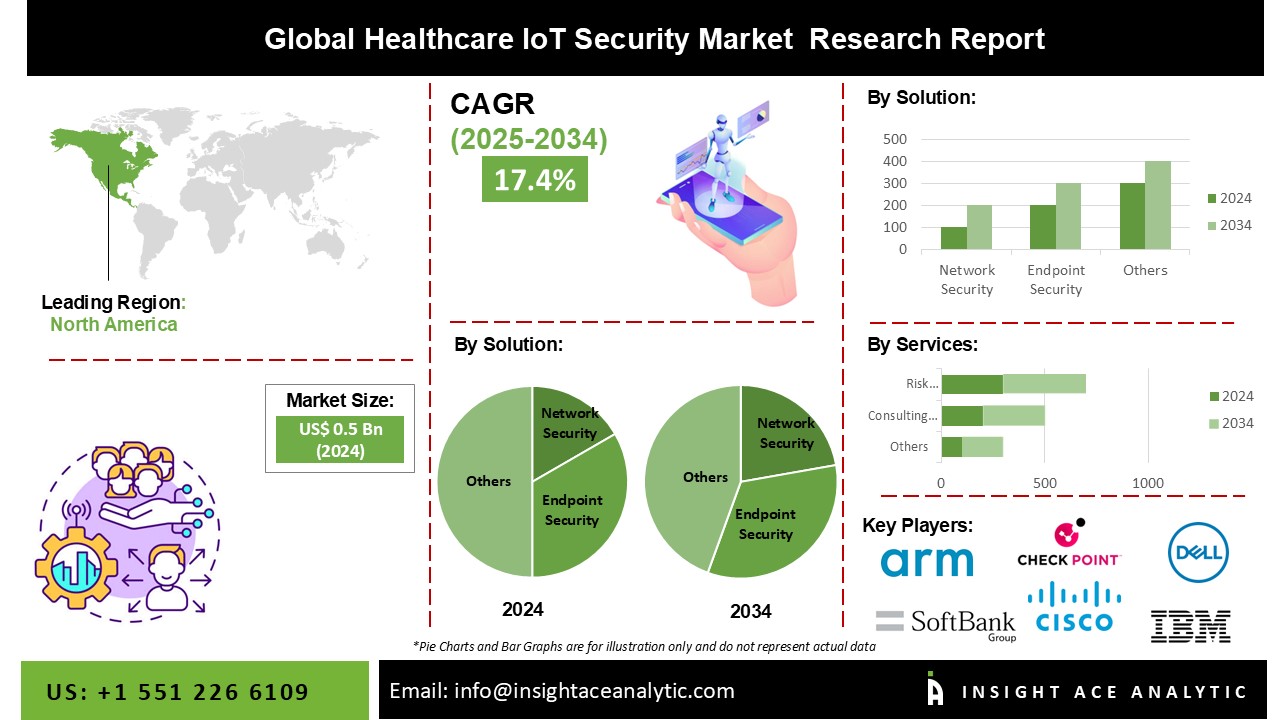
Global Healthcare IoT Security Market Size is valued at USD 589.85 Mn in 2025 and is predicted to reach USD 2,927.34 Mn by the year 2035 at a 17.5% CAGR during the forecast period for 2026 to 2035.
Healthcare IoT Security Market Size, Share & Trends Analysis Report By Solution (Endpoint Security, Content Security, Application Security, Cloud Security), By Services, By Region, And By Segment Forecasts, 2026 to 2035
Healthcare IoT Security Market Key Takeaways:
|
Key Industry Insights & Findings from the Report:
- The increasing acquiring of IoT devices in healthcare settings for various applications like inventory management, asset tracking, and patient monitoring is driving the healthcare IoT security market.
- The rising recognition of the importance of cybersecurity in healthcare is driving the healthcare IoT security market.
- North America dominated the market and accounted for a global revenue share in 2024.
- A key challenge for the healthcare IoT security market is the high initial investment required for the development & implementation of robust security solutions.
The outbreak has accelerated an already underway significant technological revolution in the healthcare industry. IoT devices, often known as internet-connected gadgets, have recently grown in popularity and significance in the healthcare sector. Technology-based security for networks of linked devices is known as the Internet of Things (IoT) security. Security solutions enable gadgets to recognize, thwart, and recover from cyberattacks by eliminating vulnerabilities. As a result of technological advancements brought about by modernization, hospitals are now visiting patients' homes to track and manage their care. The market for healthcare IoT security has been created by the advent of devices like pacemakers, insulin pumps, heartbeat monitors, nasal pumps, and other smartphones and watches to monitor human health.
The medical sector has benefited from technological advancements by streamlining operations, enhancing patient-doctor communication, and reducing the number of patients entering hospitals, yet ransomware assaults and data breaches have increased. Cyberattacks in healthcare are growing as patients and healthcare workers use new technologies. The usage of IoT has improved patient care and health services, but the growing prevalence of cyber risks has constrained the market's expansion.
Competitive Landscape
Some Major Key Players In The Healthcare IoT Security Market:
- Cisco Systems, Inc.,
- Inside Secure SA,
- Dell Corporation,
- Intel Corporation,
- ATMEL Corporation,
- Symantec Corporation,
- EUROTECH SPA,
- Fortinet, Inc.,
- Oracle Corporation,
- Deutsche Telekom AG,
Market Segmentation:
The healthcare IoT security market is categorized on the basis of solutions and services. Based on the solution, the market is differentiated into endpoint security, content security, application security, and cloud security. Based on service, the market is differentiated as consulting services, risk assessment services, design and integration services, managed security services, and others (training and education, email security, among others).
Based On Product, The Cloud Security Segment Is Accounted As A Significant Contributor In The Healthcare Iot Security Market.
The Cloud Security segment accounted for a disproportionately more significant revenue share. Since it enables more flexible operations, greater efficiency, and reduced costs, cloud security enhances the performance of healthcare organizations and boosts business flexibility. This necessitates the introduction of more potent cloud security solutions. Healthcare cloud infrastructure is in high demand due to the growing trend of digitization in the industry, the incorporation of cutting-edge AI/ML algorithms, cloud deployment of healthcare systems, rising costs, ineffective facility management, and overburdened systems. The rising availability of advanced technological solutions for the healthcare industry and the rise in cloud computing use to reduce costs and provide flexibility, storage, and scalability are projected to fuel the segment's growth.
The Email Security Segment Witnessed Growth At A Rapid Rate.
The key drivers of the email security segment include the rise in social spam and cyber dangers and the expanding BYOD trend. The preference for cloud-based secure email gateways offers protection against all modern threats, including spam, phishing, and impersonation. Email fraud protection deters fraudulent emails and improves email security. The introduction of cloud-based solutions and worries about data viruses are two more factors driving the category upward. The growing usage of email services further improves the market's perception for communication purposes in business, government, and many other sectors.
The North American Healthcare Iot Security Market Holds A Significant Revenue Share In The Region.
North America is projected to hold a more considerable proportion of the market due to the growing deployment of IoT medical devices in the region and the consequent growth in the need for solutions to counter ransomware threats and other cyber security assaults. In North America, the U.S. had the most substantial revenue share, and it is anticipated that it will continue to lead during the projected period. The primary drivers of the most significant revenue share in the life science sector are technological improvements and numerous government initiatives encouraging the usage of digital platforms. The industry is also driven by several initiatives launched to develop eHealth and clinical interoperability. The industry has been greatly supported by rising medical cost-cutting initiatives, the security of data transfer on health IoT devices, and a shift from a fee-for-service to a value-based strategy.
The Asia Pacific is anticipated to be a significantly growing regional market. The governments prioritize eHealth solutions to cater to the diverse demographics of nations like China, India, South Korea, and others. According to the 2020 report, the Chinese government uses telemedicine and digital healthcare to assist in rural and isolated areas. India is anticipated to display a quick pace of growth during the projection period. The government's massive digital investments and India's quickly expanding population are creating enormous prospects in the healthcare sector.
Recent Developments:
- In March 2023, Dell Technologies has enhanced its security portfolio by introducing a variety of additional services and solutions. Dell's latest security solutions effectively addressed these concerns, enabling enterprises to mitigate risk and safeguard their business.
Healthcare IoT Security Market Report Scope
| Report Attribute | Specifications |
| Market Size Value In 2025 | USD 589.85 Mn |
| Revenue Forecast In 2035 | USD 2,927.34 Mn |
| Growth Rate CAGR | CAGR of 17.5% from 2026 to 2035 |
| Quantitative Units | Representation of revenue in US$ Bn, and CAGR from 2026 to 2035 |
| Historic Year | 2022 to 2025 |
| Forecast Year | 2026-2035 |
| Report Coverage | The forecast of revenue, the position of the company, the competitive market structure, growth prospects, and trends |
| Segments Covered | Solution, Services |
| Regional Scope | North America; Europe; Asia Pacific; Latin America; Middle East & Africa |
| Country Scope | U.S.; Canada; U.K.; Germany; China; India; Japan; Brazil; Mexico ;The UK; France; Italy; Spain; China; Japan; India; South Korea; South East Asia; South Korea; South East Asia |
| Competitive Landscape | Cisco Systems, Inc., Inside Secure SA, Dell Corporation, Intel Corporation, ATMEL Corporation, Symantec Corporation, EUROTECH SPA, Fortinet, Inc., Oracle Corporation, and Deutsche Telekom AG, among others. |
| Customization Scope | Free customization report with the procurement of the report, Modifications to the regional and segment scope. Particular Geographic competitive landscape. |
| Pricing And Available Payment Methods | Explore pricing alternatives that are customized to your particular study requirements. |
Segmentation Of Healthcare IoT Security Market :
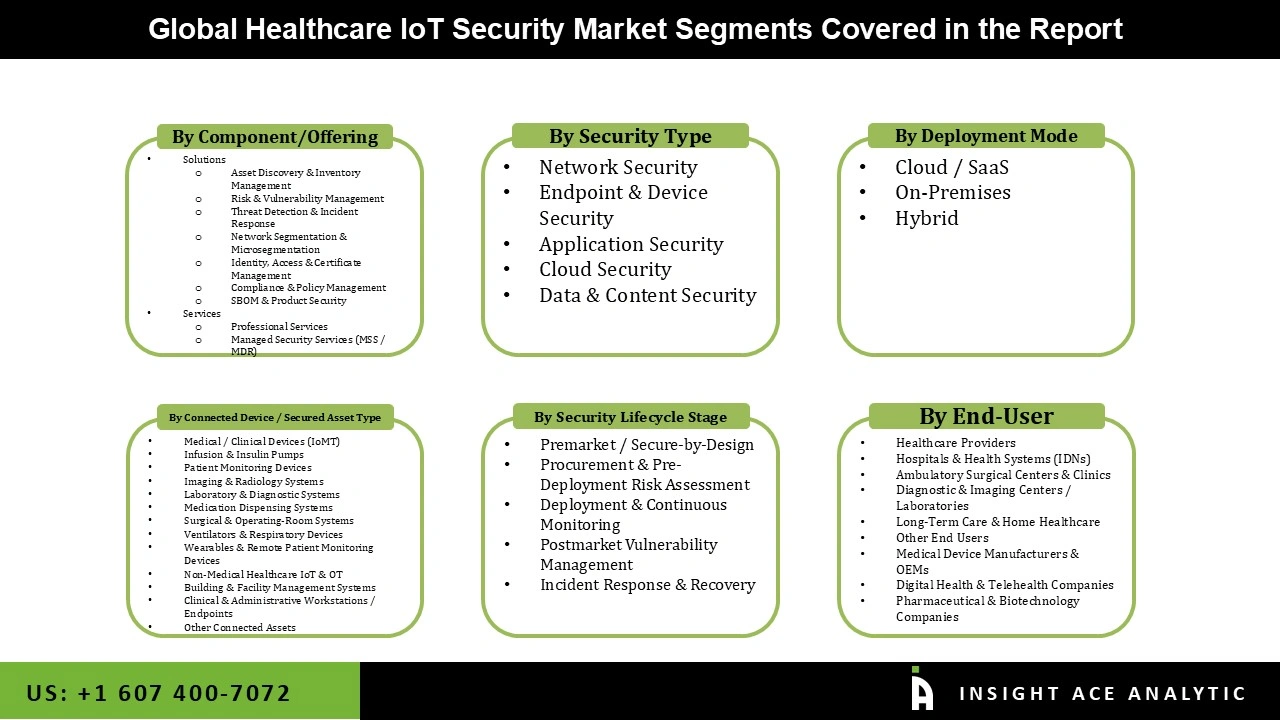
Healthcare IoT Security Market, By Component / Offering-
- Solutions
- Asset Discovery & Inventory Management
- Risk & Vulnerability Management
- Threat Detection & Incident Response
- Network Segmentation & Microsegmentation
- Identity, Access & Certificate Management
- Compliance & Policy Management
- SBOM & Product Security
- Services
- Professional Services
- Consulting & Advisory
- Design, Integration & Deployment
- Support, Maintenance & Training
- Managed Security Services (MSS / MDR)
- Professional Services
Healthcare IoT Security Market, By Security Type-
- Network Security
- Endpoint & Device Security
- Application Security
- Cloud Security
- Data & Content Security
Healthcare IoT Security Market, By Deployment Mode-
- Cloud / SaaS
- On-Premises
- Hybrid
Healthcare IoT Security Market, By Connected Device / Secured Asset Type-
- Medical / Clinical Devices (IoMT)
- Infusion & Insulin Pumps
- Patient Monitoring Devices
- Imaging & Radiology Systems
- Laboratory & Diagnostic Systems
- Medication Dispensing Systems
- Surgical & Operating-Room Systems
- Ventilators & Respiratory Devices
- Wearables & Remote Patient Monitoring Devices
- Non-Medical Healthcare IoT & OT
- Building & Facility Management Systems
- Clinical & Administrative Workstations / Endpoints
- Other Connected Assets (IP Cameras, Nurse-Call, Pneumatic Tube Systems)
Healthcare IoT Security Market, By Security Lifecycle Stage-
- Premarket / Secure-by-Design (Manufacturer)
- Procurement & Pre-Deployment Risk Assessment
- Deployment & Continuous Monitoring
- Postmarket Vulnerability Management
- Incident Response & Recovery
Healthcare IoT Security Market, By End User-
- Healthcare Providers
- Hospitals & Health Systems (IDNs)
- Ambulatory Surgical Centers & Clinics
- Diagnostic & Imaging Centers / Laboratories
- Long-Term Care & Home Healthcare
- Other End Users
- Medical Device Manufacturers & OEMs
- Digital Health & Telehealth Companies
- Pharmaceutical & Biotechnology Companies
Healthcare IoT Security Market, By Region-
- North America-
- The US
- Canada
- Europe-
- Germany
- The UK
- France
- Italy
- Spain
- Rest of Europe
- Asia-Pacific-
- China
- Japan
- India
- South Korea
- South East Asia
- Rest of Asia Pacific
- Latin America-
- Brazil
- Argentina
- Mexico
- Rest of Latin America
- Middle East and Africa-
- GCC Countries
- South Africa
- Rest of Middle East and Africa
Research Design and Approach
This study employed a multi-step, mixed-method research approach that integrates:
- Secondary research
- Primary research
- Data triangulation
- Hybrid top-down and bottom-up modelling
- Forecasting and scenario analysis
This approach ensures a balanced and validated understanding of both macro- and micro-level market factors influencing the market.
Secondary Research
Secondary research for this study involved the collection, review, and analysis of publicly available and paid data sources to build the initial fact base, understand historical market behaviour, identify data gaps, and refine the hypotheses for primary research.
Sources Consulted
Secondary data for the market study was gathered from multiple credible sources, including:
- Government databases, regulatory bodies, and public institutions
- International organizations (WHO, OECD, IMF, World Bank, etc.)
- Commercial and paid databases
- Industry associations, trade publications, and technical journals
- Company annual reports, investor presentations, press releases, and SEC filings
- Academic research papers, patents, and scientific literature
- Previous market research publications and syndicated reports
These sources were used to compile historical data, market volumes/prices, industry trends, technological developments, and competitive insights.

Primary Research
Primary research was conducted to validate secondary data, understand real-time market dynamics, capture price points and adoption trends, and verify the assumptions used in the market modelling.
Stakeholders Interviewed
Primary interviews for this study involved:
- Manufacturers and suppliers in the market value chain
- Distributors, channel partners, and integrators
- End-users / customers (e.g., hospitals, labs, enterprises, consumers, etc., depending on the market)
- Industry experts, technology specialists, consultants, and regulatory professionals
- Senior executives (CEOs, CTOs, VPs, Directors) and product managers
Interview Process
Interviews were conducted via:
- Structured and semi-structured questionnaires
- Telephonic and video interactions
- Email correspondences
- Expert consultation sessions
Primary insights were incorporated into demand modelling, pricing analysis, technology evaluation, and market share estimation.
Data Processing, Normalization, and Validation
All collected data were processed and normalized to ensure consistency and comparability across regions and time frames.
The data validation process included:
- Standardization of units (currency conversions, volume units, inflation adjustments)
- Cross-verification of data points across multiple secondary sources
- Normalization of inconsistent datasets
- Identification and resolution of data gaps
- Outlier detection and removal through algorithmic and manual checks
- Plausibility and coherence checks across segments and geographies
This ensured that the dataset used for modelling was clean, robust, and reliable.
Market Size Estimation and Data Triangulation
Bottom-Up Approach
The bottom-up approach involved aggregating segment-level data, such as:
- Company revenues
- Product-level sales
- Installed base/usage volumes
- Adoption and penetration rates
- Pricing analysis
This method was primarily used when detailed micro-level market data were available.

Top-Down Approach
The top-down approach used macro-level indicators:
- Parent market benchmarks
- Global/regional industry trends
- Economic indicators (GDP, demographics, spending patterns)
- Penetration and usage ratios
This approach was used for segments where granular data were limited or inconsistent.
Hybrid Triangulation Approach
To ensure accuracy, a triangulated hybrid model was used. This included:
- Reconciling top-down and bottom-up estimates
- Cross-checking revenues, volumes, and pricing assumptions
- Incorporating expert insights to validate segment splits and adoption rates
This multi-angle validation yielded the final market size.
Forecasting Framework and Scenario Modelling
Market forecasts were developed using a combination of time-series modelling, adoption curve analysis, and driver-based forecasting tools.
Forecasting Methods
- Time-series modelling
- S-curve and diffusion models (for emerging technologies)
- Driver-based forecasting (GDP, disposable income, adoption rates, regulatory changes)
- Price elasticity models
- Market maturity and lifecycle-based projections
Scenario Analysis
Given inherent uncertainties, three scenarios were constructed:
- Base-Case Scenario: Expected trajectory under current conditions
- Optimistic Scenario: High adoption, favourable regulation, strong economic tailwinds
- Conservative Scenario: Slow adoption, regulatory delays, economic constraints
Sensitivity testing was conducted on key variables, including pricing, demand elasticity, and regional adoption.
Request Customization
Add countries, segments, company profiles, or extend forecast — free 10% customization with purchase.
Customize This Report →Enquire Before Buying
Speak with our analyst team about scope, methodology, pricing, or deliverable formats.
Enquire Now →Frequently Asked Questions
Healthcare IoT Security Market Size is valued at USD 589.85 Mn in 2025 and is predicted to reach USD 2,927.34 Mn by the year 2035
Healthcare IoT Security Market is expected to grow at a 17.5% CAGR during the forecast period for 2026-2035
Cisco Systems, Inc., Inside Secure SA, Dell Corporation, Intel Corporation, ATMEL Corporation, Symantec Corporation, EUROTECH SPA, Fortinet, Inc., Ora
Healthcare IoT security market is categorized on the basis of solutions and services.
North America region is leading the Healthcare IoT Security Market.